
Homework Answers
As per the equation-
1 mol A reacts with 1 mol B to produce 2 mol of C.
Now,
Moles of A = Molarity / Volume (L)
= 1*0.05 = 0.05 mol
Mol of B = 0.05 mol
Mol of A = 2* Mol of C
So,
Mol of C = 0.05 mol /2 = 0.025 mol
Thus,
Theoretical yield = 0.025 mol
% Yield = Actual Yield / Theoretical Yield * 100
40 = Actual Yield / 0.025 mol * 100
0.4 = Actual Yield / Theoretical Yield
Actual Yield = 0.01 mol
Now,
Total volume = 50+50 = 100 mL = 0.1 L
Concentration = 0.01 mol / 0.1 L = 0.1 M
Piece +5 (1 pt) 100.00 mL of 1.0 MPb(NO3)2 is added to 150.00 mL of 0.215 M KOH. What is the concentration of KOH?...
 Piece +5 (1 pt) 100.00 mL of 1.0 MPb(NO3)2 is added to 150.00 mL of 0.215 M KOH. What is the concentration of KOH? Puzzle #1 (2 pt.) I mix 100.0 mL of 1.00 M Pb(NO3) with 150.0 mL of 0.215 M KOH. What mass of solid product do I expect to recover? Bonus (1 pt): I actually collected 25 g of product. What was the percent yield of my reaction?
10. Assume you are carrying out the titration of 50 mL of a 0.025 M solution...
10. Assume you are carrying out the titration of 50 mL of a 0.025 M solution of acetic acid with 0.1023 M NaOH. Acetic acid has a Ka of 1.8 × 10⁻⁵ . (a) Calculate the pH of the solution at V = 0, V = 0.3Veq, V = Veq, and V = 1.2Veq. (Veq is the equivalence point volume) (b) If a phenolphthalein indicator was used in this titration, where would the apparent endpoint occur? Assume the apparent endpoint...
25.0 mL of 1.00 M CH3COOH (ka=1.8x10^-5) is titrated with 1.00 M NaOH.? Calculate the hydronium ion concentration and pH...
25.0 mL of 1.00 M CH3COOH (ka=1.8x10^-5) is titrated with 1.00 M NaOH.? Calculate the hydronium ion concentration and pH after the following volumes of NaOH have been added. a. 0 b.14.00 c.25.90 d.26.10 e.35.00
Part 5 Finally, fill in the equilibrium concentrations: [A] (M) [B] (M) [C] (M) Initial 1.00...
 Part 5 Finally, fill in the equilibrium concentrations: [A] (M) [B] (M) [C] (M) Initial 1.00 1.00 1.00 Change + 0.25 I+ 0.25 -0.50 Equilibrium Submit Anne Tries 0/99 Part 6 It is now possible to calculate K using the equilibriuri concentrations of A, B and C. K- Submit Answe Tries 0/99 In order to find the change in the concentrations of A, B and C, when they are allowed to react and come ta equilibrium, we need to be...
Equilibrium Concentrations -- A + B = 2C At a particular temperature, K = 1.00×10² for...
 Equilibrium Concentrations -- A + B = 2C
At a particular temperature, K = 1.00×10²
for the reaction:
H2(g) + F2(g)
2HF(g)
In an experiment, at this temperature, 1.00×10⁻¹ mol
of H2 and 1.00×10⁻¹ mol of F2 are
introduced into a 1.09-L flask and allowed to react. At
equilibrium, all species remain in the gas phase.
What is the equilibrium concentration (in mol/L) of
H2?
mol/L
1 pts
What is the equilibrium concentration (in mol/L) of HF?
mol/L
1 pts...
Equilibrium Concentrations -- A + B = 2C
At a particular temperature, K = 1.00×10²
for the reaction:
H2(g) + F2(g)
2HF(g)
In an experiment, at this temperature, 1.00×10⁻¹ mol
of H2 and 1.00×10⁻¹ mol of F2 are
introduced into a 1.09-L flask and allowed to react. At
equilibrium, all species remain in the gas phase.
What is the equilibrium concentration (in mol/L) of
H2?
mol/L
1 pts
What is the equilibrium concentration (in mol/L) of HF?
mol/L
1 pts...
a.)100 mL of 1.00 M HCl solution is titrated with 1.00 M NaOH solution. You added...
a.)100 mL of 1.00 M HCl solution is titrated with 1.00 M NaOH solution. You added the following quantities of 1.00 M NaOH to the reaction flask. Classify the following conditions based on whether they are before the equivalence point, at the equivalence point, or after the equivalence point/endpoint. 1.) 150 mL of 1 M NaOH 2.) 200 mL of 1 M NaOH 3.) 50 mL of 1 M NaOH 4.) 100 mL of 1 M NaOH 5.) 5.00 mL...
The equilibrium constant Kc for the reaction: A(g) + B(g) ⇔ 2C(g) is 0.76 at 150...
The equilibrium constant Kc for the reaction: A(g) + B(g) ⇔ 2C(g) is 0.76 at 150 °C. If 0.500 M of A is added to 0.500 M of B in a 1.00 L container, calculate the [EQ] for A, B and C
1. For the reaction 2A(g)⇌B(g)+2C(g), a reaction vessel initially contains only A at a pressure of...
1. For the reaction 2A(g)⇌B(g)+2C(g), a reaction vessel initially contains only A at a pressure of PA=265 mmHg. At equilibrium, PA=41 mmHg. Calculate the value of Kp. (Assume no changes in volume or temperature.) 2. consider the following reaction: A(g)⇌2B(g) Find the equilibrium partial pressures of A and B for each of the following different values of Kp. Assume that the initial partial pressure of B in each case is 1.0 atm and that the initial partial pressure of A...
5. 2.50 mL of 0.0150 M A, 3.50 mL of 0.0250 MB, and 4.00 mL of...
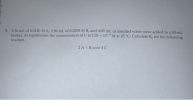 5. 2.50 mL of 0.0150 M A, 3.50 mL of 0.0250 MB, and 4.00 mL of distilled water were added to a 50-ml beaker. At equilibrium the concentration of C is 2.05 x 10"Mat 25 °C. Calculate K for the following reaction. 2 A+B= 3C
For the reaction A+2B→2C, the rate of reaction is 1.86×10⁻⁵ Ms−1 at the time when [A]=...
For the reaction A+2B→2C, the rate of reaction is 1.86×10⁻⁵ Ms−1 at the time when [A]= 0.3575 M . Part A What is the rate of formation of C? Part B What will [A] be 1.00 min later? Part C Assume the rate remains at 1.86×10⁻⁵ Ms−1 . How long would it take for [A] to change from 0.3575 M to 0.3500 M ? Express your answer using two significant figures.
 Piece +5 (1 pt) 100.00 mL of 1.0 MPb(NO3)2 is added to 150.00 mL of 0.215 M KOH. What is the concentration of KOH? Puzzle #1 (2 pt.) I mix 100.0 mL of 1.00 M Pb(NO3) with 150.0 mL of 0.215 M KOH. What mass of solid product do I expect to recover? Bonus (1 pt): I actually collected 25 g of product. What was the percent yield of my reaction?
 Part 5 Finally, fill in the equilibrium concentrations: [A] (M) [B] (M) [C] (M) Initial 1.00 1.00 1.00 Change + 0.25 I+ 0.25 -0.50 Equilibrium Submit Anne Tries 0/99 Part 6 It is now possible to calculate K using the equilibriuri concentrations of A, B and C. K- Submit Answe Tries 0/99 In order to find the change in the concentrations of A, B and C, when they are allowed to react and come ta equilibrium, we need to be...
 Equilibrium Concentrations -- A + B = 2C
At a particular temperature, K = 1.00×10²
for the reaction:
H2(g) + F2(g)
2HF(g)
In an experiment, at this temperature, 1.00×10⁻¹ mol
of H2 and 1.00×10⁻¹ mol of F2 are
introduced into a 1.09-L flask and allowed to react. At
equilibrium, all species remain in the gas phase.
What is the equilibrium concentration (in mol/L) of
H2?
mol/L
1 pts
What is the equilibrium concentration (in mol/L) of HF?
mol/L
1 pts...
Equilibrium Concentrations -- A + B = 2C
At a particular temperature, K = 1.00×10²
for the reaction:
H2(g) + F2(g)
2HF(g)
In an experiment, at this temperature, 1.00×10⁻¹ mol
of H2 and 1.00×10⁻¹ mol of F2 are
introduced into a 1.09-L flask and allowed to react. At
equilibrium, all species remain in the gas phase.
What is the equilibrium concentration (in mol/L) of
H2?
mol/L
1 pts
What is the equilibrium concentration (in mol/L) of HF?
mol/L
1 pts...
 5. 2.50 mL of 0.0150 M A, 3.50 mL of 0.0250 MB, and 4.00 mL of distilled water were added to a 50-ml beaker. At equilibrium the concentration of C is 2.05 x 10"Mat 25 °C. Calculate K for the following reaction. 2 A+B= 3C
Most questions answered within 3 hours.
-
Where is the error in this code sequence?
String s1 = "Hello";
String s2 = "ello";...
asked 11 months ago -
Financial data for Joel de Paris, Inc., for last year
follow:
Joel de Paris, Inc.
Balance...
asked 11 months ago -
Consider this reaction:
Al2(SO4)3 (aq)+ BaCl3
(aq) Al2Cl6 (aq)- +
3BaSO4(s) . What is the...
asked 11 months ago -
Suppose that Savneet is considering increasing her
recent random sample from 20 car rentals to 40...
asked 11 months ago -
Trucks arrive at an unloading terminal at an average rate of 120
per hour.
Trucks arrive...
asked 11 months ago -
Why are methanol and ethanol completely soluble in water while
octanol is not very little soluble....
asked 11 months ago -
A facilities manager at a university reads in a research report
that the mean amount of...
asked 11 months ago -
When the CuSO4 is rehydrated by adding water to the anhydrous
compound, is this an endothermic...
asked 11 months ago -
A ray of sunlight is passing from diamond into crown glass; the
angle of incidence is...
asked 11 months ago -
A block of mass 0.249 kg is placed on top of a light, vertical
spring of...
asked 11 months ago -
how do the kidneys compensate in the presences of acidosis
a) trigger hyperventilate
b) reserve acid...
asked 11 months ago -
Question 501 pts
The rental rate of capital to the firm increases. Which of the
following...
asked 11 months ago