A 2.0kg mass is initially moving at a speed of 10m/s due north, when a constant...
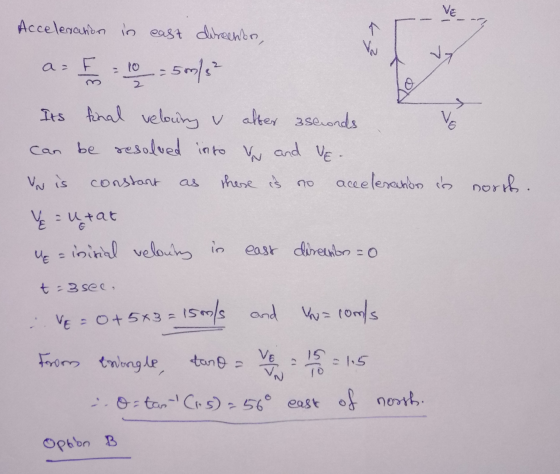
A 2.0kg mass is initially moving at a speed of 10m/s due north, when a constant eastward 10.0N force is applied to it for 3.0 seconds. Which direction is the mass going after that?
(A) 27.° east of north
(B) 56.° east of north
(C) 34.° east of north
(D) 18.° east of north
Homework Answers
Add Answer to:
A 2.0kg mass is initially moving at a speed of 10m/s due
north, when a constant...
An initially stationary 2.0kg object accelerates horizontally and uniformly to a speed of 10m/s in 3.0s....
An initially stationary 2.0kg object accelerates horizontally and uniformly to a speed of 10m/s in 3.0s. In that 3.0s interval, how much work is done on the object by the force accelerating it? What is the instantaneous power due to that force at the end of the interval and at the end of the first half of the interval?
A 2.0kg ball, initially moving to the right at a speed of 3m/s, collides head-on with...
A 2.0kg ball, initially moving to the right at a speed of 3m/s, collides head-on with another ball of mass 3.0kg, initially moving to the left at 4m/s. The collision was elastic. Find the velocities of both balls after the collision.
A 1200-kg car is moving at 19 m/s due north. A 1500-kg car is moving at...
A 1200-kg car is moving at 19 m/s due north. A 1500-kg car is moving at 18 m/s due east. The two cars simultaneously approach an icy intersection where, with no brakes or steering, they collide and stick together. Determine the speed and direction of the combined two-car wreck immediately after the collision. direction North of East
A jet airliner moving initially at 2.95 ✕ 102 mi/h due east enters a region where...
A jet airliner moving initially at 2.95 ✕ 102 mi/h due east enters a region where the wind is blowing at 1.00 ✕ 102 mi/h in a direction 30.5° north of east. (Let the x-direction be eastward and the y-direction be northward.) a)What are the speed and direction of the aircraft relative to the ground?
A 3000-Kg car moving east at 10m/s collides with a 5000-kg car moving north. The car's...
 A 3000-Kg car moving east at 10m/s collides with a 5000-kg car moving north. The car's stick together and move as a unit after a collision, at an angle of 45 degree north of east and a speed of 5 m/s. Find the speed of 5000 kg car before collision. (Ans: V_iy = 5.66m/s)
A passenger on a moving train walks at a speed of 2.30 m/s due north relative...
A passenger on a moving train walks at a speed of 2.30 m/s due north relative to the train. The train is traveling at 3.5 m/s due east relative to the ground. What are the magnitude and direction of the velocity of the passenger relative to the ground? magnitude m/s direction ° north of east
(a) A 950 kg vehicle is traveling at a constant speed of 1.44 m/s due north....
(a) A 950 kg vehicle is traveling at a constant speed of 1.44 m/s due north. What is the total force (in N) on the vehicle? (Assume north is the positive direction. Indicate the direction with the sign of your answer.) (b) What is the total force on the vehicle (in N) if it is moving due south? (Assume north is the positive direction. Indicate the direction with the sign of your answer.)
. As you walk to class with a constant speed of 1.75 m/s, you are moving...
 . As you walk to class with a constant speed of 1.75 m/s, you are moving in a direction that is 18.0° north of east. How much time does it take to change your position by (a) 20.0 m east or (b) 30.0m north? In-Class Chapter 4 Part 1 PHY-131 .A skateboarder travels on a horizontal surface with an initial velocity of 3.8 m/s toward the south and a constant acceleration of 2.2 m/s2 toward the east. Let the x...
Object A is moving due east, while object B is moving due north. They collide and...
Object A is moving due east, while object B is moving due north. They collide and stick together in a completely inelastic collision. Momentum is conserved. Object A has a mass of mA = 16.8 kg and an initial velocity of = 7.37 m/s, due east. Object B, however, has a mass of mB = 29.0 kg and an initial velocity of = 5.03 m/s, due north. Find the (a) magnitude and (b) direction of the total momentum of the...
Object A is moving due east, while object B is moving due north. They collide and...
Object A is moving due east, while object B is moving due north. They collide and stick together in a completely inelastic collision. Momentum is conserved. Object A has a mass of mA = 16.5 kg and an initial velocity of v0A = 8.20 m/s, due east. Object B, however, has a mass of mB = 27.5 kg and an initial velocity of v0B = 5.00 m/s, due north. Find the direction of the final velocity of the two-object system...
 A 3000-Kg car moving east at 10m/s collides with a 5000-kg car moving north. The car's stick together and move as a unit after a collision, at an angle of 45 degree north of east and a speed of 5 m/s. Find the speed of 5000 kg car before collision. (Ans: V_iy = 5.66m/s)
 . As you walk to class with a constant speed of 1.75 m/s, you are moving in a direction that is 18.0° north of east. How much time does it take to change your position by (a) 20.0 m east or (b) 30.0m north? In-Class Chapter 4 Part 1 PHY-131 .A skateboarder travels on a horizontal surface with an initial velocity of 3.8 m/s toward the south and a constant acceleration of 2.2 m/s2 toward the east. Let the x...
Most questions answered within 3 hours.
-
Where is the error in this code sequence?
String s1 = "Hello";
String s2 = "ello";...
asked 10 months ago -
Financial data for Joel de Paris, Inc., for last year
follow:
Joel de Paris, Inc.
Balance...
asked 10 months ago -
Consider this reaction:
Al2(SO4)3 (aq)+ BaCl3
(aq) Al2Cl6 (aq)- +
3BaSO4(s) . What is the...
asked 10 months ago -
Suppose that Savneet is considering increasing her
recent random sample from 20 car rentals to 40...
asked 10 months ago -
Trucks arrive at an unloading terminal at an average rate of 120
per hour.
Trucks arrive...
asked 10 months ago -
Why are methanol and ethanol completely soluble in water while
octanol is not very little soluble....
asked 10 months ago -
A facilities manager at a university reads in a research report
that the mean amount of...
asked 10 months ago -
When the CuSO4 is rehydrated by adding water to the anhydrous
compound, is this an endothermic...
asked 10 months ago -
A ray of sunlight is passing from diamond into crown glass; the
angle of incidence is...
asked 10 months ago -
A block of mass 0.249 kg is placed on top of a light, vertical
spring of...
asked 10 months ago -
how do the kidneys compensate in the presences of acidosis
a) trigger hyperventilate
b) reserve acid...
asked 10 months ago -
Question 501 pts
The rental rate of capital to the firm increases. Which of the
following...
asked 10 months ago