Consider the reaction C2H3Cl3 + 3H2 -> C2H6 + 3HCl If the rate of formation of...
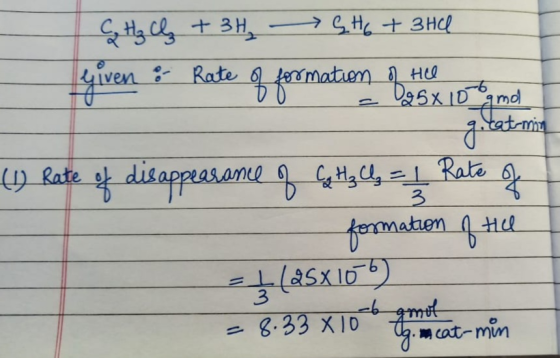
Consider the reaction C2H3Cl3 + 3H2 -> C2H6 + 3HCl
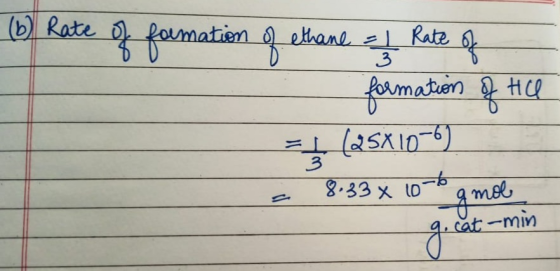
If the rate of formation of HCl is 25x10-6 gmol/g.cat-min
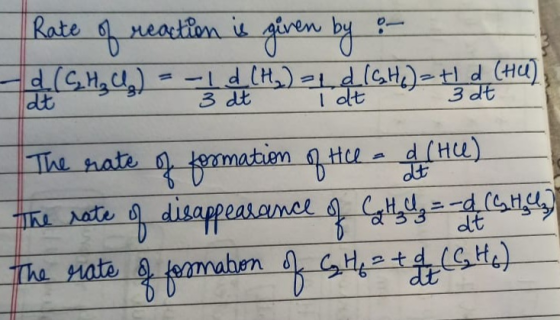
a) What is the rate of disappearance of trichloroethane?
b) What is the rate of formation of ethane?
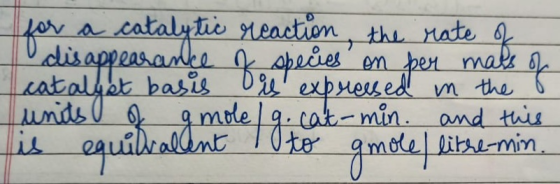
I don't know what the unit of gmol/g.cat-min is. How specific is the unit in this question?
Homework Answers
Add Answer to:
Consider the reaction C2H3Cl3 + 3H2 -> C2H6 + 3HCl
If the rate of formation of...
Given CH3Cl(g) + 3Cl2(g) → CCl4(g) + 3HCl(g) If the rate of formation of CCl4 is measured to be 0.063 M min-1
Given CH3Cl(g) + 3Cl2(g) → CCl4(g) + 3HCl(g) If the rate of formation of CCl4 is measured to be 0.063 M min-1, what is the rate of disappearance of Cl2? A) 0.063 M min-1,B) 0.19 M min-1 C) 0.021 M min-1D) 0.13 M min-1
both please What is the chemical equation corresponding to the heat of formation (AH, (C2H6 (9))...
 both please
What is the chemical equation corresponding to the heat of formation (AH, (C2H6 (9)) of ethane(C2H6(g))? 2C(s) + 3H2(g) - C2Holg) CzHole) +2C(s) + 3H2(8) 2C2H6(g) +702(g) + 4CO2(g) + 6H20(1) 2C(s) + 6H(g) —C2Hole) Question 9 1 pts Write a balanced reaction for which the following rate relationships are true. Rate - D - 00:0) = + 41231 = + 2010.) N2+O2 ® N20 N20 ® N2 + 202 N20 ® Nz+202 2 N2 + O2 ®...
both please
What is the chemical equation corresponding to the heat of formation (AH, (C2H6 (9)) of ethane(C2H6(g))? 2C(s) + 3H2(g) - C2Holg) CzHole) +2C(s) + 3H2(8) 2C2H6(g) +702(g) + 4CO2(g) + 6H20(1) 2C(s) + 6H(g) —C2Hole) Question 9 1 pts Write a balanced reaction for which the following rate relationships are true. Rate - D - 00:0) = + 41231 = + 2010.) N2+O2 ® N20 N20 ® N2 + 202 N20 ® Nz+202 2 N2 + O2 ®...
3. Consider this reaction: 2 C2H6 + 702 4CO2 + 6H2O (a) How many grams of...
 3. Consider this reaction: 2 C2H6 + 702 4CO2 + 6H2O (a) How many grams of oxygen are required to completely react with (burn) 100.0 g of ethane? (b) if 55.0 g of ethane is mixed with 55.0 gram of oxygen, and the mixture then reacts, how many grams of water will be formed?
Please answer as many questions as you can Thanks 1. For the reaction, N2(g) 3H2(g)2NH3(g). if...
 Please answer as many questions as you can
Thanks
1. For the reaction, N2(g) 3H2(g)2NH3(g). if the rate of formation of ammonia is 0.04 mol/L min, find the rate of disappearance of H2 and N2 during that same time period. 2. For the following reaction, 5Br BrO3 6H3Br2 3H20, the rate of consumption of bromide ion at some time was found to be 0.20 mo/L s. What is the rate of formation of water over the same time period? 3....
Please answer as many questions as you can
Thanks
1. For the reaction, N2(g) 3H2(g)2NH3(g). if the rate of formation of ammonia is 0.04 mol/L min, find the rate of disappearance of H2 and N2 during that same time period. 2. For the following reaction, 5Br BrO3 6H3Br2 3H20, the rate of consumption of bromide ion at some time was found to be 0.20 mo/L s. What is the rate of formation of water over the same time period? 3....
Consider the reaction, S2O82- + 3 I- à 2 SO42- + I3-. Data obtained in measuring rate of formation of I3- are...
Consider the reaction, S2O82- + 3 I- à 2 SO42- + I3-. Data obtained in measuring rate of formation of I3- are listed in the table. Experiment [S2O82-], M [I‑], M Initial rate, Ms-1 1 0.035 0.055 1.5 x 10⁻⁵ 2 0.070 0.055 3.0 x 10⁻⁵ 3 0.070 0.110 6.0 x 10⁻⁵ Determine the order of reaction with respect to S2O82-. What is the order of reaction with respect to I-? Give the overall order of reaction. Write the rate law for the reaction. Determine the...
For the following reaction, if NH3 is used up at a rate of 0.30 M, what is the rate of formation of H ? 2NH3 + N2 + 3H2...
 For the following reaction, if NH3 is used up at a rate of 0.30 M, what is the rate of formation of H ? 2NH3 + N2 + 3H2 • Your answer should have two significant figures. Provide your answer below: Mmin
Rate Laws (Section)Consider the reaction of peroxydisulfate ion (S2O8 2-) with iodide ion (I - )...
Rate Laws (Section)Consider the reaction of peroxydisulfate ion (S2O8 2-) with iodide ion (I - ) in aqueous solution:S2O82 - (aq) + 3 I - (aq)→2 SO42 - (aq) + I3- (aq)At a particular temperature the initial rate of disappearance of S2O8 2 - varies with reactant concentrations in the following manner:Experiment[S2O82‑] (M)[I_] (M)Initial Rate (M/S)10.0180.0362.6 × 10-620.0270.0363.9 × 10-630.0360.0547.8 × 10-640.0500.0721.4 × 10-5(a) Determine the rate law for the reaction and state the units of the rate constant. (b)...
Consider the reaction 2 C2H6 + 7 O2 4 CO2 + 6 H2 and complete...
Consider the reaction 2 C2H6 + 7 O2 4 CO2 + 6 H2 and complete the following exercises. to. Express the speed of the reaction in terms of each species. b. If CO2 is formed at a rate or speed of 3.0 M / s, then: 1b1. The speed with which H2 is formed is________. 1b2. The speed with which C2H6 disappears is________. 1 b3. The rate at which O2 disappears is________.
Question 18 2 pts Consider the following hypothetical reaction: A (aq) B (aq) At the beginning...
 Question 18 2 pts Consider the following hypothetical reaction: A (aq) B (aq) At the beginning of the reaction, 0.850 mol of A are added to the reaction flask containing 1.0 L of solution. The reaction is then monitored and the following data is collected: Time (minutes) 0 10 20 Moles of A 0.850 mol 0.550 mol 0.420 Calculate the average rate of disappearance of A between t = 0 minutes and t = 20 minutes. 0.0215 mol/min -0.0215 mol/min...
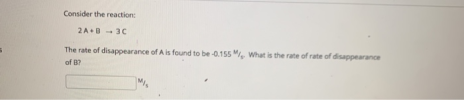
please help Consider the reaction: 2 A + B + 30 The rate of disappearance of...
 please help
Consider the reaction: 2 A + B + 30 The rate of disappearance of A is found to be -0.155 M, What is the rate of rate of disappearance of B?
please help
Consider the reaction: 2 A + B + 30 The rate of disappearance of A is found to be -0.155 M, What is the rate of rate of disappearance of B?
 both please
What is the chemical equation corresponding to the heat of formation (AH, (C2H6 (9)) of ethane(C2H6(g))? 2C(s) + 3H2(g) - C2Holg) CzHole) +2C(s) + 3H2(8) 2C2H6(g) +702(g) + 4CO2(g) + 6H20(1) 2C(s) + 6H(g) —C2Hole) Question 9 1 pts Write a balanced reaction for which the following rate relationships are true. Rate - D - 00:0) = + 41231 = + 2010.) N2+O2 ® N20 N20 ® N2 + 202 N20 ® Nz+202 2 N2 + O2 ®...
both please
What is the chemical equation corresponding to the heat of formation (AH, (C2H6 (9)) of ethane(C2H6(g))? 2C(s) + 3H2(g) - C2Holg) CzHole) +2C(s) + 3H2(8) 2C2H6(g) +702(g) + 4CO2(g) + 6H20(1) 2C(s) + 6H(g) —C2Hole) Question 9 1 pts Write a balanced reaction for which the following rate relationships are true. Rate - D - 00:0) = + 41231 = + 2010.) N2+O2 ® N20 N20 ® N2 + 202 N20 ® Nz+202 2 N2 + O2 ®...
 3. Consider this reaction: 2 C2H6 + 702 4CO2 + 6H2O (a) How many grams of oxygen are required to completely react with (burn) 100.0 g of ethane? (b) if 55.0 g of ethane is mixed with 55.0 gram of oxygen, and the mixture then reacts, how many grams of water will be formed?
 Please answer as many questions as you can
Thanks
1. For the reaction, N2(g) 3H2(g)2NH3(g). if the rate of formation of ammonia is 0.04 mol/L min, find the rate of disappearance of H2 and N2 during that same time period. 2. For the following reaction, 5Br BrO3 6H3Br2 3H20, the rate of consumption of bromide ion at some time was found to be 0.20 mo/L s. What is the rate of formation of water over the same time period? 3....
Please answer as many questions as you can
Thanks
1. For the reaction, N2(g) 3H2(g)2NH3(g). if the rate of formation of ammonia is 0.04 mol/L min, find the rate of disappearance of H2 and N2 during that same time period. 2. For the following reaction, 5Br BrO3 6H3Br2 3H20, the rate of consumption of bromide ion at some time was found to be 0.20 mo/L s. What is the rate of formation of water over the same time period? 3....
 For the following reaction, if NH3 is used up at a rate of 0.30 M, what is the rate of formation of H ? 2NH3 + N2 + 3H2 • Your answer should have two significant figures. Provide your answer below: Mmin
 Question 18 2 pts Consider the following hypothetical reaction: A (aq) B (aq) At the beginning of the reaction, 0.850 mol of A are added to the reaction flask containing 1.0 L of solution. The reaction is then monitored and the following data is collected: Time (minutes) 0 10 20 Moles of A 0.850 mol 0.550 mol 0.420 Calculate the average rate of disappearance of A between t = 0 minutes and t = 20 minutes. 0.0215 mol/min -0.0215 mol/min...
 please help
Consider the reaction: 2 A + B + 30 The rate of disappearance of A is found to be -0.155 M, What is the rate of rate of disappearance of B?
please help
Consider the reaction: 2 A + B + 30 The rate of disappearance of A is found to be -0.155 M, What is the rate of rate of disappearance of B?
Most questions answered within 3 hours.
-
Where is the error in this code sequence?
String s1 = "Hello";
String s2 = "ello";...
asked 10 months ago -
Financial data for Joel de Paris, Inc., for last year
follow:
Joel de Paris, Inc.
Balance...
asked 10 months ago -
Consider this reaction:
Al2(SO4)3 (aq)+ BaCl3
(aq) Al2Cl6 (aq)- +
3BaSO4(s) . What is the...
asked 10 months ago -
Suppose that Savneet is considering increasing her
recent random sample from 20 car rentals to 40...
asked 10 months ago -
Trucks arrive at an unloading terminal at an average rate of 120
per hour.
Trucks arrive...
asked 10 months ago -
Why are methanol and ethanol completely soluble in water while
octanol is not very little soluble....
asked 10 months ago -
A facilities manager at a university reads in a research report
that the mean amount of...
asked 10 months ago -
When the CuSO4 is rehydrated by adding water to the anhydrous
compound, is this an endothermic...
asked 10 months ago -
A ray of sunlight is passing from diamond into crown glass; the
angle of incidence is...
asked 10 months ago -
A block of mass 0.249 kg is placed on top of a light, vertical
spring of...
asked 10 months ago -
how do the kidneys compensate in the presences of acidosis
a) trigger hyperventilate
b) reserve acid...
asked 10 months ago -
Question 501 pts
The rental rate of capital to the firm increases. Which of the
following...
asked 10 months ago