
Homework Answers
Add Answer to:
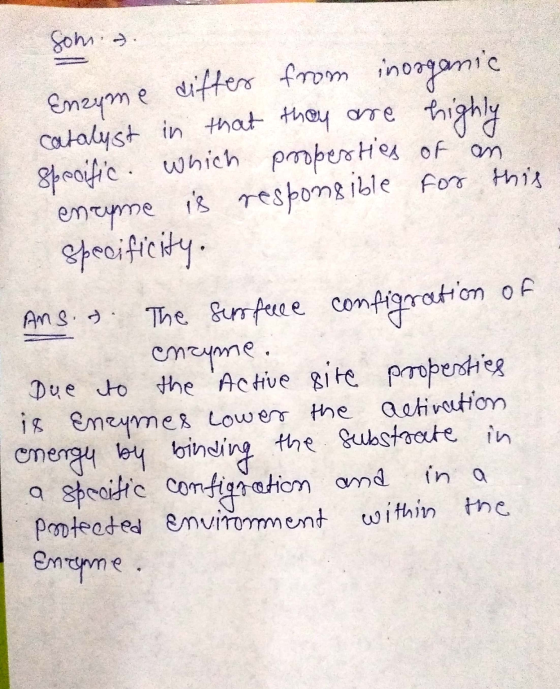
Enzymes differ from inorganic catalysts in that they are highly specific. Which property of an enzyme...
Which of the diagrams illustrates the way in which the rate of an enzyme-controlled reaction depends...
 Which of the diagrams illustrates the way in which the rate of an enzyme-controlled reaction depends on substrate concentration? * А B Rate of reaction MÚN Substrate concentration A B D When starch and amylase are mixed in the presence of iodine solution, the blue-black colour rapidly disappears. This is due to the formation of which molecule? * glucose O glycogen sucrose O maltose Which of the following enzyme groups can catalyse oxidation reactions? * O phosphorylases isomerases hydrolases dehydrogenases...
It is a fact that enzymes are highly specific and will only catalyze one or a...
It is a fact that enzymes are highly specific and will only catalyze one or a few reactions. Can you think of a benefit that is derived from such specificity? (i.e., What would happen if most biochemical reactions were catalyzed by the same enzyme?)
2. Enzymes are important biological molecules and they act as catalysts for specific chemical reactions. Their...
 2. Enzymes are important biological molecules and they act as catalysts for specific chemical reactions. Their biological function is determined by their 3 dimensional shape and the functional groups present in the active site. (a) What are the main mechanisms by which an enzyme increase the rate of a reaction? (b) What is a cofactor in an enzyme mediated reaction? (c) Give the name of a cofactor (structure if possible) and indicate the type of reaction that it facilitates. 3....
Which of the following statements is incorrect? Question 3 options: a) Because organic and inorganic colloids...
Which of the following statements is incorrect? Question 3 options: a) Because organic and inorganic colloids are distinctly different, they do not interact with each other. b) Organic colloids usually contain a large number of natural ligands, and therefore have a strong capacity to retain metal ions. c) Amino acids have a high capacity as buffers to neutralize H+, or OH-, due to the presence of –NH2 and –COOH groups in their molecular structure. d) Inorganic colloids mainly originate from...
Part A - Overview of enzyme structure and enzymatic reactions Enzymes are large globular proteins. Much...
 Part A - Overview of enzyme structure and enzymatic reactions Enzymes are large globular proteins. Much of their three dimensional shape is the result of interactions between the R (variable) groups of their amino acids. The active site is the portion of the enzyme that will interact with the substrate the molecule that the enzyme acts upon. The nature and arrangement of amino acids in the active site make each enzyme specific to a substrate and to the reaction it...
please help!! please please "Looking at table 6-8 on Enzyme Reactions from the lecture, which achieves...
 please help!! please please
"Looking at table 6-8 on Enzyme Reactions from the lecture,
which achieves an excellent specificity constant with a very
favorable kcat (insert answer here) , which with a
favorable Km (insert answer here) , and which with
moderate values for each (insert answer here) ?
(pick from acetyl cholinesterase, B-lactamase, and catalase)"
Question 2: "The units of Vmax are (insert answer
here) and the units of Km are (insert answer
here) (pick from M, M-1, M/s, s/M...
please help!! please please
"Looking at table 6-8 on Enzyme Reactions from the lecture,
which achieves an excellent specificity constant with a very
favorable kcat (insert answer here) , which with a
favorable Km (insert answer here) , and which with
moderate values for each (insert answer here) ?
(pick from acetyl cholinesterase, B-lactamase, and catalase)"
Question 2: "The units of Vmax are (insert answer
here) and the units of Km are (insert answer
here) (pick from M, M-1, M/s, s/M...
How does facilitated diffusion differ from simple diffusion? Facilitated diffusion requires ATP Facilitated diffusion requires a...
How does facilitated diffusion differ from simple diffusion? Facilitated diffusion requires ATP Facilitated diffusion requires a solute-specific protein carrier Facilitated diffusion transports solute against its’ concentration gradient Which of the following is TRUE about primary active cell membrane transport? It is a form of transport that requires a protein “pump” It is a form of transport that transports ions and/or solute against their concentration gradient It is a transport mechanism that requires energy released from the splitting of ATP by...
3) Which semicarbazone is colourless and which is yellow. Why do they differ in this property?...
 3) Which semicarbazone is colourless and which is yellow. Why do
they differ in this property? In general, what gives a compound
colour? (Isn’t chemistry cool?)
Introduction Many reactions can take more than one course but the preferential formation of only one of the possible products may be attained by a judicial choice of the reaction conditions. In general, the 1 of 5 CHEM-2300 F19 Experiment 6 formation of a product is controlled by thermodynamic (differences in relative potential energies...
3) Which semicarbazone is colourless and which is yellow. Why do
they differ in this property? In general, what gives a compound
colour? (Isn’t chemistry cool?)
Introduction Many reactions can take more than one course but the preferential formation of only one of the possible products may be attained by a judicial choice of the reaction conditions. In general, the 1 of 5 CHEM-2300 F19 Experiment 6 formation of a product is controlled by thermodynamic (differences in relative potential energies...
During the aerobic metabolism of glucose, glucose is ____________. Reduced to form water Oxidized to form...
During the aerobic metabolism of glucose, glucose is ____________. Reduced to form water Oxidized to form water Reduced to form CO2 Oxidized to form CO2 Which of the following describes the equation: FAD + XH2 à FADH2 + X. FAD is reduced to FADH2 It is a coupled reduction – oxidation reaction XH2 is oxidized to X All of the above Which of the following is FALSE about glycolysis? The initial steps of glycolysis requires energy derived from the splitting...
this are very difficult questions for my environmental biology class. These are examples from the practice...
 this are very difficult questions for my environmental biology
class. These are examples from the practice homework so can anyone
please help me check my answers.
-) The temperature classes of microorganisms are based on optimum temperatures of microbi A) cell wall C) cell membrane B) enzymes D) All of the above 20) Aerobic respiration, anaerobic respiration, and fermentation are all pathways of which involve the of nutrients. A) Catabolism, reduction B) Anabolism; oxidation C) Catabolism; oxidation D) Anabolism, reduction...
this are very difficult questions for my environmental biology
class. These are examples from the practice homework so can anyone
please help me check my answers.
-) The temperature classes of microorganisms are based on optimum temperatures of microbi A) cell wall C) cell membrane B) enzymes D) All of the above 20) Aerobic respiration, anaerobic respiration, and fermentation are all pathways of which involve the of nutrients. A) Catabolism, reduction B) Anabolism; oxidation C) Catabolism; oxidation D) Anabolism, reduction...
 Which of the diagrams illustrates the way in which the rate of an enzyme-controlled reaction depends on substrate concentration? * А B Rate of reaction MÚN Substrate concentration A B D When starch and amylase are mixed in the presence of iodine solution, the blue-black colour rapidly disappears. This is due to the formation of which molecule? * glucose O glycogen sucrose O maltose Which of the following enzyme groups can catalyse oxidation reactions? * O phosphorylases isomerases hydrolases dehydrogenases...
 2. Enzymes are important biological molecules and they act as catalysts for specific chemical reactions. Their biological function is determined by their 3 dimensional shape and the functional groups present in the active site. (a) What are the main mechanisms by which an enzyme increase the rate of a reaction? (b) What is a cofactor in an enzyme mediated reaction? (c) Give the name of a cofactor (structure if possible) and indicate the type of reaction that it facilitates. 3....
 Part A - Overview of enzyme structure and enzymatic reactions Enzymes are large globular proteins. Much of their three dimensional shape is the result of interactions between the R (variable) groups of their amino acids. The active site is the portion of the enzyme that will interact with the substrate the molecule that the enzyme acts upon. The nature and arrangement of amino acids in the active site make each enzyme specific to a substrate and to the reaction it...
 please help!! please please
"Looking at table 6-8 on Enzyme Reactions from the lecture,
which achieves an excellent specificity constant with a very
favorable kcat (insert answer here) , which with a
favorable Km (insert answer here) , and which with
moderate values for each (insert answer here) ?
(pick from acetyl cholinesterase, B-lactamase, and catalase)"
Question 2: "The units of Vmax are (insert answer
here) and the units of Km are (insert answer
here) (pick from M, M-1, M/s, s/M...
please help!! please please
"Looking at table 6-8 on Enzyme Reactions from the lecture,
which achieves an excellent specificity constant with a very
favorable kcat (insert answer here) , which with a
favorable Km (insert answer here) , and which with
moderate values for each (insert answer here) ?
(pick from acetyl cholinesterase, B-lactamase, and catalase)"
Question 2: "The units of Vmax are (insert answer
here) and the units of Km are (insert answer
here) (pick from M, M-1, M/s, s/M...
 3) Which semicarbazone is colourless and which is yellow. Why do
they differ in this property? In general, what gives a compound
colour? (Isn’t chemistry cool?)
Introduction Many reactions can take more than one course but the preferential formation of only one of the possible products may be attained by a judicial choice of the reaction conditions. In general, the 1 of 5 CHEM-2300 F19 Experiment 6 formation of a product is controlled by thermodynamic (differences in relative potential energies...
3) Which semicarbazone is colourless and which is yellow. Why do
they differ in this property? In general, what gives a compound
colour? (Isn’t chemistry cool?)
Introduction Many reactions can take more than one course but the preferential formation of only one of the possible products may be attained by a judicial choice of the reaction conditions. In general, the 1 of 5 CHEM-2300 F19 Experiment 6 formation of a product is controlled by thermodynamic (differences in relative potential energies...
 this are very difficult questions for my environmental biology
class. These are examples from the practice homework so can anyone
please help me check my answers.
-) The temperature classes of microorganisms are based on optimum temperatures of microbi A) cell wall C) cell membrane B) enzymes D) All of the above 20) Aerobic respiration, anaerobic respiration, and fermentation are all pathways of which involve the of nutrients. A) Catabolism, reduction B) Anabolism; oxidation C) Catabolism; oxidation D) Anabolism, reduction...
this are very difficult questions for my environmental biology
class. These are examples from the practice homework so can anyone
please help me check my answers.
-) The temperature classes of microorganisms are based on optimum temperatures of microbi A) cell wall C) cell membrane B) enzymes D) All of the above 20) Aerobic respiration, anaerobic respiration, and fermentation are all pathways of which involve the of nutrients. A) Catabolism, reduction B) Anabolism; oxidation C) Catabolism; oxidation D) Anabolism, reduction...
Most questions answered within 3 hours.
-
Where is the error in this code sequence?
String s1 = "Hello";
String s2 = "ello";...
asked 10 months ago -
Financial data for Joel de Paris, Inc., for last year
follow:
Joel de Paris, Inc.
Balance...
asked 10 months ago -
Consider this reaction:
Al2(SO4)3 (aq)+ BaCl3
(aq) Al2Cl6 (aq)- +
3BaSO4(s) . What is the...
asked 10 months ago -
Suppose that Savneet is considering increasing her
recent random sample from 20 car rentals to 40...
asked 10 months ago -
Trucks arrive at an unloading terminal at an average rate of 120
per hour.
Trucks arrive...
asked 10 months ago -
Why are methanol and ethanol completely soluble in water while
octanol is not very little soluble....
asked 10 months ago -
A facilities manager at a university reads in a research report
that the mean amount of...
asked 10 months ago -
When the CuSO4 is rehydrated by adding water to the anhydrous
compound, is this an endothermic...
asked 10 months ago -
A ray of sunlight is passing from diamond into crown glass; the
angle of incidence is...
asked 10 months ago -
A block of mass 0.249 kg is placed on top of a light, vertical
spring of...
asked 10 months ago -
how do the kidneys compensate in the presences of acidosis
a) trigger hyperventilate
b) reserve acid...
asked 10 months ago -
Question 501 pts
The rental rate of capital to the firm increases. Which of the
following...
asked 10 months ago