
Homework Answers

![+ ka [42] - Ká[A]?- kb[A][B] = 0 → ka [A2] =(ká [A] + ky[6] ) [A] 介 [A] = KalAz] رنا ka CA] + kbCB] :. rate of rxhi for (P)](http://img.homeworklib.com/questions/150ac8a0-da87-11ea-8bb1-078d02691575.png?x-oss-process=image/resize,w_560)
Add Answer to:
E17.1(a) The reaction mechanism for the decomposition of A, is thought to be A, A+A A+B_hit...
6. The decomposition of gaseous nitryl chloride, NO2Cl, on heating is thought to occur by the...
 6. The decomposition of gaseous nitryl chloride, NO2Cl, on heating is thought to occur by the following mechanism: step (1): . Mogl ? NO2 + Cl step (2): CI + O-Cl ? NO2 + Cl2 a. What is the overall reaction? (2 marks) b. Identify any reaction intermediates. (1 mark) c. What is the molecularity of each step? (2 marks) d. Assuming this mechanism is correct, which is the rate-determining step if the experimental rate law is first order in...
The reaction mechanism for the decomposition of N2O5 is given by the following set of equations:...
The reaction mechanism for the decomposition of N2O5 is given by the following set of equations: N2O5 -> NO2 + NO3 k1 NO2 + NO3 -> N2O5 k2 NO3 -> NO + O2 k3 NO3 + NO -> 2NO2 k4 a) Write the rate expression for the formation of O2. b) Obtain expressions for the steady state concentrations of NO and NO3. c) Using the expressions from (b), write the rate law for the formation of O2.
ki Q3: The decomposition mechanism of 2 N2O(g) → 4NO2(g) + O2(g) is believed to follow...
 ki Q3: The decomposition mechanism of 2 N2O(g) → 4NO2(g) + O2(g) is believed to follow the elementary reactions: (1) N203 → NO2 + NO3 (1') NO2 + NO3 → N20 k_1 (2) NO, + NO3 → NO, + O2 + NO kz (3) NO + N203 → NO2 + NO2 + NO2 kz Using the steady-state approximation, deduce the rate law for this reaction.
4. Now consider the catalase catalyzed decomposition of hydrogen peroxide to water. The much needed catalyst....
 4. Now consider the catalase catalyzed decomposition of hydrogen peroxide to water. The much needed catalyst. 2H202 + catalase → 2H2O + O2 + catalase a. [3] Assume the following mechanism: H2O2 + catalase = {H202-catalase} HIS 54 Inhibitor ASN 127 H2O2 + {H202-catalase} → catalase + 2H20 + O2 Oxygen When the pre-equilibrium approximation is used, the rate-law is: 41 dt Kegk2[H202]?[E]. The steady-state approximation gives a more general rate law. Derive the rate law using the SS approximation....
i. For the reaction: 2H202→ 2H2O+O2 a proposed mechanism is: H2O2 + H3O2+ → H2O +...
 i. For the reaction: 2H202→ 2H2O+O2 a proposed mechanism is: H2O2 + H3O2+ → H2O + H30+ +02 (a) The intermediate in the proposed mechanism is The catalyst is (b) Apply the steady state approximation to this mechanism to deduce the rate law in terms of d[O2]/dt. (15 pts)
6. [20pt] The Rice-Herzfeld mechanism for the thermal decomposition of acetaldehyde (CH:CНO) is k1 CH3CHO CH3...
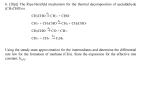 6. [20pt] The Rice-Herzfeld mechanism for the thermal decomposition of acetaldehyde (CH:CНO) is k1 CH3CHO CH3 CHO k2 CH3:: + CH3CНО $ СН4 + CH-CHO- k3 CH2CHO CO CH3 k4 СH3: + CH3. $ C2Н6 Using the steady-state approximation for the intermediates and determine the differential rate law for the formation of methane (CH4). State the expression for the effective rate constant, keff
Temperature, Question 7 (13 marks) Acetone is brominated in acidic solution according to the following reaction:...
 Temperature, Question 7 (13 marks) Acetone is brominated in acidic solution according to the following reaction: CH3COCH3(aq) + Br2(aq) - CH3COCH_Br(aq) + H" (aq) + Br" (aq) Student A proposed the following four-step mechanism for the decomposition of Bra: CH3COCH3 + H + CH3C(OH)CH3 ki, ki CH,C(OH)CH3 -CH:C(OH)-CH2 + H+ ka, slow CH;C(OH)=CH2 + Br2 - CH3C(OH)CH2Br* + Br k3 CH:C(OH)CH2Br* - CH3COCH2Br + H+ k4 Deduce the rate law for the above reaction by assuming a pre-equilibrium (7 marks)...
Physical Chemistry II 2. Hydrogen iodide can be synthesized from the elements in a gas-phase reaction....
 Physical Chemistry II
2. Hydrogen iodide can be synthesized from the elements in a gas-phase reaction. One proposed mechanism for the process is (20 pts) 1, 21(1" order) and E= 320kJ/mol ki k 21—1, (20 order) and E, = 440kJ/mol 21+H, → 2HI (36d order) and E, = 210kJ/mol Derive a differential rate law for the rate of production of HI if a) 1, and I are in equilibrium throughout the reaction (Rapid Equilibrium) b) Derive the differential rate law...
Physical Chemistry II
2. Hydrogen iodide can be synthesized from the elements in a gas-phase reaction. One proposed mechanism for the process is (20 pts) 1, 21(1" order) and E= 320kJ/mol ki k 21—1, (20 order) and E, = 440kJ/mol 21+H, → 2HI (36d order) and E, = 210kJ/mol Derive a differential rate law for the rate of production of HI if a) 1, and I are in equilibrium throughout the reaction (Rapid Equilibrium) b) Derive the differential rate law...
12. The following mechanism is proposed for the decomposition of ozone (O3) to O2: 03 + M 02 + 0 + M 0+03 2 02 Apply the steady-state approximation to the concentration of atomic oxygen, and derive t...
 12. The following mechanism is proposed for the decomposition of ozone (O3) to O2: 03 + M 02 + 0 + M 0+03 2 02 Apply the steady-state approximation to the concentration of atomic oxygen, and derive the rate law for the decomposition of ozone (M stands for a molecule that can exchange kinetic energy with particles undergoing the chemical reaction.)
12. The following mechanism is proposed for the decomposition of ozone (O3) to O2: 03 + M 02 +...
12. The following mechanism is proposed for the decomposition of ozone (O3) to O2: 03 + M 02 + 0 + M 0+03 2 02 Apply the steady-state approximation to the concentration of atomic oxygen, and derive the rate law for the decomposition of ozone (M stands for a molecule that can exchange kinetic energy with particles undergoing the chemical reaction.)
12. The following mechanism is proposed for the decomposition of ozone (O3) to O2: 03 + M 02 +...
Rates of Non-elementary reactions Class Activity Consider the following mechanism: 2NO N202 k-1 N...
 step by step
Rates of Non-elementary reactions Class Activity Consider the following mechanism: 2NO N202 k-1 NzOz + C12-2+2 NOCI a. What is the net reaction? b. Which of the above species is an intermediate? Why? c. Find the rate of the overall reaction using the steady-state approximation. d. Repeat part (c) using the rate-determining step method, assuming the first-step is fast and at equilibrium and the second step is slow. 2NO N,02 (ast,at equilibrium) k-1 N202 + Cl2-22 NOCI...
step by step
Rates of Non-elementary reactions Class Activity Consider the following mechanism: 2NO N202 k-1 NzOz + C12-2+2 NOCI a. What is the net reaction? b. Which of the above species is an intermediate? Why? c. Find the rate of the overall reaction using the steady-state approximation. d. Repeat part (c) using the rate-determining step method, assuming the first-step is fast and at equilibrium and the second step is slow. 2NO N,02 (ast,at equilibrium) k-1 N202 + Cl2-22 NOCI...
 6. The decomposition of gaseous nitryl chloride, NO2Cl, on heating is thought to occur by the following mechanism: step (1): . Mogl ? NO2 + Cl step (2): CI + O-Cl ? NO2 + Cl2 a. What is the overall reaction? (2 marks) b. Identify any reaction intermediates. (1 mark) c. What is the molecularity of each step? (2 marks) d. Assuming this mechanism is correct, which is the rate-determining step if the experimental rate law is first order in...
 ki Q3: The decomposition mechanism of 2 N2O(g) → 4NO2(g) + O2(g) is believed to follow the elementary reactions: (1) N203 → NO2 + NO3 (1') NO2 + NO3 → N20 k_1 (2) NO, + NO3 → NO, + O2 + NO kz (3) NO + N203 → NO2 + NO2 + NO2 kz Using the steady-state approximation, deduce the rate law for this reaction.
 4. Now consider the catalase catalyzed decomposition of hydrogen peroxide to water. The much needed catalyst. 2H202 + catalase → 2H2O + O2 + catalase a. [3] Assume the following mechanism: H2O2 + catalase = {H202-catalase} HIS 54 Inhibitor ASN 127 H2O2 + {H202-catalase} → catalase + 2H20 + O2 Oxygen When the pre-equilibrium approximation is used, the rate-law is: 41 dt Kegk2[H202]?[E]. The steady-state approximation gives a more general rate law. Derive the rate law using the SS approximation....
 i. For the reaction: 2H202→ 2H2O+O2 a proposed mechanism is: H2O2 + H3O2+ → H2O + H30+ +02 (a) The intermediate in the proposed mechanism is The catalyst is (b) Apply the steady state approximation to this mechanism to deduce the rate law in terms of d[O2]/dt. (15 pts)
 6. [20pt] The Rice-Herzfeld mechanism for the thermal decomposition of acetaldehyde (CH:CНO) is k1 CH3CHO CH3 CHO k2 CH3:: + CH3CНО $ СН4 + CH-CHO- k3 CH2CHO CO CH3 k4 СH3: + CH3. $ C2Н6 Using the steady-state approximation for the intermediates and determine the differential rate law for the formation of methane (CH4). State the expression for the effective rate constant, keff
 Temperature, Question 7 (13 marks) Acetone is brominated in acidic solution according to the following reaction: CH3COCH3(aq) + Br2(aq) - CH3COCH_Br(aq) + H" (aq) + Br" (aq) Student A proposed the following four-step mechanism for the decomposition of Bra: CH3COCH3 + H + CH3C(OH)CH3 ki, ki CH,C(OH)CH3 -CH:C(OH)-CH2 + H+ ka, slow CH;C(OH)=CH2 + Br2 - CH3C(OH)CH2Br* + Br k3 CH:C(OH)CH2Br* - CH3COCH2Br + H+ k4 Deduce the rate law for the above reaction by assuming a pre-equilibrium (7 marks)...
 Physical Chemistry II
2. Hydrogen iodide can be synthesized from the elements in a gas-phase reaction. One proposed mechanism for the process is (20 pts) 1, 21(1" order) and E= 320kJ/mol ki k 21—1, (20 order) and E, = 440kJ/mol 21+H, → 2HI (36d order) and E, = 210kJ/mol Derive a differential rate law for the rate of production of HI if a) 1, and I are in equilibrium throughout the reaction (Rapid Equilibrium) b) Derive the differential rate law...
Physical Chemistry II
2. Hydrogen iodide can be synthesized from the elements in a gas-phase reaction. One proposed mechanism for the process is (20 pts) 1, 21(1" order) and E= 320kJ/mol ki k 21—1, (20 order) and E, = 440kJ/mol 21+H, → 2HI (36d order) and E, = 210kJ/mol Derive a differential rate law for the rate of production of HI if a) 1, and I are in equilibrium throughout the reaction (Rapid Equilibrium) b) Derive the differential rate law...
 12. The following mechanism is proposed for the decomposition of ozone (O3) to O2: 03 + M 02 + 0 + M 0+03 2 02 Apply the steady-state approximation to the concentration of atomic oxygen, and derive the rate law for the decomposition of ozone (M stands for a molecule that can exchange kinetic energy with particles undergoing the chemical reaction.)
12. The following mechanism is proposed for the decomposition of ozone (O3) to O2: 03 + M 02 +...
12. The following mechanism is proposed for the decomposition of ozone (O3) to O2: 03 + M 02 + 0 + M 0+03 2 02 Apply the steady-state approximation to the concentration of atomic oxygen, and derive the rate law for the decomposition of ozone (M stands for a molecule that can exchange kinetic energy with particles undergoing the chemical reaction.)
12. The following mechanism is proposed for the decomposition of ozone (O3) to O2: 03 + M 02 +...
 step by step
Rates of Non-elementary reactions Class Activity Consider the following mechanism: 2NO N202 k-1 NzOz + C12-2+2 NOCI a. What is the net reaction? b. Which of the above species is an intermediate? Why? c. Find the rate of the overall reaction using the steady-state approximation. d. Repeat part (c) using the rate-determining step method, assuming the first-step is fast and at equilibrium and the second step is slow. 2NO N,02 (ast,at equilibrium) k-1 N202 + Cl2-22 NOCI...
step by step
Rates of Non-elementary reactions Class Activity Consider the following mechanism: 2NO N202 k-1 NzOz + C12-2+2 NOCI a. What is the net reaction? b. Which of the above species is an intermediate? Why? c. Find the rate of the overall reaction using the steady-state approximation. d. Repeat part (c) using the rate-determining step method, assuming the first-step is fast and at equilibrium and the second step is slow. 2NO N,02 (ast,at equilibrium) k-1 N202 + Cl2-22 NOCI...
Most questions answered within 3 hours.
-
Where is the error in this code sequence?
String s1 = "Hello";
String s2 = "ello";...
asked 10 months ago -
Financial data for Joel de Paris, Inc., for last year
follow:
Joel de Paris, Inc.
Balance...
asked 10 months ago -
Consider this reaction:
Al2(SO4)3 (aq)+ BaCl3
(aq) Al2Cl6 (aq)- +
3BaSO4(s) . What is the...
asked 10 months ago -
Suppose that Savneet is considering increasing her
recent random sample from 20 car rentals to 40...
asked 10 months ago -
Trucks arrive at an unloading terminal at an average rate of 120
per hour.
Trucks arrive...
asked 10 months ago -
Why are methanol and ethanol completely soluble in water while
octanol is not very little soluble....
asked 10 months ago -
A facilities manager at a university reads in a research report
that the mean amount of...
asked 10 months ago -
When the CuSO4 is rehydrated by adding water to the anhydrous
compound, is this an endothermic...
asked 10 months ago -
A ray of sunlight is passing from diamond into crown glass; the
angle of incidence is...
asked 10 months ago -
A block of mass 0.249 kg is placed on top of a light, vertical
spring of...
asked 10 months ago -
how do the kidneys compensate in the presences of acidosis
a) trigger hyperventilate
b) reserve acid...
asked 10 months ago -
Question 501 pts
The rental rate of capital to the firm increases. Which of the
following...
asked 10 months ago