

Homework Answers
Add Answer to:
Help and please show steps
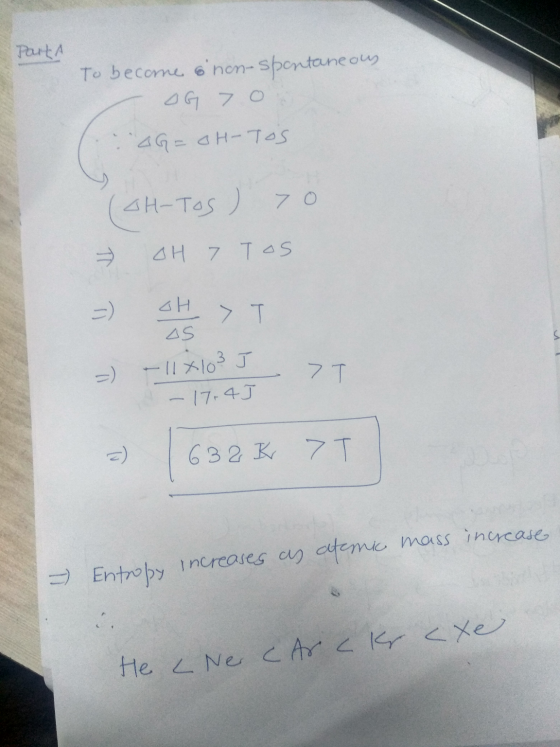
Part A Above what temperature does the following reaction become nonspontaneous?...
Above what temperature does the following reaction become nonspontaneous? FeO(s) + CO(g) → CO2 (g) +...
Above what temperature does the following reaction become nonspontaneous? FeO(s) + CO(g) → CO2 (g) + Fe(s) ΔH = -11.0 kJ; ΔS = -17.4 J/K A. 632 K B. 298 K C. 191 K D. This reaction is nonspontaneous at all temperatures. E. This reaction is spontaneous at all temperatures. Please explain how you got your answer, thanks!
please answer 25 and 26 please show all work and calculations please** 25) Place the following...
 please answer 25 and 26
please show all work and calculations please**
25) Place the following in order of increasing entropy at 298 K. Ne Xe He An Kr A) He & Kr x Ne < A < Xe | B) Xe < Kr < A < Ne & He C) He & Ne < A < K / Xe D) Ar < He < Ar < Ne < Kr E) A & Ne < Xe & K & He...
please answer 25 and 26
please show all work and calculations please**
25) Place the following in order of increasing entropy at 298 K. Ne Xe He An Kr A) He & Kr x Ne < A < Xe | B) Xe < Kr < A < Ne & He C) He & Ne < A < K / Xe D) Ar < He < Ar < Ne < Kr E) A & Ne < Xe & K & He...
Please show all work A.)Choose the statement below that is TRUE. a.If K < 1, the...
Please show all work A.)Choose the statement below that is TRUE. a.If K < 1, the reaction is spontaneous in the forward direction. b. If K < 1, the reaction is spontaneous in the reverse direction. c, If K < 1, the reaction is at equilibrium. d. Not enough information is given. B.)Place the following in order of decreasing molar entropy at 298 K. H2 Cl2 F2 a. H2 > F2 > Cl2 b. H2 > Cl2 > F2 c....
Question 7 Below what temperature does the following reaction become nonspontaneous? 12(s) + Cl2(g)--2 ICI(s) ΔΗ...
 Question 7 Below what temperature does the following reaction become nonspontaneous? 12(s) + Cl2(g)--2 ICI(s) ΔΗ +36.0 kJ: ΔS +158.8 J/K O 227 K O This reaction is spontaneous at all temperatures. O 313 K O This reaction is nonspontaneous at all temperatures. O 128 K
5. Above what temperature does the following reaction become nonspontaneous AS = -153.2 J/K Given: AH...
 5. Above what temperature does the following reaction become nonspontaneous AS = -153.2 J/K Given: AH = -1036 k); 2 H2(g) + 3 O2(g) → 2 502(g) + 2 H20(g) AG - AH' - TAS 46 = -1036000 -(T)(-153.2) = 0 6. What is the minimum temperature required for the spontaneous conversion of Cla(I) to CCL() Given: AH"vap) is 57.3 kJ/mol and ASva) is 164 J/(mol)? AG AH - TAS = 298 K 06 = 57300 - (298)(164) 46°= 8428...
Part A Draw orbital-filling diagrams for atoms with the following atomic numbers. Show each electron as...
 Part A Draw orbital-filling diagrams for atoms with the following atomic numbers. Show each electron as an up or down arrow, and use the abbreviation of the preceding noble gas to represent inner-shell electrons. Drag the appropriate labels to their respective targets. Reset Help . Ar (a) Z= 25 1+ 1 11 4s 3d He (b) Z= 56 Xe 1+ Ne 6s Ar (c) Z = 28 Ar 1+ 11 4s 3d Kr tt 1+ 1+ † (d) Z =...
show every little step please, thanks Part A What is the age of a rock whose...
 show every little step please, thanks
Part A What is the age of a rock whose 40 Ar K ratio is 1.60? The half-life of "K is 1.25 x 10 year IVO AO O 2 ? Submit Request Answer Return to Assignment Provide Feedback
show every little step please, thanks
Part A What is the age of a rock whose 40 Ar K ratio is 1.60? The half-life of "K is 1.25 x 10 year IVO AO O 2 ? Submit Request Answer Return to Assignment Provide Feedback
Above what temperature does the following reaction become nonspontaneous? 2H2S(g) + 3O2(g) →2SO2(g) + 2H2O(g) ΔH...
Above what temperature does the following reaction become nonspontaneous? 2H2S(g) + 3O2(g) →2SO2(g) + 2H2O(g) ΔH = -1036 kJ; ΔS = -153.2 J/K
Part G Calculate AH for the following reaction: CH3OH(1) +O2(g) + HCOH(1) +H2O(1) Express the enthalpy...
 Part G Calculate AH for the following reaction: CH3OH(1) +O2(g) + HCOH(1) +H2O(1) Express the enthalpy in kilojoules to one decimal place. AC O O ? AH = Submit Previous Answers Request Answer X Incorrect; Try Again; 4 attempts remaining Part 1 Calculate AS for the following reaction: CHOH(1) +O2(g) + HCO-H1) +H2O(1) Express the entropy in joules per kelvin to one decimal place. IVO AED ROO? J/K AS = Submit Request Answer Part 1 From the values of AH°...
Review Part A In the ground-state electron configuration of Fest, how many unpaired electrons are present?...
 Review Part A In the ground-state electron configuration of Fest, how many unpaired electrons are present? Express your answer numerically as an Integer. View Available Hint(s) 1s^2 2s^2 2p^6 3s^2 3p-6 4d^O 3 Submit Previous Answers X Incorrect; Try Again; 2 attempts remaining Part A The number of electrons in the ion Zn2+ is Submit Request Answer Provide Feedback Part A Using shorthand notation, the ground-state electron configuration for Co2+ is predicted to be Express your answer in condensed form,...
 please answer 25 and 26
please show all work and calculations please**
25) Place the following in order of increasing entropy at 298 K. Ne Xe He An Kr A) He & Kr x Ne < A < Xe | B) Xe < Kr < A < Ne & He C) He & Ne < A < K / Xe D) Ar < He < Ar < Ne < Kr E) A & Ne < Xe & K & He...
please answer 25 and 26
please show all work and calculations please**
25) Place the following in order of increasing entropy at 298 K. Ne Xe He An Kr A) He & Kr x Ne < A < Xe | B) Xe < Kr < A < Ne & He C) He & Ne < A < K / Xe D) Ar < He < Ar < Ne < Kr E) A & Ne < Xe & K & He...
 Question 7 Below what temperature does the following reaction become nonspontaneous? 12(s) + Cl2(g)--2 ICI(s) ΔΗ +36.0 kJ: ΔS +158.8 J/K O 227 K O This reaction is spontaneous at all temperatures. O 313 K O This reaction is nonspontaneous at all temperatures. O 128 K
 5. Above what temperature does the following reaction become nonspontaneous AS = -153.2 J/K Given: AH = -1036 k); 2 H2(g) + 3 O2(g) → 2 502(g) + 2 H20(g) AG - AH' - TAS 46 = -1036000 -(T)(-153.2) = 0 6. What is the minimum temperature required for the spontaneous conversion of Cla(I) to CCL() Given: AH"vap) is 57.3 kJ/mol and ASva) is 164 J/(mol)? AG AH - TAS = 298 K 06 = 57300 - (298)(164) 46°= 8428...
 Part A Draw orbital-filling diagrams for atoms with the following atomic numbers. Show each electron as an up or down arrow, and use the abbreviation of the preceding noble gas to represent inner-shell electrons. Drag the appropriate labels to their respective targets. Reset Help . Ar (a) Z= 25 1+ 1 11 4s 3d He (b) Z= 56 Xe 1+ Ne 6s Ar (c) Z = 28 Ar 1+ 11 4s 3d Kr tt 1+ 1+ † (d) Z =...
 show every little step please, thanks
Part A What is the age of a rock whose 40 Ar K ratio is 1.60? The half-life of "K is 1.25 x 10 year IVO AO O 2 ? Submit Request Answer Return to Assignment Provide Feedback
show every little step please, thanks
Part A What is the age of a rock whose 40 Ar K ratio is 1.60? The half-life of "K is 1.25 x 10 year IVO AO O 2 ? Submit Request Answer Return to Assignment Provide Feedback
 Part G Calculate AH for the following reaction: CH3OH(1) +O2(g) + HCOH(1) +H2O(1) Express the enthalpy in kilojoules to one decimal place. AC O O ? AH = Submit Previous Answers Request Answer X Incorrect; Try Again; 4 attempts remaining Part 1 Calculate AS for the following reaction: CHOH(1) +O2(g) + HCO-H1) +H2O(1) Express the entropy in joules per kelvin to one decimal place. IVO AED ROO? J/K AS = Submit Request Answer Part 1 From the values of AH°...
 Review Part A In the ground-state electron configuration of Fest, how many unpaired electrons are present? Express your answer numerically as an Integer. View Available Hint(s) 1s^2 2s^2 2p^6 3s^2 3p-6 4d^O 3 Submit Previous Answers X Incorrect; Try Again; 2 attempts remaining Part A The number of electrons in the ion Zn2+ is Submit Request Answer Provide Feedback Part A Using shorthand notation, the ground-state electron configuration for Co2+ is predicted to be Express your answer in condensed form,...
Most questions answered within 3 hours.
-
Where is the error in this code sequence?
String s1 = "Hello";
String s2 = "ello";...
asked 10 months ago -
Financial data for Joel de Paris, Inc., for last year
follow:
Joel de Paris, Inc.
Balance...
asked 10 months ago -
Consider this reaction:
Al2(SO4)3 (aq)+ BaCl3
(aq) Al2Cl6 (aq)- +
3BaSO4(s) . What is the...
asked 10 months ago -
Suppose that Savneet is considering increasing her
recent random sample from 20 car rentals to 40...
asked 10 months ago -
Trucks arrive at an unloading terminal at an average rate of 120
per hour.
Trucks arrive...
asked 10 months ago -
Why are methanol and ethanol completely soluble in water while
octanol is not very little soluble....
asked 10 months ago -
A facilities manager at a university reads in a research report
that the mean amount of...
asked 10 months ago -
When the CuSO4 is rehydrated by adding water to the anhydrous
compound, is this an endothermic...
asked 10 months ago -
A ray of sunlight is passing from diamond into crown glass; the
angle of incidence is...
asked 10 months ago -
A block of mass 0.249 kg is placed on top of a light, vertical
spring of...
asked 10 months ago -
how do the kidneys compensate in the presences of acidosis
a) trigger hyperventilate
b) reserve acid...
asked 10 months ago -
Question 501 pts
The rental rate of capital to the firm increases. Which of the
following...
asked 10 months ago