

Homework Answers
vi(red) = 2 m/s, vi(red) = 0 m/s
vf(red) = - 0.4 m/s, vf(blue) = 1.6 m/s
Before collision,
P(red) = 2*2 = 4 kg m/s
P(blue) = 3*0 = 0 kg m/s
After collision,
P(red) = 2*(-0.4) = - 0.8 kg m/s
P(blue) = 3*1.6 = 4.8 kg m/s
Total momentum of system,
P(before) = 4+0 = 4 kg m/s
P(after) = - 0.8+4.8 = 4 kg m/s
Change in momentum is,
P(after) - P(before) = 4 - 4 = 0
There is no change in momentum in elastic collision.
Add Answer to:
reset Collision Carts pause 0.4 m/s 1.6 m/s Initial Velocity Initial Velocity 2 m/s O m/s...
0 m/s 2 m/s Initial Velocity Initial Velocity 0 O m/s 2 m/s Mass: 2 kg...
 0 m/s 2 m/s Initial Velocity Initial Velocity 0 O m/s 2 m/s Mass: 2 kg Mass: 2 kg Elastic Case 1: Red and Blue Carts with Equal Mass Set the initial blue cart velocity to 0 m/s. Set the red and blue carts' mass values to the same value. Run the simulation and record the mass and velocity values. Before Collision After Collision Vred = m/s Vred = m/s Vblue = m/s mRed = kg m Blue = kg...
2.5 m/s2.5 m/s Initial Velocity Initial Velocity 0 1 m/s 0 3 m/s Mass: 1 kg...
 2.5 m/s2.5 m/s Initial Velocity Initial Velocity 0 1 m/s 0 3 m/s Mass: 1 kg Mass: 3 kg Inelastic Case 2: Blue Cart Moving Slower than the Red Cart Set the initial blue cart velocity to less than the red cart velocity. Position the blue cart in the middle of the track. Use different mass values. Run the simulation and record the mass and velocity values. Before Collision After Collision m/s m/s m/s mRed kg m Blue kg Table...
Explosion 2: Red Cart Less Massive than the Blue Cart <IMPORTANT>Set the initial velocities of both...
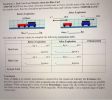 Explosion 2: Red Cart Less Massive than the Blue Cart <IMPORTANT>Set the initial velocities of both carts to 0 m/s. Set the mass of the red cart to be the smaller mass. Run the simulation and record the mass and velocity values.</IMPORTANT> After Explosion Before Explosion m/s y = At Rest. m Blue AMomentum mRed _kg Use mass and velocity values to complete the following momentum table. Before Explosion After Explosion _kg x kg x Red Cart kg•m/s kg•m/s m/s...
Let the red cart have a mass of 1 kg and an initial velocity of +10...
 Let the red cart have a mass of 1 kg and an initial velocity of +10 m/s, and the blue cart have a mass of 3 kg and an initial velocity of -10 m/s. If the two carts experience an Elastic Collision, what will be the final velocity of the blue cart? Note: Your answer is assumed to be reduced to the highest power possible. Your Answer: x10 Answer units Question 5 (0.2 points) In which type of collision is...
Let the red cart have a mass of 1 kg and an initial velocity of +10...
 Let the red cart have a mass of 1 kg and an initial velocity of +10 m/s, and the blue cart have a mass of 3 kg and an initial velocity of -10 m/s. If the two carts experience a Perfectly Inelastic Collision, what will be the final velocity of the blue cart?
if an inelastic collision of two carts on a frictionless track collides, what is the momentum...
if an inelastic collision of two carts on a frictionless track collides, what is the momentum of cart A and B, before and after the collision? cart A has a mass of .5025 kg and cart B has a mass of .5491 kg. carts A initial velocity is .5595 m/s then collides and sticks to cart B, which was initially at rest, with a final velocity of .1622 m/s.
Two carts experience a completely inelastic collision. Before the collision, cart A, which has a mass...
Two carts experience a completely inelastic collision. Before the collision, cart A, which has a mass of 1.00 kg, is traveling to the right at 7.00 m/s, while cart B, with a mass of 3.00 kg, is traveling to the left at 1.00 m/s. a) What is the velocity of the two carts after the collision? Define right as positive, so enter a negative value if you determine that the velocity is to the left. _______ m/s b) What percentage...
PART 4: Collisions where the carts make contact but do not stick together 0.250 kg 0.250...
 PART 4: Collisions where the carts make contact but do not stick together 0.250 kg 0.250 kg 0.487 m/s 0.090 m/s Trial 7: In this part we will have the magnets of the blue Both carts same mass cart face the Velcro of the red cart. Because there are no magnets on the Velcro side of the red cart, we'll end up with the plastic of the blue cart hitting Total mass mb of blue cart the Velcro of the...
Two small carts are set up on a horizontal track. Cart A (mass 0.6 kg )...
Two small carts are set up on a horizontal track. Cart A (mass 0.6 kg ) sits at rest. Cart B (mass 1.3 kg ) moves to the right with a speed of 3 m/s , colliding with cart A. A) If the collision is perfectly elastic, what is the speed of cart A after the collision? B) If the collision is perfectly elastic, what's the speed of cart B after the collision? C) If the collision is perfectly inelastic,...
Collision Problem Elastic and Inelastic: Two carts are on a frictionless surface as depicted below. 5...
 Collision Problem Elastic and Inelastic: Two carts are on a frictionless surface as depicted below. 5 m/s 20 kg 10 kg Frictionless surface Part 1. What is the common velocity just after impact if the two stick together, an inelastic collision? Give your answer to 3 significant digits. m/s Part 2. How much Kinetic energy is lost? Give your answer to 3 significant digits. J Part 3. If instead the collision is elastic, what is the velocity of the 10...
 0 m/s 2 m/s Initial Velocity Initial Velocity 0 O m/s 2 m/s Mass: 2 kg Mass: 2 kg Elastic Case 1: Red and Blue Carts with Equal Mass Set the initial blue cart velocity to 0 m/s. Set the red and blue carts' mass values to the same value. Run the simulation and record the mass and velocity values. Before Collision After Collision Vred = m/s Vred = m/s Vblue = m/s mRed = kg m Blue = kg...
 2.5 m/s2.5 m/s Initial Velocity Initial Velocity 0 1 m/s 0 3 m/s Mass: 1 kg Mass: 3 kg Inelastic Case 2: Blue Cart Moving Slower than the Red Cart Set the initial blue cart velocity to less than the red cart velocity. Position the blue cart in the middle of the track. Use different mass values. Run the simulation and record the mass and velocity values. Before Collision After Collision m/s m/s m/s mRed kg m Blue kg Table...
 Explosion 2: Red Cart Less Massive than the Blue Cart <IMPORTANT>Set the initial velocities of both carts to 0 m/s. Set the mass of the red cart to be the smaller mass. Run the simulation and record the mass and velocity values.</IMPORTANT> After Explosion Before Explosion m/s y = At Rest. m Blue AMomentum mRed _kg Use mass and velocity values to complete the following momentum table. Before Explosion After Explosion _kg x kg x Red Cart kg•m/s kg•m/s m/s...
 Let the red cart have a mass of 1 kg and an initial velocity of +10 m/s, and the blue cart have a mass of 3 kg and an initial velocity of -10 m/s. If the two carts experience an Elastic Collision, what will be the final velocity of the blue cart? Note: Your answer is assumed to be reduced to the highest power possible. Your Answer: x10 Answer units Question 5 (0.2 points) In which type of collision is...
 Let the red cart have a mass of 1 kg and an initial velocity of +10 m/s, and the blue cart have a mass of 3 kg and an initial velocity of -10 m/s. If the two carts experience a Perfectly Inelastic Collision, what will be the final velocity of the blue cart?
 PART 4: Collisions where the carts make contact but do not stick together 0.250 kg 0.250 kg 0.487 m/s 0.090 m/s Trial 7: In this part we will have the magnets of the blue Both carts same mass cart face the Velcro of the red cart. Because there are no magnets on the Velcro side of the red cart, we'll end up with the plastic of the blue cart hitting Total mass mb of blue cart the Velcro of the...
 Collision Problem Elastic and Inelastic: Two carts are on a frictionless surface as depicted below. 5 m/s 20 kg 10 kg Frictionless surface Part 1. What is the common velocity just after impact if the two stick together, an inelastic collision? Give your answer to 3 significant digits. m/s Part 2. How much Kinetic energy is lost? Give your answer to 3 significant digits. J Part 3. If instead the collision is elastic, what is the velocity of the 10...
Most questions answered within 3 hours.
-
Where is the error in this code sequence?
String s1 = "Hello";
String s2 = "ello";...
asked 11 months ago -
Financial data for Joel de Paris, Inc., for last year
follow:
Joel de Paris, Inc.
Balance...
asked 11 months ago -
Consider this reaction:
Al2(SO4)3 (aq)+ BaCl3
(aq) Al2Cl6 (aq)- +
3BaSO4(s) . What is the...
asked 11 months ago -
Suppose that Savneet is considering increasing her
recent random sample from 20 car rentals to 40...
asked 11 months ago -
Trucks arrive at an unloading terminal at an average rate of 120
per hour.
Trucks arrive...
asked 11 months ago -
Why are methanol and ethanol completely soluble in water while
octanol is not very little soluble....
asked 11 months ago -
A facilities manager at a university reads in a research report
that the mean amount of...
asked 11 months ago -
When the CuSO4 is rehydrated by adding water to the anhydrous
compound, is this an endothermic...
asked 11 months ago -
A ray of sunlight is passing from diamond into crown glass; the
angle of incidence is...
asked 11 months ago -
A block of mass 0.249 kg is placed on top of a light, vertical
spring of...
asked 11 months ago -
how do the kidneys compensate in the presences of acidosis
a) trigger hyperventilate
b) reserve acid...
asked 11 months ago -
Question 501 pts
The rental rate of capital to the firm increases. Which of the
following...
asked 11 months ago