

Homework Answers
1) The atomic mass of the element is the weighted average of all the isotopes
= { (isotope mass x percentage abundance) } / 100
= [ (53.9396 x 5.845 ) + (55.9349 x 91.754) + ( 56.9354 x 2.119) + ( 57.933 x 0.282) ] / 100
= [315.276962 + 5132.2508146 + 120. 6461126 + 16.337106 ] / 100
= 55.8451
= 55.85
Thus the atomic weight of the unknown element is 55.85 g / mol
2) The atomic weight of 55.85 is corresponds to the element Iron.
Thus the unknown element is Iron ( Fe )
3)
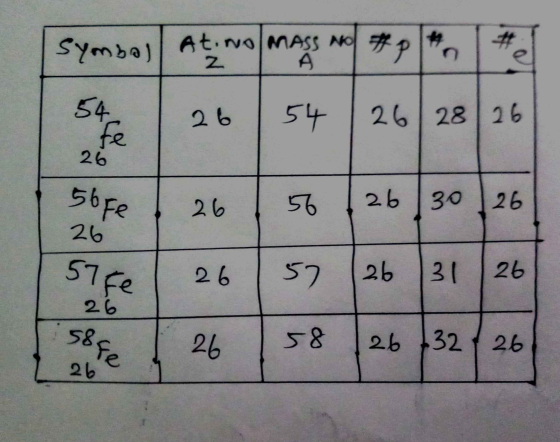
All the isotopes has the same atomic number. The mass number varies.
Number of protons = number of electrons = Atomic number = 26 for all the isotopes.
The number of neutrons = mass number - number of protons
= mass number - atomic number
The results are tablulated.
4)
The complete electronic configuration is given by
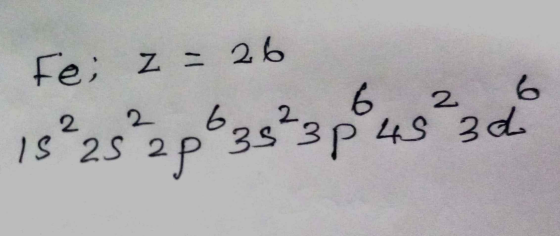
since the number of electrons are the same for all the isotopes, their electronic configurations are identical. Hence there is no need of writing electronic configuration for each isotope.
5)
The orbital diagram is as follows:
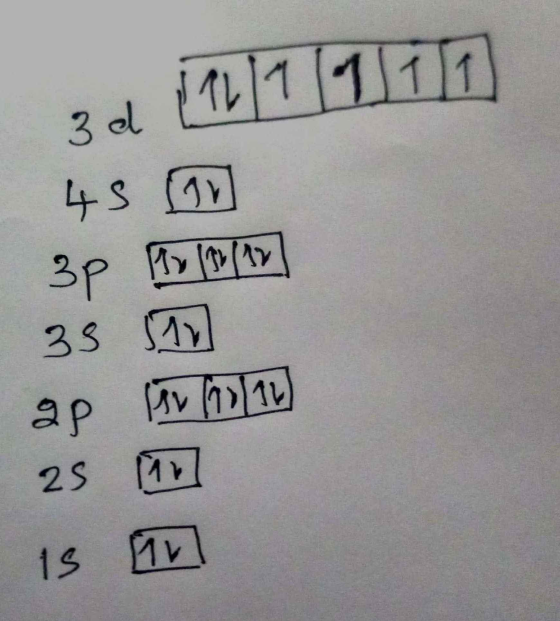
6) The position of the 23rd electron is in the 3d orbital.because 20 electrons occupy upto 4S orbital. The next 6 electrons are in the 3d orbital.

Hence n = 3
since l = n-1 = 3-1 = 2
The detailed positions of the 6 electrons in the 3d orbital are given below:
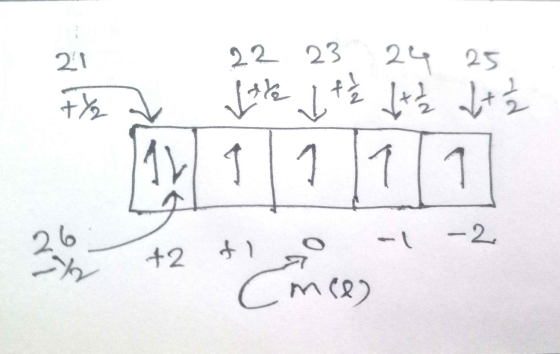
m(l) has the values +2, +1, 0 , -1,-2. The 23rd electron occupies the middle of the 3d orbital and hence its m(l) value is 0
It is an unpaired electron with positive spin. Hence m(s) = +1/2
Thus the four quantum numbers of the 23rd electron are
n = 3, l = 2 , m(l) = 0 and m(s) = +1/2
-----------------------------------------------------------------------------------------------
Add Answer to:
Please help me understand how to do this? Im very confused on
how to do this...
Atoms and Isotopes 1 Activity: Atoms and Isotopes Why? Atoms and isotopes are identified by the...
 Atoms and Isotopes 1 Activity: Atoms and Isotopes Why? Atoms and isotopes are identified by the numbers of protons, electrons, and neutrons that they contain The number of protons, electrons, and neutrons in atoms determines the chemical properties of the elements .A knowledge of the number of protons and electrons in an atom will help you understand how atoms combine to form molecules Identify the composition of atoms in terms of protons, neutrons, and electrons Use atomic symbols to represent...
-Isotopes are represented by the symbol , where Z is the atomic number, A is the...
 -Isotopes are represented by the symbol , where Z is the atomic number, A is the mass number, and E is the elemental symbol. . Write symbol that represents an isotope of nickel that contains 28 protons and 32 neutrons in the nucleus. Isotopes are also represented by the notation: Name-A, where Name is the name of the of the isotope. An example of this isotope notation is magnesium-26. This represents an isotope of The extremely small size of atoms...
Lab Section 1 2 3 4 5 6 7 8 9 Report: Quantum Numbers Assigning Quantum...
 Lab Section 1 2 3 4 5 6 7 8 9 Report: Quantum Numbers Assigning Quantum Numbers 1. For each element, complete the following tables Write the ground state condensed electron configuration, draw the energy level orbital diagram (see partial example with Na), and write the quantum numbers for the last electron in the atom. Element Me Condensede continuration Energy level Cuantum numbers Element Condensede configuration Energy level orbital diagram Quantum numbers (laste) Flement Condensede Energy level orbital diagram Quantum...
Ruthenium (Ru) is commonly used in the manufacture of platinum alloys. What is the ground-state electron...
 Ruthenium (Ru) is commonly used in the manufacture of platinum alloys. What is the ground-state electron configuration for an atom of ruthenium? 1. Analyze the Problem Known: Unknown: Determine the number of additional electrons a ruthenium atom has compared to the nearest preceding noble gas, and then write out ruthenium's electron configuration. 2. Solve for the Unknown From the periodic table, ruthenium's atomic number is determined to .Thus a ruthenium atom contains electrons. The noble gas be preceding ruthenium is...
numbers (last e) 2 Considering the energy level diagrams in the previous question, circle the correct...
 numbers (last e) 2 Considering the energy level diagrams in the previous question, circle the correct word to complete each statement. In a phosphorus atom, the 3p orbitals are ( higher lower / equal ) in energy compared a. to the 3s orbital. b. In a phosphorus atom, the 3p orbitals are ( equal / not equal) in energy to each other. c. Phosphorus has a ( higher / lower / equal ) number of unpaired electrons than silicon. d....
Report: Quantum Numbers Assigning Quantum Numbers 1. For each element, complete the following tables. Write the...
 Report: Quantum Numbers Assigning Quantum Numbers 1. For each element, complete the following tables. Write the ground state condensed electron configuration, draw the energy level orbital diagram (see partial example with Na), and write the quantum numbers for the "last" electron in the atom. Element - Na Mg Condensed e configuration NC [NC] 35 Energy level orbital diagram (Ne) Quantum numbers (last e) 1300 / 300 / Si Element ised e configuration P Ve 3²38 Ne 35² 3p' ve 35²...
3) If given the following quantum numbers, which element(s) do they likely refer to? (Assuming thot...
 3) If given the following quantum numbers, which element(s) do they likely refer to? (Assuming thot these quantum numbers describe the volence electrons in the element) Complete the table by writing only the symbol of the possible elements Possible Elements 0 4) Suppose that an atom fills its orbitals as shown: 1s 2s 2p Such an electron configuration illustrates which of the following rules? Hund's rule B) Aufbau principle C) Bohr model D) Pauli Exclusion principle and mJ tat best...
Cap Resources Suppose you take a trip to a distant universe and find that the periodic table there is derived from...
 Cap Resources Suppose you take a trip to a distant universe and find that the periodic table there is derived from an arrangement of quantum numbers different from the one on Earth. The rules in that universe are: 1. principal quantum number n 1,2,... (as on Earth); 2. angular momentum quantum number 0,1,2,... ,n- 1 (as on Earth); 3. magnetic quantum number me = 0, 1,2, ...,l (only positive integers up to and including are allowed); 4. spin quantum number...
Chemistry CHE 140, 170, 180 о Goal: With reference only to the periodic table, to write...
 Chemistry CHE 140, 170, 180 о Goal: With reference only to the periodic table, to write the electron configuration of the ground state (lowest energy), gaseous, atoms. Tools: (1) A list of the electronic sublevels within the atom in order of their increasing energy. (Write the list, 1s 2s 2p <6s, in the boxes below as indicated, by inspection of the "Aufbau" diagram or of the periodic table, where the order is explicit) (ii) Fill in the box below each...
4 For each elemens, eomplese the folowing able. Element Condensed e configuration U(2-92 Po (2 4...
 4 For each elemens, eomplese the folowing able. Element Condensed e configuration U(2-92 Po (2 4 Bh (Z107 Energy level orbital diagram Quantum numbers (last e) Note: For the "last electron" in Uranium,, give the last electron in the f-block. 5 Identify the number of protons and electrons contained in each element or ion. Then write the condensed electron configuration and give the four quantum numbers (n, 1, m, m) that describe the "last" electron in each species. Quantum numbers...
 Atoms and Isotopes 1 Activity: Atoms and Isotopes Why? Atoms and isotopes are identified by the numbers of protons, electrons, and neutrons that they contain The number of protons, electrons, and neutrons in atoms determines the chemical properties of the elements .A knowledge of the number of protons and electrons in an atom will help you understand how atoms combine to form molecules Identify the composition of atoms in terms of protons, neutrons, and electrons Use atomic symbols to represent...
 -Isotopes are represented by the symbol , where Z is the atomic number, A is the mass number, and E is the elemental symbol. . Write symbol that represents an isotope of nickel that contains 28 protons and 32 neutrons in the nucleus. Isotopes are also represented by the notation: Name-A, where Name is the name of the of the isotope. An example of this isotope notation is magnesium-26. This represents an isotope of The extremely small size of atoms...
 Lab Section 1 2 3 4 5 6 7 8 9 Report: Quantum Numbers Assigning Quantum Numbers 1. For each element, complete the following tables Write the ground state condensed electron configuration, draw the energy level orbital diagram (see partial example with Na), and write the quantum numbers for the last electron in the atom. Element Me Condensede continuration Energy level Cuantum numbers Element Condensede configuration Energy level orbital diagram Quantum numbers (laste) Flement Condensede Energy level orbital diagram Quantum...
 Ruthenium (Ru) is commonly used in the manufacture of platinum alloys. What is the ground-state electron configuration for an atom of ruthenium? 1. Analyze the Problem Known: Unknown: Determine the number of additional electrons a ruthenium atom has compared to the nearest preceding noble gas, and then write out ruthenium's electron configuration. 2. Solve for the Unknown From the periodic table, ruthenium's atomic number is determined to .Thus a ruthenium atom contains electrons. The noble gas be preceding ruthenium is...
 numbers (last e) 2 Considering the energy level diagrams in the previous question, circle the correct word to complete each statement. In a phosphorus atom, the 3p orbitals are ( higher lower / equal ) in energy compared a. to the 3s orbital. b. In a phosphorus atom, the 3p orbitals are ( equal / not equal) in energy to each other. c. Phosphorus has a ( higher / lower / equal ) number of unpaired electrons than silicon. d....
 Report: Quantum Numbers Assigning Quantum Numbers 1. For each element, complete the following tables. Write the ground state condensed electron configuration, draw the energy level orbital diagram (see partial example with Na), and write the quantum numbers for the "last" electron in the atom. Element - Na Mg Condensed e configuration NC [NC] 35 Energy level orbital diagram (Ne) Quantum numbers (last e) 1300 / 300 / Si Element ised e configuration P Ve 3²38 Ne 35² 3p' ve 35²...
 3) If given the following quantum numbers, which element(s) do they likely refer to? (Assuming thot these quantum numbers describe the volence electrons in the element) Complete the table by writing only the symbol of the possible elements Possible Elements 0 4) Suppose that an atom fills its orbitals as shown: 1s 2s 2p Such an electron configuration illustrates which of the following rules? Hund's rule B) Aufbau principle C) Bohr model D) Pauli Exclusion principle and mJ tat best...
 Cap Resources Suppose you take a trip to a distant universe and find that the periodic table there is derived from an arrangement of quantum numbers different from the one on Earth. The rules in that universe are: 1. principal quantum number n 1,2,... (as on Earth); 2. angular momentum quantum number 0,1,2,... ,n- 1 (as on Earth); 3. magnetic quantum number me = 0, 1,2, ...,l (only positive integers up to and including are allowed); 4. spin quantum number...
 Chemistry CHE 140, 170, 180 о Goal: With reference only to the periodic table, to write the electron configuration of the ground state (lowest energy), gaseous, atoms. Tools: (1) A list of the electronic sublevels within the atom in order of their increasing energy. (Write the list, 1s 2s 2p <6s, in the boxes below as indicated, by inspection of the "Aufbau" diagram or of the periodic table, where the order is explicit) (ii) Fill in the box below each...
 4 For each elemens, eomplese the folowing able. Element Condensed e configuration U(2-92 Po (2 4 Bh (Z107 Energy level orbital diagram Quantum numbers (last e) Note: For the "last electron" in Uranium,, give the last electron in the f-block. 5 Identify the number of protons and electrons contained in each element or ion. Then write the condensed electron configuration and give the four quantum numbers (n, 1, m, m) that describe the "last" electron in each species. Quantum numbers...
Most questions answered within 3 hours.
-
Where is the error in this code sequence?
String s1 = "Hello";
String s2 = "ello";...
asked 10 months ago -
Financial data for Joel de Paris, Inc., for last year
follow:
Joel de Paris, Inc.
Balance...
asked 10 months ago -
Consider this reaction:
Al2(SO4)3 (aq)+ BaCl3
(aq) Al2Cl6 (aq)- +
3BaSO4(s) . What is the...
asked 10 months ago -
Suppose that Savneet is considering increasing her
recent random sample from 20 car rentals to 40...
asked 10 months ago -
Trucks arrive at an unloading terminal at an average rate of 120
per hour.
Trucks arrive...
asked 10 months ago -
Why are methanol and ethanol completely soluble in water while
octanol is not very little soluble....
asked 10 months ago -
A facilities manager at a university reads in a research report
that the mean amount of...
asked 10 months ago -
When the CuSO4 is rehydrated by adding water to the anhydrous
compound, is this an endothermic...
asked 10 months ago -
A ray of sunlight is passing from diamond into crown glass; the
angle of incidence is...
asked 10 months ago -
A block of mass 0.249 kg is placed on top of a light, vertical
spring of...
asked 10 months ago -
how do the kidneys compensate in the presences of acidosis
a) trigger hyperventilate
b) reserve acid...
asked 10 months ago -
Question 501 pts
The rental rate of capital to the firm increases. Which of the
following...
asked 10 months ago