
Homework Answers
Add Answer to:
this is physical chemistry
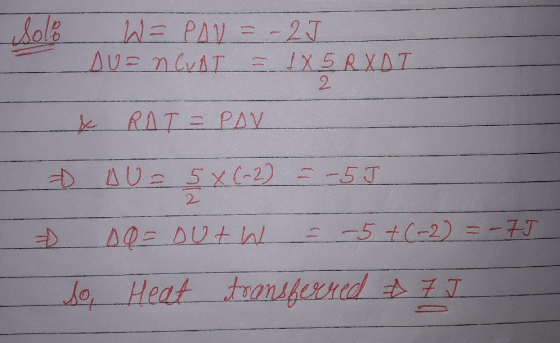
32.- What amount of heat is transferred to nitrogen gas (assumed ideal)...
Starting with 2.70 mol of N2 gas (assumed to be ideal) in a cylinder at 1.00...
Starting with 2.70 mol of N2 gas (assumed to be ideal) in a cylinder at 1.00 atm and 15.0 ∘C, a chemist first heats the gas at constant volume, adding 1.36 × 10⁴ J of heat, then continues heating and allows the gas to expand at constant pressure to twice its original volume. (a) Calculate the final temperature of the gas (b) Calculate the amount of work done by the gas. (c) Calculate the amount of heat added to the...
Please help me about Physics, Thanks. A sample of 1.00 mole of a diatomic ideal gas...
 Please help me about Physics, Thanks. A sample of 1.00 mole of a
diatomic ideal gas is intially at temperature 265K...........
Thermodynamic Processes involving Ideal Gases-in-class worksheet-(5 points) PHYS 181 Question B (B.) A sample of 1.00 mole of a diatomic ideal gas is initially at temperature 265 K and volume 0.200 m. The gas first undergoes an isobaric expansion, such that its temperature increases by 120.0 K. It then undergoes an adiabatic expansion so that its final volume is...
Please help me about Physics, Thanks. A sample of 1.00 mole of a
diatomic ideal gas is intially at temperature 265K...........
Thermodynamic Processes involving Ideal Gases-in-class worksheet-(5 points) PHYS 181 Question B (B.) A sample of 1.00 mole of a diatomic ideal gas is initially at temperature 265 K and volume 0.200 m. The gas first undergoes an isobaric expansion, such that its temperature increases by 120.0 K. It then undergoes an adiabatic expansion so that its final volume is...
physical chemistry 3. Derive formulas for AE, Aw, and Aq when a Van der Waal's gas...
 physical chemistry
3. Derive formulas for AE, Aw, and Aq when a Van der Waal's gas undergoes: a) reversible isothermal expansion b) adiabatic expansion c) repeat steps a and b for an ideal gas d) Use the Maxwell relation derived from the Helmholtz free energy F =F(T,V) = -SdT PdV To prove that e) Determine for a Van der Waal's gas and an ideal gas. T()-P f) Explain the answer to part e in terms of the assumptions that define...
physical chemistry
3. Derive formulas for AE, Aw, and Aq when a Van der Waal's gas undergoes: a) reversible isothermal expansion b) adiabatic expansion c) repeat steps a and b for an ideal gas d) Use the Maxwell relation derived from the Helmholtz free energy F =F(T,V) = -SdT PdV To prove that e) Determine for a Van der Waal's gas and an ideal gas. T()-P f) Explain the answer to part e in terms of the assumptions that define...
12. 1 mole of an ideal gas undergoes an isothermal expansion from V1 = 1.4L followed...
 12. 1 mole of an ideal gas undergoes an isothermal expansion from V1 = 1.4L followed by isobaric compression, p = cst.if P1 = 4.4atm, p2 = 1.7atm → ?- m calculate the work done by gas during the expansion. Express work in J = N·m! • For isothermal processes, AT = 0 T = cst → w=faw=fr&v=/MRT AV 594 Show your work like: `x-int_0^5 v(t)dt rarr x-int_0^5(-4*t)dt=-50 m 13. 1 mole of an ideal gas undergoes an isothermal expansion...
A monatomic ideal gas expands slowly to twice its original volume, doing 240 J of work...
A monatomic ideal gas expands slowly to twice its original volume, doing 240 J of work in the process. a) Find the heat added to the gas if the process is isothermal. b) Find the change in internal energy of the gas if the process is isothermal. c) Find the heat added to the gas if the process is adiabatic. d) Find the change in internal energy of the gas if the process is adiabatic. e) Find the heat added...
(5 pts) 15.A quantity of 2.0 moles of an ideal gas undergoes a reversible isothermal process...
 (5 pts) 15.A quantity of 2.0 moles of an ideal gas undergoes a reversible isothermal process (AT -0) at 120 K. In the process 80.0 J of heat energy flows out of the gas. In this process the entropy of the gas a decreases (b) stays the same (c) increases (5 pts) 16. In each cycle a heat engine receives 80.0 J of heat energy from the high temperature reservoir and rejects 30.0 J of heat energy into the low...
A, B , D ,E PLEASE SOLVE THEM ( DETAILED SOLUTION + CLEAR HANDWRITING) In this...
 A, B , D ,E PLEASE SOLVE THEM
( DETAILED SOLUTION + CLEAR HANDWRITING)
In this question, assume no changes in Ek or Ep (a) In one cycle of a heat engine: 70 J are input by working, 90 J are output by working, 100 J are input by heating, 80 J are output by heating. Write down which one of the following is true: (A) |Wnet-160 J (B) Iw.et-20 J (C) η-0.25 (b) For a fixed amount of gas,...
A, B , D ,E PLEASE SOLVE THEM
( DETAILED SOLUTION + CLEAR HANDWRITING)
In this question, assume no changes in Ek or Ep (a) In one cycle of a heat engine: 70 J are input by working, 90 J are output by working, 100 J are input by heating, 80 J are output by heating. Write down which one of the following is true: (A) |Wnet-160 J (B) Iw.et-20 J (C) η-0.25 (b) For a fixed amount of gas,...
(17%) Problem 4: A monatomic ideal gas is in a state with volume of Vo at...
 (17%) Problem 4: A monatomic ideal gas is in a state with volume of Vo at pressure Po and temperature T . The following questions refer to the work done on the gas, W- -PA 17% Part (a) The gas undergoes an isochoric cooling from its initial state (I-Po-T0). For this process, choose what happens to the energy heat, and work from the following Grade Summary Deductions Potential 100% 0% Submissions OAU > 0, Δυ-o-w. Q < 0, and w...
10.0 mol of argon (monoatomic) gas is introduced to an empty 50-cm3 container at 20 ⁰C....
10.0 mol of argon (monoatomic) gas is introduced to an empty 50-cm3 container at 20 ⁰C. The gas then undergoes an isobaric heating to a temperature of 300 ⁰C. a) What is the pressure at which this process happens? b) What is the final volume of gas? c) Show this process on a PV diagram. Make sure you include units and properly label axes. d) What is the amount of work done during this process? Is this work done ON...
10.0 mol of argon (monoatomic) gas is introduced to an empty 50-cm3 container at 20 ⁰C....
10.0 mol of argon (monoatomic) gas is introduced to an empty 50-cm3 container at 20 ⁰C. The gas then undergoes an isobaric heating to a temperature of 300 ⁰C. a) What is the pressure at which this process happens? b) What is the final volume of gas? c) Show this process on a PV diagram. Make sure you include units and properly label axes. d) What is the amount of work done during this process? Is this work done ON...
 Please help me about Physics, Thanks. A sample of 1.00 mole of a
diatomic ideal gas is intially at temperature 265K...........
Thermodynamic Processes involving Ideal Gases-in-class worksheet-(5 points) PHYS 181 Question B (B.) A sample of 1.00 mole of a diatomic ideal gas is initially at temperature 265 K and volume 0.200 m. The gas first undergoes an isobaric expansion, such that its temperature increases by 120.0 K. It then undergoes an adiabatic expansion so that its final volume is...
Please help me about Physics, Thanks. A sample of 1.00 mole of a
diatomic ideal gas is intially at temperature 265K...........
Thermodynamic Processes involving Ideal Gases-in-class worksheet-(5 points) PHYS 181 Question B (B.) A sample of 1.00 mole of a diatomic ideal gas is initially at temperature 265 K and volume 0.200 m. The gas first undergoes an isobaric expansion, such that its temperature increases by 120.0 K. It then undergoes an adiabatic expansion so that its final volume is...
 physical chemistry
3. Derive formulas for AE, Aw, and Aq when a Van der Waal's gas undergoes: a) reversible isothermal expansion b) adiabatic expansion c) repeat steps a and b for an ideal gas d) Use the Maxwell relation derived from the Helmholtz free energy F =F(T,V) = -SdT PdV To prove that e) Determine for a Van der Waal's gas and an ideal gas. T()-P f) Explain the answer to part e in terms of the assumptions that define...
physical chemistry
3. Derive formulas for AE, Aw, and Aq when a Van der Waal's gas undergoes: a) reversible isothermal expansion b) adiabatic expansion c) repeat steps a and b for an ideal gas d) Use the Maxwell relation derived from the Helmholtz free energy F =F(T,V) = -SdT PdV To prove that e) Determine for a Van der Waal's gas and an ideal gas. T()-P f) Explain the answer to part e in terms of the assumptions that define...
 12. 1 mole of an ideal gas undergoes an isothermal expansion from V1 = 1.4L followed by isobaric compression, p = cst.if P1 = 4.4atm, p2 = 1.7atm → ?- m calculate the work done by gas during the expansion. Express work in J = N·m! • For isothermal processes, AT = 0 T = cst → w=faw=fr&v=/MRT AV 594 Show your work like: `x-int_0^5 v(t)dt rarr x-int_0^5(-4*t)dt=-50 m 13. 1 mole of an ideal gas undergoes an isothermal expansion...
 (5 pts) 15.A quantity of 2.0 moles of an ideal gas undergoes a reversible isothermal process (AT -0) at 120 K. In the process 80.0 J of heat energy flows out of the gas. In this process the entropy of the gas a decreases (b) stays the same (c) increases (5 pts) 16. In each cycle a heat engine receives 80.0 J of heat energy from the high temperature reservoir and rejects 30.0 J of heat energy into the low...
 A, B , D ,E PLEASE SOLVE THEM
( DETAILED SOLUTION + CLEAR HANDWRITING)
In this question, assume no changes in Ek or Ep (a) In one cycle of a heat engine: 70 J are input by working, 90 J are output by working, 100 J are input by heating, 80 J are output by heating. Write down which one of the following is true: (A) |Wnet-160 J (B) Iw.et-20 J (C) η-0.25 (b) For a fixed amount of gas,...
A, B , D ,E PLEASE SOLVE THEM
( DETAILED SOLUTION + CLEAR HANDWRITING)
In this question, assume no changes in Ek or Ep (a) In one cycle of a heat engine: 70 J are input by working, 90 J are output by working, 100 J are input by heating, 80 J are output by heating. Write down which one of the following is true: (A) |Wnet-160 J (B) Iw.et-20 J (C) η-0.25 (b) For a fixed amount of gas,...
 (17%) Problem 4: A monatomic ideal gas is in a state with volume of Vo at pressure Po and temperature T . The following questions refer to the work done on the gas, W- -PA 17% Part (a) The gas undergoes an isochoric cooling from its initial state (I-Po-T0). For this process, choose what happens to the energy heat, and work from the following Grade Summary Deductions Potential 100% 0% Submissions OAU > 0, Δυ-o-w. Q < 0, and w...
Most questions answered within 3 hours.
-
Where is the error in this code sequence?
String s1 = "Hello";
String s2 = "ello";...
asked 11 months ago -
Financial data for Joel de Paris, Inc., for last year
follow:
Joel de Paris, Inc.
Balance...
asked 11 months ago -
Consider this reaction:
Al2(SO4)3 (aq)+ BaCl3
(aq) Al2Cl6 (aq)- +
3BaSO4(s) . What is the...
asked 11 months ago -
Suppose that Savneet is considering increasing her
recent random sample from 20 car rentals to 40...
asked 11 months ago -
Trucks arrive at an unloading terminal at an average rate of 120
per hour.
Trucks arrive...
asked 11 months ago -
Why are methanol and ethanol completely soluble in water while
octanol is not very little soluble....
asked 11 months ago -
A facilities manager at a university reads in a research report
that the mean amount of...
asked 11 months ago -
When the CuSO4 is rehydrated by adding water to the anhydrous
compound, is this an endothermic...
asked 11 months ago -
A ray of sunlight is passing from diamond into crown glass; the
angle of incidence is...
asked 11 months ago -
A block of mass 0.249 kg is placed on top of a light, vertical
spring of...
asked 11 months ago -
how do the kidneys compensate in the presences of acidosis
a) trigger hyperventilate
b) reserve acid...
asked 11 months ago -
Question 501 pts
The rental rate of capital to the firm increases. Which of the
following...
asked 11 months ago