An experiment was performed to determine the percentage water content in a hydrated compound. A 15.67...
An experiment was performed to determine the percentage water content in a hydrated compound. A 15.67 g sample of a hydrate, magnesium carbonate was heated, without decomposing the carbonate, to drive off the water. The mass was reduced to 7.58 g. What is the percent water content?
Homework Answers
Request Answer!
We need at least 10 more requests to produce the answer.
0 / 10 have requested this problem solution
The more requests, the faster the answer.
Add Answer to:
An experiment was performed to determine the percentage water
content in a hydrated compound. A 15.67...
15.67 g sample of a hydrate of magnesium carbonate was heated, without decomposing the carbonate, to drive off the water. The mass was reduced to 7.58 g. What is the formula of the hydrate? Name the hydrate
15.67 g sample of a hydrate of magnesium carbonate was heated, without decomposing the carbonate, to drive off the water. The mass was reduced to 7.58 g. What is the formula of the hydrate? Name the hydrate
Question five A 15.67 g sample of a hydrate of magnesium carbonate ( MOONH:O) was heated without decomposite the car...
 Question five A 15.67 g sample of a hydrate of magnesium carbonate ( MOONH:O) was heated without decomposite the carbonate, to drive off the water. The mass was reduced to 7.58 g (Molar mass of MgCO: - 84313 Smol) (5 mark) A. What is the formula of the hydrate? B. Determine the percentate in the hydrated sit
please help me solve all 3! Thank you in advance A 15.67 g of a hydrate...
 please help me solve all 3! Thank you in advance
A 15.67 g of a hydrate of magnesium carbonate was carefully heated to drive off the waters of hydration. The mass was reduced to 7.58 g after the water was driven off. What is the molecular formula of this hydrate? Complete the molecular formula by choosing the appropriate coefficient below: MgCoz v H20 Checl OVO AWN Next page Silver nitrate has the molecular formula AgNO3. In a 216.8 g sample...
please help me solve all 3! Thank you in advance
A 15.67 g of a hydrate of magnesium carbonate was carefully heated to drive off the waters of hydration. The mass was reduced to 7.58 g after the water was driven off. What is the molecular formula of this hydrate? Complete the molecular formula by choosing the appropriate coefficient below: MgCoz v H20 Checl OVO AWN Next page Silver nitrate has the molecular formula AgNO3. In a 216.8 g sample...
When a 7.50 g sample of hydrated LiClO, is heated to drive off all the water,...
 When a 7.50 g sample of hydrated LiClO, is heated to drive off all the water, the anhydrous residue that remains has a mass of 4.97 g. What is the mass percent of water in the hydrate?
4. When a 7.50 g sample of hydrated LiClo, is heated to drive off all the...
 4. When a 7.50 g sample of hydrated LiClo, is heated to drive off all the water, the anhydrous residue that remains has a mass of 4.97 g. What is the mass percent of water in the hydrate?
This portion of the experiment is due by 4:00p.m. the Monday before the experiment is done....
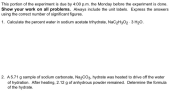 This portion of the experiment is due by 4:00p.m. the Monday before the experiment is done. Show your work on all problems. Always include the unit labels. Express the answers using the correct number of significant figures. 1. Calculate the percent water in sodium acetate trihydrate, NaC2H302.3 H2O. 2. A 5.71 g sample of sodium carbonate, Na2CO3, hydrate was heated to drive off the water of hydration. After heating, 2.12 g of anhydrous powder remained. Determine the formula of the...
In an experiment like the one you performed in lab, a hydrated CuSO_4 salt was heated...
 In an experiment like the one you performed in lab, a hydrated CuSO_4 salt was heated and thus dehydrated. Determine the % H_2O by weight in the hydrated CuSO_4 salt. mass of empty dish = 56.123 g mass of dish + hydrated salt = 56.978 g mass of dish + dehydrated salt = 56.719 Use the data found in question number 3: Determine the empirical formula for the hydrated CuSO_4 salt.
Please complete the lab report Please Danate EXPERIMENT 6 ther Water in Hydrates MATERIALS AND EQUIPMENT...
 Please complete the lab report
Please Danate EXPERIMENT 6 ther Water in Hydrates MATERIALS AND EQUIPMENT Golids: finely ground eopper I) sulfate pentahydrate (Cuso, 5H,0), and unknown hydrate Cobalt chloride test paper, clay triangle, erucible and cover, 25x 200 mm ignition test tube, watch glass DISCUSSION any salts form compounds in which a definite number of moles of water are combined with each mole of the anhydrous salt. Such compounds are called hydrates. The water which is ther two ane...
Please complete the lab report
Please Danate EXPERIMENT 6 ther Water in Hydrates MATERIALS AND EQUIPMENT Golids: finely ground eopper I) sulfate pentahydrate (Cuso, 5H,0), and unknown hydrate Cobalt chloride test paper, clay triangle, erucible and cover, 25x 200 mm ignition test tube, watch glass DISCUSSION any salts form compounds in which a definite number of moles of water are combined with each mole of the anhydrous salt. Such compounds are called hydrates. The water which is ther two ane...
Experiment 6 PRE-LABORATORY PROBLEMS NAME 1. Write a purpose statement and a summary of the procedure...
 Experiment 6 PRE-LABORATORY PROBLEMS NAME 1. Write a purpose statement and a summary of the procedure to include special technique equipment, chemicals, and chemical reactions to be performed, an understanding of any calculations that are important to understanding the procedure. 2. Calculate the molar mass of copper (II) Sulfate pentahydrate, Cuso,5H.O. 3. Calculate the mass percent of water present in Copper(II) sulfate pentahydrate. 4. Define the term hydrate and anhydrous. S. A 2.000 gram sample of hydrated barium carbonate was...
Experiment 5 Prelaboratory Assignment Percent Water in a Hydrated Salt chloride, a deliquescent salt, is used...
 Experiment 5 Prelaboratory Assignment Percent Water in a Hydrated Salt chloride, a deliquescent salt, is used as a desiccant in laboratory desiccators to maintain a dry environment Date ab SecName Desk No. Explain. 1sb 2. Experimental Procedure, Part A.1. What is the purpose of firing the crucible? 3. A 1.803-g sample of gypsum, a hydrated salt of calcium sulfate, Caso., is heated at a temperature greater than 120 C in a crucible until a constant mass is reached. The mass...
 Question five A 15.67 g sample of a hydrate of magnesium carbonate ( MOONH:O) was heated without decomposite the carbonate, to drive off the water. The mass was reduced to 7.58 g (Molar mass of MgCO: - 84313 Smol) (5 mark) A. What is the formula of the hydrate? B. Determine the percentate in the hydrated sit
 please help me solve all 3! Thank you in advance
A 15.67 g of a hydrate of magnesium carbonate was carefully heated to drive off the waters of hydration. The mass was reduced to 7.58 g after the water was driven off. What is the molecular formula of this hydrate? Complete the molecular formula by choosing the appropriate coefficient below: MgCoz v H20 Checl OVO AWN Next page Silver nitrate has the molecular formula AgNO3. In a 216.8 g sample...
please help me solve all 3! Thank you in advance
A 15.67 g of a hydrate of magnesium carbonate was carefully heated to drive off the waters of hydration. The mass was reduced to 7.58 g after the water was driven off. What is the molecular formula of this hydrate? Complete the molecular formula by choosing the appropriate coefficient below: MgCoz v H20 Checl OVO AWN Next page Silver nitrate has the molecular formula AgNO3. In a 216.8 g sample...
 When a 7.50 g sample of hydrated LiClO, is heated to drive off all the water, the anhydrous residue that remains has a mass of 4.97 g. What is the mass percent of water in the hydrate?
 4. When a 7.50 g sample of hydrated LiClo, is heated to drive off all the water, the anhydrous residue that remains has a mass of 4.97 g. What is the mass percent of water in the hydrate?
 This portion of the experiment is due by 4:00p.m. the Monday before the experiment is done. Show your work on all problems. Always include the unit labels. Express the answers using the correct number of significant figures. 1. Calculate the percent water in sodium acetate trihydrate, NaC2H302.3 H2O. 2. A 5.71 g sample of sodium carbonate, Na2CO3, hydrate was heated to drive off the water of hydration. After heating, 2.12 g of anhydrous powder remained. Determine the formula of the...
 In an experiment like the one you performed in lab, a hydrated CuSO_4 salt was heated and thus dehydrated. Determine the % H_2O by weight in the hydrated CuSO_4 salt. mass of empty dish = 56.123 g mass of dish + hydrated salt = 56.978 g mass of dish + dehydrated salt = 56.719 Use the data found in question number 3: Determine the empirical formula for the hydrated CuSO_4 salt.
 Please complete the lab report
Please Danate EXPERIMENT 6 ther Water in Hydrates MATERIALS AND EQUIPMENT Golids: finely ground eopper I) sulfate pentahydrate (Cuso, 5H,0), and unknown hydrate Cobalt chloride test paper, clay triangle, erucible and cover, 25x 200 mm ignition test tube, watch glass DISCUSSION any salts form compounds in which a definite number of moles of water are combined with each mole of the anhydrous salt. Such compounds are called hydrates. The water which is ther two ane...
Please complete the lab report
Please Danate EXPERIMENT 6 ther Water in Hydrates MATERIALS AND EQUIPMENT Golids: finely ground eopper I) sulfate pentahydrate (Cuso, 5H,0), and unknown hydrate Cobalt chloride test paper, clay triangle, erucible and cover, 25x 200 mm ignition test tube, watch glass DISCUSSION any salts form compounds in which a definite number of moles of water are combined with each mole of the anhydrous salt. Such compounds are called hydrates. The water which is ther two ane...
 Experiment 6 PRE-LABORATORY PROBLEMS NAME 1. Write a purpose statement and a summary of the procedure to include special technique equipment, chemicals, and chemical reactions to be performed, an understanding of any calculations that are important to understanding the procedure. 2. Calculate the molar mass of copper (II) Sulfate pentahydrate, Cuso,5H.O. 3. Calculate the mass percent of water present in Copper(II) sulfate pentahydrate. 4. Define the term hydrate and anhydrous. S. A 2.000 gram sample of hydrated barium carbonate was...
 Experiment 5 Prelaboratory Assignment Percent Water in a Hydrated Salt chloride, a deliquescent salt, is used as a desiccant in laboratory desiccators to maintain a dry environment Date ab SecName Desk No. Explain. 1sb 2. Experimental Procedure, Part A.1. What is the purpose of firing the crucible? 3. A 1.803-g sample of gypsum, a hydrated salt of calcium sulfate, Caso., is heated at a temperature greater than 120 C in a crucible until a constant mass is reached. The mass...
Most questions answered within 3 hours.
-
Where is the error in this code sequence?
String s1 = "Hello";
String s2 = "ello";...
asked 10 months ago -
Financial data for Joel de Paris, Inc., for last year
follow:
Joel de Paris, Inc.
Balance...
asked 10 months ago -
Consider this reaction:
Al2(SO4)3 (aq)+ BaCl3
(aq) Al2Cl6 (aq)- +
3BaSO4(s) . What is the...
asked 10 months ago -
Suppose that Savneet is considering increasing her
recent random sample from 20 car rentals to 40...
asked 10 months ago -
Trucks arrive at an unloading terminal at an average rate of 120
per hour.
Trucks arrive...
asked 10 months ago -
Why are methanol and ethanol completely soluble in water while
octanol is not very little soluble....
asked 10 months ago -
A facilities manager at a university reads in a research report
that the mean amount of...
asked 10 months ago -
When the CuSO4 is rehydrated by adding water to the anhydrous
compound, is this an endothermic...
asked 10 months ago -
A ray of sunlight is passing from diamond into crown glass; the
angle of incidence is...
asked 10 months ago -
A block of mass 0.249 kg is placed on top of a light, vertical
spring of...
asked 10 months ago -
how do the kidneys compensate in the presences of acidosis
a) trigger hyperventilate
b) reserve acid...
asked 10 months ago -
Question 501 pts
The rental rate of capital to the firm increases. Which of the
following...
asked 10 months ago