![Select the correct reaction type for each molecule or compound when added to water: Magnesium sulfate, MgSO4 [Select] Calcium](http://img.homeworklib.com/questions/981c8c00-db33-11ea-b8b0-a36911ba9bc3.png?x-oss-process=image/resize,w_560)
options for part 2 are ionic dissolution, molecular dissolution, molecular ionization, and no reaction
Homework Answers
Request Answer!
We need at least 10 more requests to produce the answer.
0 / 10 have requested this problem solution
The more requests, the faster the answer.
Add Answer to:
options for part 2 are ionic dissolution, molecular dissolution,
molecular ionization, and no reaction
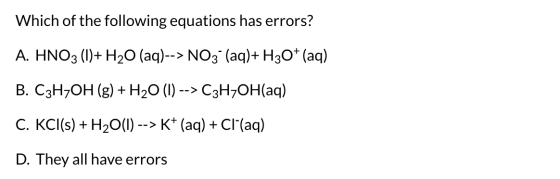
Which of...
Ksp refers to the dissolution reaction of the ionic salts. (a) Write the dissolution reaction for...
 Ksp refers to the dissolution reaction of the ionic salts. (a) Write the dissolution reaction for the ionic solids below. (Use the lowest possible coefficients. Include states-of-matter under the given conditions in your answer.) (i) NaNO3 chemPad Help X.Xº = =+ Greek NaNO3(s) +H20(1) - Na +(aq) + NO3(aq) NaNO_3(s) +H_20(1)-->Na^-+(aq) + NO_34- (aq) Your answer contains an ambiguous or incomplete reaction equation. Check all the components on the reactant-side of the equation. Check all the components on the product-side...
Verify questions 8-10, and fill in the blank for Net Ionic Equation in Q9 and Q10....
 Verify questions 8-10, and fill in the blank for Net Ionic
Equation in Q9 and Q10.
8. Identify the equations below as a molecular equation (M), a complete ionic equation (CI), OR a net ionic equation (NI). __M_ AgNO3 (aq) + NaCl (s) → AgCl (s) + NaNO3 (aq) _CI_OH- (aq) + H+ (aq) → H20 (1) _ci_Pb2+ (aq) + 2 NO3- (aq) + 2 K+ (aq) + 21 → Pbl2 (s) + 2 K+ (aq) + 2 NO3- (aq)...
Verify questions 8-10, and fill in the blank for Net Ionic
Equation in Q9 and Q10.
8. Identify the equations below as a molecular equation (M), a complete ionic equation (CI), OR a net ionic equation (NI). __M_ AgNO3 (aq) + NaCl (s) → AgCl (s) + NaNO3 (aq) _CI_OH- (aq) + H+ (aq) → H20 (1) _ci_Pb2+ (aq) + 2 NO3- (aq) + 2 K+ (aq) + 21 → Pbl2 (s) + 2 K+ (aq) + 2 NO3- (aq)...
9 > Question 39 (2 points) What is the net ionic equation for the reaction of...
 9 > Question 39 (2 points) What is the net ionic equation for the reaction of hydrochloric acid with potassium hydroxide if the molecular equation is HCl(aq) + KOH(aq) – H00) + KCl(aq)? 12 HCI + KOH — H20 + KCI 15 2H+ +2C1- + K2+ + 2OH- H20+ K2+ +2 C1- 18 OH+ + Cl- + K+ + OH- H20+ K+ + Cl- H+ + OH- H20 Question 40 (2 points) Which of the following is NOT an example...
. For the reaction: Hz (g) + 12(g) → 2 HI(g), Kc= 12.3 at a certain...
 . For the reaction: Hz (g) + 12(g) → 2 HI(g), Kc= 12.3 at a certain temperature. If at a given moment in the reaction at that temperature, [Hz] = [12] = [HI] = 3.21 x 10-*M, which direction will the reaction proceed to reach equilibrium? -. For the following reactions, label the acid, base, conjugate acid, and conjugate base: a. H2SO4 (ag) + H20 (ag) → HSO. (ag) + H30* (ag) b. HNO3 (ag) + OH- (aq) → NO3-...
Part 1.) A certain reaction has Ho = -26.10 kJ and So = 15.60 J/K. (a)...
 Part 1.)
A certain reaction has Ho = -26.10 kJ and So = 15.60 J/K.
(a) Is this reaction exothermic, endothermic or isothermic
(neither)?
This reaction is ---Select--- exothermic endothermic or
isothermic .
(b) Does this reaction lead to a decrease, an increase, or no
change in the degree of disorder in the system?
This reaction leads to ---Select--- a decrease, an
increase, or no change in the disorder of the system.
(c) Calculate Go for this reaction at 298 K. If...
Part 1.)
A certain reaction has Ho = -26.10 kJ and So = 15.60 J/K.
(a) Is this reaction exothermic, endothermic or isothermic
(neither)?
This reaction is ---Select--- exothermic endothermic or
isothermic .
(b) Does this reaction lead to a decrease, an increase, or no
change in the degree of disorder in the system?
This reaction leads to ---Select--- a decrease, an
increase, or no change in the disorder of the system.
(c) Calculate Go for this reaction at 298 K. If...
5. What is the molecular weight (molar mass)of the common antacid calcium carbonate CaCO3? A) 100.9...
 5. What is the molecular weight (molar mass)of the common antacid calcium carbonate CaCO3? A) 100.9 gimol B) 48.08 g/mol C) 17.0 g/'mol D) 4.00 x 10² g/mol E) 2.50 x 10 g/mol 6. Calculate the molar mass of rubidium carbonate, Rb CO A) 340.43 g/mol B) 255.00 g/mol C) 230.94 g/mol D) 145.47 gmol E) 113.48 g/mol 7. Balance the following equation: B) Cai(РО.h@ + 3SiOts) + 14C(s) 3CaSiOds) + į4COg) + Pa(s) -> 8. How many grams of...
I need help with these questions. Part I.A 1. Why did the indicator initially turn blue...
 I
need help with these questions.
Part I.A 1. Why did the indicator initially turn blue when NaOH was added to flask A? Consider equilibrium: Hin + H2O + H2O + In [1 mark] 2. When you left the flask A to stand for several minutes after the addition of NaOH, why did the contents of the flask A slowly change colour back from blue to yellow? Consider equilibriums: Hin + H2O + H30+ + In [2 marks] CO2(g) +...
I
need help with these questions.
Part I.A 1. Why did the indicator initially turn blue when NaOH was added to flask A? Consider equilibrium: Hin + H2O + H2O + In [1 mark] 2. When you left the flask A to stand for several minutes after the addition of NaOH, why did the contents of the flask A slowly change colour back from blue to yellow? Consider equilibriums: Hin + H2O + H30+ + In [2 marks] CO2(g) +...
if you can't answer all ,please don't answer 1) of the reactions below, which one is...
 if you can't answer all ,please don't answer
1) of the reactions below, which one is a decomposition reaction? A) Ca(NO3)2 + Na2S -- CdS +2NaNO3 B) NH4Cl- NH3 + HCI C) 2Mg + 02 - 2MgO D) 2N2 + 3H2 → 2NH3 E) 2CH4 + 402 - 2002 + 4H20 miches of - x 1? 2 2) Calculate the percentage by mass of ammonia in cisplatin, PtCl2/NH3 12. A) 12.53 B) 5.68 C) 18.09 D) 11.35 E) 4.67 3)...
if you can't answer all ,please don't answer
1) of the reactions below, which one is a decomposition reaction? A) Ca(NO3)2 + Na2S -- CdS +2NaNO3 B) NH4Cl- NH3 + HCI C) 2Mg + 02 - 2MgO D) 2N2 + 3H2 → 2NH3 E) 2CH4 + 402 - 2002 + 4H20 miches of - x 1? 2 2) Calculate the percentage by mass of ammonia in cisplatin, PtCl2/NH3 12. A) 12.53 B) 5.68 C) 18.09 D) 11.35 E) 4.67 3)...
What is the general class of each test reaction in the introduction? Precipitation? Acid-Base? Oxidation eduction?...
 What is the general class of each test reaction in the introduction? Precipitation? Acid-Base? Oxidation eduction? anoina to aizy ona svidstils Reaction Class 1 2 iliw 15 TO15192do art sshommua bns nosgol rond dass 101 12575 gbubnium oY noi de lo enor Som 10 910 w II woy Xd on abian aningstid on naloga uzib 3 OOH 4 5 DHET 6 7 SET adus 00 9 Complex ion formation 10 11 No reaction 12 13 14 Combination 15 16 17...
 Ksp refers to the dissolution reaction of the ionic salts. (a) Write the dissolution reaction for the ionic solids below. (Use the lowest possible coefficients. Include states-of-matter under the given conditions in your answer.) (i) NaNO3 chemPad Help X.Xº = =+ Greek NaNO3(s) +H20(1) - Na +(aq) + NO3(aq) NaNO_3(s) +H_20(1)-->Na^-+(aq) + NO_34- (aq) Your answer contains an ambiguous or incomplete reaction equation. Check all the components on the reactant-side of the equation. Check all the components on the product-side...
 Verify questions 8-10, and fill in the blank for Net Ionic
Equation in Q9 and Q10.
8. Identify the equations below as a molecular equation (M), a complete ionic equation (CI), OR a net ionic equation (NI). __M_ AgNO3 (aq) + NaCl (s) → AgCl (s) + NaNO3 (aq) _CI_OH- (aq) + H+ (aq) → H20 (1) _ci_Pb2+ (aq) + 2 NO3- (aq) + 2 K+ (aq) + 21 → Pbl2 (s) + 2 K+ (aq) + 2 NO3- (aq)...
Verify questions 8-10, and fill in the blank for Net Ionic
Equation in Q9 and Q10.
8. Identify the equations below as a molecular equation (M), a complete ionic equation (CI), OR a net ionic equation (NI). __M_ AgNO3 (aq) + NaCl (s) → AgCl (s) + NaNO3 (aq) _CI_OH- (aq) + H+ (aq) → H20 (1) _ci_Pb2+ (aq) + 2 NO3- (aq) + 2 K+ (aq) + 21 → Pbl2 (s) + 2 K+ (aq) + 2 NO3- (aq)...
 9 > Question 39 (2 points) What is the net ionic equation for the reaction of hydrochloric acid with potassium hydroxide if the molecular equation is HCl(aq) + KOH(aq) – H00) + KCl(aq)? 12 HCI + KOH — H20 + KCI 15 2H+ +2C1- + K2+ + 2OH- H20+ K2+ +2 C1- 18 OH+ + Cl- + K+ + OH- H20+ K+ + Cl- H+ + OH- H20 Question 40 (2 points) Which of the following is NOT an example...
 . For the reaction: Hz (g) + 12(g) → 2 HI(g), Kc= 12.3 at a certain temperature. If at a given moment in the reaction at that temperature, [Hz] = [12] = [HI] = 3.21 x 10-*M, which direction will the reaction proceed to reach equilibrium? -. For the following reactions, label the acid, base, conjugate acid, and conjugate base: a. H2SO4 (ag) + H20 (ag) → HSO. (ag) + H30* (ag) b. HNO3 (ag) + OH- (aq) → NO3-...
 Part 1.)
A certain reaction has Ho = -26.10 kJ and So = 15.60 J/K.
(a) Is this reaction exothermic, endothermic or isothermic
(neither)?
This reaction is ---Select--- exothermic endothermic or
isothermic .
(b) Does this reaction lead to a decrease, an increase, or no
change in the degree of disorder in the system?
This reaction leads to ---Select--- a decrease, an
increase, or no change in the disorder of the system.
(c) Calculate Go for this reaction at 298 K. If...
Part 1.)
A certain reaction has Ho = -26.10 kJ and So = 15.60 J/K.
(a) Is this reaction exothermic, endothermic or isothermic
(neither)?
This reaction is ---Select--- exothermic endothermic or
isothermic .
(b) Does this reaction lead to a decrease, an increase, or no
change in the degree of disorder in the system?
This reaction leads to ---Select--- a decrease, an
increase, or no change in the disorder of the system.
(c) Calculate Go for this reaction at 298 K. If...
 5. What is the molecular weight (molar mass)of the common antacid calcium carbonate CaCO3? A) 100.9 gimol B) 48.08 g/mol C) 17.0 g/'mol D) 4.00 x 10² g/mol E) 2.50 x 10 g/mol 6. Calculate the molar mass of rubidium carbonate, Rb CO A) 340.43 g/mol B) 255.00 g/mol C) 230.94 g/mol D) 145.47 gmol E) 113.48 g/mol 7. Balance the following equation: B) Cai(РО.h@ + 3SiOts) + 14C(s) 3CaSiOds) + į4COg) + Pa(s) -> 8. How many grams of...
 I
need help with these questions.
Part I.A 1. Why did the indicator initially turn blue when NaOH was added to flask A? Consider equilibrium: Hin + H2O + H2O + In [1 mark] 2. When you left the flask A to stand for several minutes after the addition of NaOH, why did the contents of the flask A slowly change colour back from blue to yellow? Consider equilibriums: Hin + H2O + H30+ + In [2 marks] CO2(g) +...
I
need help with these questions.
Part I.A 1. Why did the indicator initially turn blue when NaOH was added to flask A? Consider equilibrium: Hin + H2O + H2O + In [1 mark] 2. When you left the flask A to stand for several minutes after the addition of NaOH, why did the contents of the flask A slowly change colour back from blue to yellow? Consider equilibriums: Hin + H2O + H30+ + In [2 marks] CO2(g) +...
 if you can't answer all ,please don't answer
1) of the reactions below, which one is a decomposition reaction? A) Ca(NO3)2 + Na2S -- CdS +2NaNO3 B) NH4Cl- NH3 + HCI C) 2Mg + 02 - 2MgO D) 2N2 + 3H2 → 2NH3 E) 2CH4 + 402 - 2002 + 4H20 miches of - x 1? 2 2) Calculate the percentage by mass of ammonia in cisplatin, PtCl2/NH3 12. A) 12.53 B) 5.68 C) 18.09 D) 11.35 E) 4.67 3)...
if you can't answer all ,please don't answer
1) of the reactions below, which one is a decomposition reaction? A) Ca(NO3)2 + Na2S -- CdS +2NaNO3 B) NH4Cl- NH3 + HCI C) 2Mg + 02 - 2MgO D) 2N2 + 3H2 → 2NH3 E) 2CH4 + 402 - 2002 + 4H20 miches of - x 1? 2 2) Calculate the percentage by mass of ammonia in cisplatin, PtCl2/NH3 12. A) 12.53 B) 5.68 C) 18.09 D) 11.35 E) 4.67 3)...
 What is the general class of each test reaction in the introduction? Precipitation? Acid-Base? Oxidation eduction? anoina to aizy ona svidstils Reaction Class 1 2 iliw 15 TO15192do art sshommua bns nosgol rond dass 101 12575 gbubnium oY noi de lo enor Som 10 910 w II woy Xd on abian aningstid on naloga uzib 3 OOH 4 5 DHET 6 7 SET adus 00 9 Complex ion formation 10 11 No reaction 12 13 14 Combination 15 16 17...
Most questions answered within 3 hours.
-
Where is the error in this code sequence?
String s1 = "Hello";
String s2 = "ello";...
asked 10 months ago -
Financial data for Joel de Paris, Inc., for last year
follow:
Joel de Paris, Inc.
Balance...
asked 10 months ago -
Consider this reaction:
Al2(SO4)3 (aq)+ BaCl3
(aq) Al2Cl6 (aq)- +
3BaSO4(s) . What is the...
asked 10 months ago -
Suppose that Savneet is considering increasing her
recent random sample from 20 car rentals to 40...
asked 10 months ago -
Trucks arrive at an unloading terminal at an average rate of 120
per hour.
Trucks arrive...
asked 10 months ago -
Why are methanol and ethanol completely soluble in water while
octanol is not very little soluble....
asked 10 months ago -
A facilities manager at a university reads in a research report
that the mean amount of...
asked 10 months ago -
When the CuSO4 is rehydrated by adding water to the anhydrous
compound, is this an endothermic...
asked 10 months ago -
A ray of sunlight is passing from diamond into crown glass; the
angle of incidence is...
asked 10 months ago -
A block of mass 0.249 kg is placed on top of a light, vertical
spring of...
asked 10 months ago -
how do the kidneys compensate in the presences of acidosis
a) trigger hyperventilate
b) reserve acid...
asked 10 months ago -
Question 501 pts
The rental rate of capital to the firm increases. Which of the
following...
asked 10 months ago