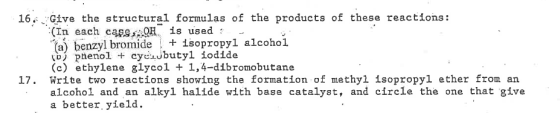
For O. Chem lab titled: "Perfumes: The Synthesis of Nerolin". Please answer questions 16 (a-c) and 17.
Homework Answers
Request Answer!
We need at least 10 more requests to produce the answer.
0 / 10 have requested this problem solution
The more requests, the faster the answer.
Add Answer to:
For O. Chem lab titled: "Perfumes: The Synthesis of Nerolin".
Please answer questions 16 (a-c) and...
Please give detailed answers to the pre and post lab questions. Thank you! NUCLEOPHILIC DISPLACEMENT- FORMATION...
 Please give detailed answers to the pre and post lab questions.
Thank you!
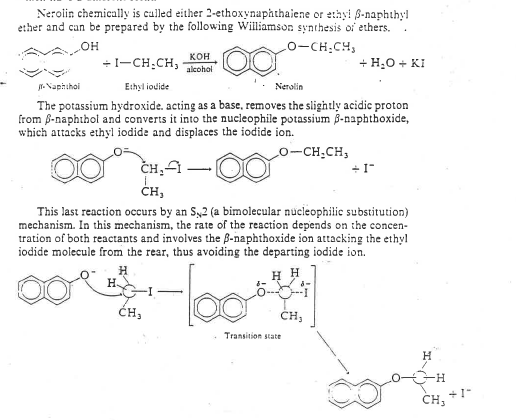
NUCLEOPHILIC DISPLACEMENT- FORMATION OF AN ETHER BY AN SN2 REACTION Bond formation by use of an SN2 reaction is very important for organic and biological synthesis. Many new bonds formed make use of this versatile reaction pathway. In this reaction, one partner is the nucleophile and the other partner is the electrophile. The electrophile will have a leaving group that will be lost in the reaction. In...
Please give detailed answers to the pre and post lab questions.
Thank you!
NUCLEOPHILIC DISPLACEMENT- FORMATION OF AN ETHER BY AN SN2 REACTION Bond formation by use of an SN2 reaction is very important for organic and biological synthesis. Many new bonds formed make use of this versatile reaction pathway. In this reaction, one partner is the nucleophile and the other partner is the electrophile. The electrophile will have a leaving group that will be lost in the reaction. In...
please answer as many questions with detail. 1. Evaluate how much "weight" (mass, strictly speaking) an average huma...
 please answer as many questions with detail.
1. Evaluate how much "weight" (mass, strictly speaking) an average human loses daily due to gas exchange while breathing. Find all necessary data, indicate your sources, and present a detailed calculation. 2. 10.00 g of a Mg-Al alloy completely dissolved in hydrochloric acid. The volume of hydrogen gas given off in the chemical reaction is 12.29 L Find the mass composition (in mass %) of the alloy. Assume that the volume of 1...
please answer as many questions with detail.
1. Evaluate how much "weight" (mass, strictly speaking) an average human loses daily due to gas exchange while breathing. Find all necessary data, indicate your sources, and present a detailed calculation. 2. 10.00 g of a Mg-Al alloy completely dissolved in hydrochloric acid. The volume of hydrogen gas given off in the chemical reaction is 12.29 L Find the mass composition (in mass %) of the alloy. Assume that the volume of 1...
(C) Protonation of alkene to form a carbocation followed by addition of bromide ion (D) Addition...
 (C) Protonation of alkene to form a carbocation followed by addition of bromide ion (D) Addition of the proton to one face of the alkene with simultaneous delivery of a bromide ion from a different molecule of H-Br. 11. Which compound is the strongest nmucleophile for reaction of methane methanesulfonate (CHOS0.CH) in methanol at room temperature? (You may assume that everything is soluble in methanol) (A) potassium bromide (B) cesium iodide (C) sodiam chloride (D) lithium flaoride 12. Which proton...
Please complete for Tuesday, we will go through the questions and mark them in class. pg 156 - 4.23,...
 Please complete for Tuesday, we will go through the questions and mark them in class. pg 156 - 4.23, 4.24, 4.26 pg 170 - 4.29, 4.31, pg 171-4.36 pg 175 - 4.59 pg 176- 4.74, 4.75, 4.80 pg 177-4.81, 4.82 pg 188- 5.1, 5.4, 5.5, 5.6, 5.11 - Using Table 5.1 pg 198-5.22, 5.25 pg 203 - 5.29 pg 206 - 5.37 pg 209 - 5.39 pg 2.14 5.61 pg 235-6.11, 6.14, 6.16 156 CHAPTER 4 Introduction to Organic Compounds...
Working on the questions at the end of this lab report (see above). I need help answering questio...
 Working on the questions at the end of this lab report
(see above). I need help answering questions 2, 3, and 4 completely
and thoroughly. Thank you!
s, until the I hexano 1 clean disti CYCLOHEXENE from CYCLOHEXANOL be dehydrated with solfuric acid to yield cyclohexene and waterf Add a 0°C (record ct and cal H,SO + H20 ainer. s in purification of any crude product are (a) the preliminary separation of the product from the reaction mixture by distillation...
Working on the questions at the end of this lab report
(see above). I need help answering questions 2, 3, and 4 completely
and thoroughly. Thank you!
s, until the I hexano 1 clean disti CYCLOHEXENE from CYCLOHEXANOL be dehydrated with solfuric acid to yield cyclohexene and waterf Add a 0°C (record ct and cal H,SO + H20 ainer. s in purification of any crude product are (a) the preliminary separation of the product from the reaction mixture by distillation...
need hep with these two questions! here is the information for the lab K2Cr₂O + H₂...
 need hep with these two questions!
here is the information for the lab
K2Cr₂O + H₂ C₂04 2H2O sklor (C204) [H202₂/2 H2otca 2k12 2 cr=x2 (+8ly kzcrgo7+ I 142 C204-21420 2 k cellow). (1) 2 - 2 H2O toc -=S7 30-4521 2. Calculate the theoretical yield of K[Cr(C,0.),(H,0), 2H,0. 3. What is the theoretical percentage by weight of Cr in K[Cr(C,0.),(H,0), 2H,0? using the spectrophotometer at your desk, at the wavelength of maximum absorbance of the blue-green chromium ion, measure...
need hep with these two questions!
here is the information for the lab
K2Cr₂O + H₂ C₂04 2H2O sklor (C204) [H202₂/2 H2otca 2k12 2 cr=x2 (+8ly kzcrgo7+ I 142 C204-21420 2 k cellow). (1) 2 - 2 H2O toc -=S7 30-4521 2. Calculate the theoretical yield of K[Cr(C,0.),(H,0), 2H,0. 3. What is the theoretical percentage by weight of Cr in K[Cr(C,0.),(H,0), 2H,0? using the spectrophotometer at your desk, at the wavelength of maximum absorbance of the blue-green chromium ion, measure...
please help with how the flow chart will look like? thank you! Synthesis of n-Butyl Bromide...
 please help with how the flow chart will look like? thank
you!
Synthesis of n-Butyl Bromide Purpose of the Experiment: In this week's experiment you will be synthesizing n-butylbromide (IUPAC 1-bromobutane from 1-butanol and a concentrated acid via a nucleophilie substitution reaction. It is important to know that alcohols dehydrate to form alkenes in the presence of strong inorganic acids, so care must be taken in this experiment not to heat the reaction too vigorously else an elimination reaction may...
please help with how the flow chart will look like? thank
you!
Synthesis of n-Butyl Bromide Purpose of the Experiment: In this week's experiment you will be synthesizing n-butylbromide (IUPAC 1-bromobutane from 1-butanol and a concentrated acid via a nucleophilie substitution reaction. It is important to know that alcohols dehydrate to form alkenes in the presence of strong inorganic acids, so care must be taken in this experiment not to heat the reaction too vigorously else an elimination reaction may...
 Please give detailed answers to the pre and post lab questions.
Thank you!
NUCLEOPHILIC DISPLACEMENT- FORMATION OF AN ETHER BY AN SN2 REACTION Bond formation by use of an SN2 reaction is very important for organic and biological synthesis. Many new bonds formed make use of this versatile reaction pathway. In this reaction, one partner is the nucleophile and the other partner is the electrophile. The electrophile will have a leaving group that will be lost in the reaction. In...
Please give detailed answers to the pre and post lab questions.
Thank you!
NUCLEOPHILIC DISPLACEMENT- FORMATION OF AN ETHER BY AN SN2 REACTION Bond formation by use of an SN2 reaction is very important for organic and biological synthesis. Many new bonds formed make use of this versatile reaction pathway. In this reaction, one partner is the nucleophile and the other partner is the electrophile. The electrophile will have a leaving group that will be lost in the reaction. In...
 please answer as many questions with detail.
1. Evaluate how much "weight" (mass, strictly speaking) an average human loses daily due to gas exchange while breathing. Find all necessary data, indicate your sources, and present a detailed calculation. 2. 10.00 g of a Mg-Al alloy completely dissolved in hydrochloric acid. The volume of hydrogen gas given off in the chemical reaction is 12.29 L Find the mass composition (in mass %) of the alloy. Assume that the volume of 1...
please answer as many questions with detail.
1. Evaluate how much "weight" (mass, strictly speaking) an average human loses daily due to gas exchange while breathing. Find all necessary data, indicate your sources, and present a detailed calculation. 2. 10.00 g of a Mg-Al alloy completely dissolved in hydrochloric acid. The volume of hydrogen gas given off in the chemical reaction is 12.29 L Find the mass composition (in mass %) of the alloy. Assume that the volume of 1...
 (C) Protonation of alkene to form a carbocation followed by addition of bromide ion (D) Addition of the proton to one face of the alkene with simultaneous delivery of a bromide ion from a different molecule of H-Br. 11. Which compound is the strongest nmucleophile for reaction of methane methanesulfonate (CHOS0.CH) in methanol at room temperature? (You may assume that everything is soluble in methanol) (A) potassium bromide (B) cesium iodide (C) sodiam chloride (D) lithium flaoride 12. Which proton...
 Please complete for Tuesday, we will go through the questions and mark them in class. pg 156 - 4.23, 4.24, 4.26 pg 170 - 4.29, 4.31, pg 171-4.36 pg 175 - 4.59 pg 176- 4.74, 4.75, 4.80 pg 177-4.81, 4.82 pg 188- 5.1, 5.4, 5.5, 5.6, 5.11 - Using Table 5.1 pg 198-5.22, 5.25 pg 203 - 5.29 pg 206 - 5.37 pg 209 - 5.39 pg 2.14 5.61 pg 235-6.11, 6.14, 6.16 156 CHAPTER 4 Introduction to Organic Compounds...
 Working on the questions at the end of this lab report
(see above). I need help answering questions 2, 3, and 4 completely
and thoroughly. Thank you!
s, until the I hexano 1 clean disti CYCLOHEXENE from CYCLOHEXANOL be dehydrated with solfuric acid to yield cyclohexene and waterf Add a 0°C (record ct and cal H,SO + H20 ainer. s in purification of any crude product are (a) the preliminary separation of the product from the reaction mixture by distillation...
Working on the questions at the end of this lab report
(see above). I need help answering questions 2, 3, and 4 completely
and thoroughly. Thank you!
s, until the I hexano 1 clean disti CYCLOHEXENE from CYCLOHEXANOL be dehydrated with solfuric acid to yield cyclohexene and waterf Add a 0°C (record ct and cal H,SO + H20 ainer. s in purification of any crude product are (a) the preliminary separation of the product from the reaction mixture by distillation...
 need hep with these two questions!
here is the information for the lab
K2Cr₂O + H₂ C₂04 2H2O sklor (C204) [H202₂/2 H2otca 2k12 2 cr=x2 (+8ly kzcrgo7+ I 142 C204-21420 2 k cellow). (1) 2 - 2 H2O toc -=S7 30-4521 2. Calculate the theoretical yield of K[Cr(C,0.),(H,0), 2H,0. 3. What is the theoretical percentage by weight of Cr in K[Cr(C,0.),(H,0), 2H,0? using the spectrophotometer at your desk, at the wavelength of maximum absorbance of the blue-green chromium ion, measure...
need hep with these two questions!
here is the information for the lab
K2Cr₂O + H₂ C₂04 2H2O sklor (C204) [H202₂/2 H2otca 2k12 2 cr=x2 (+8ly kzcrgo7+ I 142 C204-21420 2 k cellow). (1) 2 - 2 H2O toc -=S7 30-4521 2. Calculate the theoretical yield of K[Cr(C,0.),(H,0), 2H,0. 3. What is the theoretical percentage by weight of Cr in K[Cr(C,0.),(H,0), 2H,0? using the spectrophotometer at your desk, at the wavelength of maximum absorbance of the blue-green chromium ion, measure...
 please help with how the flow chart will look like? thank
you!
Synthesis of n-Butyl Bromide Purpose of the Experiment: In this week's experiment you will be synthesizing n-butylbromide (IUPAC 1-bromobutane from 1-butanol and a concentrated acid via a nucleophilie substitution reaction. It is important to know that alcohols dehydrate to form alkenes in the presence of strong inorganic acids, so care must be taken in this experiment not to heat the reaction too vigorously else an elimination reaction may...
please help with how the flow chart will look like? thank
you!
Synthesis of n-Butyl Bromide Purpose of the Experiment: In this week's experiment you will be synthesizing n-butylbromide (IUPAC 1-bromobutane from 1-butanol and a concentrated acid via a nucleophilie substitution reaction. It is important to know that alcohols dehydrate to form alkenes in the presence of strong inorganic acids, so care must be taken in this experiment not to heat the reaction too vigorously else an elimination reaction may...
Most questions answered within 3 hours.
-
Where is the error in this code sequence?
String s1 = "Hello";
String s2 = "ello";...
asked 11 months ago -
Financial data for Joel de Paris, Inc., for last year
follow:
Joel de Paris, Inc.
Balance...
asked 11 months ago -
Consider this reaction:
Al2(SO4)3 (aq)+ BaCl3
(aq) Al2Cl6 (aq)- +
3BaSO4(s) . What is the...
asked 11 months ago -
Suppose that Savneet is considering increasing her
recent random sample from 20 car rentals to 40...
asked 11 months ago -
Trucks arrive at an unloading terminal at an average rate of 120
per hour.
Trucks arrive...
asked 11 months ago -
Why are methanol and ethanol completely soluble in water while
octanol is not very little soluble....
asked 11 months ago -
A facilities manager at a university reads in a research report
that the mean amount of...
asked 11 months ago -
When the CuSO4 is rehydrated by adding water to the anhydrous
compound, is this an endothermic...
asked 11 months ago -
A ray of sunlight is passing from diamond into crown glass; the
angle of incidence is...
asked 11 months ago -
A block of mass 0.249 kg is placed on top of a light, vertical
spring of...
asked 11 months ago -
how do the kidneys compensate in the presences of acidosis
a) trigger hyperventilate
b) reserve acid...
asked 11 months ago -
Question 501 pts
The rental rate of capital to the firm increases. Which of the
following...
asked 11 months ago