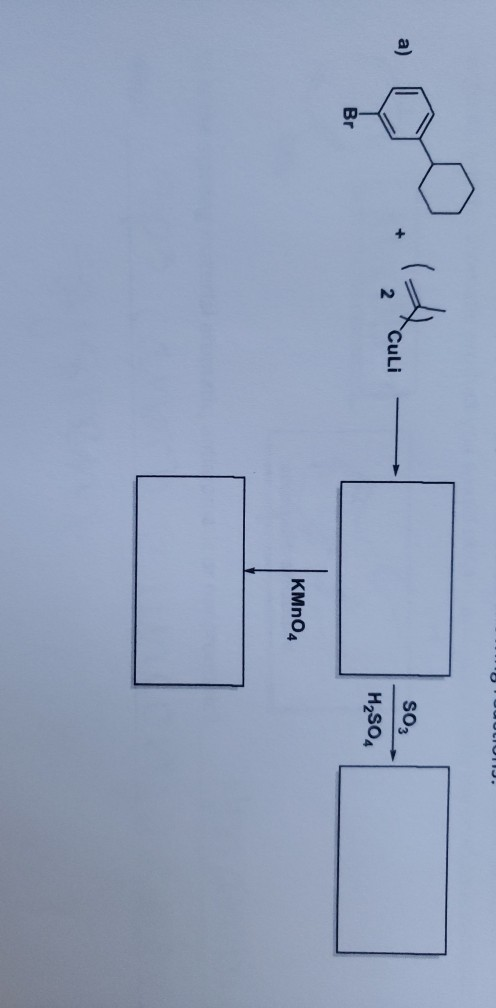

What pdts would you expect from these rxns?
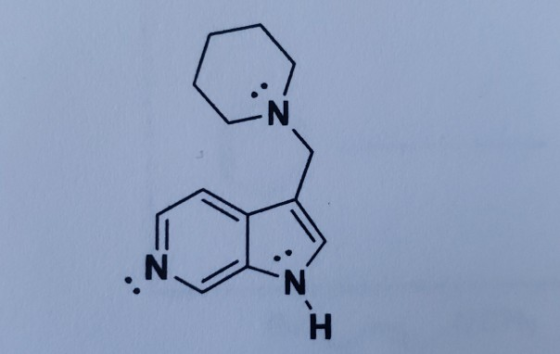
Determine which nitrogen atoms is basic. Explain the answer!
Homework Answers
Request Answer!
We need at least 10 more requests to produce the answer.
0 / 10 have requested this problem solution
The more requests, the faster the answer.
Add Answer to:
What pdts would you expect from these rxns?
Determine which nitrogen atoms is basic. Explain the...
Please write the products you would get after each reagent is added. Can you please show...
 Please write the products you would get after each reagent is
added. Can you please show the mechanisms. Thank you
Acum Culi SO3 H2SO4 2 Br KMnO4 Br B(OH)2 Pd(PPh3)4, K2CO3 N toluene, heat + 1 equiv. Br2 light
Please write the products you would get after each reagent is
added. Can you please show the mechanisms. Thank you
Acum Culi SO3 H2SO4 2 Br KMnO4 Br B(OH)2 Pd(PPh3)4, K2CO3 N toluene, heat + 1 equiv. Br2 light
Please answer and explain reasoning and methodology to achieve the answer. 1. (8 pts) Provide the...
 Please answer and explain reasoning and
methodology to achieve the answer.
1. (8 pts) Provide the organic products: B(OH)2 I Br Pd(PPh34 (5 mol %) dioxane/H20 K2CO3 1 equiv. 1 equiv. -N PdCl2(PPh3)2 (cat.) T + L BF3K Br IZ THF-H20 КОАс
Please answer and explain reasoning and
methodology to achieve the answer.
1. (8 pts) Provide the organic products: B(OH)2 I Br Pd(PPh34 (5 mol %) dioxane/H20 K2CO3 1 equiv. 1 equiv. -N PdCl2(PPh3)2 (cat.) T + L BF3K Br IZ THF-H20 КОАс
What are the products (with stereochemistry) of these rxns? (CH3) CHCCI AIC b) NaOCH,CH CH CH,OH...
 What are the products (with stereochemistry) of these
rxns?
(CH3) CHCCI AIC b) NaOCH,CH CH CH,OH c) Br2 CH,NH NO FeBry d) o O 1. NaOCH CHs 2. (CH) CHCH2Br 3. HCKaq). A CH,CH OCCH COCH CH e) CH2CH3 1. KMnO4(aq) 2. SO3. H2S04 NaOH triglceride CH,CH2NH2 (large xs) Br h)
What are the products (with stereochemistry) of these
rxns?
(CH3) CHCCI AIC b) NaOCH,CH CH CH,OH c) Br2 CH,NH NO FeBry d) o O 1. NaOCH CHs 2. (CH) CHCH2Br 3. HCKaq). A CH,CH OCCH COCH CH e) CH2CH3 1. KMnO4(aq) 2. SO3. H2S04 NaOH triglceride CH,CH2NH2 (large xs) Br h)
Select the reagents you would use to synthesize the compound below from benzene. (More than one...
 Select the reagents you would use to synthesize the compound
below from benzene.
(More than one step is required. If no third step is needed,
choose (none).)
Reagents Available f. KMnO4, H20 g. H2, Pd/C h. SO3, H2SO4 i. NaOH, H2O a. Br2, FeBr3 b. Cl2, FeCl 0 d. CH3CI, AICl3 Br e. CH3COCI, AICl3 N-bromosuccinimide (NBS) ball & stick labels Step 1: Step 2 Step 3
Select the reagents you would use to synthesize the compound
below from benzene.
(More than one step is required. If no third step is needed,
choose (none).)
Reagents Available f. KMnO4, H20 g. H2, Pd/C h. SO3, H2SO4 i. NaOH, H2O a. Br2, FeBr3 b. Cl2, FeCl 0 d. CH3CI, AICl3 Br e. CH3COCI, AICl3 N-bromosuccinimide (NBS) ball & stick labels Step 1: Step 2 Step 3
9.44 (•) Determine whether the following reactions are redox reactions. If they are, identify whether the...
 9.44 (•) Determine whether the following reactions are redox reactions. If they are, identify whether the molecule has been oxidized or reduced. (a) (b) ý modo de volg Br2, heat + HO og sm. .- Br + H-Br (c) H2SO4 t o H2SO4 , .- CH3 NaBHA CH2OH OH OH - OH .PY OH + BH3 o-Na 9.45 (•) Predict the product(s) that would result when the alkenes are allowed to react under the following conditions: i) Bra; ii) Cl2;...
1. please check what is wrong. Thank you! Determine the product formed when each compound is treated with...
 1. please check what is wrong. Thank you!
Determine the product formed when each compound is treated with Br2 and FeBr3. Drag the atom labels to their appropriate positions. CN Atom labels H H Br Br2 A. FeBr Br H OH OH Br Br. Br2 FeBr3 H H Br Br H Br2 FeBr H1 H Reset T Rank the compounds in each group in order of decreasing reactivity in electrophilic aromatic substitution. CI Decreasing reactivity Rank the compounds in each...
1. please check what is wrong. Thank you!
Determine the product formed when each compound is treated with Br2 and FeBr3. Drag the atom labels to their appropriate positions. CN Atom labels H H Br Br2 A. FeBr Br H OH OH Br Br. Br2 FeBr3 H H Br Br H Br2 FeBr H1 H Reset T Rank the compounds in each group in order of decreasing reactivity in electrophilic aromatic substitution. CI Decreasing reactivity Rank the compounds in each...
Propose an efficient synthesis for the transformation below. Enter the appropriate number of letter from the...
 Propose an efficient synthesis for the transformation below. Enter the appropriate number of letter from the reagent list handout Step 1 Step 2 Step 3 OH Alkyl Halides (X = CI, Br or 1) and Acyl chlorides: Assume Allig 15 present, if needed CIP CU CH3X X CI E A B EE Ketones. Aldehydes and Epoxides: Assume "then H20" is included if a protonation step is needed F A A K 0 MN Р Grignard, Wittig and Organocuprate Reagents: Assume...
13. (12 pts-4 pts each) Show how you could carry out th how you could carry...
 13. (12 pts-4 pts each) Show how you could carry out th how you could carry out the following synthesis reactions by placing the letters corresponding to the appropriate reagents above each ar must be in the correct order to receive full credit. priate reagents above each arrow. The reagents A. HBr, ether B. Br2, CH2Cl2 C. Br2, H2O D. 1. Hg(OAC)2, H2O/THF 2. NaBH4 E. 1. BH3, THF 2. H2O2, OH F. H2SO4, H2O/HgSO4 G. NBS, hy H. H/Pd/C...
Propose an efficient synthesis for the transformation below, using two sequential reductive aminations. Enter the appropriate number...
 Propose an efficient synthesis for the transformation below,
using two sequential reductive aminations. Enter
the appropriate number or letter from the reagent list handout.
Propose an efficient synthesis for the transformation below, using two sequential reductive aminations. Enter the appropriate number or letter from the reagent list handout. Step 1 + NaBH3CN, H+, Step 2 - NaBH3CN, H+ Reagent List (Updated 4/30/2020) Enter # or letter in the appropriate boxes. Note: Exam responses are case insensitive Alkyl Halides (X = Cl,...
Propose an efficient synthesis for the transformation below,
using two sequential reductive aminations. Enter
the appropriate number or letter from the reagent list handout.
Propose an efficient synthesis for the transformation below, using two sequential reductive aminations. Enter the appropriate number or letter from the reagent list handout. Step 1 + NaBH3CN, H+, Step 2 - NaBH3CN, H+ Reagent List (Updated 4/30/2020) Enter # or letter in the appropriate boxes. Note: Exam responses are case insensitive Alkyl Halides (X = Cl,...
The below reaction is accomplished with one reagent. Br The letters below represent all reagents you...
 The below reaction is accomplished with one reagent. Br The letters below represent all reagents you have learned in chapters 6-8. Which of the below reagents would you use to accomplish this process? Enter the ONE correct letter below. • a. H2SO4, H20 b.HBO c. Br2 • d. Br2. H20 e. 1) BH3 (or R2BH), 2) NaOH, H20 • f. 1) OsO4, 2) NaHSO3, H20 g. 1) O3. 2) CH3SCH3 h.mCPBA • i.H2.Pd/C j. NaNH2 k 2 eg NaNH2 ....
 Please write the products you would get after each reagent is
added. Can you please show the mechanisms. Thank you
Acum Culi SO3 H2SO4 2 Br KMnO4 Br B(OH)2 Pd(PPh3)4, K2CO3 N toluene, heat + 1 equiv. Br2 light
Please write the products you would get after each reagent is
added. Can you please show the mechanisms. Thank you
Acum Culi SO3 H2SO4 2 Br KMnO4 Br B(OH)2 Pd(PPh3)4, K2CO3 N toluene, heat + 1 equiv. Br2 light
 Please answer and explain reasoning and
methodology to achieve the answer.
1. (8 pts) Provide the organic products: B(OH)2 I Br Pd(PPh34 (5 mol %) dioxane/H20 K2CO3 1 equiv. 1 equiv. -N PdCl2(PPh3)2 (cat.) T + L BF3K Br IZ THF-H20 КОАс
Please answer and explain reasoning and
methodology to achieve the answer.
1. (8 pts) Provide the organic products: B(OH)2 I Br Pd(PPh34 (5 mol %) dioxane/H20 K2CO3 1 equiv. 1 equiv. -N PdCl2(PPh3)2 (cat.) T + L BF3K Br IZ THF-H20 КОАс
 What are the products (with stereochemistry) of these
rxns?
(CH3) CHCCI AIC b) NaOCH,CH CH CH,OH c) Br2 CH,NH NO FeBry d) o O 1. NaOCH CHs 2. (CH) CHCH2Br 3. HCKaq). A CH,CH OCCH COCH CH e) CH2CH3 1. KMnO4(aq) 2. SO3. H2S04 NaOH triglceride CH,CH2NH2 (large xs) Br h)
What are the products (with stereochemistry) of these
rxns?
(CH3) CHCCI AIC b) NaOCH,CH CH CH,OH c) Br2 CH,NH NO FeBry d) o O 1. NaOCH CHs 2. (CH) CHCH2Br 3. HCKaq). A CH,CH OCCH COCH CH e) CH2CH3 1. KMnO4(aq) 2. SO3. H2S04 NaOH triglceride CH,CH2NH2 (large xs) Br h)
 Select the reagents you would use to synthesize the compound
below from benzene.
(More than one step is required. If no third step is needed,
choose (none).)
Reagents Available f. KMnO4, H20 g. H2, Pd/C h. SO3, H2SO4 i. NaOH, H2O a. Br2, FeBr3 b. Cl2, FeCl 0 d. CH3CI, AICl3 Br e. CH3COCI, AICl3 N-bromosuccinimide (NBS) ball & stick labels Step 1: Step 2 Step 3
Select the reagents you would use to synthesize the compound
below from benzene.
(More than one step is required. If no third step is needed,
choose (none).)
Reagents Available f. KMnO4, H20 g. H2, Pd/C h. SO3, H2SO4 i. NaOH, H2O a. Br2, FeBr3 b. Cl2, FeCl 0 d. CH3CI, AICl3 Br e. CH3COCI, AICl3 N-bromosuccinimide (NBS) ball & stick labels Step 1: Step 2 Step 3
 9.44 (•) Determine whether the following reactions are redox reactions. If they are, identify whether the molecule has been oxidized or reduced. (a) (b) ý modo de volg Br2, heat + HO og sm. .- Br + H-Br (c) H2SO4 t o H2SO4 , .- CH3 NaBHA CH2OH OH OH - OH .PY OH + BH3 o-Na 9.45 (•) Predict the product(s) that would result when the alkenes are allowed to react under the following conditions: i) Bra; ii) Cl2;...
 1. please check what is wrong. Thank you!
Determine the product formed when each compound is treated with Br2 and FeBr3. Drag the atom labels to their appropriate positions. CN Atom labels H H Br Br2 A. FeBr Br H OH OH Br Br. Br2 FeBr3 H H Br Br H Br2 FeBr H1 H Reset T Rank the compounds in each group in order of decreasing reactivity in electrophilic aromatic substitution. CI Decreasing reactivity Rank the compounds in each...
1. please check what is wrong. Thank you!
Determine the product formed when each compound is treated with Br2 and FeBr3. Drag the atom labels to their appropriate positions. CN Atom labels H H Br Br2 A. FeBr Br H OH OH Br Br. Br2 FeBr3 H H Br Br H Br2 FeBr H1 H Reset T Rank the compounds in each group in order of decreasing reactivity in electrophilic aromatic substitution. CI Decreasing reactivity Rank the compounds in each...
 Propose an efficient synthesis for the transformation below. Enter the appropriate number of letter from the reagent list handout Step 1 Step 2 Step 3 OH Alkyl Halides (X = CI, Br or 1) and Acyl chlorides: Assume Allig 15 present, if needed CIP CU CH3X X CI E A B EE Ketones. Aldehydes and Epoxides: Assume "then H20" is included if a protonation step is needed F A A K 0 MN Р Grignard, Wittig and Organocuprate Reagents: Assume...
 13. (12 pts-4 pts each) Show how you could carry out th how you could carry out the following synthesis reactions by placing the letters corresponding to the appropriate reagents above each ar must be in the correct order to receive full credit. priate reagents above each arrow. The reagents A. HBr, ether B. Br2, CH2Cl2 C. Br2, H2O D. 1. Hg(OAC)2, H2O/THF 2. NaBH4 E. 1. BH3, THF 2. H2O2, OH F. H2SO4, H2O/HgSO4 G. NBS, hy H. H/Pd/C...
 Propose an efficient synthesis for the transformation below,
using two sequential reductive aminations. Enter
the appropriate number or letter from the reagent list handout.
Propose an efficient synthesis for the transformation below, using two sequential reductive aminations. Enter the appropriate number or letter from the reagent list handout. Step 1 + NaBH3CN, H+, Step 2 - NaBH3CN, H+ Reagent List (Updated 4/30/2020) Enter # or letter in the appropriate boxes. Note: Exam responses are case insensitive Alkyl Halides (X = Cl,...
Propose an efficient synthesis for the transformation below,
using two sequential reductive aminations. Enter
the appropriate number or letter from the reagent list handout.
Propose an efficient synthesis for the transformation below, using two sequential reductive aminations. Enter the appropriate number or letter from the reagent list handout. Step 1 + NaBH3CN, H+, Step 2 - NaBH3CN, H+ Reagent List (Updated 4/30/2020) Enter # or letter in the appropriate boxes. Note: Exam responses are case insensitive Alkyl Halides (X = Cl,...
 The below reaction is accomplished with one reagent. Br The letters below represent all reagents you have learned in chapters 6-8. Which of the below reagents would you use to accomplish this process? Enter the ONE correct letter below. • a. H2SO4, H20 b.HBO c. Br2 • d. Br2. H20 e. 1) BH3 (or R2BH), 2) NaOH, H20 • f. 1) OsO4, 2) NaHSO3, H20 g. 1) O3. 2) CH3SCH3 h.mCPBA • i.H2.Pd/C j. NaNH2 k 2 eg NaNH2 ....
Most questions answered within 3 hours.
-
Where is the error in this code sequence?
String s1 = "Hello";
String s2 = "ello";...
asked 10 months ago -
Financial data for Joel de Paris, Inc., for last year
follow:
Joel de Paris, Inc.
Balance...
asked 10 months ago -
Consider this reaction:
Al2(SO4)3 (aq)+ BaCl3
(aq) Al2Cl6 (aq)- +
3BaSO4(s) . What is the...
asked 10 months ago -
Suppose that Savneet is considering increasing her
recent random sample from 20 car rentals to 40...
asked 10 months ago -
Trucks arrive at an unloading terminal at an average rate of 120
per hour.
Trucks arrive...
asked 10 months ago -
Why are methanol and ethanol completely soluble in water while
octanol is not very little soluble....
asked 10 months ago -
A facilities manager at a university reads in a research report
that the mean amount of...
asked 10 months ago -
When the CuSO4 is rehydrated by adding water to the anhydrous
compound, is this an endothermic...
asked 10 months ago -
A ray of sunlight is passing from diamond into crown glass; the
angle of incidence is...
asked 10 months ago -
A block of mass 0.249 kg is placed on top of a light, vertical
spring of...
asked 10 months ago -
how do the kidneys compensate in the presences of acidosis
a) trigger hyperventilate
b) reserve acid...
asked 10 months ago -
Question 501 pts
The rental rate of capital to the firm increases. Which of the
following...
asked 10 months ago