Using Henderson-Hasselbalch equation, Calculate the pH of a buffer solution that is 0.060 M formic acid...
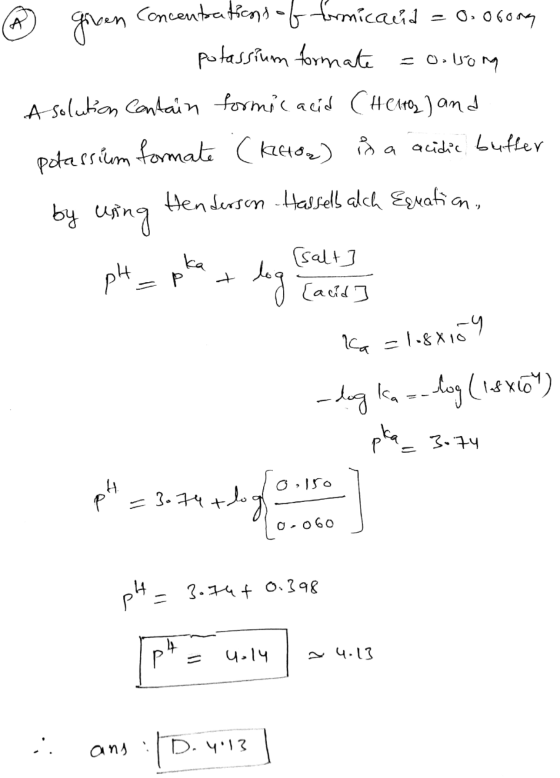
Using Henderson-Hasselbalch equation, Calculate the pH of a buffer solution that is 0.060 M formic acid (HCHO2) and 0.150 M potassium formate (KCHO2). Remember that Ka = 1.8 X 10⁻⁴ for formic acid.
Group of answer choices
A 1.45
B 2.36
C.9.12
D.4.13
E. 0.0125
F. 7.00
Homework Answers
Add Answer to:
Using Henderson-Hasselbalch equation, Calculate the pH of a
buffer solution that is 0.060 M formic acid...
Using Henderson-Hasselbalch equation, Calculate the pH of a buffer solution that is 0.060 M formic acid...
 Using Henderson-Hasselbalch equation, Calculate the pH of a buffer solution that is 0.060 M formic acid (HCHO) and 0.150 M potassium formate (KCHO2). Remember that Kg = 1.8 X 10⁻⁴ for formic acid. O 1.45 O 2.36 09.12 4.13 O 0.0125 7.00
Use the Henderson-Hasselbalch equation to determine the ratio of acid to base in a formic acid-formate...
Use the Henderson-Hasselbalch equation to determine the ratio of acid to base in a formic acid-formate buffer with a pH of 3.00 Assume that the human blood buffer includes 0.00080 M carbonic acid and 0.0080 M hydrogen carbonate. What is the pH of 7.00 liter of blood under these conditions? How many moles of strong acid must be added to the blood in question 2 to bring the hydrogen carbonate/ carbonic acid ratio to the hazardous level of 5:1 AND...
1. (3) Using the Henderson-Hasselbalch Equation, calculate the pH of a buffer solution that is 0.065...
 1. (3) Using the Henderson-Hasselbalch Equation, calculate the pH of a buffer solution that is 0.065 M in benzoic acid (HC2H5O2) and 0.125 M is sodium benzoate (NaC7H5O2). For benzoic acid, Ka = 6.5 x 10⁵.
A solution buffered at pH 3.90 is needed for a reaction. Would formic acid (HCOOH =...
A solution buffered at pH 3.90 is needed for a reaction. Would formic acid (HCOOH = HA) and its salt, sodium formate, NaHCO2 = NaA), make a good choice for this buffer? If so, what ratio of moles of A- and HA is needed? Use the Henderson Hasselbalch Equation. Ka formic acid = 1.8 x 10⁻⁴
Use the Henderson-Hasselbalch equation to calculate the pH of each solution: (a) a solution that is...
Use the Henderson-Hasselbalch equation to calculate the pH of each solution: (a) a solution that is 0.20 M in HCHO2 and 0.10 M in NaCHO2. (Ka=1.8×10⁻⁴) (b) a solution that is 0.14 M in NH3 and 0.19 M in NH4Cl. (Kb=1.76×10⁻⁵)
1. A buffer is 0.100 M in HF and 0.100 M in NaF. When a small...
 1. A buffer is 0.100 M in HF and 0.100 M in NaF. When a small
amount of nitric acid is added the pH only slightly drops. Write
the chemical equation that shows the added nitric acid being
neutralized by this buffer.
2. What is the pH of a buffer that is 0.120 M formic acid
(HCHO2) and 0.080 M in potassium formate (KCHO2)? The Ka of formic
acid is 1.8 x 10^ -4 .
3. The curve shows the...
1. A buffer is 0.100 M in HF and 0.100 M in NaF. When a small
amount of nitric acid is added the pH only slightly drops. Write
the chemical equation that shows the added nitric acid being
neutralized by this buffer.
2. What is the pH of a buffer that is 0.120 M formic acid
(HCHO2) and 0.080 M in potassium formate (KCHO2)? The Ka of formic
acid is 1.8 x 10^ -4 .
3. The curve shows the...
Calculate the pH of a buffer solution that is 0.30 M formic acid (HCO2H) and 0.50...
Calculate the pH of a buffer solution that is 0.30 M formic acid (HCO2H) and 0.50 M sodium formate (HCO2Na). Ka of HCO2H is 1.8 x 10⁻⁴
The pH of a buffer is calculated by using the Henderson-Hasselbalch equation: pH=pKa +log[Base]/[Acid] Part A: What...
The pH of a buffer is calculated by using the Henderson-Hasselbalch equation: pH=pKa +log[Base]/[Acid] Part A: What is the pH of a buffer prepared by adding 0.809mol of the weak acid HA to 0.406mol of NaA in 2.00 L of solution? The dissociation constant Ka of HA is 5.66
A buffer is composed of formic acid and its conjugate base, the formate ion. K, for...
 A buffer is composed of formic acid and its conjugate base, the formate ion. K, for formic acid is 1.8 x 10- a What is the pH of a solution that has a formic acid concentration of 0.020 M and a sodium formate concentration of 0.055 M? pH = 4.18 Correct pK, = - log(1.8 x 10^4) = 3.74 We use the Henderson-Hasselbalch equation to calculate the pH of a buffer solution. (HCO3 pH=pk.vlog HCO, = 3.74 +log 0.055 020...
The Henderson-Hasselbalch equation relates the pH of a buffer solution to the pKa of its conjugat...
The Henderson-Hasselbalch equation relates the pH of a buffer solution to the pKa of its conjugate acid and the ratio of the concentrations of the conjugate base and acid. The equation is important in laboratory work that makes use of buffered solutions, in industrial processes where pH needs to be controlled, and in medicine, where understanding the Henderson-Hasselbalch equation is critical for the control of blood pH. Part A As a technician in a large pharmaceutical research firm, you need...
 Using Henderson-Hasselbalch equation, Calculate the pH of a buffer solution that is 0.060 M formic acid (HCHO) and 0.150 M potassium formate (KCHO2). Remember that Kg = 1.8 X 10⁻⁴ for formic acid. O 1.45 O 2.36 09.12 4.13 O 0.0125 7.00
 1. (3) Using the Henderson-Hasselbalch Equation, calculate the pH of a buffer solution that is 0.065 M in benzoic acid (HC2H5O2) and 0.125 M is sodium benzoate (NaC7H5O2). For benzoic acid, Ka = 6.5 x 10⁵.
 1. A buffer is 0.100 M in HF and 0.100 M in NaF. When a small
amount of nitric acid is added the pH only slightly drops. Write
the chemical equation that shows the added nitric acid being
neutralized by this buffer.
2. What is the pH of a buffer that is 0.120 M formic acid
(HCHO2) and 0.080 M in potassium formate (KCHO2)? The Ka of formic
acid is 1.8 x 10^ -4 .
3. The curve shows the...
1. A buffer is 0.100 M in HF and 0.100 M in NaF. When a small
amount of nitric acid is added the pH only slightly drops. Write
the chemical equation that shows the added nitric acid being
neutralized by this buffer.
2. What is the pH of a buffer that is 0.120 M formic acid
(HCHO2) and 0.080 M in potassium formate (KCHO2)? The Ka of formic
acid is 1.8 x 10^ -4 .
3. The curve shows the...
 A buffer is composed of formic acid and its conjugate base, the formate ion. K, for formic acid is 1.8 x 10- a What is the pH of a solution that has a formic acid concentration of 0.020 M and a sodium formate concentration of 0.055 M? pH = 4.18 Correct pK, = - log(1.8 x 10^4) = 3.74 We use the Henderson-Hasselbalch equation to calculate the pH of a buffer solution. (HCO3 pH=pk.vlog HCO, = 3.74 +log 0.055 020...
Most questions answered within 3 hours.
-
Where is the error in this code sequence?
String s1 = "Hello";
String s2 = "ello";...
asked 10 months ago -
Financial data for Joel de Paris, Inc., for last year
follow:
Joel de Paris, Inc.
Balance...
asked 10 months ago -
Consider this reaction:
Al2(SO4)3 (aq)+ BaCl3
(aq) Al2Cl6 (aq)- +
3BaSO4(s) . What is the...
asked 10 months ago -
Suppose that Savneet is considering increasing her
recent random sample from 20 car rentals to 40...
asked 10 months ago -
Trucks arrive at an unloading terminal at an average rate of 120
per hour.
Trucks arrive...
asked 10 months ago -
Why are methanol and ethanol completely soluble in water while
octanol is not very little soluble....
asked 10 months ago -
A facilities manager at a university reads in a research report
that the mean amount of...
asked 10 months ago -
When the CuSO4 is rehydrated by adding water to the anhydrous
compound, is this an endothermic...
asked 10 months ago -
A ray of sunlight is passing from diamond into crown glass; the
angle of incidence is...
asked 10 months ago -
A block of mass 0.249 kg is placed on top of a light, vertical
spring of...
asked 10 months ago -
how do the kidneys compensate in the presences of acidosis
a) trigger hyperventilate
b) reserve acid...
asked 10 months ago -
Question 501 pts
The rental rate of capital to the firm increases. Which of the
following...
asked 10 months ago