Inclusion of bond covenants in the bond contract leads to Question 2 options: higher agency costs...
Inclusion of bond covenants in the bond contract leads to
Question 2 options:
|
higher agency costs |
|
|
higher bankruptcy costs |
|
|
decrease bankruptcy costs |
|
|
higher interest costs |
|
|
None of the above. |
Homework Answers
Inclusion of the bond covenants in the bond contract will lead to lower insolvency cost because lower bankruptcy cost will be reflecting that bondholders will be trying to protect their interest always and they will be trying to protect their principal and hence they will be trying to list certain conditions which will be strengthening the overall creditworthiness of the company and it will be helping in avoiding the bankruptcy cost.
Correct answer will be option( C) Decrease bankruptcy cost.
Add Answer to:
Inclusion of bond covenants in the bond contract leads to
Question 2 options:
higher agency costs...
In finance, agency costs refer to: Question 5 options: The costs incurred by shareholders in their...
In finance, agency costs refer to: Question 5 options: The costs incurred by shareholders in their role as agents of managers. The costs incurred by a partnership when it becomes an agency. The costs of resolving conflicts of interest between managers and shareholders. The costs incurred by firms when they hire agents such as lawyers and accountants. None of the above.
Question 27 2 pts Which of the following is true of a psychological contract? It leads...
 Question 27 2 pts Which of the following is true of a psychological contract? It leads to lower organizational commitment from employees. It reduces job satisfaction It leads to higher turnover intentions. It encourages social support for new employees.
Please answer 2. Agency conflicts between shareholders and creditors Aa Aa While the agency conflicts between...
 Please answer
2. Agency conflicts between shareholders and creditors Aa Aa While the agency conflicts between managers and shareholders tend to receive the most press, they are not the only type of agency conflict affecting the modern corporation. Another equally important type of agency conflict is sometimes observed between a firm's common shareholders and its creditors, or bondholders. As with conflicts between managers and shareholders, the basis of conflicts between shareholders and bondholders is divergent concerns and motives. In general,...
Please answer
2. Agency conflicts between shareholders and creditors Aa Aa While the agency conflicts between managers and shareholders tend to receive the most press, they are not the only type of agency conflict affecting the modern corporation. Another equally important type of agency conflict is sometimes observed between a firm's common shareholders and its creditors, or bondholders. As with conflicts between managers and shareholders, the basis of conflicts between shareholders and bondholders is divergent concerns and motives. In general,...
1st blank options = par value, coupon payment, price 2nd blank options = bankruptcy, default, liquidation...
 1st blank options = par value, coupon payment, price
2nd blank options = bankruptcy, default, liquidation
3rd blank options = convertible provision, sinking fund
provision, call provision
4th blank options= call provision, call premium,
convertibility provision
5th blank options = floating-rate, fixed-rate
6th blank options = indenture, trustee, debenture
7th = multiple choice
1. Characteristics of bonds To be effective issuing and investing in bonds, knowledge of their terminology, characteristics, and features is essential. For example: • A bond's_ par...
1st blank options = par value, coupon payment, price
2nd blank options = bankruptcy, default, liquidation
3rd blank options = convertible provision, sinking fund
provision, call provision
4th blank options= call provision, call premium,
convertibility provision
5th blank options = floating-rate, fixed-rate
6th blank options = indenture, trustee, debenture
7th = multiple choice
1. Characteristics of bonds To be effective issuing and investing in bonds, knowledge of their terminology, characteristics, and features is essential. For example: • A bond's_ par...
Question 5 Unsaved An increase in the money supply would lead to Question 5 options: an...
Question 5 Unsaved An increase in the money supply would lead to Question 5 options: an increase in interest rates. a decrease in interest rates. no change in interest rates but an increase in real GDP. no change in interest rates but an increase in inflation. none of the above
Which of the following is not an organizational cost? Question 1 options: State costs of incorporation...
Which of the following is not an organizational cost? Question 1 options: State costs of incorporation Costs of organizational meetings Expenses of temporary directors Legal expenses for setting up the corporation Costs of issuing or selling stock Question 2 (4 points) The tax rate on a professional service corporation's taxable income of $40,000 is 15%. Question 2 options: True False Question 3 (4 points) A corporation must make estimated tax payments when it expects its estimated income tax minus credits...
Inflation implies that the level of all prices _____________________. Question 8 options: 1) decrease 2) stay...
Inflation implies that the level of all prices _____________________. Question 8 options: 1) decrease 2) stay the same 3) increase 4) none of the above
Just question 8. bond? b. Does the higher-coupon bond give a higher rate of returri UVLI...
 Just question 8.
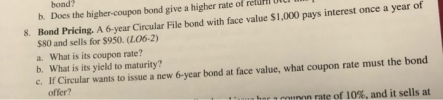
bond? b. Does the higher-coupon bond give a higher rate of returri UVLI LIM 8. Bond Pricing. A 6-year Circular File bond with face value $1,000 pays interest once a year of $80 and sells for $950. (L06-2) a. What is its coupon rate? b. What is its yield to maturity? c. If Circular wants to issue a new 6-year bond at face value, what coupon rate must the bond offer? un har a cannon rate of...
Just question 8.
bond? b. Does the higher-coupon bond give a higher rate of returri UVLI LIM 8. Bond Pricing. A 6-year Circular File bond with face value $1,000 pays interest once a year of $80 and sells for $950. (L06-2) a. What is its coupon rate? b. What is its yield to maturity? c. If Circular wants to issue a new 6-year bond at face value, what coupon rate must the bond offer? un har a cannon rate of...
In general, a decision maker should be wary of: Question 7 options: Unit variable costs Unit sale...
In general, a decision maker should be wary of: Question 7 options: Unit variable costs Unit sales prices Unit fixed costs None of the above
Question 1 - (25 points) (a) Consider a 2-year forward contract to buy a coupon-bearing bond...
 Question 1 - (25 points) (a) Consider a 2-year forward contract to buy a coupon-bearing bond that will mature 2 year from today. The current price of the bond is $102. Sup- pose that on that bond 4 coupon payments of $6 are expected after 6 months, 12 months, 18 months and 24-months. We assume that the 6-month, 12- month, 18-month and 24-month risk-free interest rates (continuously com- pounded) are, respectively, 1%, 1.3%, 1.6% and 1.9% per annum. Determine the...
 Question 27 2 pts Which of the following is true of a psychological contract? It leads to lower organizational commitment from employees. It reduces job satisfaction It leads to higher turnover intentions. It encourages social support for new employees.
 Please answer
2. Agency conflicts between shareholders and creditors Aa Aa While the agency conflicts between managers and shareholders tend to receive the most press, they are not the only type of agency conflict affecting the modern corporation. Another equally important type of agency conflict is sometimes observed between a firm's common shareholders and its creditors, or bondholders. As with conflicts between managers and shareholders, the basis of conflicts between shareholders and bondholders is divergent concerns and motives. In general,...
Please answer
2. Agency conflicts between shareholders and creditors Aa Aa While the agency conflicts between managers and shareholders tend to receive the most press, they are not the only type of agency conflict affecting the modern corporation. Another equally important type of agency conflict is sometimes observed between a firm's common shareholders and its creditors, or bondholders. As with conflicts between managers and shareholders, the basis of conflicts between shareholders and bondholders is divergent concerns and motives. In general,...
 1st blank options = par value, coupon payment, price
2nd blank options = bankruptcy, default, liquidation
3rd blank options = convertible provision, sinking fund
provision, call provision
4th blank options= call provision, call premium,
convertibility provision
5th blank options = floating-rate, fixed-rate
6th blank options = indenture, trustee, debenture
7th = multiple choice
1. Characteristics of bonds To be effective issuing and investing in bonds, knowledge of their terminology, characteristics, and features is essential. For example: • A bond's_ par...
1st blank options = par value, coupon payment, price
2nd blank options = bankruptcy, default, liquidation
3rd blank options = convertible provision, sinking fund
provision, call provision
4th blank options= call provision, call premium,
convertibility provision
5th blank options = floating-rate, fixed-rate
6th blank options = indenture, trustee, debenture
7th = multiple choice
1. Characteristics of bonds To be effective issuing and investing in bonds, knowledge of their terminology, characteristics, and features is essential. For example: • A bond's_ par...
 Just question 8.
bond? b. Does the higher-coupon bond give a higher rate of returri UVLI LIM 8. Bond Pricing. A 6-year Circular File bond with face value $1,000 pays interest once a year of $80 and sells for $950. (L06-2) a. What is its coupon rate? b. What is its yield to maturity? c. If Circular wants to issue a new 6-year bond at face value, what coupon rate must the bond offer? un har a cannon rate of...
Just question 8.
bond? b. Does the higher-coupon bond give a higher rate of returri UVLI LIM 8. Bond Pricing. A 6-year Circular File bond with face value $1,000 pays interest once a year of $80 and sells for $950. (L06-2) a. What is its coupon rate? b. What is its yield to maturity? c. If Circular wants to issue a new 6-year bond at face value, what coupon rate must the bond offer? un har a cannon rate of...
 Question 1 - (25 points) (a) Consider a 2-year forward contract to buy a coupon-bearing bond that will mature 2 year from today. The current price of the bond is $102. Sup- pose that on that bond 4 coupon payments of $6 are expected after 6 months, 12 months, 18 months and 24-months. We assume that the 6-month, 12- month, 18-month and 24-month risk-free interest rates (continuously com- pounded) are, respectively, 1%, 1.3%, 1.6% and 1.9% per annum. Determine the...
Most questions answered within 3 hours.
-
Where is the error in this code sequence?
String s1 = "Hello";
String s2 = "ello";...
asked 11 months ago -
Financial data for Joel de Paris, Inc., for last year
follow:
Joel de Paris, Inc.
Balance...
asked 11 months ago -
Consider this reaction:
Al2(SO4)3 (aq)+ BaCl3
(aq) Al2Cl6 (aq)- +
3BaSO4(s) . What is the...
asked 11 months ago -
Suppose that Savneet is considering increasing her
recent random sample from 20 car rentals to 40...
asked 11 months ago -
Trucks arrive at an unloading terminal at an average rate of 120
per hour.
Trucks arrive...
asked 11 months ago -
Why are methanol and ethanol completely soluble in water while
octanol is not very little soluble....
asked 11 months ago -
A facilities manager at a university reads in a research report
that the mean amount of...
asked 11 months ago -
When the CuSO4 is rehydrated by adding water to the anhydrous
compound, is this an endothermic...
asked 11 months ago -
A ray of sunlight is passing from diamond into crown glass; the
angle of incidence is...
asked 11 months ago -
A block of mass 0.249 kg is placed on top of a light, vertical
spring of...
asked 11 months ago -
how do the kidneys compensate in the presences of acidosis
a) trigger hyperventilate
b) reserve acid...
asked 11 months ago -
Question 501 pts
The rental rate of capital to the firm increases. Which of the
following...
asked 11 months ago