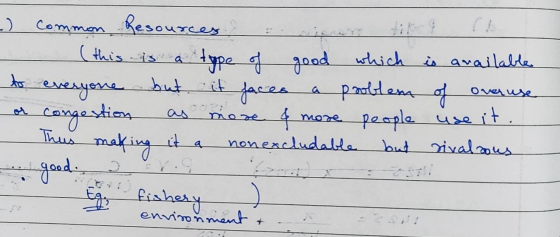
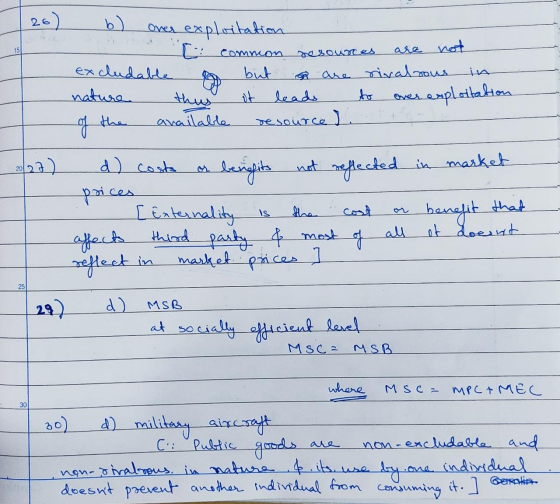
26. what environmental problem arises from common property resources? a. negative externality. b. overexploitation. c. government...
Homework Answers
Add Answer to:
26. what environmental problem arises from common property
resources? a. negative externality. b. overexploitation. c.
government...
18. If a negative externality results from the mowing of lawns, the marginal cost of lawn...
18. If a negative externality results from the mowing of lawns, the marginal cost of lawn mowing as seen by lawn mowing firms: a. does not include the marginal external cost. b. equals the marginal social cost. c. includes the marginal external cost. d. exceeds the marginal social cost. 19. Which of the following is not a negative externality? a. air pollution. b. high oil prices. c. clear-cutting in forests. d. litter. 32. Public goods are provided by the government...
19. Which of the following is not a negative externality? a. air pollution. b. high oil...
19. Which of the following is not a negative externality? a. air pollution. b. high oil prices. c. clear-cutting in forests. d. litter. 20. Which of the following types of goods is least likely to be provided by the market? a. a good that is rival in consumption and for which exclusion is possible. b. a good that is nonrival in consumption and for which exclusion is possible. c. a good that is nonrival in consumption and for which exclusion...
True or False 1. Public goods are provided by the government or not at all. The...
 True or False
1. Public goods are provided by the government or not at all. The second largest source of tax revenue for the federal government is social insurance taxes (Social Security and Medicare taxes). Other things equal, an economy's marginal willingness to pay for a non-rival good is likely to be higher the larger the population. Spending on the social security program is not included in the unified budget because it is “off-budget." Market failure cannot occur if non-rival...
True or False
1. Public goods are provided by the government or not at all. The second largest source of tax revenue for the federal government is social insurance taxes (Social Security and Medicare taxes). Other things equal, an economy's marginal willingness to pay for a non-rival good is likely to be higher the larger the population. Spending on the social security program is not included in the unified budget because it is “off-budget." Market failure cannot occur if non-rival...
1. Which of the following is true of goods that give off negative externalities? ...
1. Which of the following is true of goods that give off negative externalities? a) a competitive industry typically produces too few of these goods b) the social cost is greater than the private cost at a given level of output c) to internalize the externality, the government should remove any tax on the sellers of the product d) both a) and b) are correct e) both b) and c) are...
When there is negative externality in production, a. marginal social benefit exceeds marginal private benefit. b....
When there is negative externality in production, a. marginal social benefit exceeds marginal private benefit. b. marginal private benefit exceeds marginal social benefit. c. marginal social cost exceeds marginal private cost. d. marginal private cost exceeds marginal social cost.
Unit 8 Market Failures: Externalities, public goods, natural resources The production of coffee pods results in...
 Unit 8 Market Failures: Externalities, public goods, natural resources The production of coffee pods results in environmental damages when consumers throw the pods away. Currently consumers are not responsible for the costs of disposing of these coffee pods. The environmental damages caused by throwing away the coffee pods is an example of a: a Positive externality (6. Negative externality c. Private cost d. Private benefit Consider the market for coffee in the graph to the right. 1. Left unregulated, what...
61. A positive externality ________. a. gives rise to external benefits b. imposes an additional cost...
61. A positive externality ________. a. gives rise to external benefits b. imposes an additional cost on society c. leads to a higher economic profit d, leads to increasing returns to scale 62. If the production of a good involves positive externalities, ________. a. the average cost of production of the good in the long run is zero b. the variable cost of production of the good is zero c. the market price of the good is higher than its...
An environmental economic consulting firm is hired to measure the negative externalities associated with the pollution...
An environmental economic consulting firm is hired to measure the negative externalities associated with the pollution from an industry. The consultants calculate the marginal social cost of production to be MSC = 2Q+30 and the marginal private cost of production to be MPC =2Q +30. The market demand curve can be expressed as P=60 - Q . If the consultants have accurately measured the impact of the pollution externality, the net social benefit of producing at the social optimum (rather...
Paragraph Styles Unit 8 - Market Failures: Externalities, public goods, natural resources The production of coffee...
 Paragraph Styles Unit 8 - Market Failures: Externalities, public goods, natural resources The production of coffee pods results in environmental damages when consumers throw the pods away. Currently consumers are not responsible for the costs of disposing of these coffee pods. MSC MPC The environmental damages caused by throwing away the coffee pods is an example of a:1 Vertical (Value) Axis Major Gridlines a. Positive externality b. Negative externality c. Private costs d. Private benefits Consider the market for coffee...
6) Efficiency, Welfare & Externalities a) Discuss the notion of externality(s)? b) Are they good or bad from an efficiency point of view? c) Provide some everyday examples of positive and negative...
6) Efficiency, Welfare & Externalities a) Discuss the notion of externality(s)? b) Are they good or bad from an efficiency point of view? c) Provide some everyday examples of positive and negative externalities with a brief discussion. d) What is a public good? e) Give an example of a pure public good.
 True or False
1. Public goods are provided by the government or not at all. The second largest source of tax revenue for the federal government is social insurance taxes (Social Security and Medicare taxes). Other things equal, an economy's marginal willingness to pay for a non-rival good is likely to be higher the larger the population. Spending on the social security program is not included in the unified budget because it is “off-budget." Market failure cannot occur if non-rival...
True or False
1. Public goods are provided by the government or not at all. The second largest source of tax revenue for the federal government is social insurance taxes (Social Security and Medicare taxes). Other things equal, an economy's marginal willingness to pay for a non-rival good is likely to be higher the larger the population. Spending on the social security program is not included in the unified budget because it is “off-budget." Market failure cannot occur if non-rival...
 Unit 8 Market Failures: Externalities, public goods, natural resources The production of coffee pods results in environmental damages when consumers throw the pods away. Currently consumers are not responsible for the costs of disposing of these coffee pods. The environmental damages caused by throwing away the coffee pods is an example of a: a Positive externality (6. Negative externality c. Private cost d. Private benefit Consider the market for coffee in the graph to the right. 1. Left unregulated, what...
 Paragraph Styles Unit 8 - Market Failures: Externalities, public goods, natural resources The production of coffee pods results in environmental damages when consumers throw the pods away. Currently consumers are not responsible for the costs of disposing of these coffee pods. MSC MPC The environmental damages caused by throwing away the coffee pods is an example of a:1 Vertical (Value) Axis Major Gridlines a. Positive externality b. Negative externality c. Private costs d. Private benefits Consider the market for coffee...
Most questions answered within 3 hours.
-
Where is the error in this code sequence?
String s1 = "Hello";
String s2 = "ello";...
asked 10 months ago -
Financial data for Joel de Paris, Inc., for last year
follow:
Joel de Paris, Inc.
Balance...
asked 10 months ago -
Consider this reaction:
Al2(SO4)3 (aq)+ BaCl3
(aq) Al2Cl6 (aq)- +
3BaSO4(s) . What is the...
asked 10 months ago -
Suppose that Savneet is considering increasing her
recent random sample from 20 car rentals to 40...
asked 10 months ago -
Trucks arrive at an unloading terminal at an average rate of 120
per hour.
Trucks arrive...
asked 10 months ago -
Why are methanol and ethanol completely soluble in water while
octanol is not very little soluble....
asked 10 months ago -
A facilities manager at a university reads in a research report
that the mean amount of...
asked 10 months ago -
When the CuSO4 is rehydrated by adding water to the anhydrous
compound, is this an endothermic...
asked 10 months ago -
A ray of sunlight is passing from diamond into crown glass; the
angle of incidence is...
asked 10 months ago -
A block of mass 0.249 kg is placed on top of a light, vertical
spring of...
asked 10 months ago -
how do the kidneys compensate in the presences of acidosis
a) trigger hyperventilate
b) reserve acid...
asked 10 months ago -
Question 501 pts
The rental rate of capital to the firm increases. Which of the
following...
asked 10 months ago