
Homework Answers
(a)
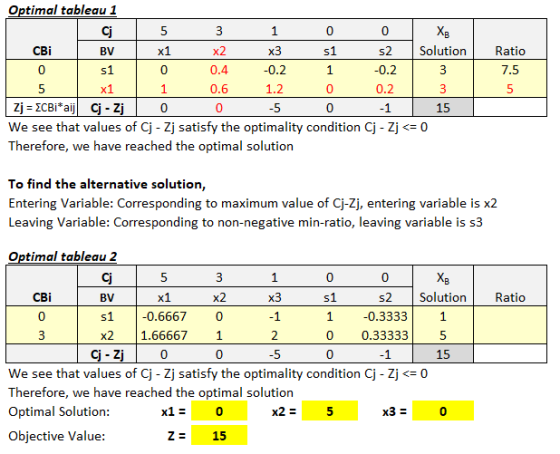
Given tableau represents the following basic solution:
x1 = 3 (x1 column has only 1 and 0, its RHS is 3)
s1 = 3 (s1 column has only 1 and 0, its RHS is 3)
x2, x3, s2 = 0
Objective value = 15
--
Cj-Zj for x1 column = 5-(0*0+5*1) = 0
Cj-Zj for x2 column = 3-(0*0.4+5*0.6) = 0
Cj-Zj for x3 column = 1-(0*(-0.2)+5*1.2) = -5
Cj-Zj for s1 column = 0-(0*1+5*0) = 0
Cj-Zj for s2 column = 0-(0*(-0.2)+5*0.2) = -1

For this solution, Value of Cj-Zj for each column is <= 0
Therefore, this solution is optimal.
-------------------------------------------------------------
(b)
In the optimal tableau, we see that value of Cj-Zj for x1 and x2 column are equal, i.e. 0, which means the solution is NOT unique.
There is an alternative solution.
Because, Cj-Zj for x2=0, therefore, x2 is the next entering variable.
Ratio for s1 row = 3/0.4 = 7.5
Ratio for x1 row = 3/0.6 = 5
Minimum ratio is 5, corresponding to x1 , so, x1 is the leaving variable.
-
Problem #7: Consider the linear program st. max z = 5x, + 3x2 + xz x...
 Problem #7: Consider the linear program st. max z = 5x, + 3x2 + xz x + x2 + x3 56 5x2 + 3x2 +6x3 =15 X1, X2, xz 20 and an associated tableau N X1 X2 X3 S1 S2 RHS 1 0 0 5 0 1 15 0 0 0.4 -0.2 1 -0.2 3 0 1 0.6 1.2 0 0.2 3 (a) What basic solution does this tableau represent? Is this solution optimal? Why or why not? (b) Does...
1. (20 pts.) Consider the following linear program: max 4x4 +xz+5x3 +3x4 s.t. *1 -X2 -X3...
 1. (20 pts.) Consider the following linear program: max 4x4 +xz+5x3 +3x4 s.t. *1 -X2 -X3 +3X, 51 5x +xz+3X3 +8X555 -X2 +2x2+3x3 -5x53 It is claimed that the solution x* = (0,14,0,5) is an optimal solution to the problem. Give a proof of the claim. Do not use the simplex method to solve this problem.
Consider the following linear program: Max Z = X1 – 2X2 Subject to – 4X1 +...
Consider the following linear program: Max Z = X1 – 2X2 Subject to – 4X1 + 3X2 <= 3 X1 – X2 <= 3 X1, X2 >= 0 a) Graph the feasible region for the problem. b) Is the feasible region unbounded? Explain. c) Find the optimal solution. d) Does an unbounded feasible region imply that the optimal solution to the linear program will be unbounded?
d) Given the primal problem Max z= 8x/+3x2+xz Subject to: x;+6x,+8x3<118 X, + 5x+10x<240 X1, X2,X3,...
 d) Given the primal problem Max z= 8x/+3x2+xz Subject to: x;+6x,+8x3<118 X, + 5x+10x<240 X1, X2,X3, 20 Write down its problem (5 marks) dual Question Nine R=622 R4 2 02. V-24V R = 422. R5=2.522. (a) What are the voltage across and the current in each of the resistors Ri through Rs in figure above? (6 Marks) (b) How much power is dissipated in R.? (4 marks)
Consider the following linear programming model Max 2X1 + 3X2 Subject to: X1 + X2 &n
Consider the following linear programming model Max 2X1 + 3X2 Subject to: X1 + X2 X1 ≥ 2 X1, X2 ≥ 0 This linear programming model has: A. Infeasible solution B. Unique solution C. Unbounded Solution D. Alternate optimal solution E. Redundant constraints
SOLVE STEP BY STEP! 4. Consider the following LP: Minimize z = x; +3x2 - X3...
 SOLVE STEP BY STEP!
4. Consider the following LP: Minimize z = x; +3x2 - X3 Subject to x + x2 + x2 > 3 -x + 2xz > 2 -x + 3x2 + x3 34 X1 X2,43 20 (a) Using the two-phase method, find the optimal solution to the primal problem above. (b) Write directly the dual of the primal problem, without using the method of transformation. (c) Determine the optimal values of the dual variables from the optimal...
SOLVE STEP BY STEP!
4. Consider the following LP: Minimize z = x; +3x2 - X3 Subject to x + x2 + x2 > 3 -x + 2xz > 2 -x + 3x2 + x3 34 X1 X2,43 20 (a) Using the two-phase method, find the optimal solution to the primal problem above. (b) Write directly the dual of the primal problem, without using the method of transformation. (c) Determine the optimal values of the dual variables from the optimal...
please help! Transform the following linear program into a MAX and in a standard form: (DO...
 please help!
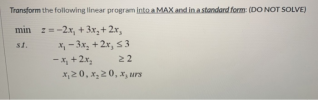
Transform the following linear program into a MAX and in a standard form: (DO NOT SOLVE) min st. z=-2x, + 3x2 + 2x, x - 3x₂ + 2x₂ < 3 - x + 2x₂ 22 x, 20, x, 20, xz urs
please help!
Transform the following linear program into a MAX and in a standard form: (DO NOT SOLVE) min st. z=-2x, + 3x2 + 2x, x - 3x₂ + 2x₂ < 3 - x + 2x₂ 22 x, 20, x, 20, xz urs
Consider the following linear program: Max 2X + 3Y s.t. 5X +5Y ≤ 400 -1X+ 1Y...
Consider the following linear program: Max 2X + 3Y s.t. 5X +5Y ≤ 400 -1X+ 1Y ≥ 10 1X + 3Y ≥ 90 X, Y ≥ 0 a. Use the graphical solution procedure to find the optimal solution. b. Conduct a sensitivity analysis to determine the range of optimality for the objective function coefficients X & Y. c. What are the binding constraints? d. If the right-hand-side of the binding constraints are marginally increased, what will be the Dual Value?
Please use the big M method to solve the following linear program. Write down all tableau,...
 Please use the big M method to solve the following linear
program. Write down all tableau, note basic variables and nonbasic
variables. Use slack and artificial variables. Construct your
tableau iterations using the standard form of the program. For
example first line z+2x1-2x2+2x3=0. If possible, STATE THE OPTIMAL
SOLUTION AND THE OPTIMAL VALUE. Otherwise state why you cannot find
them.
Consider the following linear program: 2x3 max z= –2x1 + s.t. + -x1 21 > 0, 2x2 - 2x2 +...
Please use the big M method to solve the following linear
program. Write down all tableau, note basic variables and nonbasic
variables. Use slack and artificial variables. Construct your
tableau iterations using the standard form of the program. For
example first line z+2x1-2x2+2x3=0. If possible, STATE THE OPTIMAL
SOLUTION AND THE OPTIMAL VALUE. Otherwise state why you cannot find
them.
Consider the following linear program: 2x3 max z= –2x1 + s.t. + -x1 21 > 0, 2x2 - 2x2 +...
2. Consider the following linear model where c has not yet been defined. Max z =...
 2. Consider the following linear model where c has not yet been defined. Max z = C1x1 + x2 s.t. X1 + X2 <6 X1 + 2.5x2 < 10 X1 2 0,X220 Use the graphical approach that we covered to find the optimal solution, x*=(x,x) for all values of - Sci so Hint: First draw the feasible region and notice that there are only a few corner points that can be the optimal solution. Also remember that if the objective...
 Problem #7: Consider the linear program st. max z = 5x, + 3x2 + xz x + x2 + x3 56 5x2 + 3x2 +6x3 =15 X1, X2, xz 20 and an associated tableau N X1 X2 X3 S1 S2 RHS 1 0 0 5 0 1 15 0 0 0.4 -0.2 1 -0.2 3 0 1 0.6 1.2 0 0.2 3 (a) What basic solution does this tableau represent? Is this solution optimal? Why or why not? (b) Does...
 1. (20 pts.) Consider the following linear program: max 4x4 +xz+5x3 +3x4 s.t. *1 -X2 -X3 +3X, 51 5x +xz+3X3 +8X555 -X2 +2x2+3x3 -5x53 It is claimed that the solution x* = (0,14,0,5) is an optimal solution to the problem. Give a proof of the claim. Do not use the simplex method to solve this problem.
 d) Given the primal problem Max z= 8x/+3x2+xz Subject to: x;+6x,+8x3<118 X, + 5x+10x<240 X1, X2,X3, 20 Write down its problem (5 marks) dual Question Nine R=622 R4 2 02. V-24V R = 422. R5=2.522. (a) What are the voltage across and the current in each of the resistors Ri through Rs in figure above? (6 Marks) (b) How much power is dissipated in R.? (4 marks)
 SOLVE STEP BY STEP!
4. Consider the following LP: Minimize z = x; +3x2 - X3 Subject to x + x2 + x2 > 3 -x + 2xz > 2 -x + 3x2 + x3 34 X1 X2,43 20 (a) Using the two-phase method, find the optimal solution to the primal problem above. (b) Write directly the dual of the primal problem, without using the method of transformation. (c) Determine the optimal values of the dual variables from the optimal...
SOLVE STEP BY STEP!
4. Consider the following LP: Minimize z = x; +3x2 - X3 Subject to x + x2 + x2 > 3 -x + 2xz > 2 -x + 3x2 + x3 34 X1 X2,43 20 (a) Using the two-phase method, find the optimal solution to the primal problem above. (b) Write directly the dual of the primal problem, without using the method of transformation. (c) Determine the optimal values of the dual variables from the optimal...
 please help!
Transform the following linear program into a MAX and in a standard form: (DO NOT SOLVE) min st. z=-2x, + 3x2 + 2x, x - 3x₂ + 2x₂ < 3 - x + 2x₂ 22 x, 20, x, 20, xz urs
please help!
Transform the following linear program into a MAX and in a standard form: (DO NOT SOLVE) min st. z=-2x, + 3x2 + 2x, x - 3x₂ + 2x₂ < 3 - x + 2x₂ 22 x, 20, x, 20, xz urs
 Please use the big M method to solve the following linear
program. Write down all tableau, note basic variables and nonbasic
variables. Use slack and artificial variables. Construct your
tableau iterations using the standard form of the program. For
example first line z+2x1-2x2+2x3=0. If possible, STATE THE OPTIMAL
SOLUTION AND THE OPTIMAL VALUE. Otherwise state why you cannot find
them.
Consider the following linear program: 2x3 max z= –2x1 + s.t. + -x1 21 > 0, 2x2 - 2x2 +...
Please use the big M method to solve the following linear
program. Write down all tableau, note basic variables and nonbasic
variables. Use slack and artificial variables. Construct your
tableau iterations using the standard form of the program. For
example first line z+2x1-2x2+2x3=0. If possible, STATE THE OPTIMAL
SOLUTION AND THE OPTIMAL VALUE. Otherwise state why you cannot find
them.
Consider the following linear program: 2x3 max z= –2x1 + s.t. + -x1 21 > 0, 2x2 - 2x2 +...
 2. Consider the following linear model where c has not yet been defined. Max z = C1x1 + x2 s.t. X1 + X2 <6 X1 + 2.5x2 < 10 X1 2 0,X220 Use the graphical approach that we covered to find the optimal solution, x*=(x,x) for all values of - Sci so Hint: First draw the feasible region and notice that there are only a few corner points that can be the optimal solution. Also remember that if the objective...
Most questions answered within 3 hours.
-
Where is the error in this code sequence?
String s1 = "Hello";
String s2 = "ello";...
asked 10 months ago -
Financial data for Joel de Paris, Inc., for last year
follow:
Joel de Paris, Inc.
Balance...
asked 10 months ago -
Consider this reaction:
Al2(SO4)3 (aq)+ BaCl3
(aq) Al2Cl6 (aq)- +
3BaSO4(s) . What is the...
asked 10 months ago -
Suppose that Savneet is considering increasing her
recent random sample from 20 car rentals to 40...
asked 10 months ago -
Trucks arrive at an unloading terminal at an average rate of 120
per hour.
Trucks arrive...
asked 10 months ago -
Why are methanol and ethanol completely soluble in water while
octanol is not very little soluble....
asked 10 months ago -
A facilities manager at a university reads in a research report
that the mean amount of...
asked 10 months ago -
When the CuSO4 is rehydrated by adding water to the anhydrous
compound, is this an endothermic...
asked 10 months ago -
A ray of sunlight is passing from diamond into crown glass; the
angle of incidence is...
asked 10 months ago -
A block of mass 0.249 kg is placed on top of a light, vertical
spring of...
asked 10 months ago -
how do the kidneys compensate in the presences of acidosis
a) trigger hyperventilate
b) reserve acid...
asked 10 months ago -
Question 501 pts
The rental rate of capital to the firm increases. Which of the
following...
asked 10 months ago