
Homework Answers
Ques 3.
Ques 4. (a),(b)
 (c)
(c)
(c)
Add Answer to:
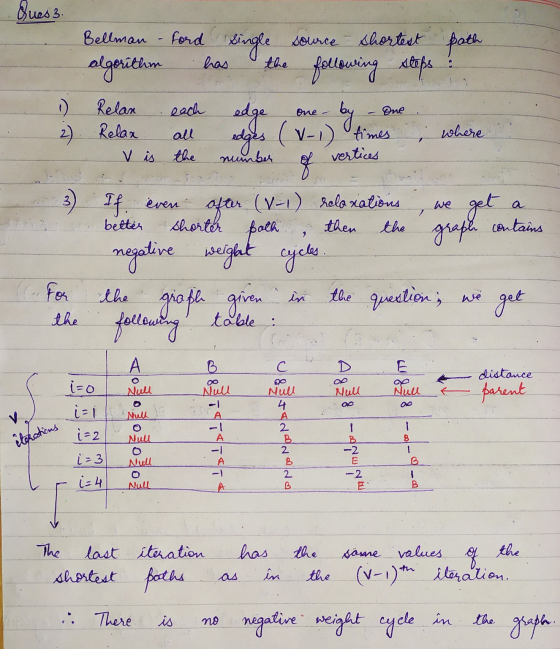
Question 3. Below is the result of the 1st and 2nd iteration of the Bellman-Ford single...
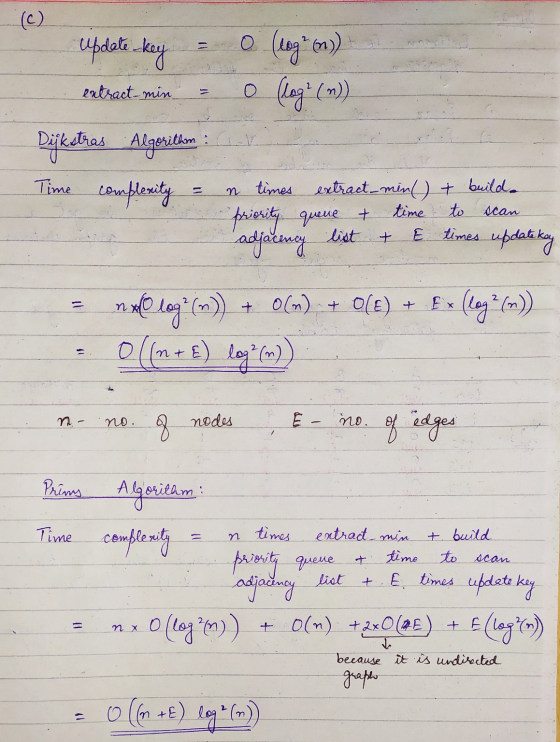
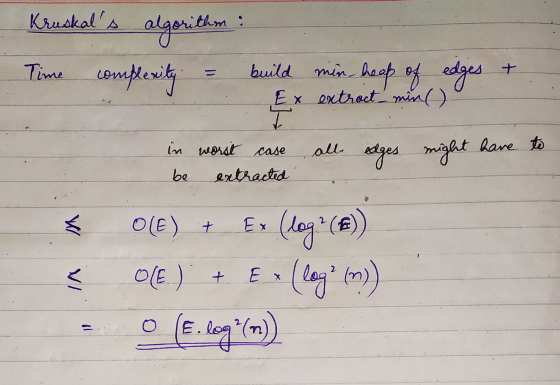
Question 4. a.)Given the graph below from part 4.b. you are using the priority queue prims...
 Question 4. a.)Given the graph below from part 4.b. you are using the priority queue prims algorithm. Let the priority queue currently contains nodes A, B. What is the value of node you u=extract_min(Q). b.) Run 1 iteration of Prims while loop, showing the priority queue. 5 A E 1 10 7 2 B с D 3 4 c.) What if you read on the news prioriy queue was improved such that both update_key, and extract min became O(log?(n)) how...
a.)Given the graph below from part 4.b. you are using the priority queue prims algorithm. Let...
 a.)Given the graph below from part 4.b. you are using the priority queue prims algorithm. Let the priority queue currently contains nodes A, B. What is the value of node you u=extract_min(Q). b.) Run 1 iteration of Prims while loop, showing the priority queue. 5 А E 1 10 7 2 B с D 3 4 c.) What if you read on the news prioriy queue was improved such that both update_key, and extract min became O(logʻ(n)) how would Prims,...
Java b) Bellman-Ford distance valuesaer each iteration of the algorithm, and show the final shortest path tree and cost...
 Java
b) Bellman-Ford distance valuesaer each iteration of the algorithm, and show the final shortest path tree and cost. 3. .2
b) Bellman-Ford distance valuesaer each iteration of the algorithm, and show the final shortest path tree and cost. 3. .2
Java
b) Bellman-Ford distance valuesaer each iteration of the algorithm, and show the final shortest path tree and cost. 3. .2
b) Bellman-Ford distance valuesaer each iteration of the algorithm, and show the final shortest path tree and cost. 3. .2
Please help me with this answer. Performance Comparison for Dijkstra Algorithm and Bellman-Ford Algorithm Problem Description...
Please help me with this answer. Performance Comparison for Dijkstra Algorithm and Bellman-Ford Algorithm Problem Description The shortest path problem is one of most important problems in graph theory and computer science in general. Shortest path problem is one of typical optimization problems. Given a graph G = (V,E), the goal is to nd a minimum cost path from s → t, s,t ∈ V . This variant is called one-to-one shortest path problem. Other variants are one-to-all (compute shortest...
310/6310 Quiz 3 Fall 2017 NAME 4. Using Bellman-Ford algorithm, find the shortest paths from the...
 310/6310 Quiz 3 Fall 2017 NAME 4. Using Bellman-Ford algorithm, find the shortest paths from the vertex 3 to all other vertices Path 3-> I: Path 3->2: Path 3.5 Path 3-6: Path 3-3: Path 3.>4: 3 5 2 3 4 How many key-value pairs will be generated in total by all mappers at every iteration of MapReduce implementation of the algorithm? Explain your answer NAME: Quiz3 CS4310
in c++ The Bellman-Ford Algorithm In this assignment, you are asked to implement the Bellman-Ford Algorithm...
 in c++
The Bellman-Ford Algorithm In this assignment, you are asked to implement the Bellman-Ford Algorithm which solves the single-source shortest-paths problem. Specifically, you are given as input a directed graph G = (V. E) with weight w(u, v) on each edge (u, v) E E along with a source vertex s EV. Edges may have negative weights. Input The input has the following format. There are two integers on the first line. The first integer represents the number of...
in c++
The Bellman-Ford Algorithm In this assignment, you are asked to implement the Bellman-Ford Algorithm which solves the single-source shortest-paths problem. Specifically, you are given as input a directed graph G = (V. E) with weight w(u, v) on each edge (u, v) E E along with a source vertex s EV. Edges may have negative weights. Input The input has the following format. There are two integers on the first line. The first integer represents the number of...
The below question refers to shortest paths trees in weighted, directed graphs. Read the following carefully....
The below question refers to shortest paths trees in weighted, directed graphs. Read the following carefully. Assume that No two edges have the same weight There are no cycles of net negative weight. There are no self-edges (edges leading from a vertex to itself). There are V vertices and E edges. 1. Assume that in addition to the conditions specified at the beginning, graphs are dense. If a graph contains V vertices and E edges, what is the greatest number...
8. Bellman-Ford Algorithm a) For iteration 1, fill arrays d and p. 5 2 3 2 3 3 Edge Weight 0-1 5 0-22 1-03 1--34 2-3 6 b) Draw the resultant graph based on the values in arrays d and p: 8. Bellm...
 8. Bellman-Ford Algorithm a) For iteration 1, fill arrays d and p. 5 2 3 2 3 3 Edge Weight 0-1 5 0-22 1-03 1--34 2-3 6 b) Draw the resultant graph based on the values in arrays d and p:
8. Bellman-Ford Algorithm a) For iteration 1, fill arrays d and p. 5 2 3 2 3 3 Edge Weight 0-1 5 0-22 1-03 1--34 2-3 6 b) Draw the resultant graph based on the values in arrays d...
8. Bellman-Ford Algorithm a) For iteration 1, fill arrays d and p. 5 2 3 2 3 3 Edge Weight 0-1 5 0-22 1-03 1--34 2-3 6 b) Draw the resultant graph based on the values in arrays d and p:
8. Bellman-Ford Algorithm a) For iteration 1, fill arrays d and p. 5 2 3 2 3 3 Edge Weight 0-1 5 0-22 1-03 1--34 2-3 6 b) Draw the resultant graph based on the values in arrays d...
Find the shortest path algorithm tables (for the graph on the homework sheet) using the (a)...
 Find the shortest path algorithm tables (for the graph on the
homework sheet) using the
(a) Dijkstra algorithm
(b) Ford-Fulkerson algorithm
Label the columns B,C,D from left to right. Node A is the root
node.
Use pointers for only the Ford Fulkerson algorithm as in the
Networks and Grids book.
(c) Let the link number be bandwidth (data rate). Create the
routing table that allows you find paths to the root node that
maximize the bottleneck bandwidth
Uhe
Find the shortest path algorithm tables (for the graph on the
homework sheet) using the
(a) Dijkstra algorithm
(b) Ford-Fulkerson algorithm
Label the columns B,C,D from left to right. Node A is the root
node.
Use pointers for only the Ford Fulkerson algorithm as in the
Networks and Grids book.
(c) Let the link number be bandwidth (data rate). Create the
routing table that allows you find paths to the root node that
maximize the bottleneck bandwidth
Uhe
Run the Dijkstra’s algorithm on the directed graph of the following figure 24.6, using vertex t...
 Run the Dijkstra’s algorithm on the directed graph of the
following figure 24.6, using vertex t as
the source. In the style of Figure 24.6, show the d and
? values and the vertices in set S after each iteration of
the while loop.
1 8 10 I 10 14 4 6 4 6 2 3 2 3 4 6 5 5 2 (a) (c) 1 10 13 4 6 (d) (e) Figure 24.6 The execution of Dijkstra's algorithm. The...
Run the Dijkstra’s algorithm on the directed graph of the
following figure 24.6, using vertex t as
the source. In the style of Figure 24.6, show the d and
? values and the vertices in set S after each iteration of
the while loop.
1 8 10 I 10 14 4 6 4 6 2 3 2 3 4 6 5 5 2 (a) (c) 1 10 13 4 6 (d) (e) Figure 24.6 The execution of Dijkstra's algorithm. The...
 Question 4. a.)Given the graph below from part 4.b. you are using the priority queue prims algorithm. Let the priority queue currently contains nodes A, B. What is the value of node you u=extract_min(Q). b.) Run 1 iteration of Prims while loop, showing the priority queue. 5 A E 1 10 7 2 B с D 3 4 c.) What if you read on the news prioriy queue was improved such that both update_key, and extract min became O(log?(n)) how...
 a.)Given the graph below from part 4.b. you are using the priority queue prims algorithm. Let the priority queue currently contains nodes A, B. What is the value of node you u=extract_min(Q). b.) Run 1 iteration of Prims while loop, showing the priority queue. 5 А E 1 10 7 2 B с D 3 4 c.) What if you read on the news prioriy queue was improved such that both update_key, and extract min became O(logʻ(n)) how would Prims,...
 Java
b) Bellman-Ford distance valuesaer each iteration of the algorithm, and show the final shortest path tree and cost. 3. .2
b) Bellman-Ford distance valuesaer each iteration of the algorithm, and show the final shortest path tree and cost. 3. .2
Java
b) Bellman-Ford distance valuesaer each iteration of the algorithm, and show the final shortest path tree and cost. 3. .2
b) Bellman-Ford distance valuesaer each iteration of the algorithm, and show the final shortest path tree and cost. 3. .2
 310/6310 Quiz 3 Fall 2017 NAME 4. Using Bellman-Ford algorithm, find the shortest paths from the vertex 3 to all other vertices Path 3-> I: Path 3->2: Path 3.5 Path 3-6: Path 3-3: Path 3.>4: 3 5 2 3 4 How many key-value pairs will be generated in total by all mappers at every iteration of MapReduce implementation of the algorithm? Explain your answer NAME: Quiz3 CS4310
 in c++
The Bellman-Ford Algorithm In this assignment, you are asked to implement the Bellman-Ford Algorithm which solves the single-source shortest-paths problem. Specifically, you are given as input a directed graph G = (V. E) with weight w(u, v) on each edge (u, v) E E along with a source vertex s EV. Edges may have negative weights. Input The input has the following format. There are two integers on the first line. The first integer represents the number of...
in c++
The Bellman-Ford Algorithm In this assignment, you are asked to implement the Bellman-Ford Algorithm which solves the single-source shortest-paths problem. Specifically, you are given as input a directed graph G = (V. E) with weight w(u, v) on each edge (u, v) E E along with a source vertex s EV. Edges may have negative weights. Input The input has the following format. There are two integers on the first line. The first integer represents the number of...
 8. Bellman-Ford Algorithm a) For iteration 1, fill arrays d and p. 5 2 3 2 3 3 Edge Weight 0-1 5 0-22 1-03 1--34 2-3 6 b) Draw the resultant graph based on the values in arrays d and p:
8. Bellman-Ford Algorithm a) For iteration 1, fill arrays d and p. 5 2 3 2 3 3 Edge Weight 0-1 5 0-22 1-03 1--34 2-3 6 b) Draw the resultant graph based on the values in arrays d...
8. Bellman-Ford Algorithm a) For iteration 1, fill arrays d and p. 5 2 3 2 3 3 Edge Weight 0-1 5 0-22 1-03 1--34 2-3 6 b) Draw the resultant graph based on the values in arrays d and p:
8. Bellman-Ford Algorithm a) For iteration 1, fill arrays d and p. 5 2 3 2 3 3 Edge Weight 0-1 5 0-22 1-03 1--34 2-3 6 b) Draw the resultant graph based on the values in arrays d...
 Find the shortest path algorithm tables (for the graph on the
homework sheet) using the
(a) Dijkstra algorithm
(b) Ford-Fulkerson algorithm
Label the columns B,C,D from left to right. Node A is the root
node.
Use pointers for only the Ford Fulkerson algorithm as in the
Networks and Grids book.
(c) Let the link number be bandwidth (data rate). Create the
routing table that allows you find paths to the root node that
maximize the bottleneck bandwidth
Uhe
Find the shortest path algorithm tables (for the graph on the
homework sheet) using the
(a) Dijkstra algorithm
(b) Ford-Fulkerson algorithm
Label the columns B,C,D from left to right. Node A is the root
node.
Use pointers for only the Ford Fulkerson algorithm as in the
Networks and Grids book.
(c) Let the link number be bandwidth (data rate). Create the
routing table that allows you find paths to the root node that
maximize the bottleneck bandwidth
Uhe
 Run the Dijkstra’s algorithm on the directed graph of the
following figure 24.6, using vertex t as
the source. In the style of Figure 24.6, show the d and
? values and the vertices in set S after each iteration of
the while loop.
1 8 10 I 10 14 4 6 4 6 2 3 2 3 4 6 5 5 2 (a) (c) 1 10 13 4 6 (d) (e) Figure 24.6 The execution of Dijkstra's algorithm. The...
Run the Dijkstra’s algorithm on the directed graph of the
following figure 24.6, using vertex t as
the source. In the style of Figure 24.6, show the d and
? values and the vertices in set S after each iteration of
the while loop.
1 8 10 I 10 14 4 6 4 6 2 3 2 3 4 6 5 5 2 (a) (c) 1 10 13 4 6 (d) (e) Figure 24.6 The execution of Dijkstra's algorithm. The...
Most questions answered within 3 hours.
-
Where is the error in this code sequence?
String s1 = "Hello";
String s2 = "ello";...
asked 11 months ago -
Financial data for Joel de Paris, Inc., for last year
follow:
Joel de Paris, Inc.
Balance...
asked 11 months ago -
Consider this reaction:
Al2(SO4)3 (aq)+ BaCl3
(aq) Al2Cl6 (aq)- +
3BaSO4(s) . What is the...
asked 11 months ago -
Suppose that Savneet is considering increasing her
recent random sample from 20 car rentals to 40...
asked 11 months ago -
Trucks arrive at an unloading terminal at an average rate of 120
per hour.
Trucks arrive...
asked 11 months ago -
Why are methanol and ethanol completely soluble in water while
octanol is not very little soluble....
asked 11 months ago -
A facilities manager at a university reads in a research report
that the mean amount of...
asked 11 months ago -
When the CuSO4 is rehydrated by adding water to the anhydrous
compound, is this an endothermic...
asked 11 months ago -
A ray of sunlight is passing from diamond into crown glass; the
angle of incidence is...
asked 11 months ago -
A block of mass 0.249 kg is placed on top of a light, vertical
spring of...
asked 11 months ago -
how do the kidneys compensate in the presences of acidosis
a) trigger hyperventilate
b) reserve acid...
asked 11 months ago -
Question 501 pts
The rental rate of capital to the firm increases. Which of the
following...
asked 11 months ago