![private static void sort(Comparable[] a, int lo, int hi) { if (hi <= lo) return; int j = partition(a, lo, hi); show(a, j, lo,](http://img.homeworklib.com/questions/62b6ea90-de00-11ea-b29a-133e9f6f969f.png?x-oss-process=image/resize,w_560)
Homework Answers
The above sorting is quick sort.
Quick sort is fastest algorithm.
The technique of quick sort is split the array into 3 parts those are
- Pivot
- Left
- Right
Comparision of left and right change the pivot after successful comparision operation.
In this the operation done on the subarray from a[lo] to a[hi].
The time complexity is reduced in this sorting technique.
Option 3
Add Answer to:
private static void sort(Comparable[] a, int lo, int hi) { if (hi <= lo) return; int...
USE JAVA PROGRAMMING Create a program that would collect list of persons using double link list...
USE JAVA PROGRAMMING Create a program that would collect list of persons using double link list and use a Merge Sort to sort the object by age. Create a class called Person : name and age Create methods that add, and delete Person from the link list Create a method that sorts the persons' objects by age. package mergesort; public class MergeSortExample { private static Comparable[] aux; // auxiliary array for merges public static void sort(Comparable[] a) { aux =...
1. Implement generic insertion sort public static <E extends Comparable<E>> void insertionSort(E[] list){ //implement body }...
1. Implement generic insertion sort public static <E extends Comparable<E>> void insertionSort(E[] list){ //implement body } 2. Implement generic bubble sort public static <E extends Comparable<E>> void bubbleSort(E[] list){ //implement body } 3. Implement generic merge sort public static <E extends Comparable<E>> void mergeSort(E[] list){ //implement body } 4. Implement generic heap sort public static <E extends Comparable<E>> void heapSort(E[] list){ //implement body }
import java.util.Arrays; public class lab { public static void main(String args[]) { int...
import java.util.Arrays; public class lab { public static void main(String args[]) { int arr[] = {10, 7, 8, 9, 1, 5,6,7}; int arr2[] = {9, 8, 7, 6, 5, 4, 3, 2, 1}; int arr3[] = {1, 3, 5, 3, 2, 6, 20}; quicksort(arr,0,arr.length-1); quicksort(arr2,0,arr2.length-1); quicksort(arr3,0,arr3.length-1); System.out.println(Arrays.toString(arr)); System.out.println(Arrays.toString(arr2)); System.out.println(Arrays.toString(arr3)); } private static int partition(int[] items,int low, int high) { int i=0; int j=0;...
Modify the sorts (selection sort, insertion sort, bubble sort, quick sort, and merge sort) by adding code to each to tally the total number of comparisons and total execution time of each algorithm. E...
Modify the sorts (selection sort, insertion sort, bubble sort, quick sort, and merge sort) by adding code to each to tally the total number of comparisons and total execution time of each algorithm. Execute the sort algorithms against the same list, recording information for the total number of comparisons and total execution time for each algorithm. Try several different lists, including at least one that is already in sorted order. ---------------------------------------------------------------------------------------------------------------- /** * Sorting demonstrates sorting and searching on an...
4. (5 Points) The following is another merge sort top down implementation, what is the running...
 4. (5 Points) The following is another merge sort top down implementation, what is the running time and space complexity for this implementation in big-0? Briefly explain your answer. public static 〈T extends Comparable〈 T> > void sort2(T[] a) { sort2(a, , a.length - 1); @Suppresswarnings ("unchecked") private static <T extends Comparable<T>> void sort2(ΤΠ a, intlo, int hi) { if (hi (z lo) return; T[] aux- (TLD new comparable[a,length]; int mid- (10 + hi) / 2; sort2 (a, lo, mid);...
must provide the following public interface: public static void insertSort(int [] arr); public static void selectSort(int...
must provide the following public interface: public static void insertSort(int [] arr); public static void selectSort(int [] arr); public static void quickSort(int [] arr); public static void mergeSort(int [] arr); The quick sort and merge sort must be implemented by using recursive thinking. So the students may provide the following private static methods: //merge method //merge two sorted portions of given array arr, namely, from start to middle //and from middle + 1 to end into one sorted portion, namely,...
Sort a queue in java with generic type, below is my approach which has some issues....
 Sort a queue in java with generic type, below is my approach
which has some issues. The porpose is to implement a method to sort
the elements of the queue in ascending order, but I am not sure how
to deal with generic type T instead of int or string. Need your
help to solve this problem. Please post the correct code and the
idea, thanks!
public static <T extends Comparable<T>> int minval(Queue<T> queue, int sort) { int min_index =...
Sort a queue in java with generic type, below is my approach
which has some issues. The porpose is to implement a method to sort
the elements of the queue in ascending order, but I am not sure how
to deal with generic type T instead of int or string. Need your
help to solve this problem. Please post the correct code and the
idea, thanks!
public static <T extends Comparable<T>> int minval(Queue<T> queue, int sort) { int min_index =...
I need the following merge-sort assignment completed using the "ArrayList<Comparable>" (the part I'm really stuck on)...
I need the following merge-sort assignment completed using the "ArrayList<Comparable>" (the part I'm really stuck on) with comments: import java.util.ArrayList; public class Mergesort { /** * Sorts list given using the mergesort algorithm * @param list the list to be sorted * @param first the index of the first element of the list to be sorted * @param last the index of the last element of the list to be sorted */ public static void mergesort(ArrayList<Comparable> list, int first, int...
13 (1 point) Assume we have a Quick sort implementation that starts out like this static...
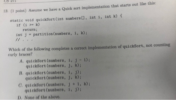 13 (1 point) Assume we have a Quick sort implementation that starts out like this static void quicksort(int numbers, int 1, int k) if (1 k) return; Int J - partition (numbers, 1. k): Which of the following completes a correct implementation of quicksort, not counting curly braces? A quickfort (numbers, 1, -); quickfort (numbers, J.); B. quicktort numbers, 1, 1); quickfort (numbers, J.) 0 quicktort numbers, J. 1, ) quickfort (numbers, 1, D. None of the above.
5. What is the Big Oh method m2? public static void m2(int[] arr, int n) for...
 5. What is the Big Oh method m2? public static void m2(int[] arr, int n) for (int í = 1; í <= n- 1; i++) pM2(arr [i], arr, 0, i - 1); // end m2 private static void pM2(int entry, int[l arr, int begin, int end) int i- end; for(; (i 〉= begin) && (entry 〈 arr [i]); i--) arr [1 + 1] = arr L1] arr[i + 1] - entry; return // end pM2
 4. (5 Points) The following is another merge sort top down implementation, what is the running time and space complexity for this implementation in big-0? Briefly explain your answer. public static 〈T extends Comparable〈 T> > void sort2(T[] a) { sort2(a, , a.length - 1); @Suppresswarnings ("unchecked") private static <T extends Comparable<T>> void sort2(ΤΠ a, intlo, int hi) { if (hi (z lo) return; T[] aux- (TLD new comparable[a,length]; int mid- (10 + hi) / 2; sort2 (a, lo, mid);...
 Sort a queue in java with generic type, below is my approach
which has some issues. The porpose is to implement a method to sort
the elements of the queue in ascending order, but I am not sure how
to deal with generic type T instead of int or string. Need your
help to solve this problem. Please post the correct code and the
idea, thanks!
public static <T extends Comparable<T>> int minval(Queue<T> queue, int sort) { int min_index =...
Sort a queue in java with generic type, below is my approach
which has some issues. The porpose is to implement a method to sort
the elements of the queue in ascending order, but I am not sure how
to deal with generic type T instead of int or string. Need your
help to solve this problem. Please post the correct code and the
idea, thanks!
public static <T extends Comparable<T>> int minval(Queue<T> queue, int sort) { int min_index =...
 13 (1 point) Assume we have a Quick sort implementation that starts out like this static void quicksort(int numbers, int 1, int k) if (1 k) return; Int J - partition (numbers, 1. k): Which of the following completes a correct implementation of quicksort, not counting curly braces? A quickfort (numbers, 1, -); quickfort (numbers, J.); B. quicktort numbers, 1, 1); quickfort (numbers, J.) 0 quicktort numbers, J. 1, ) quickfort (numbers, 1, D. None of the above.
 5. What is the Big Oh method m2? public static void m2(int[] arr, int n) for (int í = 1; í <= n- 1; i++) pM2(arr [i], arr, 0, i - 1); // end m2 private static void pM2(int entry, int[l arr, int begin, int end) int i- end; for(; (i 〉= begin) && (entry 〈 arr [i]); i--) arr [1 + 1] = arr L1] arr[i + 1] - entry; return // end pM2
Most questions answered within 3 hours.
-
Where is the error in this code sequence?
String s1 = "Hello";
String s2 = "ello";...
asked 11 months ago -
Financial data for Joel de Paris, Inc., for last year
follow:
Joel de Paris, Inc.
Balance...
asked 11 months ago -
Consider this reaction:
Al2(SO4)3 (aq)+ BaCl3
(aq) Al2Cl6 (aq)- +
3BaSO4(s) . What is the...
asked 11 months ago -
Suppose that Savneet is considering increasing her
recent random sample from 20 car rentals to 40...
asked 11 months ago -
Trucks arrive at an unloading terminal at an average rate of 120
per hour.
Trucks arrive...
asked 11 months ago -
Why are methanol and ethanol completely soluble in water while
octanol is not very little soluble....
asked 11 months ago -
A facilities manager at a university reads in a research report
that the mean amount of...
asked 11 months ago -
When the CuSO4 is rehydrated by adding water to the anhydrous
compound, is this an endothermic...
asked 11 months ago -
A ray of sunlight is passing from diamond into crown glass; the
angle of incidence is...
asked 11 months ago -
A block of mass 0.249 kg is placed on top of a light, vertical
spring of...
asked 11 months ago -
how do the kidneys compensate in the presences of acidosis
a) trigger hyperventilate
b) reserve acid...
asked 11 months ago -
Question 501 pts
The rental rate of capital to the firm increases. Which of the
following...
asked 11 months ago