
Homework Answers
Add Answer to:
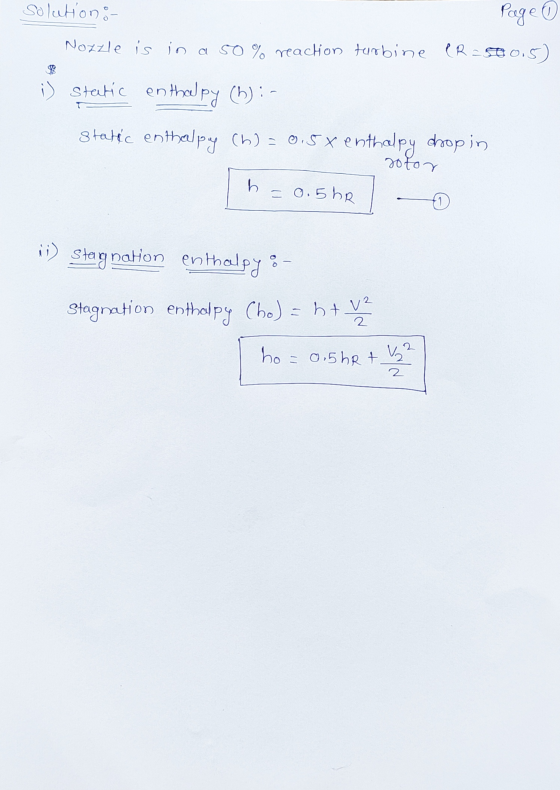
(c) (4 pts) Give the fractional drop of the following quantities across the nozzle in a...
This was given but I don't know if it would be helpful for this problem (c)...
 This was given but I don't know if it would be helpful for this
problem
(c) (4 pts) Give the fractional drop of the following quantities across the nozzle in a 50% reaction turbine: i. the static enthalpy h, and ii. the stagnation enthalpy ho. Cli W1 C1 W2 D ө U = 150 m/s Z
This was given but I don't know if it would be helpful for this
problem
(c) (4 pts) Give the fractional drop of the following quantities across the nozzle in a 50% reaction turbine: i. the static enthalpy h, and ii. the stagnation enthalpy ho. Cli W1 C1 W2 D ө U = 150 m/s Z
Give the dimensions, SI units, and English units for the following quantities: a. Density b. Pressure...
 Give the dimensions, SI units, and English units for the following quantities: a. Density b. Pressure c. Viscosity d. Shear e. Mass flow rate f. Specific heat g. Internal energy h. Specific enthalpy i. Work j. Power
26) Give the IUPAC name for the following compound. A) S-4-bromo-1-pentyne C) R-3-bromo-5-pentyne B) R-4-bromo-1-pentyne D)...
 26) Give the IUPAC name for the following compound. A) S-4-bromo-1-pentyne C) R-3-bromo-5-pentyne B) R-4-bromo-1-pentyne D) S-3-bromo-5-pentyne 27) What is the major product of the following reaction? 1. BH, 2. H,O, HO A) I B) II C) III D) IV 28) What is the correct classification of the following reaction? Lot OH A) Oxidation reaction C) Substitution reaction B) Elimination reaction D) Reduction reaction 29) Which of the following classes of organic compounds cannot undergo reduction ea. B) Alkenes
(10 pts) Give the product (s) of the following reaction and propose a mechanism. 4. H2NNH2,...
 (10 pts) Give the product (s) of the following reaction and propose a mechanism. 4. H2NNH2, H (cat.)
Answer Question 4. The potential difference across a capacitor is doubled. How does each of the following quantities cha...
Answer Question 4. The potential difference across a capacitor is doubled. How does each of the following quantities change: (a) the capacitance ; (b) the stored charge ; (c) the stored energy ?
Part Short A desulfide AN Theo ethac (S ) -> C-E- е а. А е за...
 Part Short A desulfide AN Theo ethac (S ) -> C-E- е а. А е за да а м е 29. (10 pts) Explain the difference between thermodynamic and its w o rd kinetics is how soit a reaction happens netes depends on actuation enrgyi necollesian for the reaction to toppen Whermodus wow much eMAJO of reacfauts bind hermodynamics depends on relative evorgy 30. (5 pts) Show a fully expanded, Lewis electron dot structure for the wide CCOO this question...
Question 4 2 pts All of the following have enthalpy of formation values of zero except...
 Question 4 2 pts All of the following have enthalpy of formation values of zero except Ne(g) Fe(s) N2(8) Br2(1) N(g) Question 5 3 pts U, H, q, w, VT,P Consider the following list of in thermodynamic quantities: How many variables listed above are state functions? 4 2 07
5. Give the products of the following reactions. You DO NOT need to show a detailed mechanism but...
 5. Give the products of the following reactions. You DO NOT need to show a detailed mechanism but do show ALL reaction intermediates. (30 pts) LiAIH4 G CH3-C-00HE (b) F (c) OH CH3 6. Give the product of the following reactions and in each case give a detailed reaction mechanism by which it is formed. (40 pts, 10 each) pH 4-5 ca. H2S4 HBrJ (c)--/SH NaOH I (d) H CH3 H CH3
5. Give the products of the following reactions....
5. Give the products of the following reactions. You DO NOT need to show a detailed mechanism but do show ALL reaction intermediates. (30 pts) LiAIH4 G CH3-C-00HE (b) F (c) OH CH3 6. Give the product of the following reactions and in each case give a detailed reaction mechanism by which it is formed. (40 pts, 10 each) pH 4-5 ca. H2S4 HBrJ (c)--/SH NaOH I (d) H CH3 H CH3
5. Give the products of the following reactions....
13. (12 pts) Using the following bond dissociation energies, estimate the enthalpy of the reaction for...
 13. (12 pts) Using the following bond dissociation energies, estimate the enthalpy of the reaction for the reaction between acetylene and hydroiodic acid to generate 1,2-diiodoethane. нн H-CEC-H 2 H- Bond Bond Enthalpy (kJ/mol) Bond Bond Enthalpy (kJ/mol) 839 C-H 413 С-С сс 348 C-I 240 Н-1 299 7
Homework 7 - Due 10/29/19 at the beginning of class (4 pts) 1) Rank the following...
 Homework 7 - Due 10/29/19 at the beginning of class (4 pts) 1) Rank the following alkens in order of decreasing heat of hydrogenation (1 = greatest heatest of hydrogenation: 4 smallest heat of hydrogenation) (0.5 pts) 2) Provide the major product(s) for the following reactions, S, 2 and E2 reaction will only give one major product (the substitution or elimination product), (0.5 pts each) SOCH Pyridine HCl (excess) Heat OH H2SO, H,0 • Å Nas DMF, 25 °C NaOH...
 This was given but I don't know if it would be helpful for this
problem
(c) (4 pts) Give the fractional drop of the following quantities across the nozzle in a 50% reaction turbine: i. the static enthalpy h, and ii. the stagnation enthalpy ho. Cli W1 C1 W2 D ө U = 150 m/s Z
This was given but I don't know if it would be helpful for this
problem
(c) (4 pts) Give the fractional drop of the following quantities across the nozzle in a 50% reaction turbine: i. the static enthalpy h, and ii. the stagnation enthalpy ho. Cli W1 C1 W2 D ө U = 150 m/s Z
 Give the dimensions, SI units, and English units for the following quantities: a. Density b. Pressure c. Viscosity d. Shear e. Mass flow rate f. Specific heat g. Internal energy h. Specific enthalpy i. Work j. Power
 26) Give the IUPAC name for the following compound. A) S-4-bromo-1-pentyne C) R-3-bromo-5-pentyne B) R-4-bromo-1-pentyne D) S-3-bromo-5-pentyne 27) What is the major product of the following reaction? 1. BH, 2. H,O, HO A) I B) II C) III D) IV 28) What is the correct classification of the following reaction? Lot OH A) Oxidation reaction C) Substitution reaction B) Elimination reaction D) Reduction reaction 29) Which of the following classes of organic compounds cannot undergo reduction ea. B) Alkenes
 (10 pts) Give the product (s) of the following reaction and propose a mechanism. 4. H2NNH2, H (cat.)
 Part Short A desulfide AN Theo ethac (S ) -> C-E- е а. А е за да а м е 29. (10 pts) Explain the difference between thermodynamic and its w o rd kinetics is how soit a reaction happens netes depends on actuation enrgyi necollesian for the reaction to toppen Whermodus wow much eMAJO of reacfauts bind hermodynamics depends on relative evorgy 30. (5 pts) Show a fully expanded, Lewis electron dot structure for the wide CCOO this question...
 Question 4 2 pts All of the following have enthalpy of formation values of zero except Ne(g) Fe(s) N2(8) Br2(1) N(g) Question 5 3 pts U, H, q, w, VT,P Consider the following list of in thermodynamic quantities: How many variables listed above are state functions? 4 2 07
 5. Give the products of the following reactions. You DO NOT need to show a detailed mechanism but do show ALL reaction intermediates. (30 pts) LiAIH4 G CH3-C-00HE (b) F (c) OH CH3 6. Give the product of the following reactions and in each case give a detailed reaction mechanism by which it is formed. (40 pts, 10 each) pH 4-5 ca. H2S4 HBrJ (c)--/SH NaOH I (d) H CH3 H CH3
5. Give the products of the following reactions....
5. Give the products of the following reactions. You DO NOT need to show a detailed mechanism but do show ALL reaction intermediates. (30 pts) LiAIH4 G CH3-C-00HE (b) F (c) OH CH3 6. Give the product of the following reactions and in each case give a detailed reaction mechanism by which it is formed. (40 pts, 10 each) pH 4-5 ca. H2S4 HBrJ (c)--/SH NaOH I (d) H CH3 H CH3
5. Give the products of the following reactions....
 13. (12 pts) Using the following bond dissociation energies, estimate the enthalpy of the reaction for the reaction between acetylene and hydroiodic acid to generate 1,2-diiodoethane. нн H-CEC-H 2 H- Bond Bond Enthalpy (kJ/mol) Bond Bond Enthalpy (kJ/mol) 839 C-H 413 С-С сс 348 C-I 240 Н-1 299 7
 Homework 7 - Due 10/29/19 at the beginning of class (4 pts) 1) Rank the following alkens in order of decreasing heat of hydrogenation (1 = greatest heatest of hydrogenation: 4 smallest heat of hydrogenation) (0.5 pts) 2) Provide the major product(s) for the following reactions, S, 2 and E2 reaction will only give one major product (the substitution or elimination product), (0.5 pts each) SOCH Pyridine HCl (excess) Heat OH H2SO, H,0 • Å Nas DMF, 25 °C NaOH...
Most questions answered within 3 hours.
-
Where is the error in this code sequence?
String s1 = "Hello";
String s2 = "ello";...
asked 11 months ago -
Financial data for Joel de Paris, Inc., for last year
follow:
Joel de Paris, Inc.
Balance...
asked 11 months ago -
Consider this reaction:
Al2(SO4)3 (aq)+ BaCl3
(aq) Al2Cl6 (aq)- +
3BaSO4(s) . What is the...
asked 11 months ago -
Suppose that Savneet is considering increasing her
recent random sample from 20 car rentals to 40...
asked 11 months ago -
Trucks arrive at an unloading terminal at an average rate of 120
per hour.
Trucks arrive...
asked 11 months ago -
Why are methanol and ethanol completely soluble in water while
octanol is not very little soluble....
asked 11 months ago -
A facilities manager at a university reads in a research report
that the mean amount of...
asked 11 months ago -
When the CuSO4 is rehydrated by adding water to the anhydrous
compound, is this an endothermic...
asked 11 months ago -
A ray of sunlight is passing from diamond into crown glass; the
angle of incidence is...
asked 11 months ago -
A block of mass 0.249 kg is placed on top of a light, vertical
spring of...
asked 11 months ago -
how do the kidneys compensate in the presences of acidosis
a) trigger hyperventilate
b) reserve acid...
asked 11 months ago -
Question 501 pts
The rental rate of capital to the firm increases. Which of the
following...
asked 11 months ago