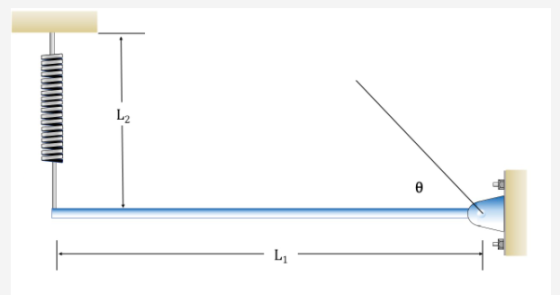
You are given a figure below. The bar moves from a position denoted by theta and stops at the horizontal position shown, That figure has 6 variables, mass, k, L1, L2, theta and unstretched length of the spring.. You will need to assign values to the 5 of the 6 variables and solve for the remaining variable. Make sure that your work is on engineering paper.
Homework Answers
Add Answer to:
You are given a figure below. The bar moves from a position
denoted by theta and...
You are given a figure below. The bar moves from a position denoted by theta and...
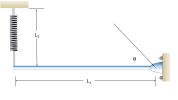 You are given a figure below. The bar moves from a position
denoted by theta and stops at the horizontal position shown, That
figure has 6 variables, mass, k, L1, L2, theta and unstretched
length of the spring.. You will need to assign values to the 5 of
the 6 variables and solve for the remaining variable. Make sure
that your work is on engineering paper.
L2 0 L
You are given a figure below. The bar moves from a position
denoted by theta and stops at the horizontal position shown, That
figure has 6 variables, mass, k, L1, L2, theta and unstretched
length of the spring.. You will need to assign values to the 5 of
the 6 variables and solve for the remaining variable. Make sure
that your work is on engineering paper.
L2 0 L
The bar, WA=100[lb] and L=3[ft], shown in figure is initially in the vertical position
 The bar, WA=100[lb] and L=3[ft], shown in figure is initially in the vertical position. The bar is subjected to a couple moment of M=20 [lb-ft] and a force F=50[l b], which is always perpendicular to the end of bar. Also, the spring is attached to bar at distance L / 2 from point A, and has unstretched length of l0=1.2[ft]. The spring remains in horizontal position throughout the motion due to the roller guide at B. Determine angular velocity of...
It is a kind of electromagnetic balance in the figure as shown below. A metal bar...
 It is a kind of electromagnetic balance in the figure as shown below. A metal bar connected to a constant current I is hanging on the right side. The area in the dashed box has a constant B-field, B = 800 T. Left arm has a length L1 = 2 m and right arm has a length L2 = 3 m. The horizontal length of the coil is 0.1 m. The total weight on the left side is m =...
(30 Pints) The 10-kg bar is released from the horizontal position when it is rested. The...
 (30 Pints) The 10-kg bar is released from the horizontal position when it is rested. The coefficient of restitution between the bar and bumper B is 0.5, and the duration of the impact is 5 ms. Determine the maximum angle of inclination of the bar subsequent to the impact and the average force exerted by the bumper during the impact. (you can assume that g 10 m/s?) 12 m 1.6m (20 Points) The bar AD is 5 kg and 2...
2. Figure 2 shows the mechanism for a door panel held in place by a bar...
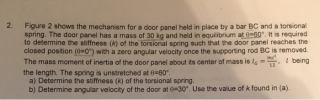 2. Figure 2 shows the mechanism for a door panel held in place by a bar BC and a torsional spring. The door panel has a mass of 30 kg and held in equilibrium at 0 60. It is required to determine the stiffness (k) of the torsional spring such that the door panel reaches the closed position (0-0") with a zero angular velocity once the supporting rod BC is removed. The mass moment of inertia of the door panel...
Need help in solving this. Please show work, thank you. Write out a hand solution for...
 Need help in solving this.
Please show work, thank you.
Write out a hand solution for the following problem. Given: L1 2 feet · L2 = 1 foot . L3 = 2 feet . The length of rope BD is 2.5 feet . The unstretched length of the spring AC is 2.5 feet . The spring constant for the spring is k- 10 lb/in. Find . The values of the weights hung and A & B (in pounds) . The...
Need help in solving this.
Please show work, thank you.
Write out a hand solution for the following problem. Given: L1 2 feet · L2 = 1 foot . L3 = 2 feet . The length of rope BD is 2.5 feet . The unstretched length of the spring AC is 2.5 feet . The spring constant for the spring is k- 10 lb/in. Find . The values of the weights hung and A & B (in pounds) . The...
I have been trying this problem for over 8 hours. How do I make the Matlab code for the given problem. It has to move. - Use the . You may use cif to clear the figure for the next instant of time...
 I have been trying this problem for over 8 hours. How
do I make the Matlab code for the given problem. It has to
move.
- Use the . You may use cif to clear the figure for the next instant of time The goal is the same as before except this time you will plot a moving 3 bar lin mechanism shown below kage. Use the L2 (k2,ya L3 The equations that govern the motion of this linkage are:...
I have been trying this problem for over 8 hours. How
do I make the Matlab code for the given problem. It has to
move.
- Use the . You may use cif to clear the figure for the next instant of time The goal is the same as before except this time you will plot a moving 3 bar lin mechanism shown below kage. Use the L2 (k2,ya L3 The equations that govern the motion of this linkage are:...
Thank you and I appreciate your help and time in advance! L = N (l/4), N...
 Thank you and I appreciate your help and time in advance!
L = N (l/4), N = 1, 3, 5
…
(1)
Where L is the length of the air column and N is an odd
integer.
When N = 1, the column has a length one quarter of wavelength
with a node at the water surface and an antinode at the opening.
Then the wavelength
L1= (1/4) l, or l=
4L1.
(2)
When N = 3, with...
Thank you and I appreciate your help and time in advance!
L = N (l/4), N = 1, 3, 5
…
(1)
Where L is the length of the air column and N is an odd
integer.
When N = 1, the column has a length one quarter of wavelength
with a node at the water surface and an antinode at the opening.
Then the wavelength
L1= (1/4) l, or l=
4L1.
(2)
When N = 3, with...
The figure below shows a plot of potential energy U versus position x of a 1.04...
 The figure below shows a plot of potential energy U
versus position x of a 1.04 kg particle that can travel
only along an x axis. (Nonconservative forces are not
involved.) In the graphs, the potential energies are
U1 = 15 J, U2 = 30 J, and
U3 = 40 J.
The figure below shows a plot of potential energy U versus position x of a 1.04 kg particle that can travel only along an x axis. (Nonconservative forces are...
The figure below shows a plot of potential energy U
versus position x of a 1.04 kg particle that can travel
only along an x axis. (Nonconservative forces are not
involved.) In the graphs, the potential energies are
U1 = 15 J, U2 = 30 J, and
U3 = 40 J.
The figure below shows a plot of potential energy U versus position x of a 1.04 kg particle that can travel only along an x axis. (Nonconservative forces are...
For the figure, what is the moment caused by the two forces F1 and Fall about...
 For the figure, what is the moment caused by the two forces F1 and Fall about a line starting at point P and extending to point Q? Use a Cartesian vector approach to solve this problem. Hint: It would be easier to find the resultant vector first, but it is not necessary Given: F1 F1= (2881 +691j -759 k) lb FAB = 2.7 kip • Point Q has coordinates of: (-0.250,3.750,-1.583) ft. A 4'-2" Note: In the US Customary (also...
 You are given a figure below. The bar moves from a position
denoted by theta and stops at the horizontal position shown, That
figure has 6 variables, mass, k, L1, L2, theta and unstretched
length of the spring.. You will need to assign values to the 5 of
the 6 variables and solve for the remaining variable. Make sure
that your work is on engineering paper.
L2 0 L
You are given a figure below. The bar moves from a position
denoted by theta and stops at the horizontal position shown, That
figure has 6 variables, mass, k, L1, L2, theta and unstretched
length of the spring.. You will need to assign values to the 5 of
the 6 variables and solve for the remaining variable. Make sure
that your work is on engineering paper.
L2 0 L
 The bar, WA=100[lb] and L=3[ft], shown in figure is initially in the vertical position. The bar is subjected to a couple moment of M=20 [lb-ft] and a force F=50[l b], which is always perpendicular to the end of bar. Also, the spring is attached to bar at distance L / 2 from point A, and has unstretched length of l0=1.2[ft]. The spring remains in horizontal position throughout the motion due to the roller guide at B. Determine angular velocity of...
 It is a kind of electromagnetic balance in the figure as shown below. A metal bar connected to a constant current I is hanging on the right side. The area in the dashed box has a constant B-field, B = 800 T. Left arm has a length L1 = 2 m and right arm has a length L2 = 3 m. The horizontal length of the coil is 0.1 m. The total weight on the left side is m =...
 (30 Pints) The 10-kg bar is released from the horizontal position when it is rested. The coefficient of restitution between the bar and bumper B is 0.5, and the duration of the impact is 5 ms. Determine the maximum angle of inclination of the bar subsequent to the impact and the average force exerted by the bumper during the impact. (you can assume that g 10 m/s?) 12 m 1.6m (20 Points) The bar AD is 5 kg and 2...
 2. Figure 2 shows the mechanism for a door panel held in place by a bar BC and a torsional spring. The door panel has a mass of 30 kg and held in equilibrium at 0 60. It is required to determine the stiffness (k) of the torsional spring such that the door panel reaches the closed position (0-0") with a zero angular velocity once the supporting rod BC is removed. The mass moment of inertia of the door panel...
 Need help in solving this.
Please show work, thank you.
Write out a hand solution for the following problem. Given: L1 2 feet · L2 = 1 foot . L3 = 2 feet . The length of rope BD is 2.5 feet . The unstretched length of the spring AC is 2.5 feet . The spring constant for the spring is k- 10 lb/in. Find . The values of the weights hung and A & B (in pounds) . The...
Need help in solving this.
Please show work, thank you.
Write out a hand solution for the following problem. Given: L1 2 feet · L2 = 1 foot . L3 = 2 feet . The length of rope BD is 2.5 feet . The unstretched length of the spring AC is 2.5 feet . The spring constant for the spring is k- 10 lb/in. Find . The values of the weights hung and A & B (in pounds) . The...
 I have been trying this problem for over 8 hours. How
do I make the Matlab code for the given problem. It has to
move.
- Use the . You may use cif to clear the figure for the next instant of time The goal is the same as before except this time you will plot a moving 3 bar lin mechanism shown below kage. Use the L2 (k2,ya L3 The equations that govern the motion of this linkage are:...
I have been trying this problem for over 8 hours. How
do I make the Matlab code for the given problem. It has to
move.
- Use the . You may use cif to clear the figure for the next instant of time The goal is the same as before except this time you will plot a moving 3 bar lin mechanism shown below kage. Use the L2 (k2,ya L3 The equations that govern the motion of this linkage are:...
 Thank you and I appreciate your help and time in advance!
L = N (l/4), N = 1, 3, 5
…
(1)
Where L is the length of the air column and N is an odd
integer.
When N = 1, the column has a length one quarter of wavelength
with a node at the water surface and an antinode at the opening.
Then the wavelength
L1= (1/4) l, or l=
4L1.
(2)
When N = 3, with...
Thank you and I appreciate your help and time in advance!
L = N (l/4), N = 1, 3, 5
…
(1)
Where L is the length of the air column and N is an odd
integer.
When N = 1, the column has a length one quarter of wavelength
with a node at the water surface and an antinode at the opening.
Then the wavelength
L1= (1/4) l, or l=
4L1.
(2)
When N = 3, with...
 The figure below shows a plot of potential energy U
versus position x of a 1.04 kg particle that can travel
only along an x axis. (Nonconservative forces are not
involved.) In the graphs, the potential energies are
U1 = 15 J, U2 = 30 J, and
U3 = 40 J.
The figure below shows a plot of potential energy U versus position x of a 1.04 kg particle that can travel only along an x axis. (Nonconservative forces are...
The figure below shows a plot of potential energy U
versus position x of a 1.04 kg particle that can travel
only along an x axis. (Nonconservative forces are not
involved.) In the graphs, the potential energies are
U1 = 15 J, U2 = 30 J, and
U3 = 40 J.
The figure below shows a plot of potential energy U versus position x of a 1.04 kg particle that can travel only along an x axis. (Nonconservative forces are...
 For the figure, what is the moment caused by the two forces F1 and Fall about a line starting at point P and extending to point Q? Use a Cartesian vector approach to solve this problem. Hint: It would be easier to find the resultant vector first, but it is not necessary Given: F1 F1= (2881 +691j -759 k) lb FAB = 2.7 kip • Point Q has coordinates of: (-0.250,3.750,-1.583) ft. A 4'-2" Note: In the US Customary (also...
Most questions answered within 3 hours.
-
Where is the error in this code sequence?
String s1 = "Hello";
String s2 = "ello";...
asked 10 months ago -
Financial data for Joel de Paris, Inc., for last year
follow:
Joel de Paris, Inc.
Balance...
asked 10 months ago -
Consider this reaction:
Al2(SO4)3 (aq)+ BaCl3
(aq) Al2Cl6 (aq)- +
3BaSO4(s) . What is the...
asked 10 months ago -
Suppose that Savneet is considering increasing her
recent random sample from 20 car rentals to 40...
asked 10 months ago -
Trucks arrive at an unloading terminal at an average rate of 120
per hour.
Trucks arrive...
asked 10 months ago -
Why are methanol and ethanol completely soluble in water while
octanol is not very little soluble....
asked 10 months ago -
A facilities manager at a university reads in a research report
that the mean amount of...
asked 10 months ago -
When the CuSO4 is rehydrated by adding water to the anhydrous
compound, is this an endothermic...
asked 10 months ago -
A ray of sunlight is passing from diamond into crown glass; the
angle of incidence is...
asked 10 months ago -
A block of mass 0.249 kg is placed on top of a light, vertical
spring of...
asked 10 months ago -
how do the kidneys compensate in the presences of acidosis
a) trigger hyperventilate
b) reserve acid...
asked 10 months ago -
Question 501 pts
The rental rate of capital to the firm increases. Which of the
following...
asked 10 months ago