
Homework Answers
Add Answer to:
Two identical 1350-kg automobiles A and B are at rest with their brakes released when B...
Two identical 1350-kg automobiles A and B are at rest with their brakes released when B...
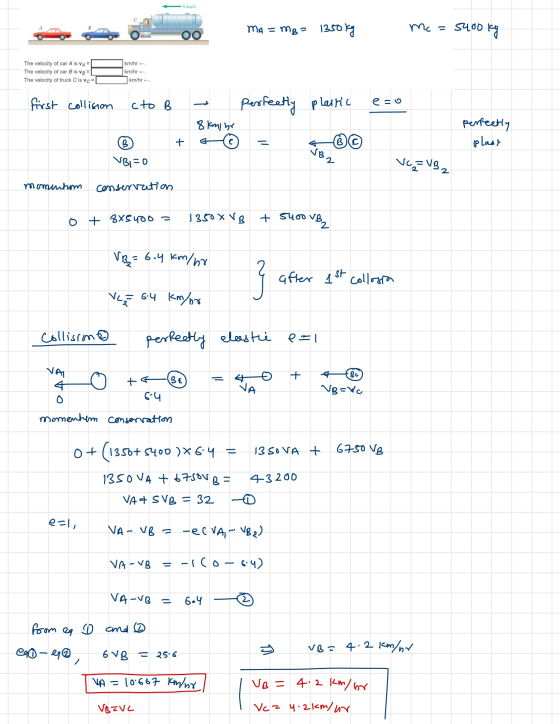
 Two identical 1350-kg automobiles A and B are at rest with their brakes released when B is struck by a 5500-kg truck C which is moving to the left at 8 km/h. A second collision then occurs when B strikes A. Assuming the first collision is perfectly plastic and the second collision is perfectly elastic, determine the velocities of the three vehicles just after the second collision. (Round the final answers to two decimal places.) - 8 km The velocity...
5. A runaway truck with a mass of 2100 kg strikes a car of mass 1350...
5. A runaway truck with a mass of 2100 kg strikes a car of mass 1350 kg, which was at rest before the collision. The car’s wheels are locked during the entire event, but the truck has no brakes, i.e., it is rolling freely on the road. The two vehicles move forward together, and the car’s tires leave skid marks for a distance of 1.5 m. Suppose that the coefficient of kinetic friction between the car’s tires and the road...
A truck with a mass of 1300 kg and moving with a speed of 12.0 m/s...
 A truck with a mass of 1300 kg and moving with a speed of 12.0 m/s rear-ends a 843 kg car stopped at an intersection. The collision is approximately elastic since the car is in neutral, the brakes are off, the metal bumpers line up well and do not get damaged. Find the speed of both vehicles after the collision in meters per second A 61.0 kg ice hockey goalie, originally at rest, catches a 0.150 kg hockey puck slapped...
14.41.In a game of pool, ball A is moving with a velocity Vo of magnitude vo...
 14.41.In a game of pool, ball A is moving with a velocity Vo of magnitude vo 15 ft/s when it strikes balls B and C, which are at rest and aligned as shown. Knowing that after the collision the three balls move in the directions indicated and assuming frictionless surfaces and perfectly elastic impact (i.e., conservation of energy), determine the magnitudes of the velocities vA, VB, and vc. 10.61 ft/s, 5.30 ft/s, 9.19 ft/s] 300 45° 30
Two identical cars A and B are at rest on a loading dock with brakes released....
 Two identical cars A and B are at rest on a loading dock with brakes released. Car C, of a slightly different style but of the same weight, has been pushed by dock workers and hits car B with a velocity of 1.75 m/s. Knowing that the coefficient of restitution is 0.8 between B and C and 0.5 between A and B. determine the velocity of each car after all collisions have taken place (Round your answer to three decimal...
A truck with a mass of 1710 kg and moving with a speed of 14.0 m/s...
 A truck with a mass of 1710 kg and moving with a speed of 14.0 m/s rear-ends a 613 kg car stopped at an intersection. The collision is approximately elastic since the car is in neutral, the brakes are off, the metal bumpers line up well and do not get damaged. Find the speed of both vehicles after the collision in meters per second. m/s truck m/s car As shown in the figure below, object m, = 1.50 kg starts...
Two identical cars A and B are at rest on a loading dock with brakes released....
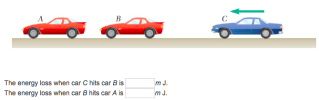 Two identical cars A and B are at rest on a loading dock with
brakes released. Car C, of a slightly different style but of the
same weight, has been pushed by dockworkers and hits car B with a
velocity of 4 m/s. Knowing that the coefficient of restitution is
0.8 between B and C and 0.5 between A and B, determine the energy
lost as a result of the series of collisions. (Round the final
answer to three decimal...
Two identical cars A and B are at rest on a loading dock with
brakes released. Car C, of a slightly different style but of the
same weight, has been pushed by dockworkers and hits car B with a
velocity of 4 m/s. Knowing that the coefficient of restitution is
0.8 between B and C and 0.5 between A and B, determine the energy
lost as a result of the series of collisions. (Round the final
answer to three decimal...
Two bodies, A and B each of mass 2.0 kg moving with velocities vA = (2.0i...
Two bodies, A and B each of mass 2.0 kg moving with velocities vA = (2.0i ˆ + 5.0j) m/s and vB = (1.0i ˆ – 5.0j) m/s collide and stick together. After the collision, what is the velocity of the composite object?
Two cars are waiting for a stoplight to turn green. When it does, the first car...
Two cars are waiting for a stoplight to turn green. When it does, the first car (1213 kg) remains at rest because the driver is reading their texts. Assuming the first driver is paying attention, the second car (1615 kg) accelerates and collides with the first driver right when the first driver releases the brakes but is still at rest. This makes the collision effectively elastic. If the cars collide at a speed of 15.4 km/h, and are in contact...
 Two identical 1350-kg automobiles A and B are at rest with their brakes released when B is struck by a 5500-kg truck C which is moving to the left at 8 km/h. A second collision then occurs when B strikes A. Assuming the first collision is perfectly plastic and the second collision is perfectly elastic, determine the velocities of the three vehicles just after the second collision. (Round the final answers to two decimal places.) - 8 km The velocity...
 A truck with a mass of 1300 kg and moving with a speed of 12.0 m/s rear-ends a 843 kg car stopped at an intersection. The collision is approximately elastic since the car is in neutral, the brakes are off, the metal bumpers line up well and do not get damaged. Find the speed of both vehicles after the collision in meters per second A 61.0 kg ice hockey goalie, originally at rest, catches a 0.150 kg hockey puck slapped...
 14.41.In a game of pool, ball A is moving with a velocity Vo of magnitude vo 15 ft/s when it strikes balls B and C, which are at rest and aligned as shown. Knowing that after the collision the three balls move in the directions indicated and assuming frictionless surfaces and perfectly elastic impact (i.e., conservation of energy), determine the magnitudes of the velocities vA, VB, and vc. 10.61 ft/s, 5.30 ft/s, 9.19 ft/s] 300 45° 30
 Two identical cars A and B are at rest on a loading dock with brakes released. Car C, of a slightly different style but of the same weight, has been pushed by dock workers and hits car B with a velocity of 1.75 m/s. Knowing that the coefficient of restitution is 0.8 between B and C and 0.5 between A and B. determine the velocity of each car after all collisions have taken place (Round your answer to three decimal...
 A truck with a mass of 1710 kg and moving with a speed of 14.0 m/s rear-ends a 613 kg car stopped at an intersection. The collision is approximately elastic since the car is in neutral, the brakes are off, the metal bumpers line up well and do not get damaged. Find the speed of both vehicles after the collision in meters per second. m/s truck m/s car As shown in the figure below, object m, = 1.50 kg starts...
 Two identical cars A and B are at rest on a loading dock with
brakes released. Car C, of a slightly different style but of the
same weight, has been pushed by dockworkers and hits car B with a
velocity of 4 m/s. Knowing that the coefficient of restitution is
0.8 between B and C and 0.5 between A and B, determine the energy
lost as a result of the series of collisions. (Round the final
answer to three decimal...
Two identical cars A and B are at rest on a loading dock with
brakes released. Car C, of a slightly different style but of the
same weight, has been pushed by dockworkers and hits car B with a
velocity of 4 m/s. Knowing that the coefficient of restitution is
0.8 between B and C and 0.5 between A and B, determine the energy
lost as a result of the series of collisions. (Round the final
answer to three decimal...
Most questions answered within 3 hours.
-
Where is the error in this code sequence?
String s1 = "Hello";
String s2 = "ello";...
asked 11 months ago -
Financial data for Joel de Paris, Inc., for last year
follow:
Joel de Paris, Inc.
Balance...
asked 11 months ago -
Consider this reaction:
Al2(SO4)3 (aq)+ BaCl3
(aq) Al2Cl6 (aq)- +
3BaSO4(s) . What is the...
asked 11 months ago -
Suppose that Savneet is considering increasing her
recent random sample from 20 car rentals to 40...
asked 11 months ago -
Trucks arrive at an unloading terminal at an average rate of 120
per hour.
Trucks arrive...
asked 11 months ago -
Why are methanol and ethanol completely soluble in water while
octanol is not very little soluble....
asked 11 months ago -
A facilities manager at a university reads in a research report
that the mean amount of...
asked 11 months ago -
When the CuSO4 is rehydrated by adding water to the anhydrous
compound, is this an endothermic...
asked 11 months ago -
A ray of sunlight is passing from diamond into crown glass; the
angle of incidence is...
asked 11 months ago -
A block of mass 0.249 kg is placed on top of a light, vertical
spring of...
asked 11 months ago -
how do the kidneys compensate in the presences of acidosis
a) trigger hyperventilate
b) reserve acid...
asked 11 months ago -
Question 501 pts
The rental rate of capital to the firm increases. Which of the
following...
asked 11 months ago