


Homework Answers
Add Answer to:
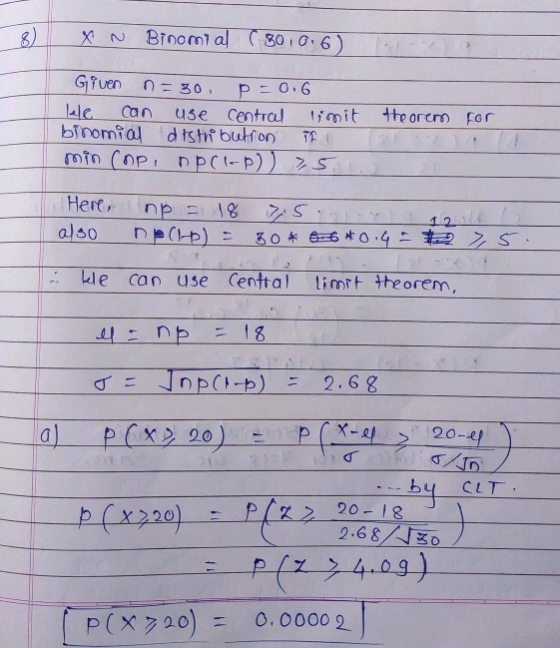
8. (15 points) Let X ~ Binomial(30,0.6). (a) (5 points) Using the Central Limit Theorem (CLT),...
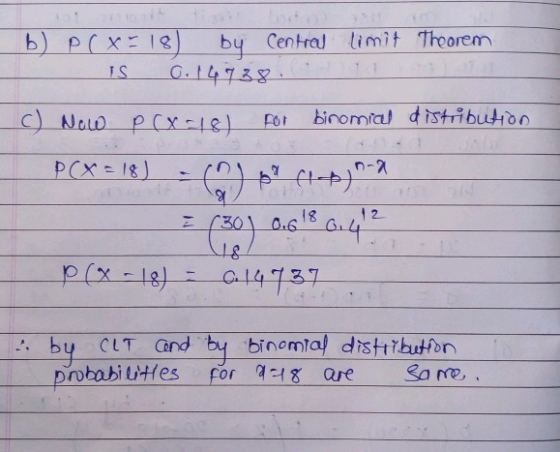
(b) (5 points) Using CLT, approximate the probability that P(X = 18). (c) (5 points) Calculate...
 (b) (5 points) Using CLT, approximate the probability that P(X =
18).
(c) (5 points) Calculate P(X = 18) exactly and compare to
part(b).
8. (15 points) Let X~Binomial(30,0.6). (a) (5 points) Using the Central Limit Theorem (CLT), approximate the probability that P(X > 20).
(b) (5 points) Using CLT, approximate the probability that P(X =
18).
(c) (5 points) Calculate P(X = 18) exactly and compare to
part(b).
8. (15 points) Let X~Binomial(30,0.6). (a) (5 points) Using the Central Limit Theorem (CLT), approximate the probability that P(X > 20).
8. Using Minitab to illustrate the Central Limit Theorem (CLT), the CLT tells us about the...
 8. Using Minitab to illustrate the Central Limit Theorem (CLT), the CLT tells us about the sampling distribution of the sample mean. With Minitab we can easily "sample" from a population with known properties (4,0 , shape). a. Our population consists of integer values X from 1 through 8, all equally likely P(x) = 1/8; x = 1, 2, 3, 4, 5, 6, 7, 8 o = 2.29 Using methods from the beginning of Chapter 4 in the textbook, find...
(1) (a) Argue using the Central Limit Theorem that one may approximate X ~ by a normal law when n is large. (b) Under the CLT approximation, find a so that P(X > a)- 10 (1) (a) Argue using...
 (1) (a) Argue using the Central Limit Theorem that one may approximate X ~ by a normal law when n is large. (b) Under the CLT approximation, find a so that P(X > a)- 10
(1) (a) Argue using the Central Limit Theorem that one may approximate X ~ by a normal law when n is large. (b) Under the CLT approximation, find a so that P(X > a)- 10
(1) (a) Argue using the Central Limit Theorem that one may approximate X ~ by a normal law when n is large. (b) Under the CLT approximation, find a so that P(X > a)- 10
(Using Central Limit Theorem) Let S100 sum of 100 independent Bernoulli (toss a coin) random variables....
(Using Central Limit Theorem) Let S100 sum of 100 independent Bernoulli (toss a coin) random variables. 1. Find P(S 100 > 55) exactly using Minitab CDF command (Binomial n=100, p=0.5). 2. Approximate this probability using bell curve approximation--Normal mean = 0 and standard deviation 1.
(d) Explain briefly the Central Limit Theorem. Using this theorem, how can you approximate the Binomial...
 (d) Explain briefly the Central Limit Theorem. Using this theorem, how can you approximate the Binomial distribution?
Why is the Central Limit Theorem useful? [Q8P5.3] a. Because when the conditions for the CLT...
 Why is the Central Limit Theorem useful? [Q8P5.3] a. Because when the conditions for the CLT are met, it allows us to use a Normal distribution to approximate the distribution of the whole population, even if we don't know whether the population follows a Normal distribution. Because when the conditions of the CLT are met, it allows us to calculate the area in the tails of the population distribution and therefore the probability of obtaining an observation as or more...
6. In this question, you are going to study the approximation to binomial probabilities using the...
 6. In this question, you are going to study the approximation to binomial probabilities using the nor mal distribution. The binomial distribution is discrete while the normal distribution is continuous Therefore, we would expect some issues with approximating the binomial with the normal. (a) (2 points) Suppose X ~ Bin (25,04). Calculate E (N) and Var . (b) (4 points) Use the central lit theorem along with (a) to approximate Pr (X 8). Compare this with your result in #4(a)....
Please use the central limit theorem. 9.14 A baseball player has a batting average of 0.328....
 Please use the central limit
theorem.
9.14 A baseball player has a batting average of 0.328. Let X be the number of hits the player gets during 20 times at bat. Use the central limit theorem to find the approximate probability P(X<k) for k = 1, 3, 6. Compare with the exact probability for each k. Problem 9.14. The problem assumes that the batter's probability of getting a hit stays constant at p=0.328 while he comes up to bat 20...
Please use the central limit
theorem.
9.14 A baseball player has a batting average of 0.328. Let X be the number of hits the player gets during 20 times at bat. Use the central limit theorem to find the approximate probability P(X<k) for k = 1, 3, 6. Compare with the exact probability for each k. Problem 9.14. The problem assumes that the batter's probability of getting a hit stays constant at p=0.328 while he comes up to bat 20...
Central Limit Theorem (CLT) 1. The CLT states: draw all possible samples of size _____________ from...
Central Limit Theorem (CLT) 1. The CLT states: draw all possible samples of size _____________ from a population. The result will be the sampling distribution of the means will approach the ___________________- as the sample size, n, increases. 2. The CLT tells us we can make probability statements about the mean using the normal distribution even though we know nothing about the ______________-
Consider the Central Limit Theorem (CLT). Fill in the appropriate variable or formula. Standard Error Standard...
Consider the Central Limit Theorem (CLT). Fill in the appropriate variable or formula. Standard Error Standard deviation of the x distribution Mean of the x distribution sample size Using the CLT to convert the x distribution to the standard normal distribution µ is equal to Considering the CLT, the standard z-distribution formula:
 (b) (5 points) Using CLT, approximate the probability that P(X =
18).
(c) (5 points) Calculate P(X = 18) exactly and compare to
part(b).
8. (15 points) Let X~Binomial(30,0.6). (a) (5 points) Using the Central Limit Theorem (CLT), approximate the probability that P(X > 20).
(b) (5 points) Using CLT, approximate the probability that P(X =
18).
(c) (5 points) Calculate P(X = 18) exactly and compare to
part(b).
8. (15 points) Let X~Binomial(30,0.6). (a) (5 points) Using the Central Limit Theorem (CLT), approximate the probability that P(X > 20).
 8. Using Minitab to illustrate the Central Limit Theorem (CLT), the CLT tells us about the sampling distribution of the sample mean. With Minitab we can easily "sample" from a population with known properties (4,0 , shape). a. Our population consists of integer values X from 1 through 8, all equally likely P(x) = 1/8; x = 1, 2, 3, 4, 5, 6, 7, 8 o = 2.29 Using methods from the beginning of Chapter 4 in the textbook, find...
 (1) (a) Argue using the Central Limit Theorem that one may approximate X ~ by a normal law when n is large. (b) Under the CLT approximation, find a so that P(X > a)- 10
(1) (a) Argue using the Central Limit Theorem that one may approximate X ~ by a normal law when n is large. (b) Under the CLT approximation, find a so that P(X > a)- 10
(1) (a) Argue using the Central Limit Theorem that one may approximate X ~ by a normal law when n is large. (b) Under the CLT approximation, find a so that P(X > a)- 10
 (d) Explain briefly the Central Limit Theorem. Using this theorem, how can you approximate the Binomial distribution?
 Why is the Central Limit Theorem useful? [Q8P5.3] a. Because when the conditions for the CLT are met, it allows us to use a Normal distribution to approximate the distribution of the whole population, even if we don't know whether the population follows a Normal distribution. Because when the conditions of the CLT are met, it allows us to calculate the area in the tails of the population distribution and therefore the probability of obtaining an observation as or more...
 6. In this question, you are going to study the approximation to binomial probabilities using the nor mal distribution. The binomial distribution is discrete while the normal distribution is continuous Therefore, we would expect some issues with approximating the binomial with the normal. (a) (2 points) Suppose X ~ Bin (25,04). Calculate E (N) and Var . (b) (4 points) Use the central lit theorem along with (a) to approximate Pr (X 8). Compare this with your result in #4(a)....
 Please use the central limit
theorem.
9.14 A baseball player has a batting average of 0.328. Let X be the number of hits the player gets during 20 times at bat. Use the central limit theorem to find the approximate probability P(X<k) for k = 1, 3, 6. Compare with the exact probability for each k. Problem 9.14. The problem assumes that the batter's probability of getting a hit stays constant at p=0.328 while he comes up to bat 20...
Please use the central limit
theorem.
9.14 A baseball player has a batting average of 0.328. Let X be the number of hits the player gets during 20 times at bat. Use the central limit theorem to find the approximate probability P(X<k) for k = 1, 3, 6. Compare with the exact probability for each k. Problem 9.14. The problem assumes that the batter's probability of getting a hit stays constant at p=0.328 while he comes up to bat 20...
Most questions answered within 3 hours.
-
Where is the error in this code sequence?
String s1 = "Hello";
String s2 = "ello";...
asked 11 months ago -
Financial data for Joel de Paris, Inc., for last year
follow:
Joel de Paris, Inc.
Balance...
asked 11 months ago -
Consider this reaction:
Al2(SO4)3 (aq)+ BaCl3
(aq) Al2Cl6 (aq)- +
3BaSO4(s) . What is the...
asked 11 months ago -
Suppose that Savneet is considering increasing her
recent random sample from 20 car rentals to 40...
asked 11 months ago -
Trucks arrive at an unloading terminal at an average rate of 120
per hour.
Trucks arrive...
asked 11 months ago -
Why are methanol and ethanol completely soluble in water while
octanol is not very little soluble....
asked 11 months ago -
A facilities manager at a university reads in a research report
that the mean amount of...
asked 11 months ago -
When the CuSO4 is rehydrated by adding water to the anhydrous
compound, is this an endothermic...
asked 11 months ago -
A ray of sunlight is passing from diamond into crown glass; the
angle of incidence is...
asked 11 months ago -
A block of mass 0.249 kg is placed on top of a light, vertical
spring of...
asked 11 months ago -
how do the kidneys compensate in the presences of acidosis
a) trigger hyperventilate
b) reserve acid...
asked 11 months ago -
Question 501 pts
The rental rate of capital to the firm increases. Which of the
following...
asked 11 months ago