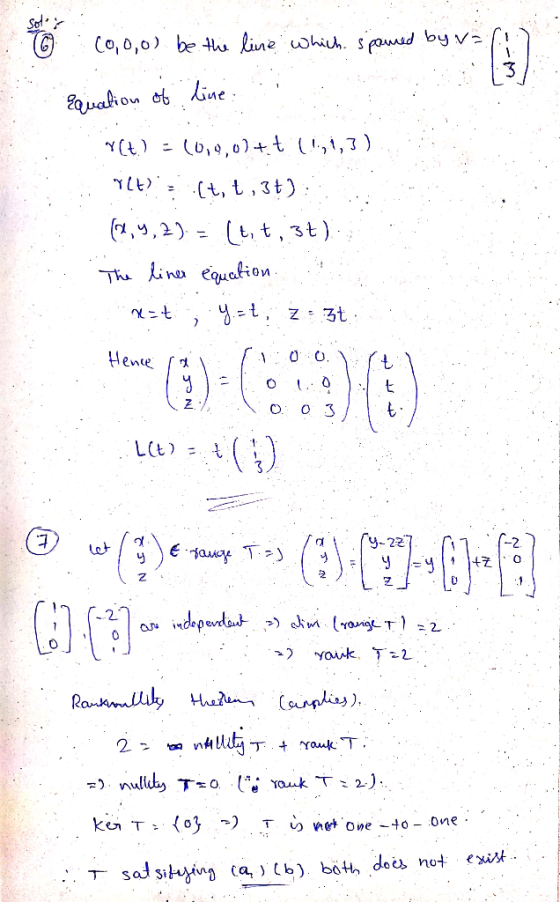
Let L in R 3 be the line through the origin spanned by the vector v = 1 1 3 . Find the linear equations that define L, i.e., find a system of linear equations whose solutions are the points in L. (7) Give an example of a linear transformation from T : R 2 → R 3 with the following two properties: (a) T is not one-to-one, and (b) range(T) = x y z ∈ R 3 : x − y + 2z = 0 ; or explain why this is not possible. If you give an example, you must include an explanation for why your linear transformation has the desired properties.

Homework Answers
Please comment if you need any clarification.
If you find my answer useful please put thumbs up. Thank you.
Add Answer to:
Let L in R 3 be the line through the origin spanned by the
vector v...
Let L in R 3 be the line through the origin spanned by the vector v...
 Let L in R 3 be the line through the origin
spanned by the vector v = 1 1 3 . Find the linear equations
that define L, i.e., find a system of linear equations whose
solutions are the points in L.
lil (6) Let L in R3 be the line through the origin spanned by the vector v= 1. Find the linear equations that define L, i.e., find a system of linear equations whose solutions are...
Let L in R 3 be the line through the origin
spanned by the vector v = 1 1 3 . Find the linear equations
that define L, i.e., find a system of linear equations whose
solutions are the points in L.
lil (6) Let L in R3 be the line through the origin spanned by the vector v= 1. Find the linear equations that define L, i.e., find a system of linear equations whose solutions are...
Problem 13. Let l be the line in R' spanned by the vector u = 3...
 Problem 13. Let l be the line in R' spanned by the vector u = 3 and let P:R -R be the projection onto line l. We have seen that projection onto a line is a linear transformation (also see page 218 example 3.59). a). Find the standard matrix representation of P by finding the images of the standard basis vectors e, e, and e, under the transformation P. b). Find the standard matrix representation of P by the second...
Let l denote the line through the origin with direction vector (1,1,1). Let r(t) = (t...
 Let l denote the line through the origin with direction vector (1,1,1). Let r(t) = (t +1,4, 2t) be a parametrized curve. Compute the point r(to) on the curve which is closest to l, and state the distance from r(to) to l.
6. Let L be the line in spanned by the vector u =(1,-1,2). (a) (6 points)...
 6. Let L be the line in spanned by the vector u =(1,-1,2). (a) (6 points) Compute a basis for the subspace Zt. 7. (6 point bonus! Find the general solution y to the second-order linear differential equa- tion below. Use C.C.C.... for the names of any unknown constants. 0-1 + 424 = 0 (b) (6 points Use the Gram-Schuit process to find an orthonormal basis for L,
Problem 4. Let V be a vector space and let T : V → V and U : V → V be two linear transforinations...
 I need the answer to problem 6
Clear and step by step please
Problem 4. Let V be a vector space and let T : V → V and U : V → V be two linear transforinations 1. Show that. TU is also a linear transformation. 2. Show that aT is a linear transformation for any scalar a. 3. Suppose that T is invertible. Show that T-1 is also a linear transformation. Problem 5. Let T : R3 →...
I need the answer to problem 6
Clear and step by step please
Problem 4. Let V be a vector space and let T : V → V and U : V → V be two linear transforinations 1. Show that. TU is also a linear transformation. 2. Show that aT is a linear transformation for any scalar a. 3. Suppose that T is invertible. Show that T-1 is also a linear transformation. Problem 5. Let T : R3 →...
3. (6 marks) Find an example of a vector space V, and a linear transformation T...
 3. (6 marks) Find an example of a vector space V, and a linear transformation T : V + V such that R(T) = ker(T). Your vector space V must have dimension > 2. You may find it helpful to let V be a euclidean space and T a matrix transformation, but that is not necessary. You must explain why your example works.
3. (6 marks) Find an example of a vector space V, and a linear transformation T...
 3. (6 marks) Find an example of a vector space V, and a linear transformation T : V +V such that R(T) = ker(T). Your vector space V must have dimension > 2. You may find it helpful to let V be a euclidean space and T a matrix transformation, but that is not necessary. You must explain why your example works.
Let u= -3 2 4 ; and let L denote the line thru the origin of R3 in the direction of u. The proj...
Let u= -3 2 4 ; and let L denote the line thru the origin of R3 in the direction of u. The projection of R3 onto L — denoted PL : R3 −→ R3 — is definded to be equal to the projection pu onto the vector u. You may assume that PL is a linear transformation. Find the standard matrix [PL] for PL.
W is a rele that A linear transformation T from a vector space V into a...
 W is a rele that A linear transformation T from a vector space V into a vector space assigns to each vector 2 in V a unique vector T() in W. such that (1) Tutu = Tu+Tv for all uv in V, and (2) Tſcu)=cT(u) for all u in V and all scalar c. *** The kernel of T = {UE V , T(U)=0} The range of T = {T(U) EW , ue V } Define T :P, - R...
Let A= and 6 = Define the linear transformation T:R? +R by T'(X) = Ai. Find...
 Let A= and 6 = Define the linear transformation T:R? +R by T'(X) = Ai. Find a vector # whose image under T' is 6. Is the vector i unique choose choose unique Submit answer not unique
 Let L in R 3 be the line through the origin
spanned by the vector v = 1 1 3 . Find the linear equations
that define L, i.e., find a system of linear equations whose
solutions are the points in L.
lil (6) Let L in R3 be the line through the origin spanned by the vector v= 1. Find the linear equations that define L, i.e., find a system of linear equations whose solutions are...
Let L in R 3 be the line through the origin
spanned by the vector v = 1 1 3 . Find the linear equations
that define L, i.e., find a system of linear equations whose
solutions are the points in L.
lil (6) Let L in R3 be the line through the origin spanned by the vector v= 1. Find the linear equations that define L, i.e., find a system of linear equations whose solutions are...
 Problem 13. Let l be the line in R' spanned by the vector u = 3 and let P:R -R be the projection onto line l. We have seen that projection onto a line is a linear transformation (also see page 218 example 3.59). a). Find the standard matrix representation of P by finding the images of the standard basis vectors e, e, and e, under the transformation P. b). Find the standard matrix representation of P by the second...
 Let l denote the line through the origin with direction vector (1,1,1). Let r(t) = (t +1,4, 2t) be a parametrized curve. Compute the point r(to) on the curve which is closest to l, and state the distance from r(to) to l.
 6. Let L be the line in spanned by the vector u =(1,-1,2). (a) (6 points) Compute a basis for the subspace Zt. 7. (6 point bonus! Find the general solution y to the second-order linear differential equa- tion below. Use C.C.C.... for the names of any unknown constants. 0-1 + 424 = 0 (b) (6 points Use the Gram-Schuit process to find an orthonormal basis for L,
 I need the answer to problem 6
Clear and step by step please
Problem 4. Let V be a vector space and let T : V → V and U : V → V be two linear transforinations 1. Show that. TU is also a linear transformation. 2. Show that aT is a linear transformation for any scalar a. 3. Suppose that T is invertible. Show that T-1 is also a linear transformation. Problem 5. Let T : R3 →...
I need the answer to problem 6
Clear and step by step please
Problem 4. Let V be a vector space and let T : V → V and U : V → V be two linear transforinations 1. Show that. TU is also a linear transformation. 2. Show that aT is a linear transformation for any scalar a. 3. Suppose that T is invertible. Show that T-1 is also a linear transformation. Problem 5. Let T : R3 →...
 3. (6 marks) Find an example of a vector space V, and a linear transformation T : V + V such that R(T) = ker(T). Your vector space V must have dimension > 2. You may find it helpful to let V be a euclidean space and T a matrix transformation, but that is not necessary. You must explain why your example works.
 3. (6 marks) Find an example of a vector space V, and a linear transformation T : V +V such that R(T) = ker(T). Your vector space V must have dimension > 2. You may find it helpful to let V be a euclidean space and T a matrix transformation, but that is not necessary. You must explain why your example works.
 W is a rele that A linear transformation T from a vector space V into a vector space assigns to each vector 2 in V a unique vector T() in W. such that (1) Tutu = Tu+Tv for all uv in V, and (2) Tſcu)=cT(u) for all u in V and all scalar c. *** The kernel of T = {UE V , T(U)=0} The range of T = {T(U) EW , ue V } Define T :P, - R...
 Let A= and 6 = Define the linear transformation T:R? +R by T'(X) = Ai. Find a vector # whose image under T' is 6. Is the vector i unique choose choose unique Submit answer not unique
Most questions answered within 3 hours.
-
Where is the error in this code sequence?
String s1 = "Hello";
String s2 = "ello";...
asked 10 months ago -
Financial data for Joel de Paris, Inc., for last year
follow:
Joel de Paris, Inc.
Balance...
asked 10 months ago -
Consider this reaction:
Al2(SO4)3 (aq)+ BaCl3
(aq) Al2Cl6 (aq)- +
3BaSO4(s) . What is the...
asked 10 months ago -
Suppose that Savneet is considering increasing her
recent random sample from 20 car rentals to 40...
asked 10 months ago -
Trucks arrive at an unloading terminal at an average rate of 120
per hour.
Trucks arrive...
asked 10 months ago -
Why are methanol and ethanol completely soluble in water while
octanol is not very little soluble....
asked 10 months ago -
A facilities manager at a university reads in a research report
that the mean amount of...
asked 10 months ago -
When the CuSO4 is rehydrated by adding water to the anhydrous
compound, is this an endothermic...
asked 10 months ago -
A ray of sunlight is passing from diamond into crown glass; the
angle of incidence is...
asked 10 months ago -
A block of mass 0.249 kg is placed on top of a light, vertical
spring of...
asked 10 months ago -
how do the kidneys compensate in the presences of acidosis
a) trigger hyperventilate
b) reserve acid...
asked 10 months ago -
Question 501 pts
The rental rate of capital to the firm increases. Which of the
following...
asked 10 months ago