![(5a) Compute ([1,2], [0, 3]) for the inner product (x,y) = x,yz + x2y2 (5b) Compute (1,x) for the inner product (f,g) = 5,«f](http://img.homeworklib.com/questions/3937c140-e01a-11ea-8ead-45673a505a9b.png?x-oss-process=image/resize,w_560)
Homework Answers
![Ans:- 5 al confute <[1,2], 10,3]} inner Prodect is (nu7 = 2xy +H2Y2 11,21, [0,3]) = Ixo + 2*3 6 So (b) <1,27 { take fini=1, g](http://img.homeworklib.com/questions/a6eecd80-e01a-11ea-9dc6-419eeb567a91.png?x-oss-process=image/resize,w_560)
![[ ( ) - (-) + 9- (-)] (-) + (-4) + 4, (-)] 중 + 9, (+) - 0 59, 3 qot 이 + , 42 ① 1 2 1 0 Similany 39, y is orthogonal so NA(N)](http://img.homeworklib.com/questions/a7f08790-e01a-11ea-86ce-77eb032d2a7a.png?x-oss-process=image/resize,w_560)
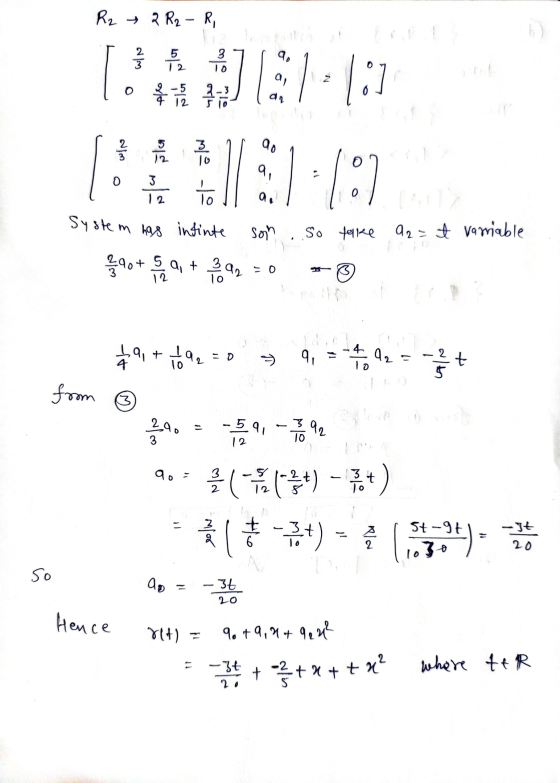
![take Then {p.983 in orthogonal set - [ 4,5] { 1,03 is ortnogal so < Pory o ( 3 P=[1,2]) <[1,2], 19, 6] >=0 9t2b =0 0 ş qr3 is](http://img.homeworklib.com/questions/aab94f00-e01a-11ea-b531-a32bb601248e.png?x-oss-process=image/resize,w_560)
Add Answer to:
kindly solve asap all problems
(5a) Compute ([1,2], [0, 3]) for the inner product (x,y) =...
6. Let p;(xi = 0,... , n}, with degp;(x) = i, be a set of orthogonal polynomials with respect to the inner product f f(...
 6. Let p;(xi = 0,... , n}, with degp;(x) = i, be a set of orthogonal polynomials with respect to the inner product f f(x)g(x) dx. Given a < b, let q(x) be the line mapping a to -1 and b to 1. Prove {p;(q(x))|i = 0,... , n} is a set of orthogonal polynomials with respect to the inner product f(x)g(x) dz, satisfying deg p;(q(x))= i -
6. Let p;(xi = 0,... , n}, with degp;(x) = i, be...
6. Let p;(xi = 0,... , n}, with degp;(x) = i, be a set of orthogonal polynomials with respect to the inner product f f(x)g(x) dx. Given a < b, let q(x) be the line mapping a to -1 and b to 1. Prove {p;(q(x))|i = 0,... , n} is a set of orthogonal polynomials with respect to the inner product f(x)g(x) dz, satisfying deg p;(q(x))= i -
6. Let p;(xi = 0,... , n}, with degp;(x) = i, be...
1.(16) Let P be an inner product space with an inner product defined as <.g >...
 1.(16) Let P be an inner product space with an inner product defined as <.g > Ox)g(x)dx a) Let / =1+x.8=-2+x-x. Compute: <.8 >. The angle between / and g, and proj, b) Let h=1+ mx' in P Find m such that and h are orthogonal c) Let B = (1+x.I-XX+X' is a basis for P. Use the Gram-Schmidt process to covert B to an orthogonal basis for P. 2. Suppose and ware vectors in an inner product space V...
5. (15') Define the inner-product on C([-1,1]), the space of all continuous functions on the interval...
 5. (15') Define the inner-product on C([-1,1]), the space of all continuous functions on the interval [-1,1], by (f(a), g(x) = $ $(a)g(x) dr. (a) Use Gram-Schmidt algorithm to convert the set {1,1 + ,(1+x)?} to an orthogonal set. (b) Is the set you found in Part (a) still orthogonal if the interval of integral in the definition of inner-product is changed to [0, 1]? Explain your an answer.
2. (a) Prove that 1 (f, g)=| x2 f(x)g(x)dx is an inner product on the vector space C(I-1,1) of co...
 NEED (B) AND (C)
2. (a) Prove that 1 (f, g)=| x2 f(x)g(x)dx is an inner product on the vector space C(I-1,1) of continuous real-valued funo- tions on the domain [-1, 1] (b) Use the Gram-Schmidt process to find an orthonormal basis for P2(R) with re- spect to this inner product (c) Find a polynomial q(x) such that for every p E P2R
2. (a) Prove that 1 (f, g)=| x2 f(x)g(x)dx is an inner product on the vector space...
NEED (B) AND (C)
2. (a) Prove that 1 (f, g)=| x2 f(x)g(x)dx is an inner product on the vector space C(I-1,1) of continuous real-valued funo- tions on the domain [-1, 1] (b) Use the Gram-Schmidt process to find an orthonormal basis for P2(R) with re- spect to this inner product (c) Find a polynomial q(x) such that for every p E P2R
2. (a) Prove that 1 (f, g)=| x2 f(x)g(x)dx is an inner product on the vector space...
Question 3. Let 3 5/' and for x(2),y -(,) ER2 define (a) Show that the assignment (x, y) > (x,y) defined ın (1) us an nner product [10 marks (b) If a - (1,-1) and b - (1,1), then show that the...
 Question 3. Let 3 5/' and for x(2),y -(,) ER2 define (a) Show that the assignment (x, y) > (x,y) defined ın (1) us an nner product [10 marks (b) If a - (1,-1) and b - (1,1), then show that the vectors a and b are lınearly ndependent but they are not orthogonal with respect to the inner product n (1) 3 marks] (c) Given the vectors a and b in (b), the set (a, by is hence a...
interval-1,1. If f.geCL1.], we'l 7) The field of play is Cil the space of all functions that are continuous on...
 interval-1,1. If f.geCL1.], we'l 7) The field of play is Cil the space of all functions that are continuous on the define the inner product as (f,g)= f'f(x)g(x)dx. The question is simply this: Find the orthogonal projection of e" onto P, and graph both functions on [-2,2].
interval-1,1. If f.geCL1.], we'l 7) The field of play is Cil the space of all functions that are continuous on the define the inner product as (f,g)= f'f(x)g(x)dx. The question is simply this:...
interval-1,1. If f.geCL1.], we'l 7) The field of play is Cil the space of all functions that are continuous on the define the inner product as (f,g)= f'f(x)g(x)dx. The question is simply this: Find the orthogonal projection of e" onto P, and graph both functions on [-2,2].
interval-1,1. If f.geCL1.], we'l 7) The field of play is Cil the space of all functions that are continuous on the define the inner product as (f,g)= f'f(x)g(x)dx. The question is simply this:...
5) In C.), with inner product <f,g> [f(x)g(x)dx, let f(x) = x², g(x)= x', a) Compute<...
 5) In C.), with inner product <f,g> [f(x)g(x)dx, let f(x) = x², g(x)= x', a) Compute< x², x? >; 0 b) Find the “angle” between the two functions.
5. (15') Define the inner-product on C([-1,1]), the space of all continuous functions on the interval...
 5. (15') Define the inner-product on C([-1,1]), the space of all continuous functions on the interval [-1, 1), by (5(2), gla) - s(z)g(z) dr. (a) Use Gram-Schmidt algorithm to convert the set (1,1 + 1,(1 + x)2} to an orthogonal set. (b) Is the set you found in Part (a) still orthogonal if the interval of integral in the definition of inner-product is changed to [0, 1]? Explain your answer.
3. Let R be equipped with the inner product (x,y) = AX Ay, where A is...
 3. Let R be equipped with the inner product (x,y) = AX Ay, where A is the matrix shown below: TO-4 21 A = 3 2 LO 0 5) a.) (5 points) Let v = (1,-1,3). Find || V || 1 b.) (5 points) Let x = (2,3,0) and y = (-3,2,1). Are x and y orthogonal in this inner product space? Justify your answer
this is all information was given, what do you need more? 2. Consider the inner product...
 this is all information was given, what do you need more?
2. Consider the inner product space V = P,(R) with (5.91 = 5(0)g(t) dt, and let T: VV be the linear operator defined by T(f) = xf'(x) +2f(x). (1) Compute T*(1+2+x2). (ii) Determine whether or not there is an orthonormal basis of eigenvectors 8 for which [T], is diagonal. If such a basis exists, find one.
this is all information was given, what do you need more?
2. Consider the inner product space V = P,(R) with (5.91 = 5(0)g(t) dt, and let T: VV be the linear operator defined by T(f) = xf'(x) +2f(x). (1) Compute T*(1+2+x2). (ii) Determine whether or not there is an orthonormal basis of eigenvectors 8 for which [T], is diagonal. If such a basis exists, find one.
 6. Let p;(xi = 0,... , n}, with degp;(x) = i, be a set of orthogonal polynomials with respect to the inner product f f(x)g(x) dx. Given a < b, let q(x) be the line mapping a to -1 and b to 1. Prove {p;(q(x))|i = 0,... , n} is a set of orthogonal polynomials with respect to the inner product f(x)g(x) dz, satisfying deg p;(q(x))= i -
6. Let p;(xi = 0,... , n}, with degp;(x) = i, be...
6. Let p;(xi = 0,... , n}, with degp;(x) = i, be a set of orthogonal polynomials with respect to the inner product f f(x)g(x) dx. Given a < b, let q(x) be the line mapping a to -1 and b to 1. Prove {p;(q(x))|i = 0,... , n} is a set of orthogonal polynomials with respect to the inner product f(x)g(x) dz, satisfying deg p;(q(x))= i -
6. Let p;(xi = 0,... , n}, with degp;(x) = i, be...
 1.(16) Let P be an inner product space with an inner product defined as <.g > Ox)g(x)dx a) Let / =1+x.8=-2+x-x. Compute: <.8 >. The angle between / and g, and proj, b) Let h=1+ mx' in P Find m such that and h are orthogonal c) Let B = (1+x.I-XX+X' is a basis for P. Use the Gram-Schmidt process to covert B to an orthogonal basis for P. 2. Suppose and ware vectors in an inner product space V...
 5. (15') Define the inner-product on C([-1,1]), the space of all continuous functions on the interval [-1,1], by (f(a), g(x) = $ $(a)g(x) dr. (a) Use Gram-Schmidt algorithm to convert the set {1,1 + ,(1+x)?} to an orthogonal set. (b) Is the set you found in Part (a) still orthogonal if the interval of integral in the definition of inner-product is changed to [0, 1]? Explain your an answer.
 NEED (B) AND (C)
2. (a) Prove that 1 (f, g)=| x2 f(x)g(x)dx is an inner product on the vector space C(I-1,1) of continuous real-valued funo- tions on the domain [-1, 1] (b) Use the Gram-Schmidt process to find an orthonormal basis for P2(R) with re- spect to this inner product (c) Find a polynomial q(x) such that for every p E P2R
2. (a) Prove that 1 (f, g)=| x2 f(x)g(x)dx is an inner product on the vector space...
NEED (B) AND (C)
2. (a) Prove that 1 (f, g)=| x2 f(x)g(x)dx is an inner product on the vector space C(I-1,1) of continuous real-valued funo- tions on the domain [-1, 1] (b) Use the Gram-Schmidt process to find an orthonormal basis for P2(R) with re- spect to this inner product (c) Find a polynomial q(x) such that for every p E P2R
2. (a) Prove that 1 (f, g)=| x2 f(x)g(x)dx is an inner product on the vector space...
 Question 3. Let 3 5/' and for x(2),y -(,) ER2 define (a) Show that the assignment (x, y) > (x,y) defined ın (1) us an nner product [10 marks (b) If a - (1,-1) and b - (1,1), then show that the vectors a and b are lınearly ndependent but they are not orthogonal with respect to the inner product n (1) 3 marks] (c) Given the vectors a and b in (b), the set (a, by is hence a...
 interval-1,1. If f.geCL1.], we'l 7) The field of play is Cil the space of all functions that are continuous on the define the inner product as (f,g)= f'f(x)g(x)dx. The question is simply this: Find the orthogonal projection of e" onto P, and graph both functions on [-2,2].
interval-1,1. If f.geCL1.], we'l 7) The field of play is Cil the space of all functions that are continuous on the define the inner product as (f,g)= f'f(x)g(x)dx. The question is simply this:...
interval-1,1. If f.geCL1.], we'l 7) The field of play is Cil the space of all functions that are continuous on the define the inner product as (f,g)= f'f(x)g(x)dx. The question is simply this: Find the orthogonal projection of e" onto P, and graph both functions on [-2,2].
interval-1,1. If f.geCL1.], we'l 7) The field of play is Cil the space of all functions that are continuous on the define the inner product as (f,g)= f'f(x)g(x)dx. The question is simply this:...
 5) In C.), with inner product <f,g> [f(x)g(x)dx, let f(x) = x², g(x)= x', a) Compute< x², x? >; 0 b) Find the “angle” between the two functions.
 5. (15') Define the inner-product on C([-1,1]), the space of all continuous functions on the interval [-1, 1), by (5(2), gla) - s(z)g(z) dr. (a) Use Gram-Schmidt algorithm to convert the set (1,1 + 1,(1 + x)2} to an orthogonal set. (b) Is the set you found in Part (a) still orthogonal if the interval of integral in the definition of inner-product is changed to [0, 1]? Explain your answer.
 3. Let R be equipped with the inner product (x,y) = AX Ay, where A is the matrix shown below: TO-4 21 A = 3 2 LO 0 5) a.) (5 points) Let v = (1,-1,3). Find || V || 1 b.) (5 points) Let x = (2,3,0) and y = (-3,2,1). Are x and y orthogonal in this inner product space? Justify your answer
 this is all information was given, what do you need more?
2. Consider the inner product space V = P,(R) with (5.91 = 5(0)g(t) dt, and let T: VV be the linear operator defined by T(f) = xf'(x) +2f(x). (1) Compute T*(1+2+x2). (ii) Determine whether or not there is an orthonormal basis of eigenvectors 8 for which [T], is diagonal. If such a basis exists, find one.
this is all information was given, what do you need more?
2. Consider the inner product space V = P,(R) with (5.91 = 5(0)g(t) dt, and let T: VV be the linear operator defined by T(f) = xf'(x) +2f(x). (1) Compute T*(1+2+x2). (ii) Determine whether or not there is an orthonormal basis of eigenvectors 8 for which [T], is diagonal. If such a basis exists, find one.
Most questions answered within 3 hours.
-
Where is the error in this code sequence?
String s1 = "Hello";
String s2 = "ello";...
asked 10 months ago -
Financial data for Joel de Paris, Inc., for last year
follow:
Joel de Paris, Inc.
Balance...
asked 10 months ago -
Consider this reaction:
Al2(SO4)3 (aq)+ BaCl3
(aq) Al2Cl6 (aq)- +
3BaSO4(s) . What is the...
asked 10 months ago -
Suppose that Savneet is considering increasing her
recent random sample from 20 car rentals to 40...
asked 10 months ago -
Trucks arrive at an unloading terminal at an average rate of 120
per hour.
Trucks arrive...
asked 10 months ago -
Why are methanol and ethanol completely soluble in water while
octanol is not very little soluble....
asked 10 months ago -
A facilities manager at a university reads in a research report
that the mean amount of...
asked 10 months ago -
When the CuSO4 is rehydrated by adding water to the anhydrous
compound, is this an endothermic...
asked 10 months ago -
A ray of sunlight is passing from diamond into crown glass; the
angle of incidence is...
asked 10 months ago -
A block of mass 0.249 kg is placed on top of a light, vertical
spring of...
asked 10 months ago -
how do the kidneys compensate in the presences of acidosis
a) trigger hyperventilate
b) reserve acid...
asked 10 months ago -
Question 501 pts
The rental rate of capital to the firm increases. Which of the
following...
asked 10 months ago