
Homework Answers

Add Answer to:
question3
3. * Let f be an entire function which restricts to a real function f:R...
1. Let f:R → R be the function defined as: 32 0 if x is rational...
 1. Let f:R → R be the function defined as: 32 0 if x is rational if x is irrational Prove that lim -70 f(x) = 0. Prove that limc f(x) does not exist for every real number c + 0. 2. Let f:R + R be a continuous function such that f(0) = 0 and f(2) = 0. Prove that there exists a real number c such that f(c+1) = f(c). 3 Let f. (a,b) R be a function...
(Problem continued) 9 (b). Let F:R ([2) R be given by F In(z +1). Find its...
 (Problem continued) 9 (b). Let F:R ([2) R be given by F In(z +1). Find its Tavlor series up to and inchading the degree 2 term (6 marks F give rise to an inner 2 (c). Referring to the function F in part (b) above, for which values of a does the matrix A (4 marks product on R2? Show how you obtained your answer.
(Problem continued) 9 (b). Let F:R ([2) R be given by F In(z +1). Find...
(Problem continued) 9 (b). Let F:R ([2) R be given by F In(z +1). Find its Tavlor series up to and inchading the degree 2 term (6 marks F give rise to an inner 2 (c). Referring to the function F in part (b) above, for which values of a does the matrix A (4 marks product on R2? Show how you obtained your answer.
(Problem continued) 9 (b). Let F:R ([2) R be given by F In(z +1). Find...
help me. 5. consider set F(R):ff: f:R-R), but set all function with set real number in...
 help me.
5. consider set F(R):ff: f:R-R), but set all function with set real number in domain and codomain. Show "addition" in any two function it.eCE(R) to produce new function such as given: ttgR2R which is every xER such as given:(tg)lx)-fx)+g(x), and any real number k ER, multiply it with any element f EF(R) to produce new function as given: kfRR in every value xER such as given:(k:0(x):-kfx)(observe it with multiply dua real number) (a) Show. FIR) ith addition and...
help me.
5. consider set F(R):ff: f:R-R), but set all function with set real number in domain and codomain. Show "addition" in any two function it.eCE(R) to produce new function such as given: ttgR2R which is every xER such as given:(tg)lx)-fx)+g(x), and any real number k ER, multiply it with any element f EF(R) to produce new function as given: kfRR in every value xER such as given:(k:0(x):-kfx)(observe it with multiply dua real number) (a) Show. FIR) ith addition and...
Let a,b and c be real numbers and consider the function defined by . For which values of a,b,...
Let a,b and c be real numbers and consider the function defined by . For which values of a,b, and c is f one-to-one and or onto ? Show all work. f:R→R We were unable to transcribe this imageWe were unable to transcribe this image f:R→R
(2) Consider the function f given by f:R R f(a)1 2 (a) Determine the domain D...
 (2) Consider the function f given by f:R R f(a)1 2 (a) Determine the domain D and range R of the function f. (b) Show that f is not one to one on D. (c) Let ç D be a subset of the domain of f such that for all x ? S, 0 and the function is one to one. Find such a set S. (d) For the set S given in Part (c), find f (x) (e) Determine...
Let f: C→C be an entire, one-to-one function. (a) Explain why g()-f() f(0) is an entire 1-1 function (b) Explain why th...
 Let f: C→C be an entire, one-to-one function. (a) Explain why g()-f() f(0) is an entire 1-1 function (b) Explain why there exists0 such that B(O,e) C g(B(O, 1)). Hint: Open Mapping thm.] (c) Explain why Ig(z)2є if 221 . [Hint: g is 1-1.] (d) Since g(0)=0, g(z)=2h(z) for some entire function h(z). Explain why h(z) is never 0 (e) Show that there is a constant C>0 such that 1/h2)l C if21 (f) Deduce that 1/h (z) is a constant...
7. Let f be an entire function. Suppose there exists € >0 such that f(2) >...
 7. Let f be an entire function. Suppose there exists € >0 such that f(2) > € for every 2 E C. Show that f is constant. (Hint: Apply Liouville's theorem to the function g(2) = 1/f().)
(5) 20 pts) Let F= {f:R → R} - the set of all real-valued functions. Determine...
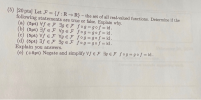 (5) 20 pts) Let F= {f:R → R} - the set of all real-valued functions. Determine if the following statements are true or false. Explain why. (a) (5pt) VEF 39 EF fog=go f = id. (b) (5pt) 3f EF Vg E F fog=go f = id. (C) (5pt) V EF Vg E F fog=go f = id. (d) (5pt) 3f EF 39 EF fog=go f = id. Explain you answers. (e) (+5pt) Negate and simplify VEF 39 EF fog=go f...
question starts at let. than one variable. Let f:R? → R3 be the function given by...
 question starts at let.
than one variable. Let f:R? → R3 be the function given by f(x, y) = (cos(x3 - y2), sin(y2 – x), e3x2-x-2y). (a) Let P be a point in the domain of f. As we saw in class, for (x, y) near P, we have f(x, y) f(P) + (Dpf)(h), where h = (x, y) - P. The expression on the right hand side is called the linear approximation of f around P. Compute the linear...
question starts at let.
than one variable. Let f:R? → R3 be the function given by f(x, y) = (cos(x3 - y2), sin(y2 – x), e3x2-x-2y). (a) Let P be a point in the domain of f. As we saw in class, for (x, y) near P, we have f(x, y) f(P) + (Dpf)(h), where h = (x, y) - P. The expression on the right hand side is called the linear approximation of f around P. Compute the linear...
7.Let A be ann x n real symmetric invertible matrix, let B Rt and C E R. Define f:R R by 2 a. Giv...
 I need help with a, b, and c.
7.Let A be ann x n real symmetric invertible matrix, let B Rt and C E R. Define f:R R by 2 a. Give f (a) c. Give f"(x) d. Prove that if A is positive definite and u is the critical point of f, then f(u) < f(x) for all x E Rn where x Prove that if A is negative definite and u is the critical point of f, then...
I need help with a, b, and c.
7.Let A be ann x n real symmetric invertible matrix, let B Rt and C E R. Define f:R R by 2 a. Give f (a) c. Give f"(x) d. Prove that if A is positive definite and u is the critical point of f, then f(u) < f(x) for all x E Rn where x Prove that if A is negative definite and u is the critical point of f, then...
 1. Let f:R → R be the function defined as: 32 0 if x is rational if x is irrational Prove that lim -70 f(x) = 0. Prove that limc f(x) does not exist for every real number c + 0. 2. Let f:R + R be a continuous function such that f(0) = 0 and f(2) = 0. Prove that there exists a real number c such that f(c+1) = f(c). 3 Let f. (a,b) R be a function...
 (Problem continued) 9 (b). Let F:R ([2) R be given by F In(z +1). Find its Tavlor series up to and inchading the degree 2 term (6 marks F give rise to an inner 2 (c). Referring to the function F in part (b) above, for which values of a does the matrix A (4 marks product on R2? Show how you obtained your answer.
(Problem continued) 9 (b). Let F:R ([2) R be given by F In(z +1). Find...
(Problem continued) 9 (b). Let F:R ([2) R be given by F In(z +1). Find its Tavlor series up to and inchading the degree 2 term (6 marks F give rise to an inner 2 (c). Referring to the function F in part (b) above, for which values of a does the matrix A (4 marks product on R2? Show how you obtained your answer.
(Problem continued) 9 (b). Let F:R ([2) R be given by F In(z +1). Find...
 help me.
5. consider set F(R):ff: f:R-R), but set all function with set real number in domain and codomain. Show "addition" in any two function it.eCE(R) to produce new function such as given: ttgR2R which is every xER such as given:(tg)lx)-fx)+g(x), and any real number k ER, multiply it with any element f EF(R) to produce new function as given: kfRR in every value xER such as given:(k:0(x):-kfx)(observe it with multiply dua real number) (a) Show. FIR) ith addition and...
help me.
5. consider set F(R):ff: f:R-R), but set all function with set real number in domain and codomain. Show "addition" in any two function it.eCE(R) to produce new function such as given: ttgR2R which is every xER such as given:(tg)lx)-fx)+g(x), and any real number k ER, multiply it with any element f EF(R) to produce new function as given: kfRR in every value xER such as given:(k:0(x):-kfx)(observe it with multiply dua real number) (a) Show. FIR) ith addition and...
 (2) Consider the function f given by f:R R f(a)1 2 (a) Determine the domain D and range R of the function f. (b) Show that f is not one to one on D. (c) Let ç D be a subset of the domain of f such that for all x ? S, 0 and the function is one to one. Find such a set S. (d) For the set S given in Part (c), find f (x) (e) Determine...
 Let f: C→C be an entire, one-to-one function. (a) Explain why g()-f() f(0) is an entire 1-1 function (b) Explain why there exists0 such that B(O,e) C g(B(O, 1)). Hint: Open Mapping thm.] (c) Explain why Ig(z)2є if 221 . [Hint: g is 1-1.] (d) Since g(0)=0, g(z)=2h(z) for some entire function h(z). Explain why h(z) is never 0 (e) Show that there is a constant C>0 such that 1/h2)l C if21 (f) Deduce that 1/h (z) is a constant...
 7. Let f be an entire function. Suppose there exists € >0 such that f(2) > € for every 2 E C. Show that f is constant. (Hint: Apply Liouville's theorem to the function g(2) = 1/f().)
 (5) 20 pts) Let F= {f:R → R} - the set of all real-valued functions. Determine if the following statements are true or false. Explain why. (a) (5pt) VEF 39 EF fog=go f = id. (b) (5pt) 3f EF Vg E F fog=go f = id. (C) (5pt) V EF Vg E F fog=go f = id. (d) (5pt) 3f EF 39 EF fog=go f = id. Explain you answers. (e) (+5pt) Negate and simplify VEF 39 EF fog=go f...
 question starts at let.
than one variable. Let f:R? → R3 be the function given by f(x, y) = (cos(x3 - y2), sin(y2 – x), e3x2-x-2y). (a) Let P be a point in the domain of f. As we saw in class, for (x, y) near P, we have f(x, y) f(P) + (Dpf)(h), where h = (x, y) - P. The expression on the right hand side is called the linear approximation of f around P. Compute the linear...
question starts at let.
than one variable. Let f:R? → R3 be the function given by f(x, y) = (cos(x3 - y2), sin(y2 – x), e3x2-x-2y). (a) Let P be a point in the domain of f. As we saw in class, for (x, y) near P, we have f(x, y) f(P) + (Dpf)(h), where h = (x, y) - P. The expression on the right hand side is called the linear approximation of f around P. Compute the linear...
 I need help with a, b, and c.
7.Let A be ann x n real symmetric invertible matrix, let B Rt and C E R. Define f:R R by 2 a. Give f (a) c. Give f"(x) d. Prove that if A is positive definite and u is the critical point of f, then f(u) < f(x) for all x E Rn where x Prove that if A is negative definite and u is the critical point of f, then...
I need help with a, b, and c.
7.Let A be ann x n real symmetric invertible matrix, let B Rt and C E R. Define f:R R by 2 a. Give f (a) c. Give f"(x) d. Prove that if A is positive definite and u is the critical point of f, then f(u) < f(x) for all x E Rn where x Prove that if A is negative definite and u is the critical point of f, then...
Most questions answered within 3 hours.
-
Where is the error in this code sequence?
String s1 = "Hello";
String s2 = "ello";...
asked 10 months ago -
Financial data for Joel de Paris, Inc., for last year
follow:
Joel de Paris, Inc.
Balance...
asked 10 months ago -
Consider this reaction:
Al2(SO4)3 (aq)+ BaCl3
(aq) Al2Cl6 (aq)- +
3BaSO4(s) . What is the...
asked 10 months ago -
Suppose that Savneet is considering increasing her
recent random sample from 20 car rentals to 40...
asked 10 months ago -
Trucks arrive at an unloading terminal at an average rate of 120
per hour.
Trucks arrive...
asked 10 months ago -
Why are methanol and ethanol completely soluble in water while
octanol is not very little soluble....
asked 10 months ago -
A facilities manager at a university reads in a research report
that the mean amount of...
asked 10 months ago -
When the CuSO4 is rehydrated by adding water to the anhydrous
compound, is this an endothermic...
asked 10 months ago -
A ray of sunlight is passing from diamond into crown glass; the
angle of incidence is...
asked 10 months ago -
A block of mass 0.249 kg is placed on top of a light, vertical
spring of...
asked 10 months ago -
how do the kidneys compensate in the presences of acidosis
a) trigger hyperventilate
b) reserve acid...
asked 10 months ago -
Question 501 pts
The rental rate of capital to the firm increases. Which of the
following...
asked 10 months ago