
Homework Answers

Add Answer to:
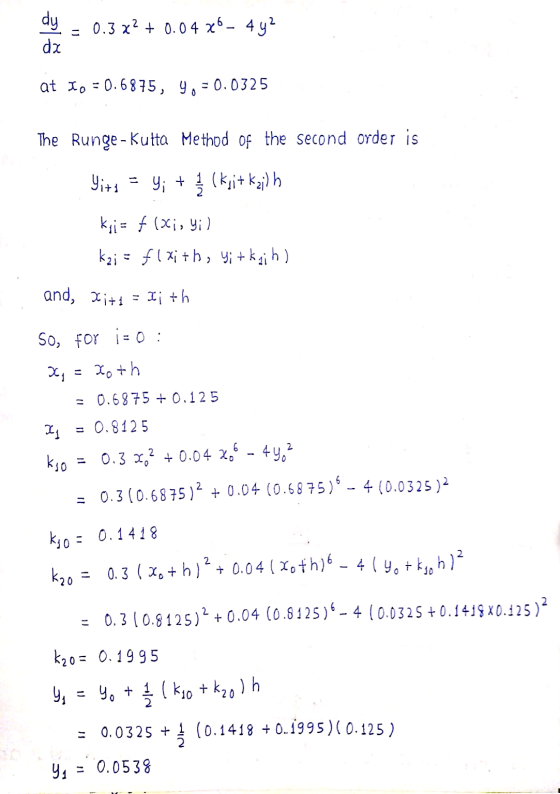
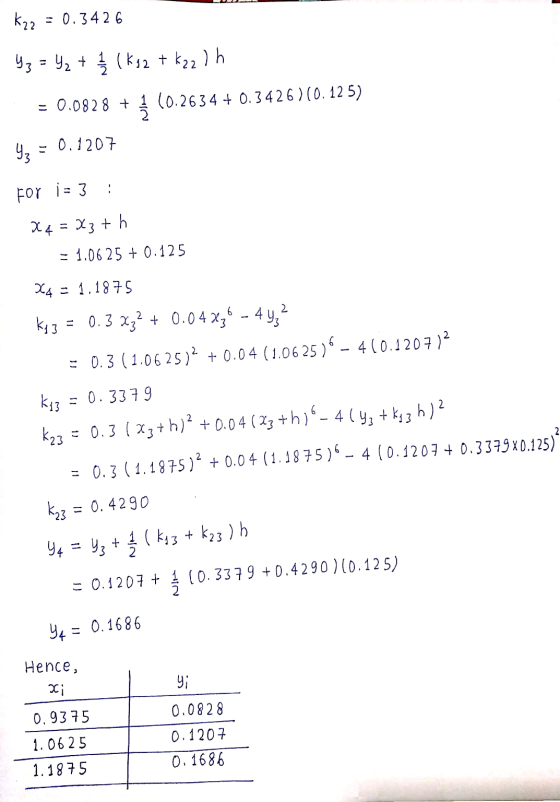
Consider the following Ordinary Differential Equation (ODE): dy = 0.3 * x2 + 0.04 * 26...
Question 4 Not yet answered Marked out of 1.5000 Flag question Consider the following Ordinary Differential...
 Question 4 Not yet answered Marked out of 1.5000 Flag question Consider the following Ordinary Differential Equation (ODE): dy dx = 4.0 * ** + 2.56* *10 - 4 * y? with initial condition at point Xo = 0.75: 3b = 0.1898 Apply Runge-Kutta method of the second order with h = 0.1 and the set of parameters given below to approximate the solution of the ODE at the three points given in the table below. Fill in the blank...
du Consider the following Ordinary Differential Equation (ODE): = 2.5 + + +0.5 210 - 2.y?...
 du Consider the following Ordinary Differential Equation (ODE): = 2.5 + + +0.5 210 - 2.y? with initial condition at point o = 0.375: 300.0037 Apply Runge-Kutta method of the second order with h = 0.25 and the set of parameters given below to approximate the solution of the ODE at the three points given in the table below. Fill in the blank spaces. Round up your answers to 4 decimals. M 0.375 0.0037 0.625 0.0497 0.875 1.125 1.375 Parameters...
PLEASE PLEASE,ONLY ANSWER THIS QUESTION IF YOU COULD GIVE ME THE MATLAB CODE.THANK YOU. Consider the...
 PLEASE PLEASE,ONLY ANSWER THIS QUESTION IF YOU COULD
GIVE ME THE MATLAB CODE.THANK YOU.
Consider the following Ordinary Differential Equation (ODE): dy = 3.0*** + 1.08 * 210 – 3* y2 dat with initial condition at point xo = 0.375: Yo = 0.0044 Apply Runge-Kutta method of the second order with h = 0.25 and the set of parameters given below to approximate the solution of the ODE at the three points given in the table below. Fill in the...
PLEASE PLEASE,ONLY ANSWER THIS QUESTION IF YOU COULD
GIVE ME THE MATLAB CODE.THANK YOU.
Consider the following Ordinary Differential Equation (ODE): dy = 3.0*** + 1.08 * 210 – 3* y2 dat with initial condition at point xo = 0.375: Yo = 0.0044 Apply Runge-Kutta method of the second order with h = 0.25 and the set of parameters given below to approximate the solution of the ODE at the three points given in the table below. Fill in the...
3. (a) Express the following ordinary differential equation and initial conditions as an autonomous system of...
 3. (a) Express the following ordinary differential equation and initial conditions as an autonomous system of first order equations: 2"-223z = 2, '(0)= 1 z(0) 0, (b) Consider the following second order explicit Runge-Kutta scheme written in au- tonomous vector form (y' = f(y)): hf (ynk kihf (yn), k2 yn+1 ynk2. IT Use the second order explicit Runge-Kutta scheme with steplength h compute approximations to z(0.1) and z'(0.1) 0.1 to _
3. (a) Express the following ordinary differential equation and...
3. (a) Express the following ordinary differential equation and initial conditions as an autonomous system of first order equations: 2"-223z = 2, '(0)= 1 z(0) 0, (b) Consider the following second order explicit Runge-Kutta scheme written in au- tonomous vector form (y' = f(y)): hf (ynk kihf (yn), k2 yn+1 ynk2. IT Use the second order explicit Runge-Kutta scheme with steplength h compute approximations to z(0.1) and z'(0.1) 0.1 to _
3. (a) Express the following ordinary differential equation and...
(e) Consider the Runge-Kutta method in solving the following first order ODE: dy First, using Taylor series expansion, we have the following approximation of y evaluated at the time step n+1 as a...
 (e) Consider the Runge-Kutta method in solving the following first order ODE: dy First, using Taylor series expansion, we have the following approximation of y evaluated at the time step n+1 as a function of y at the time step n: where h is the size of the time step. The fourth order Runge-Kutta method assumes the following form where the following approximations can be made at various iterations: )sh+รู้: ,f(t.ta, ),. Note that the first term is evaluated at...
dy: 2 Consider the following Ordinary Differential Equation (ODE) for function yı(z) on interval [0, 1]...
 dy: 2 Consider the following Ordinary Differential Equation (ODE) for function yı(z) on interval [0, 1] +(-10,3) dayi dy + 28.06 + (-16.368) + y(x) = 1.272.0.52 with the following initial conditions at point a = 0; dy 91 = 4.572 = 30.6248 = 185.2223 dar Introducting notations dyi dy2 dy dar dar dir? convert the ODE to the system of three first-order ODEs for functions y1, y2, y3 in the form: dy dar fi (1, y1, ya, y) dy2...
With 5. Consider the differential equation y, f(x,y) with initial condition y(zo) = yo. Show that...
 1
with 5. Consider the differential equation y, f(x,y) with initial condition y(zo) = yo. Show that, zi = zo +h, the solution at x1 can be obtained with an er ror O(h3) by the formula In other words, this formula describes a Runge-Kutta method of order 2.
with 5. Consider the differential equation y, f(x,y) with initial condition y(zo) = yo. Show that, zi = zo +h, the solution at x1 can be obtained with an er ror O(h3)...
1
with 5. Consider the differential equation y, f(x,y) with initial condition y(zo) = yo. Show that, zi = zo +h, the solution at x1 can be obtained with an er ror O(h3) by the formula In other words, this formula describes a Runge-Kutta method of order 2.
with 5. Consider the differential equation y, f(x,y) with initial condition y(zo) = yo. Show that, zi = zo +h, the solution at x1 can be obtained with an er ror O(h3)...
ďyi dx dx 1 Consider the following Ordinary Differential Equation (ODE) for function yı(x) on interval...
 ďyi dx dx 1 Consider the following Ordinary Differential Equation (ODE) for function yı(x) on interval [0, 1] dyi dyi +(-4.7) * + 4.4 * +(-0.7) * yı(x) = -0.216. el.1-x dx dx2 with the following initial conditions at point x = 0: dyi dayı Yi = -0.316, = 6.2424, = 22.3846 dx2 Introducting notations dyi dy2 dy1 Y2 = Y3 = dx2 convert the ODE to the system of three first-order ODEs for functions yi, Y2, y3 in the...
Problem 4. The higher order differential equation and initial conditions are shown as follows: = dy...
 Problem 4. The higher order differential equation and initial conditions are shown as follows: = dy dy +y?, y(0) = 1, y'(0) = -1, "(0) = 2 dt3 dt (a) [5pts. Transform the above initial value problem into an equivalent first order differential system, including initial conditions. (b) [2pts.] Express the system and the initial condition in (a) in vector form. (c) [4pts.] Using the second order Runge Kutta method as follows Ū* = Ūi + hĚ(ti, Ūi) h =...
ME 32200 Programming course (MATLAB) 4. Please finish the following Matlab code for solving the ODE:...
 ME 32200 Programming course (MATLAB)
4. Please finish the following Matlab code for solving the ODE: dy = y(1+1) dt I.C. y(0) = 0 with the multi-step 4th order Milne's Method, and apply 4th order Runge Kutta method to the first 4 points (1 boundary point and the next 3 points). (Hint: 4th order Milne's Method Predictor: 7i+ = Y-3 +h(2f;- fi- +25,-2) Corrector: y = y + + +0. +45j + fi-) Where f; = f(t;,y,) and Fit =...
ME 32200 Programming course (MATLAB)
4. Please finish the following Matlab code for solving the ODE: dy = y(1+1) dt I.C. y(0) = 0 with the multi-step 4th order Milne's Method, and apply 4th order Runge Kutta method to the first 4 points (1 boundary point and the next 3 points). (Hint: 4th order Milne's Method Predictor: 7i+ = Y-3 +h(2f;- fi- +25,-2) Corrector: y = y + + +0. +45j + fi-) Where f; = f(t;,y,) and Fit =...
 Question 4 Not yet answered Marked out of 1.5000 Flag question Consider the following Ordinary Differential Equation (ODE): dy dx = 4.0 * ** + 2.56* *10 - 4 * y? with initial condition at point Xo = 0.75: 3b = 0.1898 Apply Runge-Kutta method of the second order with h = 0.1 and the set of parameters given below to approximate the solution of the ODE at the three points given in the table below. Fill in the blank...
 du Consider the following Ordinary Differential Equation (ODE): = 2.5 + + +0.5 210 - 2.y? with initial condition at point o = 0.375: 300.0037 Apply Runge-Kutta method of the second order with h = 0.25 and the set of parameters given below to approximate the solution of the ODE at the three points given in the table below. Fill in the blank spaces. Round up your answers to 4 decimals. M 0.375 0.0037 0.625 0.0497 0.875 1.125 1.375 Parameters...
 PLEASE PLEASE,ONLY ANSWER THIS QUESTION IF YOU COULD
GIVE ME THE MATLAB CODE.THANK YOU.
Consider the following Ordinary Differential Equation (ODE): dy = 3.0*** + 1.08 * 210 – 3* y2 dat with initial condition at point xo = 0.375: Yo = 0.0044 Apply Runge-Kutta method of the second order with h = 0.25 and the set of parameters given below to approximate the solution of the ODE at the three points given in the table below. Fill in the...
PLEASE PLEASE,ONLY ANSWER THIS QUESTION IF YOU COULD
GIVE ME THE MATLAB CODE.THANK YOU.
Consider the following Ordinary Differential Equation (ODE): dy = 3.0*** + 1.08 * 210 – 3* y2 dat with initial condition at point xo = 0.375: Yo = 0.0044 Apply Runge-Kutta method of the second order with h = 0.25 and the set of parameters given below to approximate the solution of the ODE at the three points given in the table below. Fill in the...
 3. (a) Express the following ordinary differential equation and initial conditions as an autonomous system of first order equations: 2"-223z = 2, '(0)= 1 z(0) 0, (b) Consider the following second order explicit Runge-Kutta scheme written in au- tonomous vector form (y' = f(y)): hf (ynk kihf (yn), k2 yn+1 ynk2. IT Use the second order explicit Runge-Kutta scheme with steplength h compute approximations to z(0.1) and z'(0.1) 0.1 to _
3. (a) Express the following ordinary differential equation and...
3. (a) Express the following ordinary differential equation and initial conditions as an autonomous system of first order equations: 2"-223z = 2, '(0)= 1 z(0) 0, (b) Consider the following second order explicit Runge-Kutta scheme written in au- tonomous vector form (y' = f(y)): hf (ynk kihf (yn), k2 yn+1 ynk2. IT Use the second order explicit Runge-Kutta scheme with steplength h compute approximations to z(0.1) and z'(0.1) 0.1 to _
3. (a) Express the following ordinary differential equation and...
 (e) Consider the Runge-Kutta method in solving the following first order ODE: dy First, using Taylor series expansion, we have the following approximation of y evaluated at the time step n+1 as a function of y at the time step n: where h is the size of the time step. The fourth order Runge-Kutta method assumes the following form where the following approximations can be made at various iterations: )sh+รู้: ,f(t.ta, ),. Note that the first term is evaluated at...
 dy: 2 Consider the following Ordinary Differential Equation (ODE) for function yı(z) on interval [0, 1] +(-10,3) dayi dy + 28.06 + (-16.368) + y(x) = 1.272.0.52 with the following initial conditions at point a = 0; dy 91 = 4.572 = 30.6248 = 185.2223 dar Introducting notations dyi dy2 dy dar dar dir? convert the ODE to the system of three first-order ODEs for functions y1, y2, y3 in the form: dy dar fi (1, y1, ya, y) dy2...
 1
with 5. Consider the differential equation y, f(x,y) with initial condition y(zo) = yo. Show that, zi = zo +h, the solution at x1 can be obtained with an er ror O(h3) by the formula In other words, this formula describes a Runge-Kutta method of order 2.
with 5. Consider the differential equation y, f(x,y) with initial condition y(zo) = yo. Show that, zi = zo +h, the solution at x1 can be obtained with an er ror O(h3)...
1
with 5. Consider the differential equation y, f(x,y) with initial condition y(zo) = yo. Show that, zi = zo +h, the solution at x1 can be obtained with an er ror O(h3) by the formula In other words, this formula describes a Runge-Kutta method of order 2.
with 5. Consider the differential equation y, f(x,y) with initial condition y(zo) = yo. Show that, zi = zo +h, the solution at x1 can be obtained with an er ror O(h3)...
 ďyi dx dx 1 Consider the following Ordinary Differential Equation (ODE) for function yı(x) on interval [0, 1] dyi dyi +(-4.7) * + 4.4 * +(-0.7) * yı(x) = -0.216. el.1-x dx dx2 with the following initial conditions at point x = 0: dyi dayı Yi = -0.316, = 6.2424, = 22.3846 dx2 Introducting notations dyi dy2 dy1 Y2 = Y3 = dx2 convert the ODE to the system of three first-order ODEs for functions yi, Y2, y3 in the...
 Problem 4. The higher order differential equation and initial conditions are shown as follows: = dy dy +y?, y(0) = 1, y'(0) = -1, "(0) = 2 dt3 dt (a) [5pts. Transform the above initial value problem into an equivalent first order differential system, including initial conditions. (b) [2pts.] Express the system and the initial condition in (a) in vector form. (c) [4pts.] Using the second order Runge Kutta method as follows Ū* = Ūi + hĚ(ti, Ūi) h =...
 ME 32200 Programming course (MATLAB)
4. Please finish the following Matlab code for solving the ODE: dy = y(1+1) dt I.C. y(0) = 0 with the multi-step 4th order Milne's Method, and apply 4th order Runge Kutta method to the first 4 points (1 boundary point and the next 3 points). (Hint: 4th order Milne's Method Predictor: 7i+ = Y-3 +h(2f;- fi- +25,-2) Corrector: y = y + + +0. +45j + fi-) Where f; = f(t;,y,) and Fit =...
ME 32200 Programming course (MATLAB)
4. Please finish the following Matlab code for solving the ODE: dy = y(1+1) dt I.C. y(0) = 0 with the multi-step 4th order Milne's Method, and apply 4th order Runge Kutta method to the first 4 points (1 boundary point and the next 3 points). (Hint: 4th order Milne's Method Predictor: 7i+ = Y-3 +h(2f;- fi- +25,-2) Corrector: y = y + + +0. +45j + fi-) Where f; = f(t;,y,) and Fit =...
Most questions answered within 3 hours.
-
Where is the error in this code sequence?
String s1 = "Hello";
String s2 = "ello";...
asked 10 months ago -
Financial data for Joel de Paris, Inc., for last year
follow:
Joel de Paris, Inc.
Balance...
asked 10 months ago -
Consider this reaction:
Al2(SO4)3 (aq)+ BaCl3
(aq) Al2Cl6 (aq)- +
3BaSO4(s) . What is the...
asked 10 months ago -
Suppose that Savneet is considering increasing her
recent random sample from 20 car rentals to 40...
asked 10 months ago -
Trucks arrive at an unloading terminal at an average rate of 120
per hour.
Trucks arrive...
asked 10 months ago -
Why are methanol and ethanol completely soluble in water while
octanol is not very little soluble....
asked 10 months ago -
A facilities manager at a university reads in a research report
that the mean amount of...
asked 10 months ago -
When the CuSO4 is rehydrated by adding water to the anhydrous
compound, is this an endothermic...
asked 10 months ago -
A ray of sunlight is passing from diamond into crown glass; the
angle of incidence is...
asked 10 months ago -
A block of mass 0.249 kg is placed on top of a light, vertical
spring of...
asked 10 months ago -
how do the kidneys compensate in the presences of acidosis
a) trigger hyperventilate
b) reserve acid...
asked 10 months ago -
Question 501 pts
The rental rate of capital to the firm increases. Which of the
following...
asked 10 months ago