 clear handwriting , no typing , show all
work please!
clear handwriting , no typing , show all
work please!
Homework Answers
Add Answer to:
clear handwriting , no typing , show all
work please!
A cast iron flywheel used for...
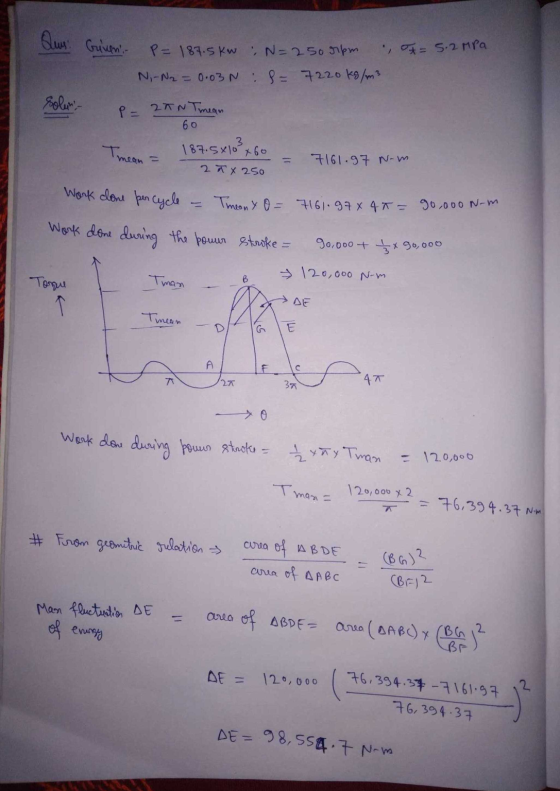
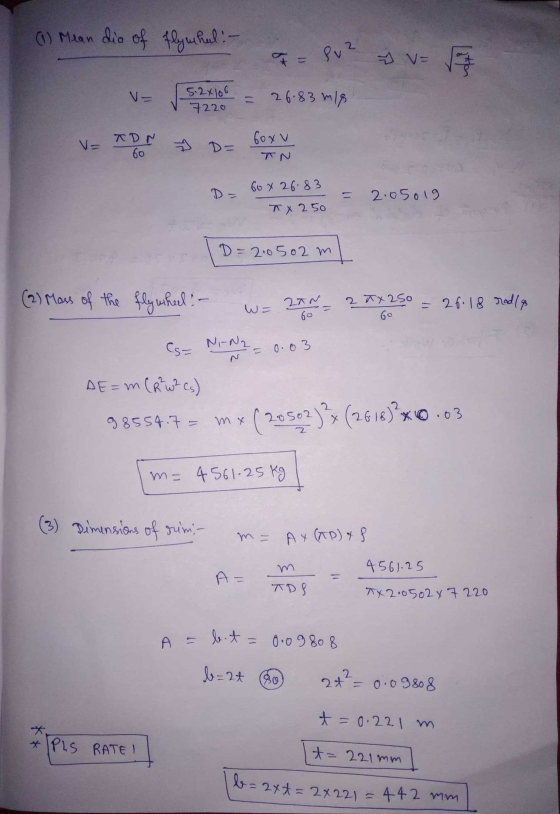
clear handwriting , no typing , show all work please! A steam engine runs at 150...
 clear handwriting , no typing , show all
work please!
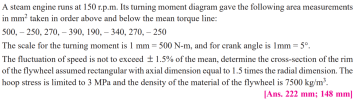
A steam engine runs at 150 r.p.m. Its turning moment diagram gave the following area measurements in mm? taken in order above and below the mean torque line: 500,- 250, 270, – 390, 190, – 340, 270, - 250 The scale for the turning moment is 1 mm 500 N-m, and for crank angle is 1mm = 5º. The fluctuation of speed is not to exceed + 1.5% of the...
clear handwriting , no typing , show all
work please!
A steam engine runs at 150 r.p.m. Its turning moment diagram gave the following area measurements in mm? taken in order above and below the mean torque line: 500,- 250, 270, – 390, 190, – 340, 270, - 250 The scale for the turning moment is 1 mm 500 N-m, and for crank angle is 1mm = 5º. The fluctuation of speed is not to exceed + 1.5% of the...
clear handwriting , no typing , show all work please! The turning moment diagram for the...
 clear handwriting , no typing , show all
work please!
The turning moment diagram for the engine is drawn to the following scales: Turning moment, 1 mm = 1000 N-m and crank angle, 1 mm = 6º. The areas above and below the mean turning moment line taken in order are : 530, 330, 380, 470, 180, 360, 350 and 280 mm2. The mean speed of the engine is 150 r.p.m. and the total fluctuation of speed must not exceed...
clear handwriting , no typing , show all
work please!
The turning moment diagram for the engine is drawn to the following scales: Turning moment, 1 mm = 1000 N-m and crank angle, 1 mm = 6º. The areas above and below the mean turning moment line taken in order are : 530, 330, 380, 470, 180, 360, 350 and 280 mm2. The mean speed of the engine is 150 r.p.m. and the total fluctuation of speed must not exceed...
Show complete solutions. Show FBD diagram, label properly. Show formulas and their direct substitution. 67. Find the rim thickness for a cast iron flywheel with a width of 200 mm, a mean diameter f 1...
 Show complete solutions. Show FBD diagram, label properly. Show
formulas and their direct substitution.
67. Find the rim thickness for a cast iron flywheel with a width of 200 mm, a mean diameter f 1.2 in a normal operating speed of 300 rpm, a coefficient fluctuation of 0.05 and which is capable of hanging 3000 N-m of kinetic energy. Assume that the hub and arms represent 10% of the rim weight and the specific weight of cast iron is 7200...
Show complete solutions. Show FBD diagram, label properly. Show
formulas and their direct substitution.
67. Find the rim thickness for a cast iron flywheel with a width of 200 mm, a mean diameter f 1.2 in a normal operating speed of 300 rpm, a coefficient fluctuation of 0.05 and which is capable of hanging 3000 N-m of kinetic energy. Assume that the hub and arms represent 10% of the rim weight and the specific weight of cast iron is 7200...
clear handwriting , no typing , show all work please! An electric motor is mounted by...
 clear handwriting , no typing , show all work please!
An electric motor is mounted by means of gears on a mid span of a shaft rested between two bearings as shown in the figure. It is found that the motor suffers from vibration due to unbalance of 0.1 kg.m. The clearance between the armature and the stator is 1 mm. Design the diameter of the shaft such that when the motor vibrates the armature wont touch the stator at...
clear handwriting , no typing , show all work please!
An electric motor is mounted by means of gears on a mid span of a shaft rested between two bearings as shown in the figure. It is found that the motor suffers from vibration due to unbalance of 0.1 kg.m. The clearance between the armature and the stator is 1 mm. Design the diameter of the shaft such that when the motor vibrates the armature wont touch the stator at...
clear handwriting , no typing , show all work please! e.g.24 A vibrating system is analyzed...
 clear handwriting , no typing , show all
work please!
e.g.24 A vibrating system is analyzed and it is found that two successive oscillations have amplitudes of 3 mm and 0.5 mm respectively. Calculate the damping ratio.
clear handwriting , no typing , show all
work please!
e.g.24 A vibrating system is analyzed and it is found that two successive oscillations have amplitudes of 3 mm and 0.5 mm respectively. Calculate the damping ratio.
clear handwriting , no typing , show all work please! e.g.23 An electric motor of 10...
 clear handwriting , no typing , show all
work please!
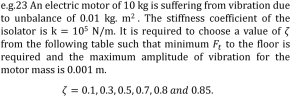
e.g.23 An electric motor of 10 kg is suffering from vibration due to unbalance of 0.01 kg. m2. The stiffness coefficient of the isolator is k = 105 N/m. It is required to choose a value of 3 from the following table such that minimum Ft to the floor is required and the maximum amplitude of vibration for the motor mass is 0.001 m. S = 0.1, 0.3, 0.5, 0.7,0.8...
clear handwriting , no typing , show all
work please!
e.g.23 An electric motor of 10 kg is suffering from vibration due to unbalance of 0.01 kg. m2. The stiffness coefficient of the isolator is k = 105 N/m. It is required to choose a value of 3 from the following table such that minimum Ft to the floor is required and the maximum amplitude of vibration for the motor mass is 0.001 m. S = 0.1, 0.3, 0.5, 0.7,0.8...
clear handwriting , no typing , show all work please! e.g.25 A mass of 5 kg...
 clear handwriting , no typing , show all
work please!
e.g.25 A mass of 5 kg is suspended on a spring and set oscillating. It is observed that the amplitude reduces to 5% of its initial value after 2 oscillations. It takes 0.5 seconds to do them. Calculate the following: i. The damping ratio. ii. The natural frequency. iii. The actual frequency. iv. The spring stiffness. v. The critical damping coefficient. vi. The actual damping coefficient.
clear handwriting , no typing , show all
work please!
e.g.25 A mass of 5 kg is suspended on a spring and set oscillating. It is observed that the amplitude reduces to 5% of its initial value after 2 oscillations. It takes 0.5 seconds to do them. Calculate the following: i. The damping ratio. ii. The natural frequency. iii. The actual frequency. iv. The spring stiffness. v. The critical damping coefficient. vi. The actual damping coefficient.
 clear handwriting , no typing , show all
work please!
A steam engine runs at 150 r.p.m. Its turning moment diagram gave the following area measurements in mm? taken in order above and below the mean torque line: 500,- 250, 270, – 390, 190, – 340, 270, - 250 The scale for the turning moment is 1 mm 500 N-m, and for crank angle is 1mm = 5º. The fluctuation of speed is not to exceed + 1.5% of the...
clear handwriting , no typing , show all
work please!
A steam engine runs at 150 r.p.m. Its turning moment diagram gave the following area measurements in mm? taken in order above and below the mean torque line: 500,- 250, 270, – 390, 190, – 340, 270, - 250 The scale for the turning moment is 1 mm 500 N-m, and for crank angle is 1mm = 5º. The fluctuation of speed is not to exceed + 1.5% of the...
 clear handwriting , no typing , show all
work please!
The turning moment diagram for the engine is drawn to the following scales: Turning moment, 1 mm = 1000 N-m and crank angle, 1 mm = 6º. The areas above and below the mean turning moment line taken in order are : 530, 330, 380, 470, 180, 360, 350 and 280 mm2. The mean speed of the engine is 150 r.p.m. and the total fluctuation of speed must not exceed...
clear handwriting , no typing , show all
work please!
The turning moment diagram for the engine is drawn to the following scales: Turning moment, 1 mm = 1000 N-m and crank angle, 1 mm = 6º. The areas above and below the mean turning moment line taken in order are : 530, 330, 380, 470, 180, 360, 350 and 280 mm2. The mean speed of the engine is 150 r.p.m. and the total fluctuation of speed must not exceed...
 Show complete solutions. Show FBD diagram, label properly. Show
formulas and their direct substitution.
67. Find the rim thickness for a cast iron flywheel with a width of 200 mm, a mean diameter f 1.2 in a normal operating speed of 300 rpm, a coefficient fluctuation of 0.05 and which is capable of hanging 3000 N-m of kinetic energy. Assume that the hub and arms represent 10% of the rim weight and the specific weight of cast iron is 7200...
Show complete solutions. Show FBD diagram, label properly. Show
formulas and their direct substitution.
67. Find the rim thickness for a cast iron flywheel with a width of 200 mm, a mean diameter f 1.2 in a normal operating speed of 300 rpm, a coefficient fluctuation of 0.05 and which is capable of hanging 3000 N-m of kinetic energy. Assume that the hub and arms represent 10% of the rim weight and the specific weight of cast iron is 7200...
 clear handwriting , no typing , show all work please!
An electric motor is mounted by means of gears on a mid span of a shaft rested between two bearings as shown in the figure. It is found that the motor suffers from vibration due to unbalance of 0.1 kg.m. The clearance between the armature and the stator is 1 mm. Design the diameter of the shaft such that when the motor vibrates the armature wont touch the stator at...
clear handwriting , no typing , show all work please!
An electric motor is mounted by means of gears on a mid span of a shaft rested between two bearings as shown in the figure. It is found that the motor suffers from vibration due to unbalance of 0.1 kg.m. The clearance between the armature and the stator is 1 mm. Design the diameter of the shaft such that when the motor vibrates the armature wont touch the stator at...
 clear handwriting , no typing , show all
work please!
e.g.24 A vibrating system is analyzed and it is found that two successive oscillations have amplitudes of 3 mm and 0.5 mm respectively. Calculate the damping ratio.
clear handwriting , no typing , show all
work please!
e.g.24 A vibrating system is analyzed and it is found that two successive oscillations have amplitudes of 3 mm and 0.5 mm respectively. Calculate the damping ratio.
 clear handwriting , no typing , show all
work please!
e.g.23 An electric motor of 10 kg is suffering from vibration due to unbalance of 0.01 kg. m2. The stiffness coefficient of the isolator is k = 105 N/m. It is required to choose a value of 3 from the following table such that minimum Ft to the floor is required and the maximum amplitude of vibration for the motor mass is 0.001 m. S = 0.1, 0.3, 0.5, 0.7,0.8...
clear handwriting , no typing , show all
work please!
e.g.23 An electric motor of 10 kg is suffering from vibration due to unbalance of 0.01 kg. m2. The stiffness coefficient of the isolator is k = 105 N/m. It is required to choose a value of 3 from the following table such that minimum Ft to the floor is required and the maximum amplitude of vibration for the motor mass is 0.001 m. S = 0.1, 0.3, 0.5, 0.7,0.8...
 clear handwriting , no typing , show all
work please!
e.g.25 A mass of 5 kg is suspended on a spring and set oscillating. It is observed that the amplitude reduces to 5% of its initial value after 2 oscillations. It takes 0.5 seconds to do them. Calculate the following: i. The damping ratio. ii. The natural frequency. iii. The actual frequency. iv. The spring stiffness. v. The critical damping coefficient. vi. The actual damping coefficient.
clear handwriting , no typing , show all
work please!
e.g.25 A mass of 5 kg is suspended on a spring and set oscillating. It is observed that the amplitude reduces to 5% of its initial value after 2 oscillations. It takes 0.5 seconds to do them. Calculate the following: i. The damping ratio. ii. The natural frequency. iii. The actual frequency. iv. The spring stiffness. v. The critical damping coefficient. vi. The actual damping coefficient.
Most questions answered within 3 hours.
-
Where is the error in this code sequence?
String s1 = "Hello";
String s2 = "ello";...
asked 10 months ago -
Financial data for Joel de Paris, Inc., for last year
follow:
Joel de Paris, Inc.
Balance...
asked 10 months ago -
Consider this reaction:
Al2(SO4)3 (aq)+ BaCl3
(aq) Al2Cl6 (aq)- +
3BaSO4(s) . What is the...
asked 10 months ago -
Suppose that Savneet is considering increasing her
recent random sample from 20 car rentals to 40...
asked 10 months ago -
Trucks arrive at an unloading terminal at an average rate of 120
per hour.
Trucks arrive...
asked 10 months ago -
Why are methanol and ethanol completely soluble in water while
octanol is not very little soluble....
asked 10 months ago -
A facilities manager at a university reads in a research report
that the mean amount of...
asked 10 months ago -
When the CuSO4 is rehydrated by adding water to the anhydrous
compound, is this an endothermic...
asked 10 months ago -
A ray of sunlight is passing from diamond into crown glass; the
angle of incidence is...
asked 10 months ago -
A block of mass 0.249 kg is placed on top of a light, vertical
spring of...
asked 10 months ago -
how do the kidneys compensate in the presences of acidosis
a) trigger hyperventilate
b) reserve acid...
asked 10 months ago -
Question 501 pts
The rental rate of capital to the firm increases. Which of the
following...
asked 10 months ago