
Homework Answers
The meaning of post order tree traversal is left-right-root
Post order = m, i, b, l, u, o, k, r, s. p, c
The meaning of pre-order tree traversal is root-left-right
pre order = c, l, i, m, b, u, p, r, o, k, s
I would like to tell you a trick by which you will get the right answer always, draw a fake branch to every point and make sure that all points has two branches. Don't name it just draw and while solving it becomes easy.
Thanks.
Add Answer to:
Answer each question in the space provided below. 1. Consider the tree shown below: (a) Give...
can you please do all question #1? Answer each question in the space provided below. 1....
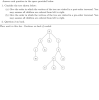 can you please do all question #1?
Answer each question in the space provided below. 1. Consider the tree shown below: (a) Give the order in which the vertices of the tree are visited in a post-order traversal. You may assume all children are ordered from left to right. (b) Give the order in which the vertices of the tree are visited in a pre-order traversal. You may assume all children are ordered from left to right. 2. Question 2...
can you please do all question #1?
Answer each question in the space provided below. 1. Consider the tree shown below: (a) Give the order in which the vertices of the tree are visited in a post-order traversal. You may assume all children are ordered from left to right. (b) Give the order in which the vertices of the tree are visited in a pre-order traversal. You may assume all children are ordered from left to right. 2. Question 2...
Answer each question in the space provided below. 1. Draw all non-isomorphic free trees with five...
 Answer each question in the space provided below. 1. Draw all non-isomorphic free trees with five vertices. You should not include two trees that are isomorphic. 2. If a tree has n vertices, what is the maximum possible number of leaves? (Your answer should be an expression depending on the variable n. 3. Find a graph with the given set of properties or explain why no such graph can exist. The graphs do not need to be trees unless explicitly...
(4 marks) Consider the binary tree shown in Figure 8. Perform the iterative pre-order tree traversal...
 (4 marks) Consider the binary tree shown in Figure 8. Perform the iterative pre-order tree traversal using a stack as shown to you in class. Write your answers in the U- shaped diagrams in Figure 9. For the first stack, show the value on the stack before entering the loop. For the rest of the stacks, show the values on the stack at the end of each loop iteration. 42 3 67 19 19 35 12 29 55 60 54...
2. This question concerns the graph G shown below. (a) Mark the spanning tree for G...
 2. This question concerns the graph G shown below. (a) Mark the spanning tree for G obtained by performing a depth-first search starting at the vertex E, and using the convention that nearby vertices should be explored in a counter-clockwise fasion, beginning with east; so E comes first, then NE, then N, ... (b) Mark the spanning tree for G obtained by performing a breadth-first search starting at the vertex E, and using the convention that nearby vertices should be...
PROBLEM 6: Suppose we insert keys below into an initially empty binary search tree in the...
 PROBLEM 6: Suppose we insert keys below into an initially empty binary search tree in the given order 6, 9, 2, 1, 5, 7, 10, 8, 3,4 (a) Draw the resulting binary search tree. (b) List the keys according to: A pre-order traversal An in-order traversal A post-order traversal (c) Now we perform some deletions using the "deletion by copying" strategy in which promoted keys are always drawn from a node's right subtree (so that there is only one correct...
PROBLEM 6: Suppose we insert keys below into an initially empty Vanilla binary search tree in...
PROBLEM 6: Suppose we insert keys below into an initially empty Vanilla binary search tree in the given order: 6, 9, 2, 1, 5, 7, 10, 8, 3, 4 (a) Draw the resulting binary search tree. (b) List the keys according to: A pre-order traversal An in-order traversal A post-order traversal (c) Now we perform some deletions using the “deletion by copying” strategy in which promoted keys are always drawn from a node’s right subtree (so that there is only...
I need question 9-10 answered. Thank you Question 1 iShow the resulting binary search tree if...
 I need question 9-10 answered. Thank you
Question 1 iShow the resulting binary search tree if we are to insert following elements into the tree in given order, [34, 12, 23, 27,31,9,11,45, 20, 37. i) Show the resulting balanced binary search tree if we are to insert following sorted elements into the tree, [9,12,21, 23, 29, 31, 34, 45, 48, 52, 55] iii What is the pre-order traversal of the balanced binary search tree? v) What is the post-order traversal...
I need question 9-10 answered. Thank you
Question 1 iShow the resulting binary search tree if we are to insert following elements into the tree in given order, [34, 12, 23, 27,31,9,11,45, 20, 37. i) Show the resulting balanced binary search tree if we are to insert following sorted elements into the tree, [9,12,21, 23, 29, 31, 34, 45, 48, 52, 55] iii What is the pre-order traversal of the balanced binary search tree? v) What is the post-order traversal...
Would appreciate the answer in the Java coding language please and thank you! 10d 10h left...
 Would appreciate the answer in the Java coding language please
and thank you!
10d 10h left Java 7 1. Check the Structure Autocomplete Ready 1 > import java.io.*;... 10 ALL A binary tree uses a multi-node data structure where each node may have 0 to 2 child nodes, and has one stored value, its node number in this case. A tree may either be: 11 class Result { * Complete the 'isValid' function below. • An empty tree, the root...
Would appreciate the answer in the Java coding language please
and thank you!
10d 10h left Java 7 1. Check the Structure Autocomplete Ready 1 > import java.io.*;... 10 ALL A binary tree uses a multi-node data structure where each node may have 0 to 2 child nodes, and has one stored value, its node number in this case. A tree may either be: 11 class Result { * Complete the 'isValid' function below. • An empty tree, the root...
2. This question concerns the graph G shown below. (a) Mark the spanning tree for G...
 2. This question concerns the graph G shown below. (a) Mark the spanning tree for G obtained by performing a depth-first search starting at the vertex A, and using the convention that nearby vertices should be explored in a counter-clockwise fasion, beginning with east; so E comes first, then NE, then N, ... (b) Mark the spanning tree for G obtained by performing a breadth-first search starting at the vertex A, and using the convention that nearby vertices should be...
2. This question concerns the graph G shown below. (a) Mark the spanning tree for G...
 2. This question concerns the graph G shown below. (a) Mark the spanning tree for G obtained by performing a depth-first search starting at the vertex A, and using the convention that nearby vertices should be explored in a counter-clockwise fasion, beginning with east; so E comes first, then NE, then N, ... (b) Mark the spanning tree for G obtained by performing a breadth-first search starting at the vertex A, and using the convention that nearby vertices should be...
 can you please do all question #1?
Answer each question in the space provided below. 1. Consider the tree shown below: (a) Give the order in which the vertices of the tree are visited in a post-order traversal. You may assume all children are ordered from left to right. (b) Give the order in which the vertices of the tree are visited in a pre-order traversal. You may assume all children are ordered from left to right. 2. Question 2...
can you please do all question #1?
Answer each question in the space provided below. 1. Consider the tree shown below: (a) Give the order in which the vertices of the tree are visited in a post-order traversal. You may assume all children are ordered from left to right. (b) Give the order in which the vertices of the tree are visited in a pre-order traversal. You may assume all children are ordered from left to right. 2. Question 2...
 Answer each question in the space provided below. 1. Draw all non-isomorphic free trees with five vertices. You should not include two trees that are isomorphic. 2. If a tree has n vertices, what is the maximum possible number of leaves? (Your answer should be an expression depending on the variable n. 3. Find a graph with the given set of properties or explain why no such graph can exist. The graphs do not need to be trees unless explicitly...
 (4 marks) Consider the binary tree shown in Figure 8. Perform the iterative pre-order tree traversal using a stack as shown to you in class. Write your answers in the U- shaped diagrams in Figure 9. For the first stack, show the value on the stack before entering the loop. For the rest of the stacks, show the values on the stack at the end of each loop iteration. 42 3 67 19 19 35 12 29 55 60 54...
 2. This question concerns the graph G shown below. (a) Mark the spanning tree for G obtained by performing a depth-first search starting at the vertex E, and using the convention that nearby vertices should be explored in a counter-clockwise fasion, beginning with east; so E comes first, then NE, then N, ... (b) Mark the spanning tree for G obtained by performing a breadth-first search starting at the vertex E, and using the convention that nearby vertices should be...
 PROBLEM 6: Suppose we insert keys below into an initially empty binary search tree in the given order 6, 9, 2, 1, 5, 7, 10, 8, 3,4 (a) Draw the resulting binary search tree. (b) List the keys according to: A pre-order traversal An in-order traversal A post-order traversal (c) Now we perform some deletions using the "deletion by copying" strategy in which promoted keys are always drawn from a node's right subtree (so that there is only one correct...
 I need question 9-10 answered. Thank you
Question 1 iShow the resulting binary search tree if we are to insert following elements into the tree in given order, [34, 12, 23, 27,31,9,11,45, 20, 37. i) Show the resulting balanced binary search tree if we are to insert following sorted elements into the tree, [9,12,21, 23, 29, 31, 34, 45, 48, 52, 55] iii What is the pre-order traversal of the balanced binary search tree? v) What is the post-order traversal...
I need question 9-10 answered. Thank you
Question 1 iShow the resulting binary search tree if we are to insert following elements into the tree in given order, [34, 12, 23, 27,31,9,11,45, 20, 37. i) Show the resulting balanced binary search tree if we are to insert following sorted elements into the tree, [9,12,21, 23, 29, 31, 34, 45, 48, 52, 55] iii What is the pre-order traversal of the balanced binary search tree? v) What is the post-order traversal...
 Would appreciate the answer in the Java coding language please
and thank you!
10d 10h left Java 7 1. Check the Structure Autocomplete Ready 1 > import java.io.*;... 10 ALL A binary tree uses a multi-node data structure where each node may have 0 to 2 child nodes, and has one stored value, its node number in this case. A tree may either be: 11 class Result { * Complete the 'isValid' function below. • An empty tree, the root...
Would appreciate the answer in the Java coding language please
and thank you!
10d 10h left Java 7 1. Check the Structure Autocomplete Ready 1 > import java.io.*;... 10 ALL A binary tree uses a multi-node data structure where each node may have 0 to 2 child nodes, and has one stored value, its node number in this case. A tree may either be: 11 class Result { * Complete the 'isValid' function below. • An empty tree, the root...
 2. This question concerns the graph G shown below. (a) Mark the spanning tree for G obtained by performing a depth-first search starting at the vertex A, and using the convention that nearby vertices should be explored in a counter-clockwise fasion, beginning with east; so E comes first, then NE, then N, ... (b) Mark the spanning tree for G obtained by performing a breadth-first search starting at the vertex A, and using the convention that nearby vertices should be...
 2. This question concerns the graph G shown below. (a) Mark the spanning tree for G obtained by performing a depth-first search starting at the vertex A, and using the convention that nearby vertices should be explored in a counter-clockwise fasion, beginning with east; so E comes first, then NE, then N, ... (b) Mark the spanning tree for G obtained by performing a breadth-first search starting at the vertex A, and using the convention that nearby vertices should be...
Most questions answered within 3 hours.
-
Where is the error in this code sequence?
String s1 = "Hello";
String s2 = "ello";...
asked 11 months ago -
Financial data for Joel de Paris, Inc., for last year
follow:
Joel de Paris, Inc.
Balance...
asked 11 months ago -
Consider this reaction:
Al2(SO4)3 (aq)+ BaCl3
(aq) Al2Cl6 (aq)- +
3BaSO4(s) . What is the...
asked 11 months ago -
Suppose that Savneet is considering increasing her
recent random sample from 20 car rentals to 40...
asked 11 months ago -
Trucks arrive at an unloading terminal at an average rate of 120
per hour.
Trucks arrive...
asked 11 months ago -
Why are methanol and ethanol completely soluble in water while
octanol is not very little soluble....
asked 11 months ago -
A facilities manager at a university reads in a research report
that the mean amount of...
asked 11 months ago -
When the CuSO4 is rehydrated by adding water to the anhydrous
compound, is this an endothermic...
asked 11 months ago -
A ray of sunlight is passing from diamond into crown glass; the
angle of incidence is...
asked 11 months ago -
A block of mass 0.249 kg is placed on top of a light, vertical
spring of...
asked 11 months ago -
how do the kidneys compensate in the presences of acidosis
a) trigger hyperventilate
b) reserve acid...
asked 11 months ago -
Question 501 pts
The rental rate of capital to the firm increases. Which of the
following...
asked 11 months ago