
The integral needs to be calculated in order to solve.
Show all work that was used, thanks.
Homework Answers
Add Answer to:
The integral needs to be calculated in order to solve.
Show all work that was used,...
show all work please Use Definition 7.1.1. DEFINITION 7.1.1 Laplace Transform Let be a function defined...
 show all work please
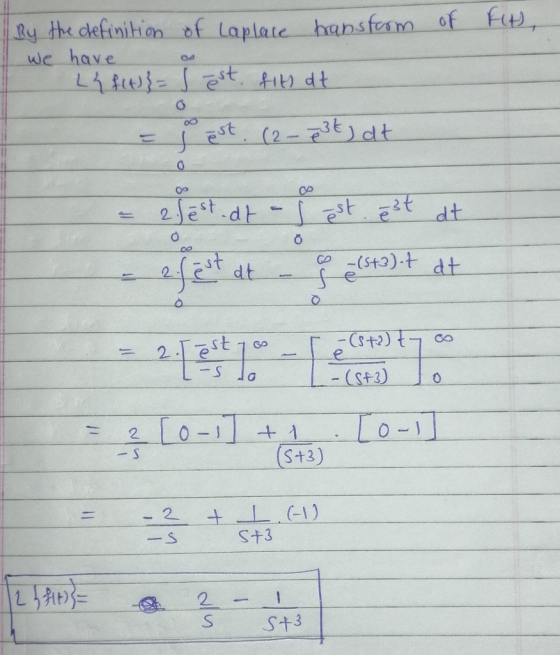
Use Definition 7.1.1. DEFINITION 7.1.1 Laplace Transform Let be a function defined for t 2 0. Then the integral LARE)) = -stPct) of Find is said to be the Laplace transform of provided that the integral converges. ). (Write your answer as a function of s.) (t) =35, Ost2 Lot 2 2 CZA()= 2 9e-25 (s > 0)
show all work please
Use Definition 7.1.1. DEFINITION 7.1.1 Laplace Transform Let be a function defined for t 2 0. Then the integral LARE)) = -stPct) of Find is said to be the Laplace transform of provided that the integral converges. ). (Write your answer as a function of s.) (t) =35, Ost2 Lot 2 2 CZA()= 2 9e-25 (s > 0)
Show work please (1 point) Use Laplace transforms to solve the integral equation y(t) – v...
 Show work please
(1 point) Use Laplace transforms to solve the integral equation y(t) – v yết – U) do = 4. The first step is to apply the Laplace transform and solve for Y(s) = L(y(t)) Y(s) = Next apply the inverse Laplace transform to obtain y(t) y(t) =
Show work please
(1 point) Use Laplace transforms to solve the integral equation y(t) – v yết – U) do = 4. The first step is to apply the Laplace transform and solve for Y(s) = L(y(t)) Y(s) = Next apply the inverse Laplace transform to obtain y(t) y(t) =
If we are given the improper integral definition of the gamma function above, i) show that...
 If we are given the improper integral definition of the gamma
function above,
i) show that , a>-1 where
ii) show that
iii) Given that , find the laplace transform of
please show all steps for all parts
0<'FP 2-0 1-07 OU = (20).J T + 5 Si = {27}] (I+D)) [{f(t)} = S.*f(t)e-stat T(a + 1) = al(a) r(a) = var f(t) = 43/2
If we are given the improper integral definition of the gamma
function above,
i) show that , a>-1 where
ii) show that
iii) Given that , find the laplace transform of
please show all steps for all parts
0<'FP 2-0 1-07 OU = (20).J T + 5 Si = {27}] (I+D)) [{f(t)} = S.*f(t)e-stat T(a + 1) = al(a) r(a) = var f(t) = 43/2
USE DEFINITION 1 TO DETERMINE THE LAPLACE TRANSFORM OF THE FOLLOWING FUNCTION. f(t)= e sin(t) Laplace...
 USE DEFINITION 1 TO DETERMINE THE LAPLACE TRANSFORM OF THE FOLLOWING FUNCTION. f(t)= e sin(t) Laplace Transform Definition 1. Let f(t)be a function on [0,00). The Laplace transform of f is the function defined by the integral The domain of F(s) is all the values of " for which the integral in (1) exists.' The Laplace transform of fis denoted by both and ${/}. QUESTION 2. (3PTS) USE TABLE 7.1 AND 7.2 TO DETERMINE THE LAPLACE TRANSFORM OF THE GIVEN...
Use Definition 7.1.1. DEFINITION 7.1.1 Laplace Transform Let f be a function defined for t ≥ 0. Then the integral ℒ{f(t)} = ∞ e−stf(t) dt 0 is said to be the Laplace transform of f, provided that the integral converges. Find ℒ{f(t)}. (Write your
 Use Definition 7.1.1.DEFINITION 7.1.1 Laplace TransformLet f be a function defined for t ≥ 0. Then the integralℒ{f(t)} = ∞e−stf(t) dt0is said to be the Laplace transform of f, provided that the integral converges.Find ℒ{f(t)}. (Write your answer as a function of s.)f(t) = et + 2ℒ{f(t)} = (s > 1)
Use Definition 7.1.1. DEFINITION 7.1.1 Laplace Transform Let f be a function defined for t ≥ 0. Then the integral ℒ{f(t)} = ∞ e−stf(t) dt 0 is said to be the Laplace transform of f, provided that the integral converges. Find ℒ{f(t)}. (Write your
 Use Definition 7.1.1.DEFINITION 7.1.1 Laplace TransformLet f be a function defined for t ≥ 0. Then the integralℒ{f(t)} = ∞e−stf(t) dt0is said to be the Laplace transform of f, provided that the integral converges.Find ℒ{f(t)}. (Write your answer as a function of s.)f(t) = 9, 0 ≤ t
Calculate the Fourier transform for f(t) - e-3t by calculating the Fourier transform integral. Ca...
 Calculate the Fourier transform for f(t) - e-3t by calculating the Fourier transform integral. Calculate the magnitude |F(o)| and sketch the magnitude |F(o)| as a function ofo.
Calculate the Fourier transform for f(t) - e-3t by calculating the Fourier transform integral. Calculate the magnitude |F(o)| and sketch the magnitude |F(o)| as a function ofo.
Calculate the Fourier transform for f(t) - e-3t by calculating the Fourier transform integral. Calculate the magnitude |F(o)| and sketch the magnitude |F(o)| as a function ofo.
iH Use Definition 7.1.1 × Math 285-Laplace Trar Cengage e Use Appropriate Alget × veb Student/Assignment.Responses/...
 iH Use Definition 7.1.1 × Math 285-Laplace Trar Cengage e Use Appropriate Alget × veb Student/Assignment.Responses/submit?dep-20750 https://www.webassign.net С 0 -) O Top 10 Qualities of Should Your Child New Tab S YouTube亘Imported From IE Apps Show My Work (Optional) @ 2. 0/1 points | Previous Answers ZillDitEQModAp11 7.1.006. Use Definition 7.1.1, Laplace Transform DEFINITION 7.1.1 0, Then the integral Let f be a function defined for t 2f(tf(t) dt is said to be the Laplace transform of f, provided that...
Use Definition 7.1.1. DEFINITION 7.1.1 Laplace Transform Let f be a function defined for t ≥...
 Use Definition 7.1.1.
DEFINITION 7.1.1 Laplace Transform Let f be a function defined for
t ≥ 0. Then the integral ℒ{f(t)} = ∞ e−stf(t) dt 0 is said to be
the Laplace transform of f, provided that the integral converges.
Find ℒ{f(t)}. (Write your answer as a function of s.) ℒ{f(t)} = (s
> 0)
Use Definition 7.1.1. DEFINITION 7.1.1 Laplace Transform et f be a function defined for t2 0. Then the integral is said to be the Laplace...
Use Definition 7.1.1.
DEFINITION 7.1.1 Laplace Transform Let f be a function defined for
t ≥ 0. Then the integral ℒ{f(t)} = ∞ e−stf(t) dt 0 is said to be
the Laplace transform of f, provided that the integral converges.
Find ℒ{f(t)}. (Write your answer as a function of s.) ℒ{f(t)} = (s
> 0)
Use Definition 7.1.1. DEFINITION 7.1.1 Laplace Transform et f be a function defined for t2 0. Then the integral is said to be the Laplace...
Use Definition 7.1.1, DEFINITION 7.1.1 Laplace Transform Let f be a function defined for t ≥ 0. Then the integral ℒ{f(t)} = ∞ e−stf(t) dt 0 is said to be the Laplace transform of f, provided that the integral converges. to find ℒ{f(t)}. (Write yo
 Use Definition 7.1.1,DEFINITION 7.1.1 Laplace TransformLet f be a function defined for t ≥ 0. Then the integralℒ{f(t)} = ∞e−stf(t) dt0is said to be the Laplace transform of f, provided that the integral converges.to find ℒ{f(t)}. (Write your answer as a function of s.)f(t) = cos(t),0 ≤ t 0)
 show all work please
Use Definition 7.1.1. DEFINITION 7.1.1 Laplace Transform Let be a function defined for t 2 0. Then the integral LARE)) = -stPct) of Find is said to be the Laplace transform of provided that the integral converges. ). (Write your answer as a function of s.) (t) =35, Ost2 Lot 2 2 CZA()= 2 9e-25 (s > 0)
show all work please
Use Definition 7.1.1. DEFINITION 7.1.1 Laplace Transform Let be a function defined for t 2 0. Then the integral LARE)) = -stPct) of Find is said to be the Laplace transform of provided that the integral converges. ). (Write your answer as a function of s.) (t) =35, Ost2 Lot 2 2 CZA()= 2 9e-25 (s > 0)
 Show work please
(1 point) Use Laplace transforms to solve the integral equation y(t) – v yết – U) do = 4. The first step is to apply the Laplace transform and solve for Y(s) = L(y(t)) Y(s) = Next apply the inverse Laplace transform to obtain y(t) y(t) =
Show work please
(1 point) Use Laplace transforms to solve the integral equation y(t) – v yết – U) do = 4. The first step is to apply the Laplace transform and solve for Y(s) = L(y(t)) Y(s) = Next apply the inverse Laplace transform to obtain y(t) y(t) =
 If we are given the improper integral definition of the gamma
function above,
i) show that , a>-1 where
ii) show that
iii) Given that , find the laplace transform of
please show all steps for all parts
0<'FP 2-0 1-07 OU = (20).J T + 5 Si = {27}] (I+D)) [{f(t)} = S.*f(t)e-stat T(a + 1) = al(a) r(a) = var f(t) = 43/2
If we are given the improper integral definition of the gamma
function above,
i) show that , a>-1 where
ii) show that
iii) Given that , find the laplace transform of
please show all steps for all parts
0<'FP 2-0 1-07 OU = (20).J T + 5 Si = {27}] (I+D)) [{f(t)} = S.*f(t)e-stat T(a + 1) = al(a) r(a) = var f(t) = 43/2
 USE DEFINITION 1 TO DETERMINE THE LAPLACE TRANSFORM OF THE FOLLOWING FUNCTION. f(t)= e sin(t) Laplace Transform Definition 1. Let f(t)be a function on [0,00). The Laplace transform of f is the function defined by the integral The domain of F(s) is all the values of " for which the integral in (1) exists.' The Laplace transform of fis denoted by both and ${/}. QUESTION 2. (3PTS) USE TABLE 7.1 AND 7.2 TO DETERMINE THE LAPLACE TRANSFORM OF THE GIVEN...
 Calculate the Fourier transform for f(t) - e-3t by calculating the Fourier transform integral. Calculate the magnitude |F(o)| and sketch the magnitude |F(o)| as a function ofo.
Calculate the Fourier transform for f(t) - e-3t by calculating the Fourier transform integral. Calculate the magnitude |F(o)| and sketch the magnitude |F(o)| as a function ofo.
Calculate the Fourier transform for f(t) - e-3t by calculating the Fourier transform integral. Calculate the magnitude |F(o)| and sketch the magnitude |F(o)| as a function ofo.
 iH Use Definition 7.1.1 × Math 285-Laplace Trar Cengage e Use Appropriate Alget × veb Student/Assignment.Responses/submit?dep-20750 https://www.webassign.net С 0 -) O Top 10 Qualities of Should Your Child New Tab S YouTube亘Imported From IE Apps Show My Work (Optional) @ 2. 0/1 points | Previous Answers ZillDitEQModAp11 7.1.006. Use Definition 7.1.1, Laplace Transform DEFINITION 7.1.1 0, Then the integral Let f be a function defined for t 2f(tf(t) dt is said to be the Laplace transform of f, provided that...
 Use Definition 7.1.1.
DEFINITION 7.1.1 Laplace Transform Let f be a function defined for
t ≥ 0. Then the integral ℒ{f(t)} = ∞ e−stf(t) dt 0 is said to be
the Laplace transform of f, provided that the integral converges.
Find ℒ{f(t)}. (Write your answer as a function of s.) ℒ{f(t)} = (s
> 0)
Use Definition 7.1.1. DEFINITION 7.1.1 Laplace Transform et f be a function defined for t2 0. Then the integral is said to be the Laplace...
Use Definition 7.1.1.
DEFINITION 7.1.1 Laplace Transform Let f be a function defined for
t ≥ 0. Then the integral ℒ{f(t)} = ∞ e−stf(t) dt 0 is said to be
the Laplace transform of f, provided that the integral converges.
Find ℒ{f(t)}. (Write your answer as a function of s.) ℒ{f(t)} = (s
> 0)
Use Definition 7.1.1. DEFINITION 7.1.1 Laplace Transform et f be a function defined for t2 0. Then the integral is said to be the Laplace...
Most questions answered within 3 hours.
-
Where is the error in this code sequence?
String s1 = "Hello";
String s2 = "ello";...
asked 10 months ago -
Financial data for Joel de Paris, Inc., for last year
follow:
Joel de Paris, Inc.
Balance...
asked 10 months ago -
Consider this reaction:
Al2(SO4)3 (aq)+ BaCl3
(aq) Al2Cl6 (aq)- +
3BaSO4(s) . What is the...
asked 10 months ago -
Suppose that Savneet is considering increasing her
recent random sample from 20 car rentals to 40...
asked 10 months ago -
Trucks arrive at an unloading terminal at an average rate of 120
per hour.
Trucks arrive...
asked 10 months ago -
Why are methanol and ethanol completely soluble in water while
octanol is not very little soluble....
asked 10 months ago -
A facilities manager at a university reads in a research report
that the mean amount of...
asked 10 months ago -
When the CuSO4 is rehydrated by adding water to the anhydrous
compound, is this an endothermic...
asked 10 months ago -
A ray of sunlight is passing from diamond into crown glass; the
angle of incidence is...
asked 10 months ago -
A block of mass 0.249 kg is placed on top of a light, vertical
spring of...
asked 10 months ago -
how do the kidneys compensate in the presences of acidosis
a) trigger hyperventilate
b) reserve acid...
asked 10 months ago -
Question 501 pts
The rental rate of capital to the firm increases. Which of the
following...
asked 10 months ago