
Homework Answers
rd der ⅝r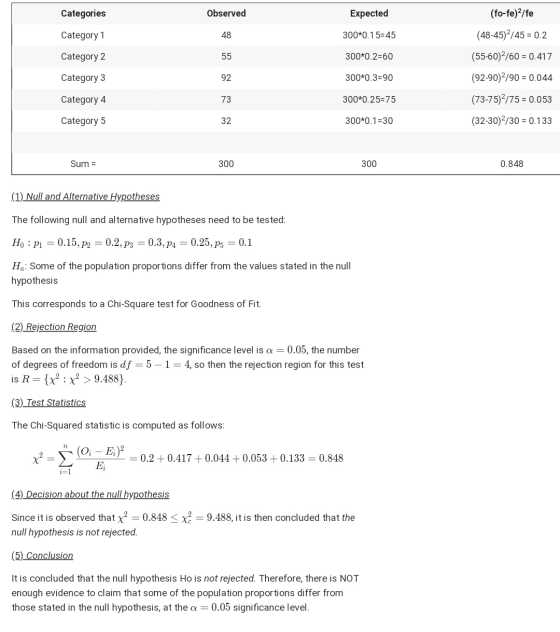
please like ??
Add Answer to:
Problem 8 (15 marks) Consider a multinomial experiment involving n= 300 students of a large high...
Problem 2 (15 marks) Consider a multinomial experiment involving n = 200 students of a large...
 Problem 2 (15 marks) Consider a multinomial experiment involving n = 200 students of a large high school. The attendance department recorded the number of students who were absent during the weekdays. The null hypothesis to be tested is: Ho: p1 = .10, p2 = 25, p3 = .30, p4 = 20, p5 = 15. The following data regarding absenteeism have been collected during the last week. Day of the Week Mon. Tues. Wed. Thurs. Fri. Number Absent 16 44...
Absenteeism of college students from math classes is a major concern to math instructors because missing...
Absenteeism of college students from math classes is a major concern to math instructors because missing class appears to increase the drop rate. Three statistics instructors wondered whether the absentee rate was the same for every day of the school week. They took a sample of absent students from three of their statistics classes during one week of the term. The results of the survey appear in the table. Mon. Tues. Wed. Thurs. Fri. # of students absent 28 22...
Consider a multinomial experiment with n = 260 and k = 4. The null hypothesis to...
Consider a multinomial experiment with n = 260 and k = 4. The null hypothesis to be tested is H0: p1 = p2 = p3 = p4 = 0.25. The observed frequencies resulting from the experiment are: (You may find it useful to reference the appropriate table: chi-square table or F table) Category 1 2 3 4 Frequency 73 44 75 68 a. Choose the appropriate alternative hypothesis. All population proportions differ from 0.25. Not all population proportions are equal...
 Problem 2 (15 marks) Consider a multinomial experiment involving n = 200 students of a large high school. The attendance department recorded the number of students who were absent during the weekdays. The null hypothesis to be tested is: Ho: p1 = .10, p2 = 25, p3 = .30, p4 = 20, p5 = 15. The following data regarding absenteeism have been collected during the last week. Day of the Week Mon. Tues. Wed. Thurs. Fri. Number Absent 16 44...
Most questions answered within 3 hours.
-
Where is the error in this code sequence?
String s1 = "Hello";
String s2 = "ello";...
asked 10 months ago -
Financial data for Joel de Paris, Inc., for last year
follow:
Joel de Paris, Inc.
Balance...
asked 10 months ago -
Consider this reaction:
Al2(SO4)3 (aq)+ BaCl3
(aq) Al2Cl6 (aq)- +
3BaSO4(s) . What is the...
asked 10 months ago -
Suppose that Savneet is considering increasing her
recent random sample from 20 car rentals to 40...
asked 10 months ago -
Trucks arrive at an unloading terminal at an average rate of 120
per hour.
Trucks arrive...
asked 10 months ago -
Why are methanol and ethanol completely soluble in water while
octanol is not very little soluble....
asked 10 months ago -
A facilities manager at a university reads in a research report
that the mean amount of...
asked 10 months ago -
When the CuSO4 is rehydrated by adding water to the anhydrous
compound, is this an endothermic...
asked 10 months ago -
A ray of sunlight is passing from diamond into crown glass; the
angle of incidence is...
asked 10 months ago -
A block of mass 0.249 kg is placed on top of a light, vertical
spring of...
asked 10 months ago -
how do the kidneys compensate in the presences of acidosis
a) trigger hyperventilate
b) reserve acid...
asked 10 months ago -
Question 501 pts
The rental rate of capital to the firm increases. Which of the
following...
asked 10 months ago