
Homework Answers
Add Answer to:
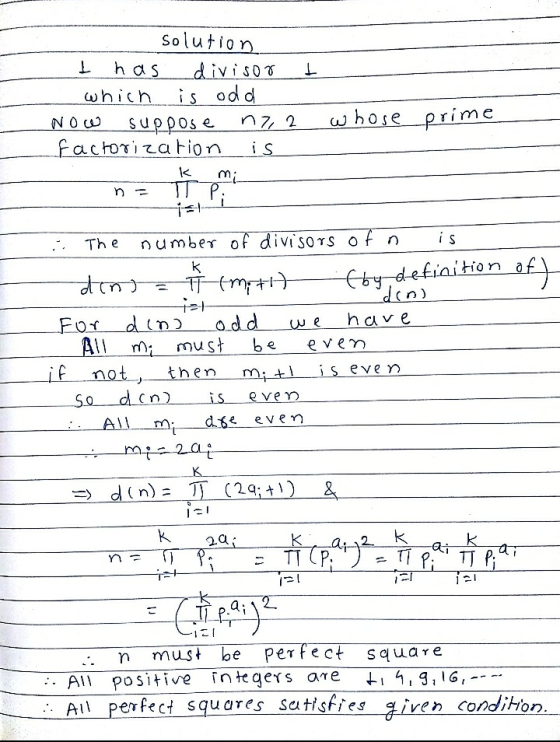
Problem 2. Find (with proof) all positive integers n that have an odd number of positive...
Find all integers x, and odd integers n such that, 1 + n^2 = x^3. Please...
Find all integers x, and odd integers n such that, 1 + n^2 = x^3. Please give an explanation with proof thank you.
Let n be an odd positive integer. Consider a list of n consecutive integers, not necessarily...
Let n be an odd positive integer. Consider a list of n consecutive integers, not necessarily starting with 1. Show that the average is the middle number (that is the number in the middle of the list when they are arranged in an increasing order). What is the average when n is an even positive integer instead. We learned that for the odd numbers, we would have to show why n-1/2(2k+n)+(k+n) all over n equals k+(n+1)/2.
DEFINITION: For a positive integer n, τ(n) is the number of positive divisors of n and...
 DEFINITION: For a positive integer n, τ(n) is the number of
positive divisors of n and σ(n) is the sum of those divisors.
4. The goal of this problem is to prove the inequality in part (b), that o(1)+(2)+...+on) < nº for each positive integer n. The first part is a stepping-stone for that. (a) (10 points.) Fix positive integers n and k with 1 <ksn. (i) For which integers i with 1 <i<n is k a term in the...
DEFINITION: For a positive integer n, τ(n) is the number of
positive divisors of n and σ(n) is the sum of those divisors.
4. The goal of this problem is to prove the inequality in part (b), that o(1)+(2)+...+on) < nº for each positive integer n. The first part is a stepping-stone for that. (a) (10 points.) Fix positive integers n and k with 1 <ksn. (i) For which integers i with 1 <i<n is k a term in the...
Prove that for all integers n, (-n) mod 2 = n mod 2. Give an example...
Prove that for all integers n, (-n) mod 2 = n mod 2. Give an example to show that it is not always true that (-n) mod 3 = n mod 3. Professor mentioned to prove for odd and even integers, however, I don't know how to start the proof.
Exercise 17.8 Find all positive integers n for which o(n) = 60. Whenever a mathematician asks...
 Exercise 17.8 Find all positive integers n for which o(n) = 60. Whenever a mathematician asks you to find all numbers with certain properties, you are being asked to prove that the values you do find are the only values that work. Hint: Compare the factors of o(n) of the form 1+p+ ... + pk with the positive divisors of 60.
Question 3 (a) Write down the prime factorization of 10!. (b) Find the number of positive...
 Question 3 (a) Write down the prime factorization of 10!. (b) Find the number of positive integers n such that n|10! and gcd(n, 27.34.7) = 27.3.7. Justify your answer. Question 4 Let m, n E N. Prove that ged(m2, n2) = (gcd(m, n))2. Question 5 Let p and q be consecutive odd primes with p < q. Prove that (p + q) has at least three prime divisors (not necessarily distinct).
A perfect number is a positive integer that equals the sum of all of its divisors...
 A perfect number is a positive integer that equals the sum of all of its divisors (including the divisor 1 but excluding the number itself). For example 6, 28 and 496 are perfect numbers because 6=1+2+3 28 1 + 2 + 4 + 7 + 14 496 1 + 2 + 4 + 8 + 16 + 31 + 62 + 124 + 248 Write a program to read a positive integer value, N, and find the smallest perfect number...
4) Let D be the set of all finite subsets of positive integers. Define a function...
 4) Let D be the set of all finite subsets of positive integers. Define a function (:2 - D as follows: For each positive integer n, f(n) =the set of positive divisors of n. Find the following f (1), f(17) and f(18). Is f one-to-one? Prove or give a counterexample.
C Programming Write a C program that asks the user for a positive number n (n...
C Programming Write a C program that asks the user for a positive number n (n ≥ 1) then, the program displays all the perfect numbers up to (including) n. A number n is said to be a perfect number if the sum of all its positive divisors (excluding itself) equals n. For example, the divisors of 6 (excluding 6 itself) are 1,2 and 3, and their sum equals 6, thus, 6 is a perfect number. Display the numbers with...
I got a C++ problem. Let n be a positive integer and let S(n) denote the...
 I got a C++ problem.
Let n be a positive integer and let S(n) denote the number of divisors of n. For example, S(1)- 1, S(4)-3, S(6)-4 A positive integer p is called antiprime if S(n)くS(p) for all positive n 〈P. In other words, an antiprime is a number that has a larger number of divisors than any number smaller than itself. Given a positive integer b, your program should output the largest antiprime that is less than or equal...
I got a C++ problem.
Let n be a positive integer and let S(n) denote the number of divisors of n. For example, S(1)- 1, S(4)-3, S(6)-4 A positive integer p is called antiprime if S(n)くS(p) for all positive n 〈P. In other words, an antiprime is a number that has a larger number of divisors than any number smaller than itself. Given a positive integer b, your program should output the largest antiprime that is less than or equal...
 DEFINITION: For a positive integer n, τ(n) is the number of
positive divisors of n and σ(n) is the sum of those divisors.
4. The goal of this problem is to prove the inequality in part (b), that o(1)+(2)+...+on) < nº for each positive integer n. The first part is a stepping-stone for that. (a) (10 points.) Fix positive integers n and k with 1 <ksn. (i) For which integers i with 1 <i<n is k a term in the...
DEFINITION: For a positive integer n, τ(n) is the number of
positive divisors of n and σ(n) is the sum of those divisors.
4. The goal of this problem is to prove the inequality in part (b), that o(1)+(2)+...+on) < nº for each positive integer n. The first part is a stepping-stone for that. (a) (10 points.) Fix positive integers n and k with 1 <ksn. (i) For which integers i with 1 <i<n is k a term in the...
 Exercise 17.8 Find all positive integers n for which o(n) = 60. Whenever a mathematician asks you to find all numbers with certain properties, you are being asked to prove that the values you do find are the only values that work. Hint: Compare the factors of o(n) of the form 1+p+ ... + pk with the positive divisors of 60.
 Question 3 (a) Write down the prime factorization of 10!. (b) Find the number of positive integers n such that n|10! and gcd(n, 27.34.7) = 27.3.7. Justify your answer. Question 4 Let m, n E N. Prove that ged(m2, n2) = (gcd(m, n))2. Question 5 Let p and q be consecutive odd primes with p < q. Prove that (p + q) has at least three prime divisors (not necessarily distinct).
 A perfect number is a positive integer that equals the sum of all of its divisors (including the divisor 1 but excluding the number itself). For example 6, 28 and 496 are perfect numbers because 6=1+2+3 28 1 + 2 + 4 + 7 + 14 496 1 + 2 + 4 + 8 + 16 + 31 + 62 + 124 + 248 Write a program to read a positive integer value, N, and find the smallest perfect number...
 4) Let D be the set of all finite subsets of positive integers. Define a function (:2 - D as follows: For each positive integer n, f(n) =the set of positive divisors of n. Find the following f (1), f(17) and f(18). Is f one-to-one? Prove or give a counterexample.
 I got a C++ problem.
Let n be a positive integer and let S(n) denote the number of divisors of n. For example, S(1)- 1, S(4)-3, S(6)-4 A positive integer p is called antiprime if S(n)くS(p) for all positive n 〈P. In other words, an antiprime is a number that has a larger number of divisors than any number smaller than itself. Given a positive integer b, your program should output the largest antiprime that is less than or equal...
I got a C++ problem.
Let n be a positive integer and let S(n) denote the number of divisors of n. For example, S(1)- 1, S(4)-3, S(6)-4 A positive integer p is called antiprime if S(n)くS(p) for all positive n 〈P. In other words, an antiprime is a number that has a larger number of divisors than any number smaller than itself. Given a positive integer b, your program should output the largest antiprime that is less than or equal...
Most questions answered within 3 hours.
-
Where is the error in this code sequence?
String s1 = "Hello";
String s2 = "ello";...
asked 10 months ago -
Financial data for Joel de Paris, Inc., for last year
follow:
Joel de Paris, Inc.
Balance...
asked 10 months ago -
Consider this reaction:
Al2(SO4)3 (aq)+ BaCl3
(aq) Al2Cl6 (aq)- +
3BaSO4(s) . What is the...
asked 10 months ago -
Suppose that Savneet is considering increasing her
recent random sample from 20 car rentals to 40...
asked 10 months ago -
Trucks arrive at an unloading terminal at an average rate of 120
per hour.
Trucks arrive...
asked 10 months ago -
Why are methanol and ethanol completely soluble in water while
octanol is not very little soluble....
asked 10 months ago -
A facilities manager at a university reads in a research report
that the mean amount of...
asked 10 months ago -
When the CuSO4 is rehydrated by adding water to the anhydrous
compound, is this an endothermic...
asked 10 months ago -
A ray of sunlight is passing from diamond into crown glass; the
angle of incidence is...
asked 10 months ago -
A block of mass 0.249 kg is placed on top of a light, vertical
spring of...
asked 10 months ago -
how do the kidneys compensate in the presences of acidosis
a) trigger hyperventilate
b) reserve acid...
asked 10 months ago -
Question 501 pts
The rental rate of capital to the firm increases. Which of the
following...
asked 10 months ago