
Homework Answers
Request Answer!
We need at least 10 more requests to produce the answer.
0 / 10 have requested this problem solution
The more requests, the faster the answer.
Add Answer to:
Question 1 4 pts The molar mass of an unknown gas was measured by an effusion...
The molar mass of an unknown gas was measured by an effusion experiment. It was found...
The molar mass of an unknown gas was measured by an effusion experiment. It was found that the unknown gas effused at a rate of 2.7 x 10^-6 mol/hr, whereas the nitrogen gas effused at a rate of 3.3 x 10^-6 mol/hr. What is the molar mass of the gas?
Please help! QUESTION 1 A gas effusion cell is loaded with O2 gas at STP it...
 Please help!
QUESTION 1 A gas effusion cell is loaded with O2 gas at STP it take 34 seconds 0.010% of the gas to effuse through the hole. Under the same conditions, an unknown gas takes 59.4 seconds for 0.010% of gas to effuse through the hole. Based on these data, what is the molar mass of the unknown gas (in g/mol)? QUESTION 2 A sample of gas is contained in a cylinder with a movable piston. The initial conditions...
Please help!
QUESTION 1 A gas effusion cell is loaded with O2 gas at STP it take 34 seconds 0.010% of the gas to effuse through the hole. Under the same conditions, an unknown gas takes 59.4 seconds for 0.010% of gas to effuse through the hole. Based on these data, what is the molar mass of the unknown gas (in g/mol)? QUESTION 2 A sample of gas is contained in a cylinder with a movable piston. The initial conditions...
The effusion rate of an unknown gas is measured and found to be 31.50 mL/min. Under...
 The effusion rate of an unknown gas is measured and found to be 31.50 mL/min. Under identical experimental conditions, the effusion rate of O2(g) is found to be 30.50 mL/min. What is the molar mass of the unknown gas?
A gas effusion cell is loaded with O2 gas at STP it take 35.7 seconds 0.010%...
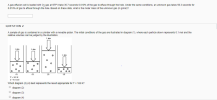 A gas effusion cell is loaded with O2 gas at STP it take 35.7 seconds 0.010% of the gas to effuse through the hole. Under the same conditions, an unknown gas takes 56.3 seconds for 0.010% of gas to effuse through the hole. Based on these data, what is the molar mass of the unknown gas (in g/mol)? QUESTION 2 A sample of gas is contained in a cylinder with a movable piston. The initial conditions of the gas are...
Question 14 2.5 pts The rate of effusion of an unknown gas was measured and found...
 Question 14 2.5 pts The rate of effusion of an unknown gas was measured and found to be 14.3 mL/min. Under identical conditions, the rate of effusion of pure oxygen (O2) gas is 16.8 mL/min. Based on this information, the identity of the unknown gas could be: N2 С-Н. none of these CO2 NO
A gas of unknown molecular mass was allowed to effuse through a small opening under constant...
 A gas of unknown molecular mass was allowed to effuse through a small opening under constant pressure conditions. It required 52 s for 1.0 L of the gas to effuse. Under identical experimental conditions it required 27 s for 1.0 L of O2 gas to effuse. Calculate the molar mass of the unknown gas. (Remember that the faster the rate of effusion, the shorter the time required for effusion of 1.0 L; that is, rate and time are inversely proportional.)...
Homework 5 The rate of effusion of a particular gas was measured and found to be...
 Homework 5 The rate of effusion of a particular gas was measured and found to be 25.2 mL/min. Under the same conditions, the rate of effusion of pure methane (CH4) gas is 47.8 mL/min. What is the molar mass of the unknown gas? Question 1 Question 2 1 pt Question 3 Mass- g/mol Question 4 1 pt Question 5 1 pt Submit Answer Try Another Version Question 6 3 item attempts remaining 1 pt 1 pt 1 pt 1 pt...
A sample of N2 gas is contaminated with a gas (A) of unknown molar mass. The...
A sample of N2 gas is contaminated with a gas (A) of unknown molar mass. The partial pressure of each gas is known to be 200. torr at 25°C. The gases are allowed to effuse through a pinhole, and it is found that gas A escapes at 2 times the rate of N2. The molar mass of gas A is: 56 g/mol 14.01 g/mol 7.00 g/mol 112 g/mol none of these
1. The rate of effusion of CH4 gas through a porous barrier is observed to be...
1. The rate of effusion of CH4 gas through a porous barrier is observed to be 9.17*10^-4 mol/h. Under the same conditions, the rate of effusion of gas would be _____________ mol/h. 2. A sample of N2 gas is observed to effuse through a pourous barrier in 1.93 minutes. Under the same conditions, the same number of moles of an unknown gas requires 2.97 minutes to effuse through the same barrier. The molar mass of the unknown gas is _______________
Please explain and show steps. Thanks! The rate of effusion of a particular gas was measured...
 Please explain and show steps. Thanks!
The rate of effusion of a particular gas was measured to be 28.6 mL/min. Under the same conditions, the rate of effusion of pure methane (CH4) gas is 48.4 mL/min. What is the molar mass of the unknown gas? g/mol
Please explain and show steps. Thanks!
The rate of effusion of a particular gas was measured to be 28.6 mL/min. Under the same conditions, the rate of effusion of pure methane (CH4) gas is 48.4 mL/min. What is the molar mass of the unknown gas? g/mol
 Please help!
QUESTION 1 A gas effusion cell is loaded with O2 gas at STP it take 34 seconds 0.010% of the gas to effuse through the hole. Under the same conditions, an unknown gas takes 59.4 seconds for 0.010% of gas to effuse through the hole. Based on these data, what is the molar mass of the unknown gas (in g/mol)? QUESTION 2 A sample of gas is contained in a cylinder with a movable piston. The initial conditions...
Please help!
QUESTION 1 A gas effusion cell is loaded with O2 gas at STP it take 34 seconds 0.010% of the gas to effuse through the hole. Under the same conditions, an unknown gas takes 59.4 seconds for 0.010% of gas to effuse through the hole. Based on these data, what is the molar mass of the unknown gas (in g/mol)? QUESTION 2 A sample of gas is contained in a cylinder with a movable piston. The initial conditions...
 The effusion rate of an unknown gas is measured and found to be 31.50 mL/min. Under identical experimental conditions, the effusion rate of O2(g) is found to be 30.50 mL/min. What is the molar mass of the unknown gas?
 A gas effusion cell is loaded with O2 gas at STP it take 35.7 seconds 0.010% of the gas to effuse through the hole. Under the same conditions, an unknown gas takes 56.3 seconds for 0.010% of gas to effuse through the hole. Based on these data, what is the molar mass of the unknown gas (in g/mol)? QUESTION 2 A sample of gas is contained in a cylinder with a movable piston. The initial conditions of the gas are...
 Question 14 2.5 pts The rate of effusion of an unknown gas was measured and found to be 14.3 mL/min. Under identical conditions, the rate of effusion of pure oxygen (O2) gas is 16.8 mL/min. Based on this information, the identity of the unknown gas could be: N2 С-Н. none of these CO2 NO
 A gas of unknown molecular mass was allowed to effuse through a small opening under constant pressure conditions. It required 52 s for 1.0 L of the gas to effuse. Under identical experimental conditions it required 27 s for 1.0 L of O2 gas to effuse. Calculate the molar mass of the unknown gas. (Remember that the faster the rate of effusion, the shorter the time required for effusion of 1.0 L; that is, rate and time are inversely proportional.)...
 Homework 5 The rate of effusion of a particular gas was measured and found to be 25.2 mL/min. Under the same conditions, the rate of effusion of pure methane (CH4) gas is 47.8 mL/min. What is the molar mass of the unknown gas? Question 1 Question 2 1 pt Question 3 Mass- g/mol Question 4 1 pt Question 5 1 pt Submit Answer Try Another Version Question 6 3 item attempts remaining 1 pt 1 pt 1 pt 1 pt...
 Please explain and show steps. Thanks!
The rate of effusion of a particular gas was measured to be 28.6 mL/min. Under the same conditions, the rate of effusion of pure methane (CH4) gas is 48.4 mL/min. What is the molar mass of the unknown gas? g/mol
Please explain and show steps. Thanks!
The rate of effusion of a particular gas was measured to be 28.6 mL/min. Under the same conditions, the rate of effusion of pure methane (CH4) gas is 48.4 mL/min. What is the molar mass of the unknown gas? g/mol
Most questions answered within 3 hours.
-
Where is the error in this code sequence?
String s1 = "Hello";
String s2 = "ello";...
asked 11 months ago -
Financial data for Joel de Paris, Inc., for last year
follow:
Joel de Paris, Inc.
Balance...
asked 11 months ago -
Consider this reaction:
Al2(SO4)3 (aq)+ BaCl3
(aq) Al2Cl6 (aq)- +
3BaSO4(s) . What is the...
asked 11 months ago -
Suppose that Savneet is considering increasing her
recent random sample from 20 car rentals to 40...
asked 11 months ago -
Trucks arrive at an unloading terminal at an average rate of 120
per hour.
Trucks arrive...
asked 11 months ago -
Why are methanol and ethanol completely soluble in water while
octanol is not very little soluble....
asked 11 months ago -
A facilities manager at a university reads in a research report
that the mean amount of...
asked 11 months ago -
When the CuSO4 is rehydrated by adding water to the anhydrous
compound, is this an endothermic...
asked 11 months ago -
A ray of sunlight is passing from diamond into crown glass; the
angle of incidence is...
asked 11 months ago -
A block of mass 0.249 kg is placed on top of a light, vertical
spring of...
asked 11 months ago -
how do the kidneys compensate in the presences of acidosis
a) trigger hyperventilate
b) reserve acid...
asked 11 months ago -
Question 501 pts
The rental rate of capital to the firm increases. Which of the
following...
asked 11 months ago