This question has three parts. Part 1. The data and scenario from this question follows into...
This question has three parts.
Part 1.
The data and scenario from this question follows into the next two questions.
A plumbing company sells plumbing supplies for commercial and residential applications. The company currently has only one supplier for a particular type of faucet. Based on historical data that the company has maintained, the company has assessed the first accompanying probability distribution for the proportion of defective faucets that it receives from this supplier. This supplier charges the company $33.00 per unit for this faucet. Although the supplier will replace any defects free of charge, the plumbing company managers figure the cost of dealing with the defects is about $4.00 each.
| Proportion Defective | Probability |
| 0.01 | 0.4 |
| 0.03 | 0.3 |
| 0.07 | 0.2 |
| 0.16 | 0.1 |
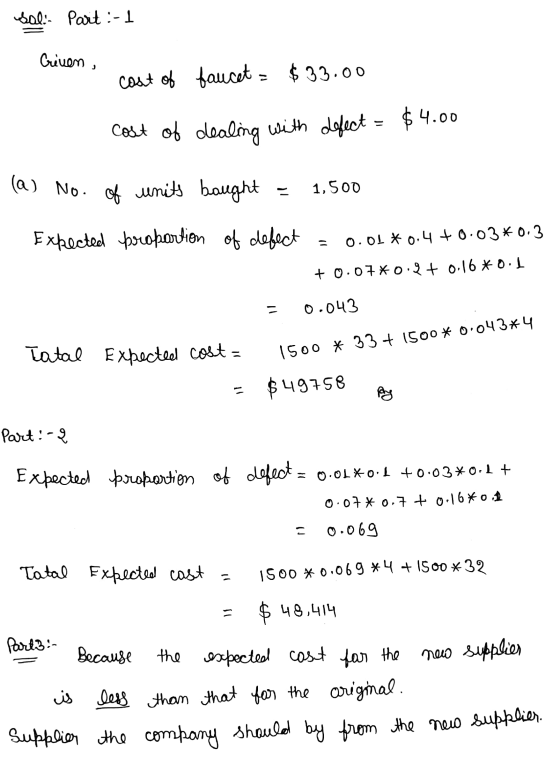
Assuming that the plumbing company is planning to purchase 1,500 of these faucets from the supplier, what is the total expected cost to the plumbing company for the deal?
The total expected cost is $ ______. (Type the entire number, do not round. Do not include a comma)
Part 2)
The data and scenario from part of this question relates to the previous question.
Suppose that the plumbing company has an opportunity to buy the same faucets from another supplier at a cost of $ 32.00 per unit. However, based on its investigations, the company has assessed the second accompanying probability distribution for the proportion of defective faucets that will be delivered by the new supplier (see below). Assuming that the defect cost is still $4.00 each and based on total expected cost for an order of 1,500 faucets.
| Proportion Defective | Probability |
| 0.01 | 0.1 |
| 0.03 | 0.1 |
| 0.07 | 0.7 |
| 0.16 | 0.1 |
The total expected cost is $ ______ . (Type the entire number, do not round. Do not include a comma)
Part 3)
Because the expected cost for the new supplier is [more
OR less] than that for the original
supplier, the company should buy from the [new OR
original] supplier.
Homework Answers
Add Answer to:
This question has three parts.
Part 1.
The data and scenario from this question follows into...
This question has three parts. Part 1. The data and scenario from this question follows into...
This question has three parts. Part 1. The data and scenario from this question follows into the next two questions. A plumbing company sells plumbing supplies for commercial and residential applications. The company currently has only one supplier for a particular type of faucet. Based on historical data that the company has maintained, the company has assessed the first accompanying probability distribution for the proportion of defective faucets that it receives from this supplier. This supplier charges the company $33.00...
The data and scenario from this question follows into the next two questions, A plumbing company...
 The data and scenario from this question follows into the next two questions, A plumbing company sells plumbing supplies for commercial and residential applications. The company currently has only one supplier for a particular type of faucet. Based on historical data that the company has maintained, the company has assessed the first accompanying probability distribution for the proportion of defective faucets that it receives from this supplier. This supplier charges the company $33.00 per unit for this faucet. Although the...
The data and scenario from this question follows into the next question. Assume that for an...
 The data and scenario from this question follows into the next question. Assume that for an ad campaign to be successful, at least 76% of those seeing a television commercial must be able to recall the name of the company featured in the commercial one hour after viewing the commercial. Before distributing an ad campaign nationally, an advertising company plans to show the commercial to a random sample of 24 people. It will also show the same people two additional...
QUESTION 13 (MRH_CH05-322B) You want to test the proportion of defectives in samples from two suppliers....
 QUESTION 13 (MRH_CH05-322B) You want to test the proportion of defectives in samples from two suppliers. Supplier A has sent you 310 samples, of which 27 are defective. Supplier B has sent you 280 samples, of which 17 are defective. What is the value of your test statistic zo? Enter your answer to four decimal places. If you calculate a negative number, just type the minus sign in front of it. Do not take the absolute value of anything.
Higbee Manufacturing Corp. has recently received 5 cases of a certain part from one of its...
Higbee Manufacturing Corp. has recently received 5 cases of a certain part from one of its suppliers. The defect rate for the parts is normally 5%, but the supplier has just notified Higbee that one of the cases shipped to them has been made on a misaligned machine that has a defect rate of 97%. So the plant manager selects a case at random and tests a part. a. What is the probability that the part is defective? b. Suppose...
This question has two parts. Part 1) Assume that for an ad campaign to be successful,...
This question has two parts. Part 1) Assume that for an ad campaign to be successful, at least 76% of those seeing a television commercial must be able to recall the name of the company featured in the commercial one hour after viewing the commercial. Before distributing an ad campaign nationally, an advertising company plans to show the commercial to a random sample of 24 people. It will also show the same people two additional commercials for different products or...
This question has two parts. Part 1) Assume that for an ad campaign to be successful,...
This question has two parts. Part 1) Assume that for an ad campaign to be successful, at least 76% of those seeing a television commercial must be able to recall the name of the company featured in the commercial one hour after viewing the commercial. Before distributing an ad campaign nationally, an advertising company plans to show the commercial to a random sample of 24 people. It will also show the same people two additional commercials for different products or...
Question 8 1 pts An inspection on 160 parts made from two production lines at a...
 Question 8 1 pts An inspection on 160 parts made from two production lines at a factory yields the following table. A part is randomly selected from these 160 parts. Line 1 Line 2 total Good 65 82 147 Defective 5 8 13 total 70 90 160 The probability that this part is made from Line 1 is about O 0.41 0.56 O 0.44 0.39 0.03 Question 10 1 pts The following two-way contingency table gives the breakdown of the...
This question has two parts. Part 1) Using historical records, a manufacturing firm has developed the...
This question has two parts. Part 1) Using historical records, a manufacturing firm has developed the following probability distribution for the number of days required to get components from its suppliers. The distribution is shown here, where the random variable x is the number of days. x P(x) 4 0.17 5 0.38 6 0.31 7 0.105 8 0.035 a. The average lead time is ______ days. (Type the entire number, do not round.) b. The coefficient of variation is ______...
B89 itself. It has been producing 9 comma 0009,000 units of Part B89 annually. The annual...
B89 itself. It has been producing 9 comma 0009,000 units of Part B89 annually. The annual costs of producing Part B89 at the level of 9 comma 0009,000 units include: Direct materials $ 3.00$3.00 Direct labor $ 8.30$8.30 Variable manufacturing overhead $ 4.40$4.40 Fixed manufacturing overhead $ 3.40$3.40 Total cost $ 19.10$19.10 All of the fixed manufacturing overhead costs would continue whether Part B89 is made internally or purchased from an outside supplier. Assume Lasso can purchase 9 comma 0009,000...
 The data and scenario from this question follows into the next two questions, A plumbing company sells plumbing supplies for commercial and residential applications. The company currently has only one supplier for a particular type of faucet. Based on historical data that the company has maintained, the company has assessed the first accompanying probability distribution for the proportion of defective faucets that it receives from this supplier. This supplier charges the company $33.00 per unit for this faucet. Although the...
 The data and scenario from this question follows into the next question. Assume that for an ad campaign to be successful, at least 76% of those seeing a television commercial must be able to recall the name of the company featured in the commercial one hour after viewing the commercial. Before distributing an ad campaign nationally, an advertising company plans to show the commercial to a random sample of 24 people. It will also show the same people two additional...
 QUESTION 13 (MRH_CH05-322B) You want to test the proportion of defectives in samples from two suppliers. Supplier A has sent you 310 samples, of which 27 are defective. Supplier B has sent you 280 samples, of which 17 are defective. What is the value of your test statistic zo? Enter your answer to four decimal places. If you calculate a negative number, just type the minus sign in front of it. Do not take the absolute value of anything.
 Question 8 1 pts An inspection on 160 parts made from two production lines at a factory yields the following table. A part is randomly selected from these 160 parts. Line 1 Line 2 total Good 65 82 147 Defective 5 8 13 total 70 90 160 The probability that this part is made from Line 1 is about O 0.41 0.56 O 0.44 0.39 0.03 Question 10 1 pts The following two-way contingency table gives the breakdown of the...
Most questions answered within 3 hours.
-
Where is the error in this code sequence?
String s1 = "Hello";
String s2 = "ello";...
asked 10 months ago -
Financial data for Joel de Paris, Inc., for last year
follow:
Joel de Paris, Inc.
Balance...
asked 10 months ago -
Consider this reaction:
Al2(SO4)3 (aq)+ BaCl3
(aq) Al2Cl6 (aq)- +
3BaSO4(s) . What is the...
asked 10 months ago -
Suppose that Savneet is considering increasing her
recent random sample from 20 car rentals to 40...
asked 10 months ago -
Trucks arrive at an unloading terminal at an average rate of 120
per hour.
Trucks arrive...
asked 10 months ago -
Why are methanol and ethanol completely soluble in water while
octanol is not very little soluble....
asked 10 months ago -
A facilities manager at a university reads in a research report
that the mean amount of...
asked 10 months ago -
When the CuSO4 is rehydrated by adding water to the anhydrous
compound, is this an endothermic...
asked 10 months ago -
A ray of sunlight is passing from diamond into crown glass; the
angle of incidence is...
asked 10 months ago -
A block of mass 0.249 kg is placed on top of a light, vertical
spring of...
asked 10 months ago -
how do the kidneys compensate in the presences of acidosis
a) trigger hyperventilate
b) reserve acid...
asked 10 months ago -
Question 501 pts
The rental rate of capital to the firm increases. Which of the
following...
asked 10 months ago