
Homework Answers
Add Answer to:
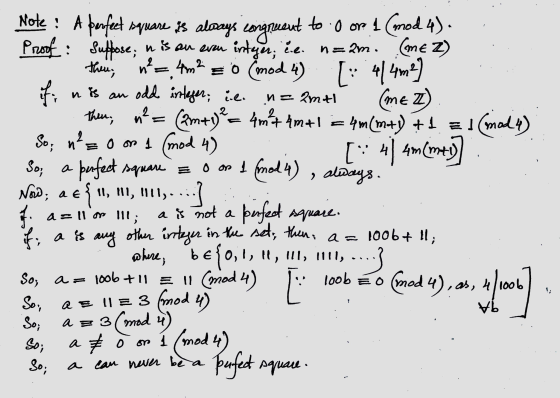
Problem 5. Let a € {11, 111, 1111, ...} be a positive integer with all 1s...
Problem 1. Let a be any positive integer relatively prime to 10 (so gcd(a, 10) 1)....
 Problem 1. Let a be any positive integer relatively prime to 10 (so gcd(a, 10) 1). Show there are an infinite number of multiples of a whose decimal expansion is all 9s. For example, 13 we have 13 · 76923 = 999999 and 13 · 76923076923 = 999999999999. (Hint: a number whose decimal expansion is all 9s is of the form 109 – 1). Do you notice any connection here to the decimal expansion of the fraction 1/a? for a...
5. Let X be a non-negative integer-valued random variable with positive expectation. Prove that (...
 5. Let X be a non-negative integer-valued random variable with positive expectation. Prove that (Hint: Use the following special case of the Cauchy-Schwarz Inequality: First, make sure you see why this is a special case of the Cauchy-Schwarz Inequality; then apply it to get one of the inequalities of this problem.)
5. Let X be a non-negative integer-valued random variable with positive expectation. Prove that (Hint: Use the following special case of the Cauchy-Schwarz Inequality: First, make sure you see...
5. Let X be a non-negative integer-valued random variable with positive expectation. Prove that (Hint: Use the following special case of the Cauchy-Schwarz Inequality: First, make sure you see why this is a special case of the Cauchy-Schwarz Inequality; then apply it to get one of the inequalities of this problem.)
5. Let X be a non-negative integer-valued random variable with positive expectation. Prove that (Hint: Use the following special case of the Cauchy-Schwarz Inequality: First, make sure you see...
5. Let X be a non-negative integer-valued random variable with positive expectation. Prove that E...
 5. Let X be a non-negative integer-valued random variable with positive expectation. Prove that E X2] (Hint: Use the following special case of the Cauchy-Schwarz Inequality: First, make sure you see why this is a special case of the Cauchy-Schwarz Inequality; then apply it to get one of the inequalities of this problem.)
5. Let X be a non-negative integer-valued random variable with positive expectation. Prove that E X2] (Hint: Use the following special case of the Cauchy-Schwarz Inequality: First,...
5. Let X be a non-negative integer-valued random variable with positive expectation. Prove that E X2] (Hint: Use the following special case of the Cauchy-Schwarz Inequality: First, make sure you see why this is a special case of the Cauchy-Schwarz Inequality; then apply it to get one of the inequalities of this problem.)
5. Let X be a non-negative integer-valued random variable with positive expectation. Prove that E X2] (Hint: Use the following special case of the Cauchy-Schwarz Inequality: First,...
5. Let X be a non-negative integer-valued random variable with positive expectation. Prove that E...
 5. Let X be a non-negative integer-valued random variable with positive expectation. Prove that E X2] (Hint: Use the following special case of the Cauchy-Schwarz Inequality: First, make sure you see why this is a special case of the Cauchy-Schwarz Inequality; then apply it to get one of the inequalities of this problem.)
5. Let X be a non-negative integer-valued random variable with positive expectation. Prove that E X2] (Hint: Use the following special case of the Cauchy-Schwarz Inequality: First,...
5. Let X be a non-negative integer-valued random variable with positive expectation. Prove that E X2] (Hint: Use the following special case of the Cauchy-Schwarz Inequality: First, make sure you see why this is a special case of the Cauchy-Schwarz Inequality; then apply it to get one of the inequalities of this problem.)
5. Let X be a non-negative integer-valued random variable with positive expectation. Prove that E X2] (Hint: Use the following special case of the Cauchy-Schwarz Inequality: First,...
4. Let n be a positive integer. Z" is the set of all lists of length n whose entries are in Z. Prove that Z" is...
 4. Let n be a positive integer. Z" is the set of all lists of length n whose entries are in Z. Prove that Z" is countable. (Hint: Find a bijection between Z"-1x Z and Z" and then use induction.)
4. Let n be a positive integer. Z" is the set of all lists of length n whose entries are in Z. Prove that Z" is countable. (Hint: Find a bijection between Z"-1x Z and Z" and then use induction.)
4. Let n be a positive integer. Z" is the set of all lists of length n whose entries are in Z. Prove that Z" is countable. (Hint: Find a bijection between Z"-1x Z and Z" and then use induction.)
Let n be a positive integer. Show that nº + 4n +5 has no prime divisor...
 Let n be a positive integer. Show that nº + 4n +5 has no prime divisor p with p 3 mod 4.
(i) Vz, y E R : (z +R y) , (z) +s (y) ii )-1s (5)...
 (i) Vz, y E R : (z +R y) , (z) +s (y) ii )-1s (5) A ring homomorphism. (2 pts) Let m be a positive integer, and let d be a positive divisor of Show that the map a : z/mZ 2/dZ by a(a mod m) show that t has properties (i)-(ii) in the previous problem mod d is a ring homomorphism (i.e.,
5. (a) Show that 26 = 1 mod 9. (b) Let m be a positive integer,...
 5. (a) Show that 26 = 1 mod 9. (b) Let m be a positive integer, and let m = 6q+r where q and r are integers with 0 <r < 6. Use (a) and rules of exponents to show that 2" = 2 mod 9 (c) Use (b) to find an s in {0,1,...,8} with 21024 = s mod 9.
Let m be a positive integer and let a and b be integers relatively prime to m with (ord m a , ord...
Let m be a positive integer and let a and b be integers relatively prime to m with (ord m a , ord m b) )=1. Prove that ord m (ab)= (ord m a) (ord m b) (Hint: Let k=ord m(a),l=ord m(b), and n=ord m(ab). Then 1≡(ab)^kn≡b^kn mod m. What does this imply about l in relation to kn?
5. Let AE Maxn(C). Recall that A is said to be nilpo tent if there exists a positive integer k such that A 0. Prove...
 5. Let AE Maxn(C). Recall that A is said to be nilpo tent if there exists a positive integer k such that A 0. Prove the following statements (a) If A is nilpotent, then A 0. (Hint: First show that if A is nilpotent, then the Jordan form of A is also nilpotent.) (b) If A is nilpotent, then tr(A) 0 (e) A is nilpotent if and only if the characteristic polynomial of A is (-1)"" (d) If A is...
 Problem 1. Let a be any positive integer relatively prime to 10 (so gcd(a, 10) 1). Show there are an infinite number of multiples of a whose decimal expansion is all 9s. For example, 13 we have 13 · 76923 = 999999 and 13 · 76923076923 = 999999999999. (Hint: a number whose decimal expansion is all 9s is of the form 109 – 1). Do you notice any connection here to the decimal expansion of the fraction 1/a? for a...
 5. Let X be a non-negative integer-valued random variable with positive expectation. Prove that (Hint: Use the following special case of the Cauchy-Schwarz Inequality: First, make sure you see why this is a special case of the Cauchy-Schwarz Inequality; then apply it to get one of the inequalities of this problem.)
5. Let X be a non-negative integer-valued random variable with positive expectation. Prove that (Hint: Use the following special case of the Cauchy-Schwarz Inequality: First, make sure you see...
5. Let X be a non-negative integer-valued random variable with positive expectation. Prove that (Hint: Use the following special case of the Cauchy-Schwarz Inequality: First, make sure you see why this is a special case of the Cauchy-Schwarz Inequality; then apply it to get one of the inequalities of this problem.)
5. Let X be a non-negative integer-valued random variable with positive expectation. Prove that (Hint: Use the following special case of the Cauchy-Schwarz Inequality: First, make sure you see...
 5. Let X be a non-negative integer-valued random variable with positive expectation. Prove that E X2] (Hint: Use the following special case of the Cauchy-Schwarz Inequality: First, make sure you see why this is a special case of the Cauchy-Schwarz Inequality; then apply it to get one of the inequalities of this problem.)
5. Let X be a non-negative integer-valued random variable with positive expectation. Prove that E X2] (Hint: Use the following special case of the Cauchy-Schwarz Inequality: First,...
5. Let X be a non-negative integer-valued random variable with positive expectation. Prove that E X2] (Hint: Use the following special case of the Cauchy-Schwarz Inequality: First, make sure you see why this is a special case of the Cauchy-Schwarz Inequality; then apply it to get one of the inequalities of this problem.)
5. Let X be a non-negative integer-valued random variable with positive expectation. Prove that E X2] (Hint: Use the following special case of the Cauchy-Schwarz Inequality: First,...
 5. Let X be a non-negative integer-valued random variable with positive expectation. Prove that E X2] (Hint: Use the following special case of the Cauchy-Schwarz Inequality: First, make sure you see why this is a special case of the Cauchy-Schwarz Inequality; then apply it to get one of the inequalities of this problem.)
5. Let X be a non-negative integer-valued random variable with positive expectation. Prove that E X2] (Hint: Use the following special case of the Cauchy-Schwarz Inequality: First,...
5. Let X be a non-negative integer-valued random variable with positive expectation. Prove that E X2] (Hint: Use the following special case of the Cauchy-Schwarz Inequality: First, make sure you see why this is a special case of the Cauchy-Schwarz Inequality; then apply it to get one of the inequalities of this problem.)
5. Let X be a non-negative integer-valued random variable with positive expectation. Prove that E X2] (Hint: Use the following special case of the Cauchy-Schwarz Inequality: First,...
 4. Let n be a positive integer. Z" is the set of all lists of length n whose entries are in Z. Prove that Z" is countable. (Hint: Find a bijection between Z"-1x Z and Z" and then use induction.)
4. Let n be a positive integer. Z" is the set of all lists of length n whose entries are in Z. Prove that Z" is countable. (Hint: Find a bijection between Z"-1x Z and Z" and then use induction.)
4. Let n be a positive integer. Z" is the set of all lists of length n whose entries are in Z. Prove that Z" is countable. (Hint: Find a bijection between Z"-1x Z and Z" and then use induction.)
 Let n be a positive integer. Show that nº + 4n +5 has no prime divisor p with p 3 mod 4.
 (i) Vz, y E R : (z +R y) , (z) +s (y) ii )-1s (5) A ring homomorphism. (2 pts) Let m be a positive integer, and let d be a positive divisor of Show that the map a : z/mZ 2/dZ by a(a mod m) show that t has properties (i)-(ii) in the previous problem mod d is a ring homomorphism (i.e.,
 5. (a) Show that 26 = 1 mod 9. (b) Let m be a positive integer, and let m = 6q+r where q and r are integers with 0 <r < 6. Use (a) and rules of exponents to show that 2" = 2 mod 9 (c) Use (b) to find an s in {0,1,...,8} with 21024 = s mod 9.
 5. Let AE Maxn(C). Recall that A is said to be nilpo tent if there exists a positive integer k such that A 0. Prove the following statements (a) If A is nilpotent, then A 0. (Hint: First show that if A is nilpotent, then the Jordan form of A is also nilpotent.) (b) If A is nilpotent, then tr(A) 0 (e) A is nilpotent if and only if the characteristic polynomial of A is (-1)"" (d) If A is...
Most questions answered within 3 hours.
-
Where is the error in this code sequence?
String s1 = "Hello";
String s2 = "ello";...
asked 10 months ago -
Financial data for Joel de Paris, Inc., for last year
follow:
Joel de Paris, Inc.
Balance...
asked 10 months ago -
Consider this reaction:
Al2(SO4)3 (aq)+ BaCl3
(aq) Al2Cl6 (aq)- +
3BaSO4(s) . What is the...
asked 10 months ago -
Suppose that Savneet is considering increasing her
recent random sample from 20 car rentals to 40...
asked 10 months ago -
Trucks arrive at an unloading terminal at an average rate of 120
per hour.
Trucks arrive...
asked 10 months ago -
Why are methanol and ethanol completely soluble in water while
octanol is not very little soluble....
asked 10 months ago -
A facilities manager at a university reads in a research report
that the mean amount of...
asked 10 months ago -
When the CuSO4 is rehydrated by adding water to the anhydrous
compound, is this an endothermic...
asked 10 months ago -
A ray of sunlight is passing from diamond into crown glass; the
angle of incidence is...
asked 10 months ago -
A block of mass 0.249 kg is placed on top of a light, vertical
spring of...
asked 10 months ago -
how do the kidneys compensate in the presences of acidosis
a) trigger hyperventilate
b) reserve acid...
asked 10 months ago -
Question 501 pts
The rental rate of capital to the firm increases. Which of the
following...
asked 10 months ago