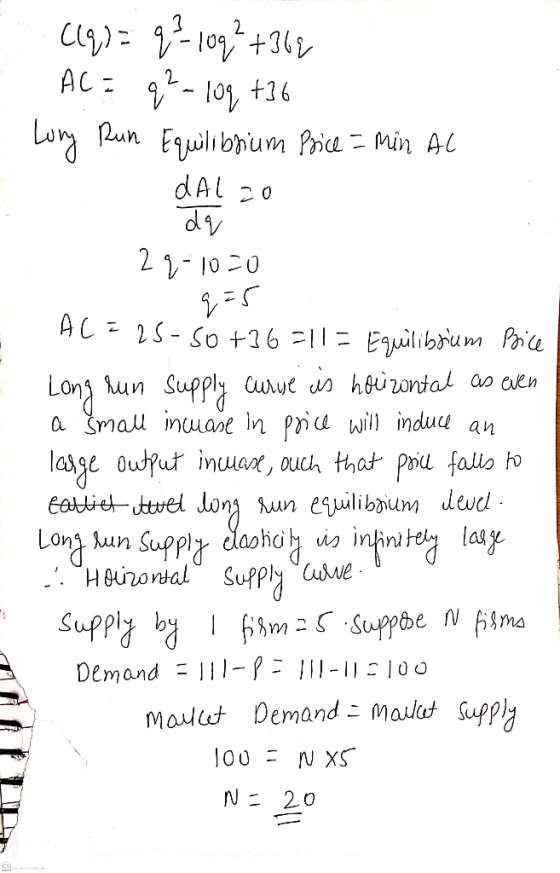
All firms in a competitive industry have the following (firm-level) long-run total cost curve: C(q) =...
All firms in a competitive industry have the following (firm-level) long-run total cost curve:
C(q) = q3–10q2 + 36q
where q is the output of the firm.
a. Compute the long run equilibrium price. What does the long-run
supply curve look like if this is a constant cost industry?
Explain.
b. Suppose the market demand is given by Q = 111–p. Determine the
long-run equilibrium number of firms in the industry.
Homework Answers
Add Answer to:
All firms in a competitive industry have the following
(firm-level) long-run total cost curve:
C(q) =...
1. All (identical) firms in a competitive industry have the following long-run total cost curve: C(q)...
 1. All (identical) firms in a competitive industry have the following long-run total cost curve: C(q) = q3 – 10q2 + 369 where q is the output of the firm. a. Compute the long run equilibrium price. What does the long-run supply curve look like? b. Suppose the market demand is given by Q=111 - p. Determine the long-run equilibrium number of firms in the industry.
All firms in a competitive industry have the following long-run total cost curve: where q is...
 All firms in a competitive industry have the following long-run total cost curve: where q is the output of the firm. a. Compute the long run equilibrium price and explain how you obtain the result [20 marks] b. Suppose the market demand is given byp 10- Q. Determine the long-run equilibrium number of firms in the industry c. Suppose that the same market is instead served by a monopolist who shares the same technology described by the long-run total cost...
(a) All firms in a perfectly competitive industry face the same long-run average cost curve, AC...
(a) All firms in a perfectly competitive industry face the same long-run average cost curve, AC = 0.05q – 5 + 500/q, and the same long-run marginal cost curve given by MC = 0.1q – 5. The market demand for the product of these firms is QD = 100,000 – 10,000P. i.Calculate the equilibrium price and quantity. ii.Assuming the market is in long-run equilibrium, how many firms will be on the market? (b) Suppose the demand for cotton T-shirts is...
i) The long run cost function for each firm in a perfectly competitive market is c(q)...
 i) The long run cost function for each firm in a perfectly competitive market is c(q) = 2^1.5+16q^0.5, LMC = 1.59^0.5+ 8q^-0.5, market demand curve is Q=1600-2p. Find price (p) of output and the level of output (q) produced by the firm in a long run equilibrium. Find the long run average cost curve for the firm. ii) what happens in the long run if the market demand curve shifts to Q=160-20p?/ -A competitive industry is in long run equilibrium....
Consider a perfectly competitive market with many identical firms. Each firm has a long-run marginal cost...
Consider a perfectly competitive market with many identical firms. Each firm has a long-run marginal cost function given by LRMC(y) = y ^2 + 1. We do not know the firms’ LRAT C function, but we know that at a quantity of 3 it is equal to LRMC. In other words: LRAT C(3) = LRMC(3). (a) Find an expression for an individual firm’s long-run inverse supply curve: this will be p as a function of y. Note that it will...
For a constant cost industry in which all firms the same cost functions, their long-run average...
For a constant cost industry in which all firms the same cost functions, their long-run average cost is minimized at $10 per unit output and 20 units (i.e. q = 20). Market demand is given by QD=DP=1,500-50P. Find the long-run market supply function Find the long-run equilibrium price (P*), market quantity (Q*), firm output (q*), number of firms (n), and each firm’s profit. The short-run total cost function associated with each firm’s long-run costs is SCq=0.5q2-10q+200. Calculate the short-run average...
Suppose that all firms in a constant-cost industry have the following long-run cost curve: C(q) =...
 Suppose that all firms in a constant-cost industry have the following long-run cost curve: C(q) = Aq? + Bq+C where A = 4, B = 100, and C = 167. Suppose a firm is required to have a permit to operate and the number of permits is fixed at 90, so that there are 90 firms operating. Suppose the market demand is the following: D(p) = X – Yp where X = 1,120 and Y = 2. If firms could...
Consider a competitive industry with a large number of firms, all of which have the cost...
Consider a competitive industry with a large number of firms, all of which have the cost function c(y) = y 2 + 1 for y > 0 and c(0) = 0. Note that the marginal cost for this cost function is MC = 2y for y > 0. Suppose that initially the demand curve for this industry is given by D(p) = 84 − p. Note that the output of a firm does not have to be an integer number,...
Answer just part b ) All firms in a perfectly competitive industry face the same long-run...
Answer just part b ) All firms in a perfectly competitive industry face the same long-run average cost curve, AC = 0.05q – 5 + 500/q, and the same long-run marginal cost curve given by MC = 0.1q – 5. The market demand for the product of these firms is QD = 100,000 – 10,000P. i. Calculate the equilibrium price and quantity. ii. Assuming the market is in long-run equilibrium, how many firms will be on the market? (b) Suppose...
Suppose that all firms in a constant-cost industry have the following long-run cost curve: c(q) =...
Suppose that all firms in a constant-cost industry have the following long-run cost curve: c(q) = 3q2 + 100q + 75 The demand in this market is given by QD = 1280 -2p. To produce firms need to have a permit and there are only 60 permits a. Derive the supply curve in this situation. Find the market equilibrium price and quantity with the restriction . b. If firms are allowed to buy and sell these permits in an open...
 1. All (identical) firms in a competitive industry have the following long-run total cost curve: C(q) = q3 – 10q2 + 369 where q is the output of the firm. a. Compute the long run equilibrium price. What does the long-run supply curve look like? b. Suppose the market demand is given by Q=111 - p. Determine the long-run equilibrium number of firms in the industry.
 All firms in a competitive industry have the following long-run total cost curve: where q is the output of the firm. a. Compute the long run equilibrium price and explain how you obtain the result [20 marks] b. Suppose the market demand is given byp 10- Q. Determine the long-run equilibrium number of firms in the industry c. Suppose that the same market is instead served by a monopolist who shares the same technology described by the long-run total cost...
 i) The long run cost function for each firm in a perfectly competitive market is c(q) = 2^1.5+16q^0.5, LMC = 1.59^0.5+ 8q^-0.5, market demand curve is Q=1600-2p. Find price (p) of output and the level of output (q) produced by the firm in a long run equilibrium. Find the long run average cost curve for the firm. ii) what happens in the long run if the market demand curve shifts to Q=160-20p?/ -A competitive industry is in long run equilibrium....
 Suppose that all firms in a constant-cost industry have the following long-run cost curve: C(q) = Aq? + Bq+C where A = 4, B = 100, and C = 167. Suppose a firm is required to have a permit to operate and the number of permits is fixed at 90, so that there are 90 firms operating. Suppose the market demand is the following: D(p) = X – Yp where X = 1,120 and Y = 2. If firms could...
Most questions answered within 3 hours.
-
Where is the error in this code sequence?
String s1 = "Hello";
String s2 = "ello";...
asked 11 months ago -
Financial data for Joel de Paris, Inc., for last year
follow:
Joel de Paris, Inc.
Balance...
asked 11 months ago -
Consider this reaction:
Al2(SO4)3 (aq)+ BaCl3
(aq) Al2Cl6 (aq)- +
3BaSO4(s) . What is the...
asked 11 months ago -
Suppose that Savneet is considering increasing her
recent random sample from 20 car rentals to 40...
asked 11 months ago -
Trucks arrive at an unloading terminal at an average rate of 120
per hour.
Trucks arrive...
asked 11 months ago -
Why are methanol and ethanol completely soluble in water while
octanol is not very little soluble....
asked 11 months ago -
A facilities manager at a university reads in a research report
that the mean amount of...
asked 11 months ago -
When the CuSO4 is rehydrated by adding water to the anhydrous
compound, is this an endothermic...
asked 11 months ago -
A ray of sunlight is passing from diamond into crown glass; the
angle of incidence is...
asked 11 months ago -
A block of mass 0.249 kg is placed on top of a light, vertical
spring of...
asked 11 months ago -
how do the kidneys compensate in the presences of acidosis
a) trigger hyperventilate
b) reserve acid...
asked 11 months ago -
Question 501 pts
The rental rate of capital to the firm increases. Which of the
following...
asked 11 months ago