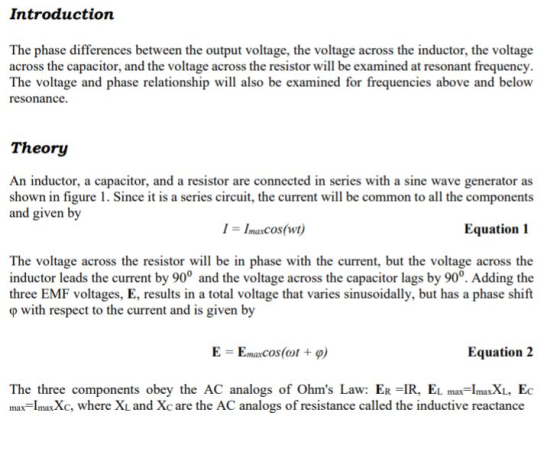
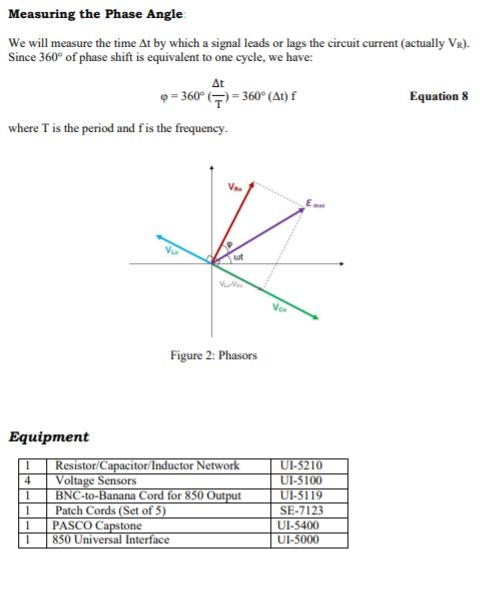
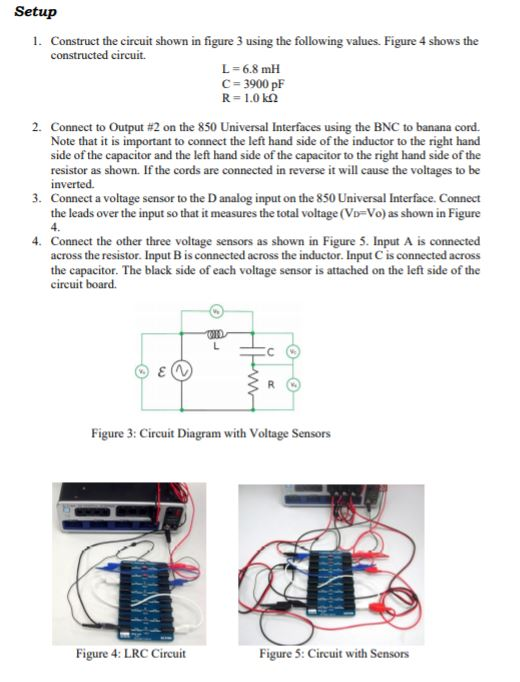
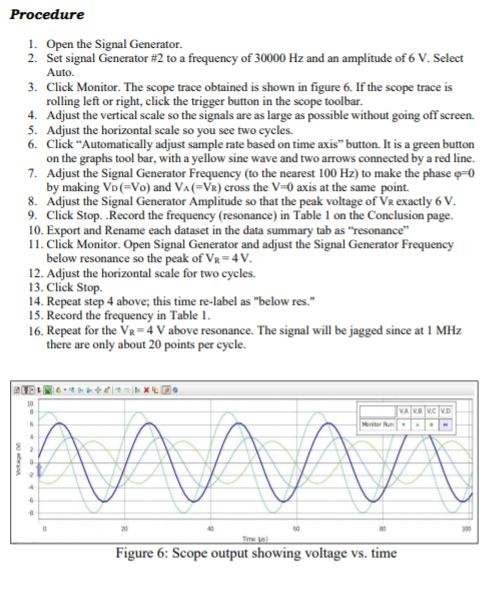
I am currently trying to figure out the experiment below. Please complete Table 1 with an explanation, I appreciate it thank you! Promise to give thumbs up!


Homework Answers
here is the answer:-
 =
360
=
360  (
(  ) = 360
(
) = 360
( )
) =
=
for resonance:-
L
= 360
(
VL)
= 360
(7.8810-6)(30700)
= 87.08
C=360
(
VC)
= 360
(-7.8110-6)(30700)
= -86.31
tot
=360
(
Vo)
= 360
(0)
(30700) = 0
| system | frequency |
VL |
VC |
Vo |
 |
 |
 |
|---|---|---|---|---|---|---|---|
| Resonance | 30700 | 7.88 | -7.81 | 0.00 | 87.08 | -86.31 | 0 |
| below resonance | 18700 | 12.50 | -12.80 | -6.97 | 84.15 | -86.16 | -47.92 |
| Above resonance | 48700 | 5.10 | -4.94 | 2.77 | 89.41 | -86.61 | 48.56 |
please have a look that in
tot do we have to make addition of
L and
C or we have to take
Vo for calculations as taken here.
thank you.
Add Answer to:
I am currently trying to figure out the experiment below. Please
complete Table 1 with an...
An AC generator supplies an rms voltage of 120 V at 60.0 Hz. It is connected...
An AC generator supplies an rms voltage of 120 V at 60.0 Hz. It is connected in series with a 0.450 H inductor, a 5.4 uF capacitor and a 351 ohm resistor. What is the impedance of the circuit? What is the rms current through the resistor? What is the average power dissipated in the circuit? What is the peak current through the resistor? What is the peak voltage across the inductor? What is the peak voltage across the capacitor?...
Generator An AC generator supplies an rms voltage of 220 V at 50.0 Hz. It is...
Generator An AC generator supplies an rms voltage of 220 V at 50.0 Hz. It is connected in series with a 0.700 H inductor, a 5.20 μF capacitor and a 401 Ω resistor. What is the impedance of the circuit? What is the rms current through the resistor? What is the average power dissipated in the circuit? What is the peak current through the resistor? What is the peak voltage across the inductor? What is the peak voltage across the...
An AC generator supplies an rms voltage of 120 V at 60.0 Hz. It is connected...
An AC generator supplies an rms voltage of 120 V at 60.0 Hz. It is connected in series with a 0.400 H inductor, a 5.30 ?F capacitor and a 251 ohm resistor. A.) What is the impedance of the circuit? B.) What is the rms current through the resistor? C.) What is the average power dissipated in the circuit? D.) What is the peak current through the resistor? E.) What is the peak voltage across the inductor F.) What is...
An AC generator supplies an rms voltage of 120 V at 60.0 Hz. It is connected...
An AC generator supplies an rms voltage of 120 V at 60.0 Hz. It is connected in series with a 0.350 H inductor, a 5.10 μF capacitor and a 306 Ω resistor. a. What is the impedance of the circuit? b. What is the rms current through the resistor? c. What is the average power dissipated in the circuit? d. What is the peak current through the resistor? e. What is the peak voltage across the inductor? f. What is...
An AC generator supplies an rms voltage of 240 V at 50.0 Hz. It is connected...
An AC generator supplies an rms voltage of 240 V at 50.0 Hz. It is connected in series with a 0.650 H inductor, a 4.70 μF capacitor and a 246 Ω resistor. a) What is the impedance of the circuit? b) What is the rms current through the resistor? c) What is the average power dissipated in the circuit? d) What is the peak current through the resistor? e) What is the peak voltage across the inductor? f) What is...
A resistance R = 10Ω, a capacitor C = 15μF, an inductor of L = 38mH,...
A resistance R = 10Ω, a capacitor C = 15μF, an inductor of L = 38mH, and an alternating current source with a voltage amplitude of 50V to 160Hz are connected in series. A- Calculate the angular frequency of the source B- Calculate the XL, XC, and Z impedance reactances C- Calculate the lag between the circuit current and the source voltage D- Calculate the amplitude of the circuit current and express the circuit current as a function of time...
An AC generator supplies an rms voltage of 115 V at 60.0 Hz. It is connected...
An AC generator supplies an rms voltage of 115 V at 60.0 Hz. It is connected in series with a 0.450 H inductor, a 3.20 μF capacitor and a 396 Ω resistor. What is the impedance of the circuit? 7.69×10² ohm You are correct. Previous Tries What is the rms current through the resistor? You can use a similar equation fo Ohm's law for an RLC circuit. Incorrect. Tries 1/20 Previous Tries What is the average power dissipated in the...
Question 2- An alternating current power supply is connected as shown in the figure to a...
 Question 2- An alternating current power supply is connected as shown in the figure to a resistor, a capacitor, and an inductor. The power supply provides a voltage given by ε(t)-fo . cos(ωt). a) Make a phasor diagram and draw the voltage and current phasors for the resistor, capacitor, and inductor. (Be sure the phase relations between each phasor is clear, and be sure to label all phasors.) b) Use your diagram to find an equation for lo (the amplitude...
An AC generator supplies an rms voltage of 115 V at 50.0 Hz. It is connected...
An AC generator supplies an rms voltage of 115 V at 50.0 Hz. It is connected in series with a 0.600 H inductor, a 5.60 μF capacitor and a 271 Ω resistor. a. What is the impedance of the circuit? Tries 0/20 b. What is the rms current through the resistor? Tries 0/20 c. What is the average power dissipated in the circuit? Tries 0/20 d. What is the peak current through the resistor? Tries 0/20 e. What is the...
8–31 A voltage vs(t) = 50 cos (5000t) V is applied to the circuit in Figure...
 8–31 A voltage vs(t) = 50 cos (5000t) V is applied to the circuit in Figure P8–31. (a) Convert the circuit into the phasor domain. (b) Find the phasor current flowing through the circuit and the phasor voltages across the inductor and the resistor. (c) Plot all three phasors from (b) on a phasor diagram. Describe if the current leads or lags the inductor voltage. i(t) 50 22 25 mH 00 + VL(t) - + Vr(t)- vs(t) (+) FIGURE P8-31
 Question 2- An alternating current power supply is connected as shown in the figure to a resistor, a capacitor, and an inductor. The power supply provides a voltage given by ε(t)-fo . cos(ωt). a) Make a phasor diagram and draw the voltage and current phasors for the resistor, capacitor, and inductor. (Be sure the phase relations between each phasor is clear, and be sure to label all phasors.) b) Use your diagram to find an equation for lo (the amplitude...
 8–31 A voltage vs(t) = 50 cos (5000t) V is applied to the circuit in Figure P8–31. (a) Convert the circuit into the phasor domain. (b) Find the phasor current flowing through the circuit and the phasor voltages across the inductor and the resistor. (c) Plot all three phasors from (b) on a phasor diagram. Describe if the current leads or lags the inductor voltage. i(t) 50 22 25 mH 00 + VL(t) - + Vr(t)- vs(t) (+) FIGURE P8-31
Most questions answered within 3 hours.
-
Where is the error in this code sequence?
String s1 = "Hello";
String s2 = "ello";...
asked 10 months ago -
Financial data for Joel de Paris, Inc., for last year
follow:
Joel de Paris, Inc.
Balance...
asked 10 months ago -
Consider this reaction:
Al2(SO4)3 (aq)+ BaCl3
(aq) Al2Cl6 (aq)- +
3BaSO4(s) . What is the...
asked 10 months ago -
Suppose that Savneet is considering increasing her
recent random sample from 20 car rentals to 40...
asked 10 months ago -
Trucks arrive at an unloading terminal at an average rate of 120
per hour.
Trucks arrive...
asked 10 months ago -
Why are methanol and ethanol completely soluble in water while
octanol is not very little soluble....
asked 10 months ago -
A facilities manager at a university reads in a research report
that the mean amount of...
asked 10 months ago -
When the CuSO4 is rehydrated by adding water to the anhydrous
compound, is this an endothermic...
asked 10 months ago -
A ray of sunlight is passing from diamond into crown glass; the
angle of incidence is...
asked 10 months ago -
A block of mass 0.249 kg is placed on top of a light, vertical
spring of...
asked 10 months ago -
how do the kidneys compensate in the presences of acidosis
a) trigger hyperventilate
b) reserve acid...
asked 10 months ago -
Question 501 pts
The rental rate of capital to the firm increases. Which of the
following...
asked 10 months ago