lagrangian
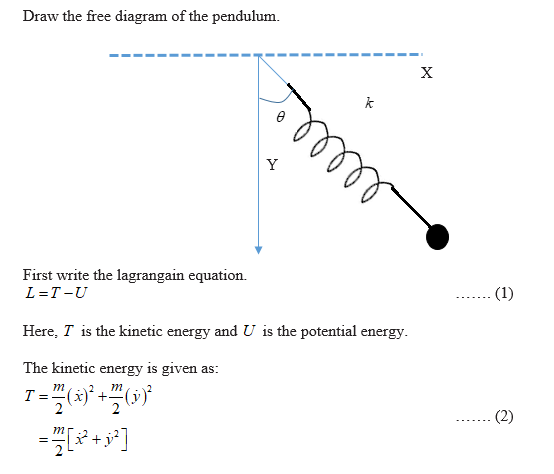
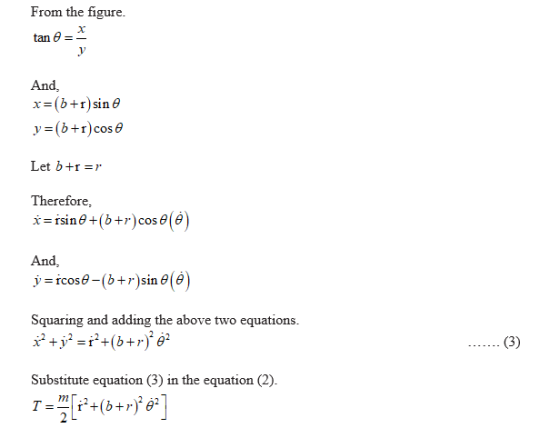
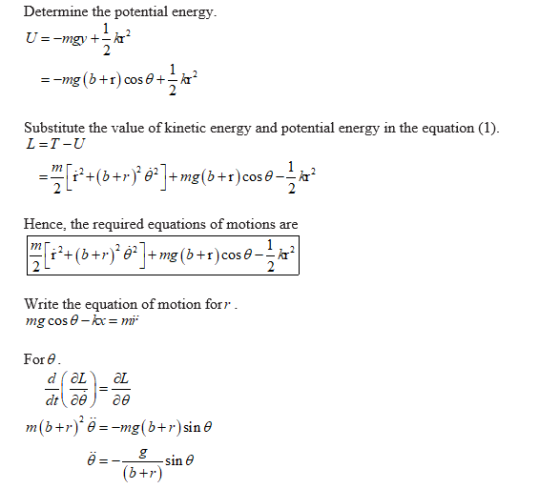
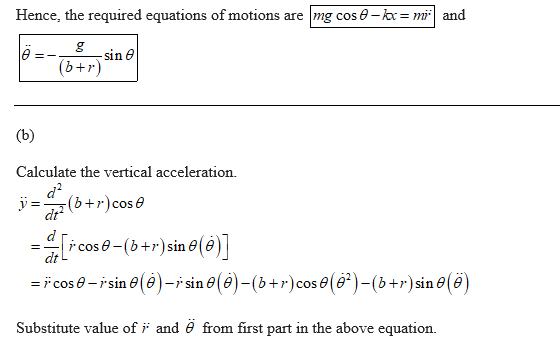
a. use the lagrangian method to find the equations of motion
b. determine the Hamilton's equation of motion
c. What is the period of small oscillations?
Homework Answers


(c) Ans:
as the point of support rises vertically with constant acceleration
effective gravity , geff = g + a
for the time constant
T = 2pi * sqrt(m/k)
the time period will be same
time period is 2pi * sqrt(m/k)
Hamiltonian equations of motion
A pendulum consists of a mass m suspended by a massless springwith unextended length b and spring constant k.The pendulum's point of supportrises vertically with a constantacceleration a.a) Use the Lagrangian method to find the equations ofmotion.b) Determine the Hamiltonian and Hamiltonian's equation ofmotion.c) What is the period of small oscillations?
Solve problem 6 parabolic shape and rotates with a constant angular velocity ? set up Haniltons...
 Solve problem 6
parabolic shape and rotates with a constant angular velocity ? set up Haniltons equations of motion. 6. A mass m is suspended by a massless spring of spring constant k and unstretched length b. The suspension point has a constant upward acceleration ao. Gravity is acting vertically downward. Find the Lagrangian and Hamiltonian functions and obtain Hamilton's equa- tions of motion. What is the period of motion?
Solve problem 6
parabolic shape and rotates with a constant angular velocity ? set up Haniltons equations of motion. 6. A mass m is suspended by a massless spring of spring constant k and unstretched length b. The suspension point has a constant upward acceleration ao. Gravity is acting vertically downward. Find the Lagrangian and Hamiltonian functions and obtain Hamilton's equa- tions of motion. What is the period of motion?
Consider a simple pendulum of length / and mass m placed in a rail-road cart that...
 Consider a simple pendulum of length / and mass m placed in a rail-road cart that has constant acceleration a in the positive x-direction. (Hint: This means that suspension point of the pendulum moves with acceleration a, this needs to be accounted for when considering motion of the pendulum) a) (11 pts.) Find the Lagrangian function of this pendulum. b) (11 pts.) Obtain Lagrange's equations of motion for this pendulum. c) (11 pts.) Find the Hamiltonian function of this pendulum....
A) Write the Lagrangian for a simple pendulum consisting of a point mass m suspended at...
A) Write the Lagrangian for a simple pendulum consisting of a point mass m suspended at the end of a massless string of length l. Derive the equation of motion from the Euler-Lagrange equation, and solve for the motion in the small angle approximation. B) Assume the massless string can stretch with a restoring force F = -k (r-r0), where r0 is the unstretched length. Write the new Lagrangian and find the equations of motion. C) Can you re-write the...
Prob. 7.3: A simple pendulum (mass M and length L) is suspended from a cart (mass...
 Prob. 7.3: A simple pendulum (mass M and length L) is suspended from a cart (mass m) that canoscillate on the end of a spring of spring constant k, as shown in the figure at right. (a) Write the Lagrangian in terms of the generalized coordinates x and ?, where x is the extension of the spring from its equilibrium length and ? is the angle of the pendulum from the vertical. Find the two Lagrange equations. (b) Simplify the...
a mass m is hung from a fixed support by a spring of constant k whose...
 a mass m is hung from a fixed support by a spring of constant
k whose natural length is l. a second equal mass is hung from the
first mass by an identical spring. we assume that only the vertical
motion is possible. find the normal modes for small oscillations of
this system from its equilibrium point.
1. A mass m is hung from a fixed support by a spring of constant k whose natural length (relaxed length) is l....
a mass m is hung from a fixed support by a spring of constant
k whose natural length is l. a second equal mass is hung from the
first mass by an identical spring. we assume that only the vertical
motion is possible. find the normal modes for small oscillations of
this system from its equilibrium point.
1. A mass m is hung from a fixed support by a spring of constant k whose natural length (relaxed length) is l....
The point of support of a simplc pendulum is bcing clevated at a constant acccleration a...
 The point of support of a simplc pendulum is bcing clevated at a constant acccleration a Use Lagrange's method to find the differential equation of motion and show that for small oscillations, the period T of the pendulum is T = 2π
2. (35 points) A pendulum consists of a point mass (m) attached to the end of a spring (massless ...
 2. (35 points) A pendulum consists of a point mass (m) attached to the end of a spring (massless spring, equilibrium length-Lo and spring constant- k). The other end of the spring is attached to the ceiling. Initially the spring is un-sketched but is making an angle θ° with the vertical, the mass is released from rest, see figure below. Let the instantaneous length of the spring be r. Let the acceleration due to gravity be g celing (a) (10...
JUST ANSWER PART B A. A point mass m moves frictionlessly on a horizontal plane. An...
 JUST ANSWER PART B
A. A point mass m moves frictionlessly on a horizontal plane. An unusual, anharmonic spring with unstretched length ro is attached between a pivot at the origin and the mass. Let the radial force exerted by the spring be given by Fr =-c(r-ro)" where c is a positive constant. Using plane polar coordinates r and θ: (i) Write down the Lagrangian L(r, θ,0) and use Lagrange's method to find the equations of motion for the mass...
JUST ANSWER PART B
A. A point mass m moves frictionlessly on a horizontal plane. An unusual, anharmonic spring with unstretched length ro is attached between a pivot at the origin and the mass. Let the radial force exerted by the spring be given by Fr =-c(r-ro)" where c is a positive constant. Using plane polar coordinates r and θ: (i) Write down the Lagrangian L(r, θ,0) and use Lagrange's method to find the equations of motion for the mass...
Problem 2) Consider a simple pendulum consisting of a bob of mass m suspended by a...
 Problem 2) Consider a simple pendulum consisting of a bob of mass m suspended by a massless rigid rod of length l. (a) Find the Hamiltonian of the system by following the prescription given in the textbook. (b) Find the Hamilton's equations of motion.
 Solve problem 6
parabolic shape and rotates with a constant angular velocity ? set up Haniltons equations of motion. 6. A mass m is suspended by a massless spring of spring constant k and unstretched length b. The suspension point has a constant upward acceleration ao. Gravity is acting vertically downward. Find the Lagrangian and Hamiltonian functions and obtain Hamilton's equa- tions of motion. What is the period of motion?
Solve problem 6
parabolic shape and rotates with a constant angular velocity ? set up Haniltons equations of motion. 6. A mass m is suspended by a massless spring of spring constant k and unstretched length b. The suspension point has a constant upward acceleration ao. Gravity is acting vertically downward. Find the Lagrangian and Hamiltonian functions and obtain Hamilton's equa- tions of motion. What is the period of motion?
 Consider a simple pendulum of length / and mass m placed in a rail-road cart that has constant acceleration a in the positive x-direction. (Hint: This means that suspension point of the pendulum moves with acceleration a, this needs to be accounted for when considering motion of the pendulum) a) (11 pts.) Find the Lagrangian function of this pendulum. b) (11 pts.) Obtain Lagrange's equations of motion for this pendulum. c) (11 pts.) Find the Hamiltonian function of this pendulum....
 Prob. 7.3: A simple pendulum (mass M and length L) is suspended from a cart (mass m) that canoscillate on the end of a spring of spring constant k, as shown in the figure at right. (a) Write the Lagrangian in terms of the generalized coordinates x and ?, where x is the extension of the spring from its equilibrium length and ? is the angle of the pendulum from the vertical. Find the two Lagrange equations. (b) Simplify the...
 a mass m is hung from a fixed support by a spring of constant
k whose natural length is l. a second equal mass is hung from the
first mass by an identical spring. we assume that only the vertical
motion is possible. find the normal modes for small oscillations of
this system from its equilibrium point.
1. A mass m is hung from a fixed support by a spring of constant k whose natural length (relaxed length) is l....
a mass m is hung from a fixed support by a spring of constant
k whose natural length is l. a second equal mass is hung from the
first mass by an identical spring. we assume that only the vertical
motion is possible. find the normal modes for small oscillations of
this system from its equilibrium point.
1. A mass m is hung from a fixed support by a spring of constant k whose natural length (relaxed length) is l....
 The point of support of a simplc pendulum is bcing clevated at a constant acccleration a Use Lagrange's method to find the differential equation of motion and show that for small oscillations, the period T of the pendulum is T = 2π
 2. (35 points) A pendulum consists of a point mass (m) attached to the end of a spring (massless spring, equilibrium length-Lo and spring constant- k). The other end of the spring is attached to the ceiling. Initially the spring is un-sketched but is making an angle θ° with the vertical, the mass is released from rest, see figure below. Let the instantaneous length of the spring be r. Let the acceleration due to gravity be g celing (a) (10...
 JUST ANSWER PART B
A. A point mass m moves frictionlessly on a horizontal plane. An unusual, anharmonic spring with unstretched length ro is attached between a pivot at the origin and the mass. Let the radial force exerted by the spring be given by Fr =-c(r-ro)" where c is a positive constant. Using plane polar coordinates r and θ: (i) Write down the Lagrangian L(r, θ,0) and use Lagrange's method to find the equations of motion for the mass...
JUST ANSWER PART B
A. A point mass m moves frictionlessly on a horizontal plane. An unusual, anharmonic spring with unstretched length ro is attached between a pivot at the origin and the mass. Let the radial force exerted by the spring be given by Fr =-c(r-ro)" where c is a positive constant. Using plane polar coordinates r and θ: (i) Write down the Lagrangian L(r, θ,0) and use Lagrange's method to find the equations of motion for the mass...
 Problem 2) Consider a simple pendulum consisting of a bob of mass m suspended by a massless rigid rod of length l. (a) Find the Hamiltonian of the system by following the prescription given in the textbook. (b) Find the Hamilton's equations of motion.
Most questions answered within 3 hours.
-
Where is the error in this code sequence?
String s1 = "Hello";
String s2 = "ello";...
asked 10 months ago -
Financial data for Joel de Paris, Inc., for last year
follow:
Joel de Paris, Inc.
Balance...
asked 10 months ago -
Consider this reaction:
Al2(SO4)3 (aq)+ BaCl3
(aq) Al2Cl6 (aq)- +
3BaSO4(s) . What is the...
asked 10 months ago -
Suppose that Savneet is considering increasing her
recent random sample from 20 car rentals to 40...
asked 10 months ago -
Trucks arrive at an unloading terminal at an average rate of 120
per hour.
Trucks arrive...
asked 10 months ago -
Why are methanol and ethanol completely soluble in water while
octanol is not very little soluble....
asked 10 months ago -
A facilities manager at a university reads in a research report
that the mean amount of...
asked 10 months ago -
When the CuSO4 is rehydrated by adding water to the anhydrous
compound, is this an endothermic...
asked 10 months ago -
A ray of sunlight is passing from diamond into crown glass; the
angle of incidence is...
asked 10 months ago -
A block of mass 0.249 kg is placed on top of a light, vertical
spring of...
asked 10 months ago -
how do the kidneys compensate in the presences of acidosis
a) trigger hyperventilate
b) reserve acid...
asked 10 months ago -
Question 501 pts
The rental rate of capital to the firm increases. Which of the
following...
asked 10 months ago