
Homework Answers
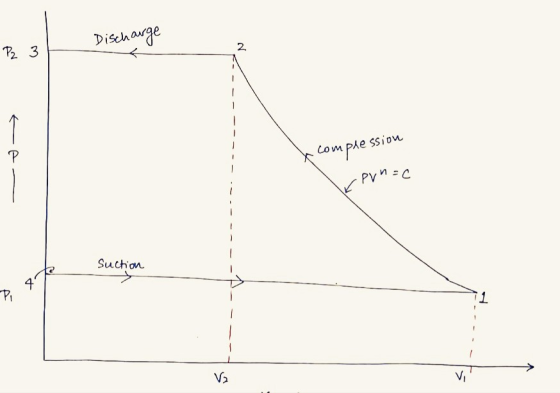
Hello student I will distinguish their work required in each of these three process but before that I will show you on p-v diagram and giving you general formula for work input per cylce for compressor.

![Wd P2. (0-2) = -P2 V2 [P2 V2 - P.VI + P2. V2 - P. Vi (n-D Weyele -- [13V2- Pivool 0,[1+] - CP2 V2 - PVD. (1+ 2 w/ cycle P2 V2](http://img.homeworklib.com/questions/654a0440-e35b-11ea-a79b-9d296c011c97.png?x-oss-process=image/resize,w_560)
So work per cylce for compressor is derived above now put value of n as per process.
If process is isothermal then put n=1
If process is adiabatic then put n= 1.4 that is k
If process is polytropic then put n = 1 to 1.4
Above all process is reversible.
So put value of n you will get your required formula for all those three mentioned curve.
Please rate me thumbs up for the solution.
Thank you
Add Answer to:
b) Figure Q1(b) shows a P-v diagram consists of isentropic, polytropic, and isothermal compression processes between...
b) Figure Q1(b) shows a P-v diagram consists of isentropic, polytropic, and isothermal compression processes between...
 b) Figure Q1(b) shows a P-v diagram consists of isentropic, polytropic, and isothermal compression processes between the same pressure limits. Based on the figure, distinguish the work input to the compressor for all the three processes. (6 marks) PA -Isentropic (n = k) -Polytropic (1 <n<k) Isothermal (n = 1) Pi 1 V Figure Q1(b)
Q1 a) Company A designed a heat pump to supply heat into a library in Canada during...
 Q1
a) Company A designed a heat pump to
supply heat into a library in Canada during
winter, so that the library can maintain to be at 20°C. The heat
pump utilizes
12,000 L/min of Refrigerant-134a as the working fluid and absorb
heat from an
industrial water stream. The water stream enters the evaporator at
50°C and exits
at 25°C. The refrigerant enters the evaporator at 10°C with 90%
moisture content
and leaves at 20°C. There is no pressure drop in...
Q1
a) Company A designed a heat pump to
supply heat into a library in Canada during
winter, so that the library can maintain to be at 20°C. The heat
pump utilizes
12,000 L/min of Refrigerant-134a as the working fluid and absorb
heat from an
industrial water stream. The water stream enters the evaporator at
50°C and exits
at 25°C. The refrigerant enters the evaporator at 10°C with 90%
moisture content
and leaves at 20°C. There is no pressure drop in...
engine performance experiment (otto cycle) III.4 Isentropic Polytropic Processes The air-standard Otto cycle models bot...
 engine performance experiment (otto cycle)
III.4 Isentropic Polytropic Processes The air-standard Otto cycle models both the compression and expansion phases of the combustion gases as isentropic. How well does this assumption hold up? From the same set of data used in III.1, plot a graph of log p versus log V (or ln p versus In V) From visual inspection of the graph obtained, are expansion and compression processes polytropic? If so, determine the polytropic indices. By comparing these values...
engine performance experiment (otto cycle)
III.4 Isentropic Polytropic Processes The air-standard Otto cycle models both the compression and expansion phases of the combustion gases as isentropic. How well does this assumption hold up? From the same set of data used in III.1, plot a graph of log p versus log V (or ln p versus In V) From visual inspection of the graph obtained, are expansion and compression processes polytropic? If so, determine the polytropic indices. By comparing these values...
Consider a modification of the air-standard Otto cycle in which the isentropic compression and expansion processes...
Consider a modification of the air-standard Otto cycle in which the isentropic compression and expansion processes are each replaced with polytropic processes having n = 1.35. The compression ratio is 10 for the modified cycle. At the beginning of compression, p1 = 1 bar and T1 = 310 K. The maximum temperature during the cycle is 2200 K. Determine: (a) the heat transfer and work in kJ per kg of air for each process in the modified cycle. (b) the...
A thermodynamic cycle consists of the following reversible processes: 1-2 isothermal expansion 2-3 isentropic compression 3-1 heat rejection at constant pressure The cycle works with 1.5 kg of water v...
A thermodynamic cycle consists of the following reversible processes: 1-2 isothermal expansion 2-3 isentropic compression 3-1 heat rejection at constant pressure The cycle works with 1.5 kg of water vapor. State 1 is dry saturated steam at 200 ° C; state 2 has a pressure of 100 kPa. Determine: a) The addition of heat, b) the net work, and c) the entropy change from 1 to 2.
Consider a modification of the air-standard Otto cycle in which the isentropic compression and expansion processes...
Consider a modification of the air-standard Otto cycle in which the isentropic compression and expansion processes are each replaced with polytropic processes having n = 1.25. The compression ratio is 8 for the modified cycle. At the beginning of compression, p1 = 1 bar and T1 = 310 K. The maximum temperature during the cycle is 2200 K. Determine: (a) the heat transfer and work in kJ per kg of air for each process in the modified cycle. (b) the...
An ideal diatomic gas undergoes 3 processes in series: process 1-2: isothermal compression from pr-100kPa and...
 An ideal diatomic gas undergoes 3 processes in series: process 1-2: isothermal compression from pr-100kPa and V-0.1m2 to V0.025m; process 2-3: at constant pressure and process 3-1: isentropic process closing cycle. Determine: a) ratio of the maximum and minimum temperature of the cycle, b) heats of the processes, c) thermal efficiency of the cycle, d) sketch the processes on p-V and T-s diagrams. Gas constant is 287 J/(kgK), isentropic exponent is 1.4.
PA AQi T =Th AQ19 2 4 3 AQout T= Te V Figure 1: Pressure-volume diagram of the Stirling cycle. (a) A Stirling cycle...
 PA AQi T =Th AQ19 2 4 3 AQout T= Te V Figure 1: Pressure-volume diagram of the Stirling cycle. (a) A Stirling cycle consists of two isothermal processes and two isochoricprocesses as shown in Fig. J. The hot reservoir is at temperature T and the cold-reservoir AS at temperaturé T)You may assume that the working fluid is anideal gas with Llegrees of freedom. The compression ratio V2/Vi)i.e. the ratio of the volume of the gas at state 2 to...
NGINEERI 13. A centrifugal compressor (not a piston type) compresses the air from the ambient condition at T, 300K and Pi 1 bar to P 10 bar following three different, standalone paths: isentropic,...
 NGINEERI 13. A centrifugal compressor (not a piston type) compresses the air from the ambient condition at T, 300K and Pi 1 bar to P 10 bar following three different, standalone paths: isentropic, reversible isothermal, and an irreversible adiabatic process, respectively. (Note: These processes are not sequential processes; rather each of them is an independent, standalone p They all start at the same initial condition at state 1, but they end at different state 2.) The mass flow rate is...
Problem B: Diesel Cyele The Diesel cycle represents the ideal cycle for Compression-Ignition engines. The ideal...
 Problem B: Diesel Cyele The Diesel cycle represents the ideal cycle for Compression-Ignition engines. The ideal Diesel cycle is described by the four-step cycle (process): 1-2: Isentropic Compression from Bottom-Dead-Center (BDC) to Top-Dead-Center (TDC), 2-3: Constant pressure heat addition (n) to 3-+4: Isentropic Expansion from vy to V 4+1: Constant volume heat rejection (Qout) at TDC (). (a) Sketch the P vs. v diagram for the Diesel cycle (label all key parameters and processes). [7 pts] (b) Sketch the T...
 b) Figure Q1(b) shows a P-v diagram consists of isentropic, polytropic, and isothermal compression processes between the same pressure limits. Based on the figure, distinguish the work input to the compressor for all the three processes. (6 marks) PA -Isentropic (n = k) -Polytropic (1 <n<k) Isothermal (n = 1) Pi 1 V Figure Q1(b)
 Q1
a) Company A designed a heat pump to
supply heat into a library in Canada during
winter, so that the library can maintain to be at 20°C. The heat
pump utilizes
12,000 L/min of Refrigerant-134a as the working fluid and absorb
heat from an
industrial water stream. The water stream enters the evaporator at
50°C and exits
at 25°C. The refrigerant enters the evaporator at 10°C with 90%
moisture content
and leaves at 20°C. There is no pressure drop in...
Q1
a) Company A designed a heat pump to
supply heat into a library in Canada during
winter, so that the library can maintain to be at 20°C. The heat
pump utilizes
12,000 L/min of Refrigerant-134a as the working fluid and absorb
heat from an
industrial water stream. The water stream enters the evaporator at
50°C and exits
at 25°C. The refrigerant enters the evaporator at 10°C with 90%
moisture content
and leaves at 20°C. There is no pressure drop in...
 engine performance experiment (otto cycle)
III.4 Isentropic Polytropic Processes The air-standard Otto cycle models both the compression and expansion phases of the combustion gases as isentropic. How well does this assumption hold up? From the same set of data used in III.1, plot a graph of log p versus log V (or ln p versus In V) From visual inspection of the graph obtained, are expansion and compression processes polytropic? If so, determine the polytropic indices. By comparing these values...
engine performance experiment (otto cycle)
III.4 Isentropic Polytropic Processes The air-standard Otto cycle models both the compression and expansion phases of the combustion gases as isentropic. How well does this assumption hold up? From the same set of data used in III.1, plot a graph of log p versus log V (or ln p versus In V) From visual inspection of the graph obtained, are expansion and compression processes polytropic? If so, determine the polytropic indices. By comparing these values...
 An ideal diatomic gas undergoes 3 processes in series: process 1-2: isothermal compression from pr-100kPa and V-0.1m2 to V0.025m; process 2-3: at constant pressure and process 3-1: isentropic process closing cycle. Determine: a) ratio of the maximum and minimum temperature of the cycle, b) heats of the processes, c) thermal efficiency of the cycle, d) sketch the processes on p-V and T-s diagrams. Gas constant is 287 J/(kgK), isentropic exponent is 1.4.
 PA AQi T =Th AQ19 2 4 3 AQout T= Te V Figure 1: Pressure-volume diagram of the Stirling cycle. (a) A Stirling cycle consists of two isothermal processes and two isochoricprocesses as shown in Fig. J. The hot reservoir is at temperature T and the cold-reservoir AS at temperaturé T)You may assume that the working fluid is anideal gas with Llegrees of freedom. The compression ratio V2/Vi)i.e. the ratio of the volume of the gas at state 2 to...
 NGINEERI 13. A centrifugal compressor (not a piston type) compresses the air from the ambient condition at T, 300K and Pi 1 bar to P 10 bar following three different, standalone paths: isentropic, reversible isothermal, and an irreversible adiabatic process, respectively. (Note: These processes are not sequential processes; rather each of them is an independent, standalone p They all start at the same initial condition at state 1, but they end at different state 2.) The mass flow rate is...
 Problem B: Diesel Cyele The Diesel cycle represents the ideal cycle for Compression-Ignition engines. The ideal Diesel cycle is described by the four-step cycle (process): 1-2: Isentropic Compression from Bottom-Dead-Center (BDC) to Top-Dead-Center (TDC), 2-3: Constant pressure heat addition (n) to 3-+4: Isentropic Expansion from vy to V 4+1: Constant volume heat rejection (Qout) at TDC (). (a) Sketch the P vs. v diagram for the Diesel cycle (label all key parameters and processes). [7 pts] (b) Sketch the T...
Most questions answered within 3 hours.
-
Where is the error in this code sequence?
String s1 = "Hello";
String s2 = "ello";...
asked 11 months ago -
Financial data for Joel de Paris, Inc., for last year
follow:
Joel de Paris, Inc.
Balance...
asked 11 months ago -
Consider this reaction:
Al2(SO4)3 (aq)+ BaCl3
(aq) Al2Cl6 (aq)- +
3BaSO4(s) . What is the...
asked 11 months ago -
Suppose that Savneet is considering increasing her
recent random sample from 20 car rentals to 40...
asked 11 months ago -
Trucks arrive at an unloading terminal at an average rate of 120
per hour.
Trucks arrive...
asked 11 months ago -
Why are methanol and ethanol completely soluble in water while
octanol is not very little soluble....
asked 11 months ago -
A facilities manager at a university reads in a research report
that the mean amount of...
asked 11 months ago -
When the CuSO4 is rehydrated by adding water to the anhydrous
compound, is this an endothermic...
asked 11 months ago -
A ray of sunlight is passing from diamond into crown glass; the
angle of incidence is...
asked 11 months ago -
A block of mass 0.249 kg is placed on top of a light, vertical
spring of...
asked 11 months ago -
how do the kidneys compensate in the presences of acidosis
a) trigger hyperventilate
b) reserve acid...
asked 11 months ago -
Question 501 pts
The rental rate of capital to the firm increases. Which of the
following...
asked 11 months ago