
Homework Answers
20. A within subjects design uses the same group of participants for all treatment conditions.
Add Answer to:
How many participants would be needed for a within-subjects experiment comparing four different treatment conditions with...
Dr. Can-Adian will be conducting an experiment comparing 4 treatment conditions. If she uses a between-subjects...
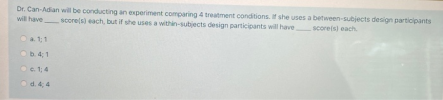 Dr. Can-Adian will be conducting an experiment comparing 4 treatment conditions. If she uses a between-subjects design participants will have score(s) each, but if she uses a within-subjects design participants will have score(s) each. a. 1; 1 b. 4; 1 c. 1: 4 d. 4; 4
A researcher conducts an experiment comparing two treatment conditions and obtains 20 scores in each treatment?...
A researcher conducts an experiment comparing two treatment conditions and obtains 20 scores in each treatment? Which design would require the smallest number of subjects? a repeated-measures design an independent-measures design a matched-subjects design either an independent-measures or a matched-subjects design
1. A researcher conducts an experiment comparing two treatment conditions and obtains data from 15 people...
1. A researcher conducts an experiment comparing two treatment conditions and obtains data from 15 people for each treatment condition a. If the researcher used an independent-measures design, how many subjects altogether participated in the experiment? b. If the researcher used a repeated-measures design, how many subjects altogether participated in the experiment? c. If the researcher used a matched-subjects design, how many subjects altogether participated in the experiment?
3. Repeated-measures and matched-subjects experiments Aa Aa Repeated-measures experiments measure the same set of research participants...
 3. Repeated-measures and matched-subjects experiments Aa Aa Repeated-measures experiments measure the same set of research participants two or more times, while matched-subjects experiments study participants who are matched on one or more characteristics. Which of the following are true for both a repeated-measures experiment and a matched-subjects experiment when used to compare two treatment conditions? Check all that apply. The researcher computes difference scores to compute a t statistic. □ If the researcher has n number of participants to use...
describe the four problems that can develop if participants from different treatment conditions have an opportunity...
describe the four problems that can develop if participants from different treatment conditions have an opportunity to talk with each other during the course of the experiment
QUESTION 17 A researcher conducts an experiment comparing four treatment conditions with a separate sample of...
 QUESTION 17 A researcher conducts an experiment comparing four treatment conditions with a separate sample of n-6 in each treatment. An ANOVA is used to evaluate the data, and the results of the ANOVA are presented in the following table. Complete all missing values in the table. Hint: Begin with the values in the df column. Source SS dr MS Between Treatments Within Treatments | | | Total
1) A researcher conducts an experiment comparing four treatment conditions with a separate sample of n...
 1) A researcher conducts an experiment comparing four treatment conditions with a separate sample of n 10 in each treatment. An ANOVA is used to evaluate the data, and the results of the ANOVA are presented in the following table Complete all missing values in the table. Hint: Begin with the values in the df column Source SS Between treatments 10 Within treatments Total df MS 164
An interaction effect means that the combination of factors creates a different result. True False "A...
An interaction effect means that the combination of factors creates a different result. True False "A researcher conducts an experiment comparing four treatment conditions with n=12 scores in each condition. If the researcher uses a repeated-measures design, how many individuals are needed for the study?" a 12 b 24 c 36 d 48 "You have to find the F-critical for each effect when running a two-factor, independent measures, ANOVA. " True False "After you remove the individual differences in a...
1. You conduct a within-subjects paired t-test. Your degree of freedom is 29. How many TOTAL...
1. You conduct a within-subjects paired t-test. Your degree of freedom is 29. How many TOTAL participants did you have in your experiment? a. 28 b. 62 c. 30 d. 60 2. One advantage of using a repeated measure paired t-test versus a between-measures paired t-test is that you would need: a. more participants b. fewer participants c. more simple calcuations d. fewer nominal variables 3. When performing a one-sample t-test, you have ____ mean(s) and _____ standard deviation(s). (1, 2,...
A researcher conducts an experiment comparing three treatment conditions. The data consist of n = 34...
A researcher conducts an experiment comparing three treatment conditions. The data consist of n = 34 scores for each treatment condition. a. If the researcher used an independent-measures design, then how many individuals were needed for the study and what are the df-values for the F-ratio? Explain in detail and be sure to show all formulas with symbols (and plug in numbers), steps, processes and calculations for all steps and all parts of all answers. b. If the researcher used...
 Dr. Can-Adian will be conducting an experiment comparing 4 treatment conditions. If she uses a between-subjects design participants will have score(s) each, but if she uses a within-subjects design participants will have score(s) each. a. 1; 1 b. 4; 1 c. 1: 4 d. 4; 4
 3. Repeated-measures and matched-subjects experiments Aa Aa Repeated-measures experiments measure the same set of research participants two or more times, while matched-subjects experiments study participants who are matched on one or more characteristics. Which of the following are true for both a repeated-measures experiment and a matched-subjects experiment when used to compare two treatment conditions? Check all that apply. The researcher computes difference scores to compute a t statistic. □ If the researcher has n number of participants to use...
 QUESTION 17 A researcher conducts an experiment comparing four treatment conditions with a separate sample of n-6 in each treatment. An ANOVA is used to evaluate the data, and the results of the ANOVA are presented in the following table. Complete all missing values in the table. Hint: Begin with the values in the df column. Source SS dr MS Between Treatments Within Treatments | | | Total
 1) A researcher conducts an experiment comparing four treatment conditions with a separate sample of n 10 in each treatment. An ANOVA is used to evaluate the data, and the results of the ANOVA are presented in the following table Complete all missing values in the table. Hint: Begin with the values in the df column Source SS Between treatments 10 Within treatments Total df MS 164
Most questions answered within 3 hours.
-
Where is the error in this code sequence?
String s1 = "Hello";
String s2 = "ello";...
asked 10 months ago -
Financial data for Joel de Paris, Inc., for last year
follow:
Joel de Paris, Inc.
Balance...
asked 10 months ago -
Consider this reaction:
Al2(SO4)3 (aq)+ BaCl3
(aq) Al2Cl6 (aq)- +
3BaSO4(s) . What is the...
asked 10 months ago -
Suppose that Savneet is considering increasing her
recent random sample from 20 car rentals to 40...
asked 10 months ago -
Trucks arrive at an unloading terminal at an average rate of 120
per hour.
Trucks arrive...
asked 10 months ago -
Why are methanol and ethanol completely soluble in water while
octanol is not very little soluble....
asked 10 months ago -
A facilities manager at a university reads in a research report
that the mean amount of...
asked 10 months ago -
When the CuSO4 is rehydrated by adding water to the anhydrous
compound, is this an endothermic...
asked 10 months ago -
A ray of sunlight is passing from diamond into crown glass; the
angle of incidence is...
asked 10 months ago -
A block of mass 0.249 kg is placed on top of a light, vertical
spring of...
asked 10 months ago -
how do the kidneys compensate in the presences of acidosis
a) trigger hyperventilate
b) reserve acid...
asked 10 months ago -
Question 501 pts
The rental rate of capital to the firm increases. Which of the
following...
asked 10 months ago