
Homework Answers
Add Answer to:
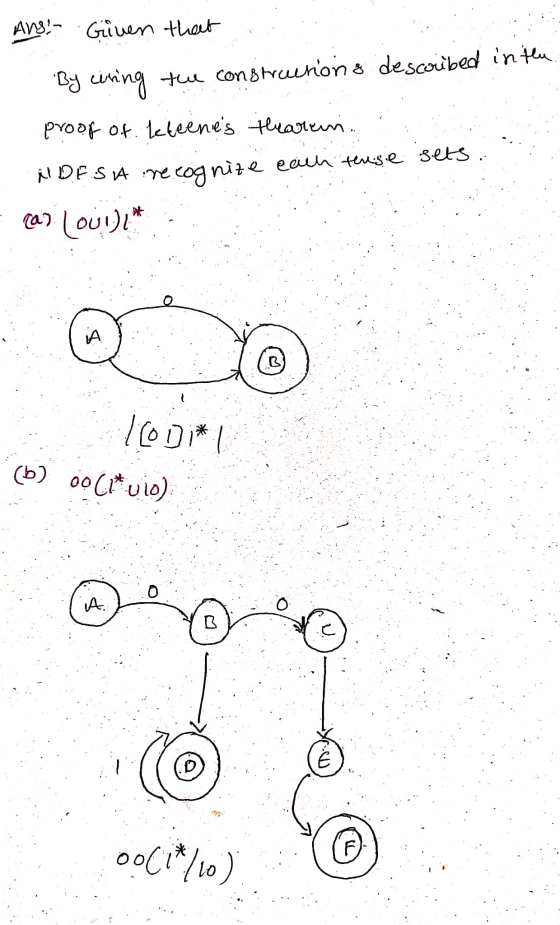
Using the constructions described in the proof of Kleene's theorem, find NDFSA that recognize each of...
I need proof of this numerical analysis theorem. This theorem is from Burden's Numerical analysis book....
 I need proof of this numerical analysis theorem. This theorem is
from Burden's Numerical analysis book. Please give me the detailed
solution of this theorem.
Theorem If {00, ... , ºn} is an orthogonal set of functions on an interval [a, b] with respect to the weight function w, then the least squares approximation to f on [a, b] with respect to w is 11 P(x) = a;°;(x), j=0 where, for each j = 0, 1, ... ,n, cb aj...
I need proof of this numerical analysis theorem. This theorem is
from Burden's Numerical analysis book. Please give me the detailed
solution of this theorem.
Theorem If {00, ... , ºn} is an orthogonal set of functions on an interval [a, b] with respect to the weight function w, then the least squares approximation to f on [a, b] with respect to w is 11 P(x) = a;°;(x), j=0 where, for each j = 0, 1, ... ,n, cb aj...
Hint: Use the fundamental theorem of arithmetic. 15. Theorem 14.5 implies that Nx N is countably infinite. Construct an alternate proof of this fact by showing that the function ф : N x N 2n-1(...
 Hint: Use the fundamental theorem of arithmetic.
15. Theorem 14.5 implies that Nx N is countably infinite. Construct an alternate proof of this fact by showing that the function ф : N x N 2n-1(2m-1) is bijective. N defined as ф(m,n) It is also true that the Cartesian product of two countably infinite sets is itself countably infinite, as our next theorem states. Theorem 14.5 If A and B are both countably infinite, then so is A x B. Proof....
Hint: Use the fundamental theorem of arithmetic.
15. Theorem 14.5 implies that Nx N is countably infinite. Construct an alternate proof of this fact by showing that the function ф : N x N 2n-1(2m-1) is bijective. N defined as ф(m,n) It is also true that the Cartesian product of two countably infinite sets is itself countably infinite, as our next theorem states. Theorem 14.5 If A and B are both countably infinite, then so is A x B. Proof....
(06) Proof the following absorption theorem using the fundamental of Boolean algebra X+ XY= X (07)...
 (06) Proof the following absorption theorem using the fundamental of Boolean algebra X+ XY= X (07) Use De Morgan's Theorem, to find the complement of the following function F(X, Y, Z) = XYZ + xyz (08) Obtain the truth table of the following function, then express it in sum-of-minterms and product-of-maxterms form F= XY+XZ (Q9) For the following abbreviated forms, find the corresponding canonical representations, (a) F(A, B, C) = (0,2,4,6) (b) F(X, Y, Z) = II (1,3,5,7)
Complete the proof of Theorem 4.22 by showing that < is a transitive relation. Let R...
 Complete the proof of Theorem 4.22 by showing that < is a transitive relation. Let R be a transitive relation that is reflexive on a set S, and let E-ROR-1. Then E is an equivalence relation on S, and if for any two equivalence classes [a] and [b] we define [a] < [b] provided that for each x e [a] and each y e [b], (x, y) e R, then (S/E, is a partially ordered set.
only (b) please Exercise 4.3.3. (a) Supply a proof for Theorem 4.3.9 using the ed charac-...
 only (b) please
Exercise 4.3.3. (a) Supply a proof for Theorem 4.3.9 using the ed charac- terization of continuity. Excreien: :03a supely a pot be Tovem 130 ming the ó dheas (b) Give another proof of this theorem using the sequential characterization of continuity (from Theorem 4.3.2 (iii)). Theorem 4.3.9 (Composition of Continuous Functions). Given f : A R and g: B + R, assume that the range f(A) = {f(): € A} is contained in the domain B so...
only (b) please
Exercise 4.3.3. (a) Supply a proof for Theorem 4.3.9 using the ed charac- terization of continuity. Excreien: :03a supely a pot be Tovem 130 ming the ó dheas (b) Give another proof of this theorem using the sequential characterization of continuity (from Theorem 4.3.2 (iii)). Theorem 4.3.9 (Composition of Continuous Functions). Given f : A R and g: B + R, assume that the range f(A) = {f(): € A} is contained in the domain B so...
4. 20 points (Ex 21.2-3 of text book) Adapt the aggregate proof of Theorem 21.1 in...
 4. 20 points (Ex 21.2-3 of text book) Adapt the aggregate proof of Theorem 21.1 in the text book (slide 44 of Lecture5) to obtain amortized time bounds of O(1) for Make-Set and Find-Set and O(log n) for Union using linked list representation and weighted-union heuristic. Theorem 21.1 Using the linked-list representation of disjoint sets and the weighted-union heuris- tic, a sequence of m MAKE-SET, UNION, and FIND-SET operations, n of which are MAKE-SET operations, takes O(m + n lgn)...
Prove (4) by breaking the proof into cases akin to the proof of Theorem 1.1. x·y...
Prove (4) by breaking the proof into cases akin to the proof of Theorem 1.1. x·y ≤ |x·y| = |x|·|y| for all x,y∈R. (4) (for reference) Theorem 1.1 (Triangle inequality). |x+y|≤|x|+|y| forallx,y∈R. (3) Proof. To prove (3), we consider each possible case so to be able to exploit the definition (1).Case 1: x ≥ 0, y ≥ 0. We then have by (1) that |x| = x, |y| = y, and |x + y| = x + y, and so...
9. Use the construction in the proof of the Chinese remainder theorem to find a solution to the system of congruences X 1 mod 2 x 2 mod 3 x 3 mod 5 x 4 mod 11 10. Use Fermats little theorem to fin...
 9. Use the construction in the proof of the Chinese remainder theorem to find a solution to the system of congruences X 1 mod 2 x 2 mod 3 x 3 mod 5 x 4 mod 11 10. Use Fermats little theorem to find 712 mod 13 11. What sequence of pseudorandom numbers is generated using the linear congruential generator Xn+1 (4xn + 1) mod 7 with seed xo 3?
9. Use the construction in the proof of the Chinese...
9. Use the construction in the proof of the Chinese remainder theorem to find a solution to the system of congruences X 1 mod 2 x 2 mod 3 x 3 mod 5 x 4 mod 11 10. Use Fermats little theorem to find 712 mod 13 11. What sequence of pseudorandom numbers is generated using the linear congruential generator Xn+1 (4xn + 1) mod 7 with seed xo 3?
9. Use the construction in the proof of the Chinese...
3. Let f be a continuous function on [a, b] with f(a)0< f(b). (a) The proof of Theorem 7-1 showed that there is a smallest x in [a, bl with f(x)0. If there is more than one x in [a, b] with...
 3. Let f be a continuous function on [a, b] with f(a)0< f(b). (a) The proof of Theorem 7-1 showed that there is a smallest x in [a, bl with f(x)0. If there is more than one x in [a, b] with f(x)0, is there necessarily a second smallest? Show that there is a largest x in [a, b] with f(x) -0. (Try to give an easy proof by considering a new function closely related to f.) b) The proof...
4. (a) Supply proof of the Menelaus Theorem concerning a transversal line L cutting the sides...
 4. (a) Supply proof of the Menelaus Theorem concerning a transversal line L cutting the sides of ΔABC at points X,Y,Z respectively. (Hint) Drop perpendicular line segments from A, B, C to L and use similar triangles b)Centuries after Menelaus, Ceva discovered the Theorem that if P,Q, R are points on BC, CA and AB respectively so that AP, BQ, CR meet at a single point K, thern AR BP co RB PC QA Prove Ceva's theorem and its converse,...
 I need proof of this numerical analysis theorem. This theorem is
from Burden's Numerical analysis book. Please give me the detailed
solution of this theorem.
Theorem If {00, ... , ºn} is an orthogonal set of functions on an interval [a, b] with respect to the weight function w, then the least squares approximation to f on [a, b] with respect to w is 11 P(x) = a;°;(x), j=0 where, for each j = 0, 1, ... ,n, cb aj...
I need proof of this numerical analysis theorem. This theorem is
from Burden's Numerical analysis book. Please give me the detailed
solution of this theorem.
Theorem If {00, ... , ºn} is an orthogonal set of functions on an interval [a, b] with respect to the weight function w, then the least squares approximation to f on [a, b] with respect to w is 11 P(x) = a;°;(x), j=0 where, for each j = 0, 1, ... ,n, cb aj...
 Hint: Use the fundamental theorem of arithmetic.
15. Theorem 14.5 implies that Nx N is countably infinite. Construct an alternate proof of this fact by showing that the function ф : N x N 2n-1(2m-1) is bijective. N defined as ф(m,n) It is also true that the Cartesian product of two countably infinite sets is itself countably infinite, as our next theorem states. Theorem 14.5 If A and B are both countably infinite, then so is A x B. Proof....
Hint: Use the fundamental theorem of arithmetic.
15. Theorem 14.5 implies that Nx N is countably infinite. Construct an alternate proof of this fact by showing that the function ф : N x N 2n-1(2m-1) is bijective. N defined as ф(m,n) It is also true that the Cartesian product of two countably infinite sets is itself countably infinite, as our next theorem states. Theorem 14.5 If A and B are both countably infinite, then so is A x B. Proof....
 (06) Proof the following absorption theorem using the fundamental of Boolean algebra X+ XY= X (07) Use De Morgan's Theorem, to find the complement of the following function F(X, Y, Z) = XYZ + xyz (08) Obtain the truth table of the following function, then express it in sum-of-minterms and product-of-maxterms form F= XY+XZ (Q9) For the following abbreviated forms, find the corresponding canonical representations, (a) F(A, B, C) = (0,2,4,6) (b) F(X, Y, Z) = II (1,3,5,7)
 Complete the proof of Theorem 4.22 by showing that < is a transitive relation. Let R be a transitive relation that is reflexive on a set S, and let E-ROR-1. Then E is an equivalence relation on S, and if for any two equivalence classes [a] and [b] we define [a] < [b] provided that for each x e [a] and each y e [b], (x, y) e R, then (S/E, is a partially ordered set.
 only (b) please
Exercise 4.3.3. (a) Supply a proof for Theorem 4.3.9 using the ed charac- terization of continuity. Excreien: :03a supely a pot be Tovem 130 ming the ó dheas (b) Give another proof of this theorem using the sequential characterization of continuity (from Theorem 4.3.2 (iii)). Theorem 4.3.9 (Composition of Continuous Functions). Given f : A R and g: B + R, assume that the range f(A) = {f(): € A} is contained in the domain B so...
only (b) please
Exercise 4.3.3. (a) Supply a proof for Theorem 4.3.9 using the ed charac- terization of continuity. Excreien: :03a supely a pot be Tovem 130 ming the ó dheas (b) Give another proof of this theorem using the sequential characterization of continuity (from Theorem 4.3.2 (iii)). Theorem 4.3.9 (Composition of Continuous Functions). Given f : A R and g: B + R, assume that the range f(A) = {f(): € A} is contained in the domain B so...
 4. 20 points (Ex 21.2-3 of text book) Adapt the aggregate proof of Theorem 21.1 in the text book (slide 44 of Lecture5) to obtain amortized time bounds of O(1) for Make-Set and Find-Set and O(log n) for Union using linked list representation and weighted-union heuristic. Theorem 21.1 Using the linked-list representation of disjoint sets and the weighted-union heuris- tic, a sequence of m MAKE-SET, UNION, and FIND-SET operations, n of which are MAKE-SET operations, takes O(m + n lgn)...
 9. Use the construction in the proof of the Chinese remainder theorem to find a solution to the system of congruences X 1 mod 2 x 2 mod 3 x 3 mod 5 x 4 mod 11 10. Use Fermats little theorem to find 712 mod 13 11. What sequence of pseudorandom numbers is generated using the linear congruential generator Xn+1 (4xn + 1) mod 7 with seed xo 3?
9. Use the construction in the proof of the Chinese...
9. Use the construction in the proof of the Chinese remainder theorem to find a solution to the system of congruences X 1 mod 2 x 2 mod 3 x 3 mod 5 x 4 mod 11 10. Use Fermats little theorem to find 712 mod 13 11. What sequence of pseudorandom numbers is generated using the linear congruential generator Xn+1 (4xn + 1) mod 7 with seed xo 3?
9. Use the construction in the proof of the Chinese...
 3. Let f be a continuous function on [a, b] with f(a)0< f(b). (a) The proof of Theorem 7-1 showed that there is a smallest x in [a, bl with f(x)0. If there is more than one x in [a, b] with f(x)0, is there necessarily a second smallest? Show that there is a largest x in [a, b] with f(x) -0. (Try to give an easy proof by considering a new function closely related to f.) b) The proof...
 4. (a) Supply proof of the Menelaus Theorem concerning a transversal line L cutting the sides of ΔABC at points X,Y,Z respectively. (Hint) Drop perpendicular line segments from A, B, C to L and use similar triangles b)Centuries after Menelaus, Ceva discovered the Theorem that if P,Q, R are points on BC, CA and AB respectively so that AP, BQ, CR meet at a single point K, thern AR BP co RB PC QA Prove Ceva's theorem and its converse,...
Most questions answered within 3 hours.
-
Where is the error in this code sequence?
String s1 = "Hello";
String s2 = "ello";...
asked 10 months ago -
Financial data for Joel de Paris, Inc., for last year
follow:
Joel de Paris, Inc.
Balance...
asked 10 months ago -
Consider this reaction:
Al2(SO4)3 (aq)+ BaCl3
(aq) Al2Cl6 (aq)- +
3BaSO4(s) . What is the...
asked 10 months ago -
Suppose that Savneet is considering increasing her
recent random sample from 20 car rentals to 40...
asked 10 months ago -
Trucks arrive at an unloading terminal at an average rate of 120
per hour.
Trucks arrive...
asked 10 months ago -
Why are methanol and ethanol completely soluble in water while
octanol is not very little soluble....
asked 10 months ago -
A facilities manager at a university reads in a research report
that the mean amount of...
asked 10 months ago -
When the CuSO4 is rehydrated by adding water to the anhydrous
compound, is this an endothermic...
asked 10 months ago -
A ray of sunlight is passing from diamond into crown glass; the
angle of incidence is...
asked 10 months ago -
A block of mass 0.249 kg is placed on top of a light, vertical
spring of...
asked 10 months ago -
how do the kidneys compensate in the presences of acidosis
a) trigger hyperventilate
b) reserve acid...
asked 10 months ago -
Question 501 pts
The rental rate of capital to the firm increases. Which of the
following...
asked 10 months ago