
Homework Answers

Add Answer to:
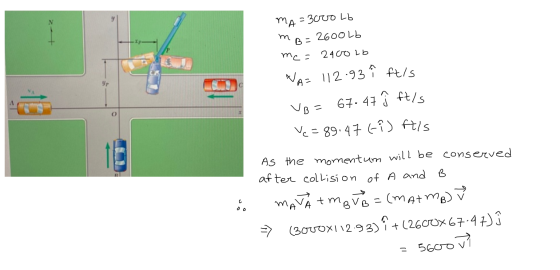
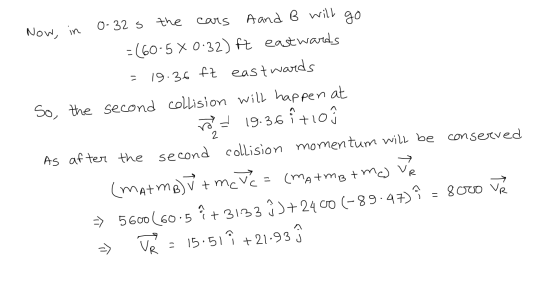
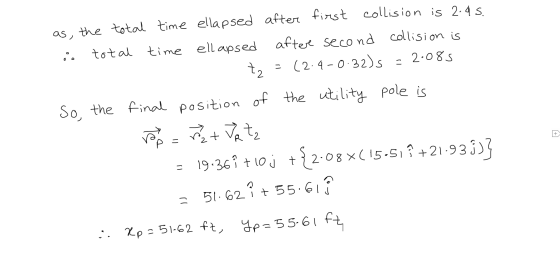
Car A was traveling east at high speed when it collided at point with car B,...
A car collided with a telephone pole and left 20 ft skid marks on the dry...
A car collided with a telephone pole and left 20 ft skid marks on the dry pavement. Based on the damages sustained, an engineer estimated that the speed at collision was 15 mi/h. If the roadway had a 3% grade, calculate the speed of the car at the onset of skidding.
2. A driver is traveling at 90 mi/h down a 3% grade on good, wet pavement....
2. A driver is traveling at 90 mi/h down a 3% grade on good, wet pavement. An accident investigation team noted that braking skid marks started 410 ft before a parked car was hit at an estimated 45 mi/h. Ignoring air resistance, and using theoretical stopping distance, a. what was the braking efficiency of the car? b. If the car’s antilock braking system was effective (no sliding wheels on the pavement), what would the crash speed be?
A 900-kg car traveling east at 15.0 m/s collides with a 750-kg car traveling north at...
A 900-kg car traveling east at 15.0 m/s collides with a 750-kg car traveling north at 20.0 m/s. The cars stick together. Assume that any other unbalanced forces are negligible. a. What is the speed of the wreckage just after the collision? b. In what direction does the wreckage move just after the collision? c. How much kinetic energy is lost in this collision.
A 900 Kg car is traveling east at 15 m/s when it collides with a 750...
A 900 Kg car is traveling east at 15 m/s when it collides with a 750 Kg car traveling north at 20 m/s. The cars stick together. What is the kinetic energy of the system after the collision?
Two cars, both of mass m, collide and stick togetber. Prior to the collision, one car had been traveling north at speed 2v
 Two cars, both of mass m, collide and stick togetber. Prior to the collision, one car had been traveling north at speed 2v, while the second was traveling at speed u at an angle φ south of east (as indicated in the figure). After the collision, the two-car system travels at speed vfinal at an angle θ east of north.
Two cars, both of mass m, collide and stick together. Prior to thecollision, one car had been traveling north at speed...
 Two cars, both of mass m, collide and stick together. Prior to the collision, one car had been traveling north at speed 2v, while the second was traveling at speed v at an angle phi south of east
(asindicated in the figure). After the collision, the two-car system travels at speed v_final at an angle theta east of
north.Part AFind the speed v_final of the joined cars after the
collision.Express your answer in terms of v and phi.Part BWhat is...
Two cars, both of mass m, collide and stick together. Prior to the collision, one car had been traveling north at speed 2v, while the second was traveling at speed v at an angle phi south of east
(asindicated in the figure). After the collision, the two-car system travels at speed v_final at an angle theta east of
north.Part AFind the speed v_final of the joined cars after the
collision.Express your answer in terms of v and phi.Part BWhat is...
Two cars are latched together with a speed of 3 m/s traveling to the east when...
Two cars are latched together with a speed of 3 m/s traveling to the east when they catch up and collide with another car moving at a speed of 0.6m/s east. If the three-car latches to the other two. How fast will the three cars joint together after the collision happens? Same Mass for all vehicles.
Car A is parked along the northbound lane of a highway, and car B is traveling...
 Car A is parked along the
northbound lane of a highway, and car B is traveling in the
southbound lane at a constant speed of 60 mi/h. At t = 0, A starts
and accelerates at a constant rate aA, while at t = 5 s,
B begins to slow down with a constant deceleration of magnitude
aA/6. Knowing that when the cars pass each other x = 294
ft and vA = vB, determine (a) the
acceleration aA, (b)...
Car A is parked along the
northbound lane of a highway, and car B is traveling in the
southbound lane at a constant speed of 60 mi/h. At t = 0, A starts
and accelerates at a constant rate aA, while at t = 5 s,
B begins to slow down with a constant deceleration of magnitude
aA/6. Knowing that when the cars pass each other x = 294
ft and vA = vB, determine (a) the
acceleration aA, (b)...
Insurance claim. Your friend has just been in a car wreck and is trying to get...
Insurance claim. Your friend has just been in a car wreck and is trying to get the insurance company of the other driver to pay for fixing her car. She believes that she was driving within the speed limit and the other driver was speeding, and so the accident was the other driver's fault. She hopes that you can use your command of physics to prove her conjecture. She takes you out to the scene and describes what happened. She...
1. A pole is held vertically by attaching wires at a height of 13.4 m above...
1. A pole is held vertically by attaching wires at a height of 13.4 m above the ground. The other end of each wire is anchored in the ground at a distance of 9.54 m from the base of the pole. The pole makes a right angle with the ground. What is the length of each wire? 2. A bug crawls 2.25 m along the base of a wall. Upon reaching a corner, the bug's direction of travel changes from...
 Car A is parked along the
northbound lane of a highway, and car B is traveling in the
southbound lane at a constant speed of 60 mi/h. At t = 0, A starts
and accelerates at a constant rate aA, while at t = 5 s,
B begins to slow down with a constant deceleration of magnitude
aA/6. Knowing that when the cars pass each other x = 294
ft and vA = vB, determine (a) the
acceleration aA, (b)...
Car A is parked along the
northbound lane of a highway, and car B is traveling in the
southbound lane at a constant speed of 60 mi/h. At t = 0, A starts
and accelerates at a constant rate aA, while at t = 5 s,
B begins to slow down with a constant deceleration of magnitude
aA/6. Knowing that when the cars pass each other x = 294
ft and vA = vB, determine (a) the
acceleration aA, (b)...
Most questions answered within 3 hours.
-
Where is the error in this code sequence?
String s1 = "Hello";
String s2 = "ello";...
asked 11 months ago -
Financial data for Joel de Paris, Inc., for last year
follow:
Joel de Paris, Inc.
Balance...
asked 11 months ago -
Consider this reaction:
Al2(SO4)3 (aq)+ BaCl3
(aq) Al2Cl6 (aq)- +
3BaSO4(s) . What is the...
asked 11 months ago -
Suppose that Savneet is considering increasing her
recent random sample from 20 car rentals to 40...
asked 11 months ago -
Trucks arrive at an unloading terminal at an average rate of 120
per hour.
Trucks arrive...
asked 11 months ago -
Why are methanol and ethanol completely soluble in water while
octanol is not very little soluble....
asked 11 months ago -
A facilities manager at a university reads in a research report
that the mean amount of...
asked 11 months ago -
When the CuSO4 is rehydrated by adding water to the anhydrous
compound, is this an endothermic...
asked 11 months ago -
A ray of sunlight is passing from diamond into crown glass; the
angle of incidence is...
asked 11 months ago -
A block of mass 0.249 kg is placed on top of a light, vertical
spring of...
asked 11 months ago -
how do the kidneys compensate in the presences of acidosis
a) trigger hyperventilate
b) reserve acid...
asked 11 months ago -
Question 501 pts
The rental rate of capital to the firm increases. Which of the
following...
asked 11 months ago