 Assuming an ideal op-amp (1)find
the 3dB frequency of the circuit, if R1=1.5 KΩ, R2=13.2
KΩ, R3=20 KΩ, and C=5 nF
Assuming an ideal op-amp (1)find
the 3dB frequency of the circuit, if R1=1.5 KΩ, R2=13.2
KΩ, R3=20 KΩ, and C=5 nF
2)Consider the above circuit with the component values: R1=13.2 KΩ, R2= 795.77 Ω, R3=20 KΩ, and C=100 nF. Find the angle of the transfer function in degrees at 2KHz .
Homework Answers
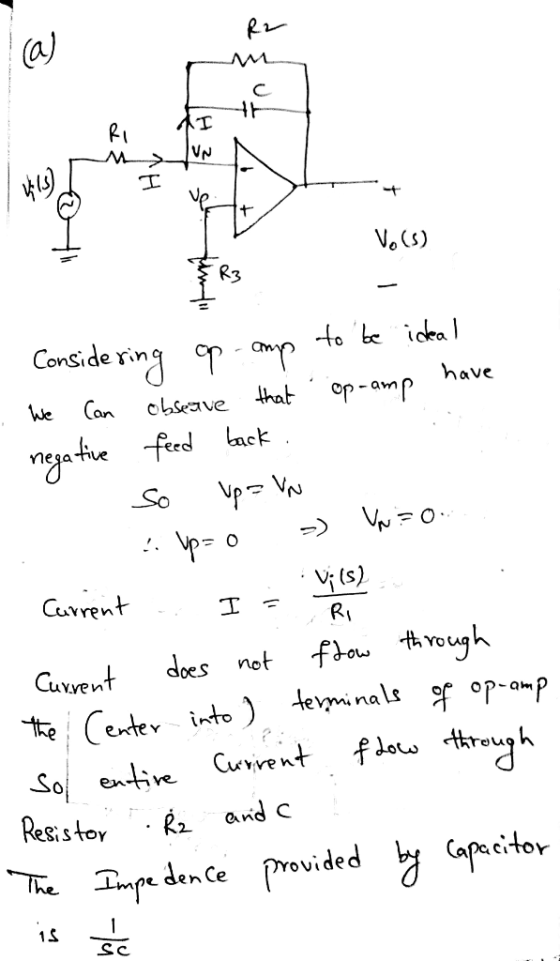
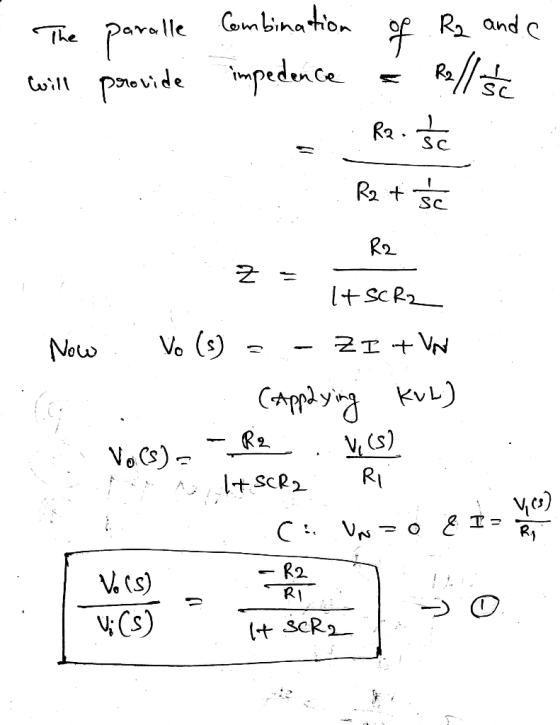
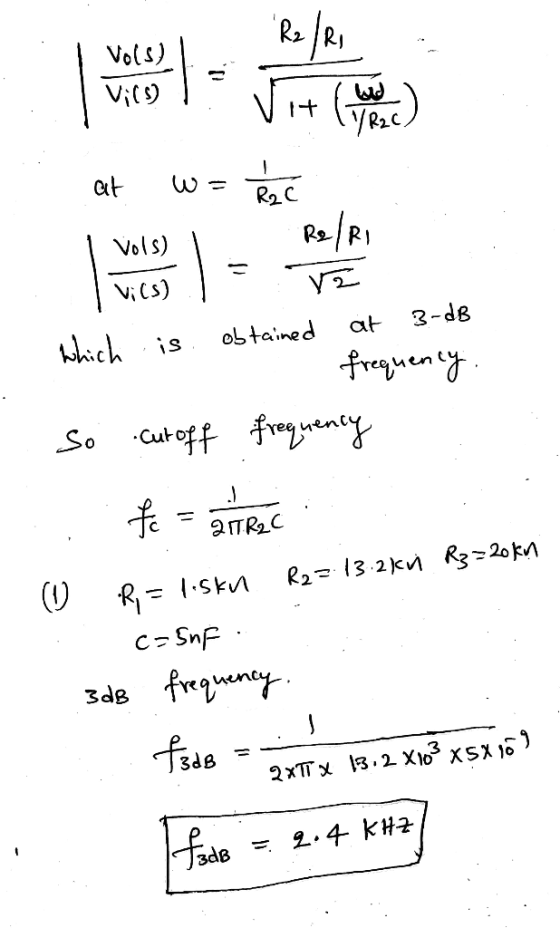
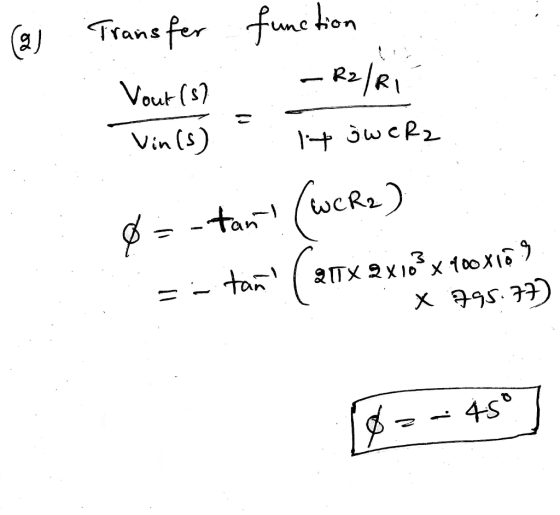
Please comment if you have any doubts...
Please give me upvote if you like my answer...tq...
Add Answer to:
Assuming an ideal op-amp (1)find
the 3dB frequency of the circuit, if R1=1.5 KΩ, R2=13.2
KΩ,...
Assuming an ideal op-amp find the 3dB frequency of the circuit, if R1=2.4 KS2, R2=13.4 K2,...
 Assuming an ideal op-amp find the 3dB frequency of the circuit, if R1=2.4 KS2, R2=13.4 K2, R3=20 KS2, and C=5 nF. HH C R2 R1 + Vi(jw) Vo R3 IH Answer: rad/s Consider the above circuit with the component values: R1=2.4 K12, R2=13.4 KS, R3=20 KN and C=5 nF. Find the DC gain of the circuit. Answer: Consider the above circuit with the component values: R1=13.4 KS, R2= 795.77 12, R3=20 K12, and C=100 nF. Find the angle of the...
Assuming an ideal op-amp find the 3dB frequency of the circuit, if R1=2.3 K12, R2=13.1 KS2,...
 Assuming an ideal op-amp find the 3dB frequency of the circuit, if R1=2.3 K12, R2=13.1 KS2, R3=20 KS2, and C=5 nF. HA с R2 R1 Viljw) Vo R3 IH = Consider the above circuit with the component values: R1=2.3 KS2, R2=13.1 K12, R3=20 KS2 and C=5 nF. Find the DC gain of the circuit. Consider the above circuit with the component values: R1=13.1 K12, R2= 795.77 12, R3=20 K2, and C=100 nF. Find the angle of the transfer function in...
Assuming an ideal op-amp find the 3dB frequency of the circuit, if R1=1.8 K2, R2=10.9 KQ,...
 Assuming an ideal op-amp find the 3dB frequency of the circuit, if R1=1.8 K2, R2=10.9 KQ, R3=20 K., and C=5 nF. HH с R2 Answer: orad/s R1 Vw R3 Consider the above circuit with the component values: R1=1.8 KO, R2=10.9 KO, R3=20 KQ and C=5 nF. Find the DC gain of the circuit. Answer: Consider the above circuit with the component values: R1=10.9 K2, R2= 795.77 2, R3=20 K, and C=100 nF. Find the angle of the transfer function in...
Assuming an ideal op-amp find the 3dB frequency of the circuit, if R1=1.7 K2, R2=11.2 K22,...
 Assuming an ideal op-amp find the 3dB frequency of the circuit, if R1=1.7 K2, R2=11.2 K22, R3=20 KS, and C=5 nF. Question 9 Not yet answered Marked out of 7.00 HE C P Flag question R2 R1 VI(w) Vo R3 = = Answer: Orad/s
Assuming an ideal op-amp find the 3ds frequency of the circuit, if R1-1.7 KA, R2-112 KA,...
 Assuming an ideal op-amp find the 3ds frequency of the circuit, if R1-1.7 KA, R2-112 KA, R3:20 KQ, and C-5 nf, HH but с Answer radi w R2 w R1 Vw vo R3 Oton 10 Consider the above circuit with the component values: 11.7KO, R2112 KOR320 KO and Co. Find the DC gain of the circuit Consider the above circuit with the component values 1.770,000 in the other teretanin degrees 100
Question 9 Not yet answered Marked out of 7.00 P Flag question Assuming an ideal op-amp...
 Question 9 Not yet answered Marked out of 7.00 P Flag question Assuming an ideal op-amp find the 3dB frequency of the circuit, if R1=1.7 K., R2=11.2 KN, R3=20 KS, and C=5 nF. HH С R2 R1 Vow Vo R3 Answer: Orad/s Question 10 Not yet answered Marked out of 6.00 P Flag question Consider the above circuit with the component values: R1=1.7 KN, R2=11.2 K12, R3=20 KS2 and C=5 nF. Find the DC gain of the circuit. Answer: Question...
R3 R2 Do Us R1 Determine Vo/Vs for this op amp circuit with an ideal op...
 R3 R2 Do Us R1 Determine Vo/Vs for this op amp circuit with an ideal op amp and R1 = 6 k. R2 = 25 ㏀, R: 49 ㏀, C1 = 0.5 μF, and a= 5 k rad/s.
Assuming an ideal op-amp in the following circuit, find output voltage, Vo if R1= 2 KS,...
 Assuming an ideal op-amp in the following circuit, find output voltage, Vo if R1= 2 KS, R2=8 KN, R3=3.4 KA, R4=6 KN, R5=20 KN, R6=2.9 KN, RL=12.5 KN, V1=1V, 12=0.5 mA and V3=3.1 V. R6 R1 R5 VO + RL 12 R2 V1 R3 { R4 w V3 Answer: "V
For the following circuit, assuming the op-amp is ideal, find the current through the load (IL)...
 For the following circuit, assuming the op-amp is ideal, find
the current through the load (IL) if V1=3.7V, V2=2V, R1=1.5KΩ,
R2=8.5KΩ, R3=1 KΩ, R4=39 KΩ and RL=2.3KΩ.
Consider the same circuit as in with Question 1, but
with the following new component values:
V1=3.7V, V2=6V, R1=1.5KΩ, R2=8.5KΩ, R3=1
KΩ, R4=39 KΩ and RL=2.3KΩ. What is the input impedance as
seen by the source V1?
RL R4 w n w n + R1 +1 V1 R2 R3 } > +1 V2
For the following circuit, assuming the op-amp is ideal, find
the current through the load (IL) if V1=3.7V, V2=2V, R1=1.5KΩ,
R2=8.5KΩ, R3=1 KΩ, R4=39 KΩ and RL=2.3KΩ.
Consider the same circuit as in with Question 1, but
with the following new component values:
V1=3.7V, V2=6V, R1=1.5KΩ, R2=8.5KΩ, R3=1
KΩ, R4=39 KΩ and RL=2.3KΩ. What is the input impedance as
seen by the source V1?
RL R4 w n w n + R1 +1 V1 R2 R3 } > +1 V2
1)What is the output voltage V0 if op-amp is ideal? R1= 2 KΩ, R2=8 KΩ, R3=3.2...
 1)What is the output
voltage V0 if op-amp is ideal?
R1= 2 KΩ, R2=8 KΩ, R3=3.2 KΩ, R4=6 KΩ, R5=19
KΩ, R6=4.6 KΩ, RL=9.6 KΩ, V1=1V, I2=0.5 mA and V3=2.5 V.
2) for the same circuit, R1= 2 KΩ R2=8
KΩ, R3=3.6 KΩ, R4=6 KΩ, R5=16.9 KΩ, R6=15 KΩ, RL=10 KΩ, V1=1V,
I2=0.5mA and V3=2V. What is the input impedance as
seen by source V3?
+ | R1 ہی ہے۔ ۸۸۸ ة -(1+ R5 | + ابرها -
1)What is the output
voltage V0 if op-amp is ideal?
R1= 2 KΩ, R2=8 KΩ, R3=3.2 KΩ, R4=6 KΩ, R5=19
KΩ, R6=4.6 KΩ, RL=9.6 KΩ, V1=1V, I2=0.5 mA and V3=2.5 V.
2) for the same circuit, R1= 2 KΩ R2=8
KΩ, R3=3.6 KΩ, R4=6 KΩ, R5=16.9 KΩ, R6=15 KΩ, RL=10 KΩ, V1=1V,
I2=0.5mA and V3=2V. What is the input impedance as
seen by source V3?
+ | R1 ہی ہے۔ ۸۸۸ ة -(1+ R5 | + ابرها -
 Assuming an ideal op-amp find the 3dB frequency of the circuit, if R1=2.4 KS2, R2=13.4 K2, R3=20 KS2, and C=5 nF. HH C R2 R1 + Vi(jw) Vo R3 IH Answer: rad/s Consider the above circuit with the component values: R1=2.4 K12, R2=13.4 KS, R3=20 KN and C=5 nF. Find the DC gain of the circuit. Answer: Consider the above circuit with the component values: R1=13.4 KS, R2= 795.77 12, R3=20 K12, and C=100 nF. Find the angle of the...
 Assuming an ideal op-amp find the 3dB frequency of the circuit, if R1=2.3 K12, R2=13.1 KS2, R3=20 KS2, and C=5 nF. HA с R2 R1 Viljw) Vo R3 IH = Consider the above circuit with the component values: R1=2.3 KS2, R2=13.1 K12, R3=20 KS2 and C=5 nF. Find the DC gain of the circuit. Consider the above circuit with the component values: R1=13.1 K12, R2= 795.77 12, R3=20 K2, and C=100 nF. Find the angle of the transfer function in...
 Assuming an ideal op-amp find the 3dB frequency of the circuit, if R1=1.8 K2, R2=10.9 KQ, R3=20 K., and C=5 nF. HH с R2 Answer: orad/s R1 Vw R3 Consider the above circuit with the component values: R1=1.8 KO, R2=10.9 KO, R3=20 KQ and C=5 nF. Find the DC gain of the circuit. Answer: Consider the above circuit with the component values: R1=10.9 K2, R2= 795.77 2, R3=20 K, and C=100 nF. Find the angle of the transfer function in...
 Assuming an ideal op-amp find the 3dB frequency of the circuit, if R1=1.7 K2, R2=11.2 K22, R3=20 KS, and C=5 nF. Question 9 Not yet answered Marked out of 7.00 HE C P Flag question R2 R1 VI(w) Vo R3 = = Answer: Orad/s
 Assuming an ideal op-amp find the 3ds frequency of the circuit, if R1-1.7 KA, R2-112 KA, R3:20 KQ, and C-5 nf, HH but с Answer radi w R2 w R1 Vw vo R3 Oton 10 Consider the above circuit with the component values: 11.7KO, R2112 KOR320 KO and Co. Find the DC gain of the circuit Consider the above circuit with the component values 1.770,000 in the other teretanin degrees 100
 Question 9 Not yet answered Marked out of 7.00 P Flag question Assuming an ideal op-amp find the 3dB frequency of the circuit, if R1=1.7 K., R2=11.2 KN, R3=20 KS, and C=5 nF. HH С R2 R1 Vow Vo R3 Answer: Orad/s Question 10 Not yet answered Marked out of 6.00 P Flag question Consider the above circuit with the component values: R1=1.7 KN, R2=11.2 K12, R3=20 KS2 and C=5 nF. Find the DC gain of the circuit. Answer: Question...
 R3 R2 Do Us R1 Determine Vo/Vs for this op amp circuit with an ideal op amp and R1 = 6 k. R2 = 25 ㏀, R: 49 ㏀, C1 = 0.5 μF, and a= 5 k rad/s.
 Assuming an ideal op-amp in the following circuit, find output voltage, Vo if R1= 2 KS, R2=8 KN, R3=3.4 KA, R4=6 KN, R5=20 KN, R6=2.9 KN, RL=12.5 KN, V1=1V, 12=0.5 mA and V3=3.1 V. R6 R1 R5 VO + RL 12 R2 V1 R3 { R4 w V3 Answer: "V
 For the following circuit, assuming the op-amp is ideal, find
the current through the load (IL) if V1=3.7V, V2=2V, R1=1.5KΩ,
R2=8.5KΩ, R3=1 KΩ, R4=39 KΩ and RL=2.3KΩ.
Consider the same circuit as in with Question 1, but
with the following new component values:
V1=3.7V, V2=6V, R1=1.5KΩ, R2=8.5KΩ, R3=1
KΩ, R4=39 KΩ and RL=2.3KΩ. What is the input impedance as
seen by the source V1?
RL R4 w n w n + R1 +1 V1 R2 R3 } > +1 V2
For the following circuit, assuming the op-amp is ideal, find
the current through the load (IL) if V1=3.7V, V2=2V, R1=1.5KΩ,
R2=8.5KΩ, R3=1 KΩ, R4=39 KΩ and RL=2.3KΩ.
Consider the same circuit as in with Question 1, but
with the following new component values:
V1=3.7V, V2=6V, R1=1.5KΩ, R2=8.5KΩ, R3=1
KΩ, R4=39 KΩ and RL=2.3KΩ. What is the input impedance as
seen by the source V1?
RL R4 w n w n + R1 +1 V1 R2 R3 } > +1 V2
 1)What is the output
voltage V0 if op-amp is ideal?
R1= 2 KΩ, R2=8 KΩ, R3=3.2 KΩ, R4=6 KΩ, R5=19
KΩ, R6=4.6 KΩ, RL=9.6 KΩ, V1=1V, I2=0.5 mA and V3=2.5 V.
2) for the same circuit, R1= 2 KΩ R2=8
KΩ, R3=3.6 KΩ, R4=6 KΩ, R5=16.9 KΩ, R6=15 KΩ, RL=10 KΩ, V1=1V,
I2=0.5mA and V3=2V. What is the input impedance as
seen by source V3?
+ | R1 ہی ہے۔ ۸۸۸ ة -(1+ R5 | + ابرها -
1)What is the output
voltage V0 if op-amp is ideal?
R1= 2 KΩ, R2=8 KΩ, R3=3.2 KΩ, R4=6 KΩ, R5=19
KΩ, R6=4.6 KΩ, RL=9.6 KΩ, V1=1V, I2=0.5 mA and V3=2.5 V.
2) for the same circuit, R1= 2 KΩ R2=8
KΩ, R3=3.6 KΩ, R4=6 KΩ, R5=16.9 KΩ, R6=15 KΩ, RL=10 KΩ, V1=1V,
I2=0.5mA and V3=2V. What is the input impedance as
seen by source V3?
+ | R1 ہی ہے۔ ۸۸۸ ة -(1+ R5 | + ابرها -
Most questions answered within 3 hours.
-
Where is the error in this code sequence?
String s1 = "Hello";
String s2 = "ello";...
asked 10 months ago -
Financial data for Joel de Paris, Inc., for last year
follow:
Joel de Paris, Inc.
Balance...
asked 10 months ago -
Consider this reaction:
Al2(SO4)3 (aq)+ BaCl3
(aq) Al2Cl6 (aq)- +
3BaSO4(s) . What is the...
asked 10 months ago -
Suppose that Savneet is considering increasing her
recent random sample from 20 car rentals to 40...
asked 10 months ago -
Trucks arrive at an unloading terminal at an average rate of 120
per hour.
Trucks arrive...
asked 10 months ago -
Why are methanol and ethanol completely soluble in water while
octanol is not very little soluble....
asked 10 months ago -
A facilities manager at a university reads in a research report
that the mean amount of...
asked 10 months ago -
When the CuSO4 is rehydrated by adding water to the anhydrous
compound, is this an endothermic...
asked 10 months ago -
A ray of sunlight is passing from diamond into crown glass; the
angle of incidence is...
asked 10 months ago -
A block of mass 0.249 kg is placed on top of a light, vertical
spring of...
asked 10 months ago -
how do the kidneys compensate in the presences of acidosis
a) trigger hyperventilate
b) reserve acid...
asked 10 months ago -
Question 501 pts
The rental rate of capital to the firm increases. Which of the
following...
asked 10 months ago