
Homework Answers
Add Answer to:
DETAILS LARLINALG8 5.R.040. ASK YOUR TEACHER Apply the Gram-Schmidt orthonormalization process to transform the given basis...
Apply the Gram-Schmidt orthonormalization process to transform the given basis for R" into an orthonormal basis. Us...
 Apply the Gram-Schmidt orthonormalization process to transform the given basis for R" into an orthonormal basis. Use the vectors in the order in which they are given. B = {(4, 1, 0), (0,0,4), (1, 1, 1)) は,ヤ) 4 .0 17 'V17 U1 Uz = | (0.0.1 ) (かか) u3 =
Apply the Gram-Schmidt orthonormalization process to transform the given basis for R" into an orthonormal basis. Use the vectors in the order in which they are given. B = {(4,...
Apply the Gram-Schmidt orthonormalization process to transform the given basis for R" into an orthonormal basis. Use the vectors in the order in which they are given. B = {(4, 1, 0), (0,0,4), (1, 1, 1)) は,ヤ) 4 .0 17 'V17 U1 Uz = | (0.0.1 ) (かか) u3 =
Apply the Gram-Schmidt orthonormalization process to transform the given basis for R" into an orthonormal basis. Use the vectors in the order in which they are given. B = {(4,...
Apply the Gram-Schmidt orthonormalization process to transform the given basis for p into an orthonormal basis....
 Apply the Gram-Schmidt orthonormalization process to transform the given basis for p into an orthonormal basis. Use the vectors in the order in which they are given. B = {(0, 1), (4,9)} U1 = U2 =
10. -/3 POINTS LARLINALG8 5.3.013. MY NOTES ASK YOUR TEACHER Consider the following. {(-1,8), (16, 2)}...
 10. -/3 POINTS LARLINALG8 5.3.013. MY NOTES ASK YOUR TEACHER Consider the following. {(-1,8), (16, 2)} (a) Show that the set of vectors in Rh is orthogonal. (-1,8) · (16, 2) = (b) Normalize the set to produce an orthonormal set. 11. -/2 POINTS LARLINALG8 5.3.025. MY NOTES ASK YOUR TEACHER Apply the Gram-Schmidt orthonormalization process to transform the given basis for Rh into an orthonormal basis. Use the vectors in the order in which they are given. B =...
Use the Gram-Schmidt process to transform the basis, B = {(1,2), (3, 4)} for R² into...
 Use the Gram-Schmidt process to transform the basis, B = {(1,2), (3, 4)} for R² into (a) an orthogonal basis for R and (b) an orthonormal basis for R using the Euclidean inner product; that is, dot product, and use vectors in the order in which they are given.
Use the inner product <u, v>= 2u1v1 + u2v2 in R2 and the Gram-Schmidt orthonormalization process...
Use the inner product <u, v>= 2u1v1 + u2v2 in R2 and the Gram-Schmidt orthonormalization process to transform {(−2, 1), (−2, 7)} into an orthonormal basis. (Use the vectors in the order in which they are given.)
0 6. 11 points HoltLinAlg2 10.2.012. My Notes Ask Your Teacher Find projsf for Rx)- ex, where S-span1, x and the inner product is eBook 7. 1 points HoltLinAlg2 10.2.014 My Notes Ask Your Teacher Use...
 0 6. 11 points HoltLinAlg2 10.2.012. My Notes Ask Your Teacher Find projsf for Rx)- ex, where S-span1, x and the inner product is eBook 7. 1 points HoltLinAlg2 10.2.014 My Notes Ask Your Teacher Use the Gram-Schmidt process to convert the given set of vectors to an orthogonal basis with respect to the given inner product. (Apply the Gram-Schmidt process in the order the vectors are given and do not normalize.) The set,1,0with respect to the inner product (u,...
Use the Gram-Schmidt process to transform each of the following into an orthonormal basis:
Use the Gram-Schmidt process to transform each of the following into an orthonormalbasis:(i) {(1, 1, 1),(1, 0, 1),(0, 1, 2)} for IR3 with dot product.(ii) Same set as in above but use the inner product defined as< (x, y, z),(x', y', z')>= xx'+ 2yy'+ 3zz'how to solve second part?
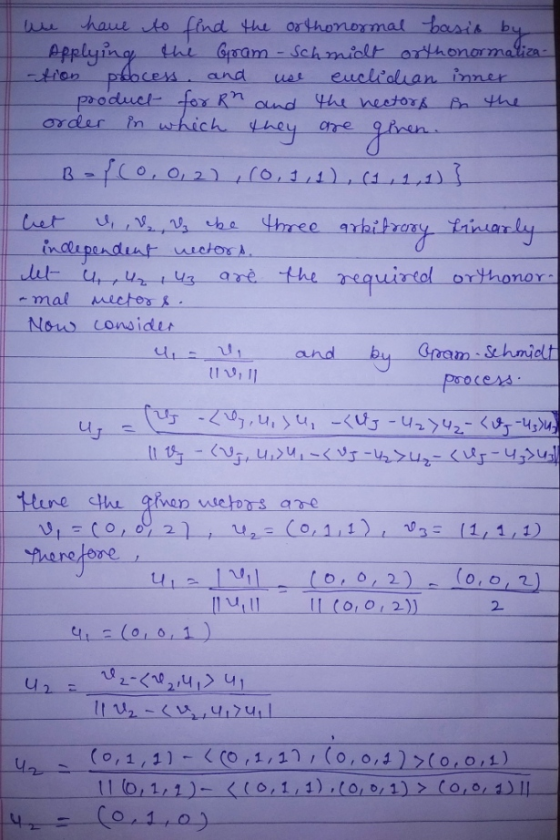
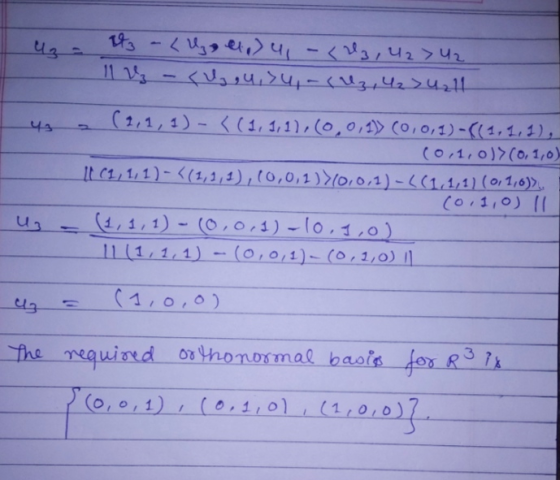
Apply Gram-Schmidt Orthonomalization process to transform the basis (012), (2,0,0), (W} for Rs into orthonomal barriso...
 Apply Gram-Schmidt Orthonomalization process to transform the basis (012), (2,0,0), (W} for Rs into orthonomal barriso use the Vectors in the order in which they are giver
1. Use the Gram-Schmidt process to transform the given basis into an orthonormal basis. w= (1,...
 1. Use the Gram-Schmidt process to transform the given basis into an orthonormal basis. w= (1, 2, 1,0), w, = (1, 1, 2,0), W3 = (0,1,1, - 2), w4 = (1, 0, 3, 1)
The given vectors form a basis for a subspace W of ℝ3. Apply the Gram-Schmidt Process...
The given vectors form a basis for a subspace W of ℝ3. Apply the Gram-Schmidt Process to obtain an orthogonal basis for W. (Use the Gram-Schmidt Process found here to calculate your answer.) x1 = 1 1 0 , x2 = 3 4 1
 Apply the Gram-Schmidt orthonormalization process to transform the given basis for R" into an orthonormal basis. Use the vectors in the order in which they are given. B = {(4, 1, 0), (0,0,4), (1, 1, 1)) は,ヤ) 4 .0 17 'V17 U1 Uz = | (0.0.1 ) (かか) u3 =
Apply the Gram-Schmidt orthonormalization process to transform the given basis for R" into an orthonormal basis. Use the vectors in the order in which they are given. B = {(4,...
Apply the Gram-Schmidt orthonormalization process to transform the given basis for R" into an orthonormal basis. Use the vectors in the order in which they are given. B = {(4, 1, 0), (0,0,4), (1, 1, 1)) は,ヤ) 4 .0 17 'V17 U1 Uz = | (0.0.1 ) (かか) u3 =
Apply the Gram-Schmidt orthonormalization process to transform the given basis for R" into an orthonormal basis. Use the vectors in the order in which they are given. B = {(4,...
 Apply the Gram-Schmidt orthonormalization process to transform the given basis for p into an orthonormal basis. Use the vectors in the order in which they are given. B = {(0, 1), (4,9)} U1 = U2 =
 10. -/3 POINTS LARLINALG8 5.3.013. MY NOTES ASK YOUR TEACHER Consider the following. {(-1,8), (16, 2)} (a) Show that the set of vectors in Rh is orthogonal. (-1,8) · (16, 2) = (b) Normalize the set to produce an orthonormal set. 11. -/2 POINTS LARLINALG8 5.3.025. MY NOTES ASK YOUR TEACHER Apply the Gram-Schmidt orthonormalization process to transform the given basis for Rh into an orthonormal basis. Use the vectors in the order in which they are given. B =...
 Use the Gram-Schmidt process to transform the basis, B = {(1,2), (3, 4)} for R² into (a) an orthogonal basis for R and (b) an orthonormal basis for R using the Euclidean inner product; that is, dot product, and use vectors in the order in which they are given.
 0 6. 11 points HoltLinAlg2 10.2.012. My Notes Ask Your Teacher Find projsf for Rx)- ex, where S-span1, x and the inner product is eBook 7. 1 points HoltLinAlg2 10.2.014 My Notes Ask Your Teacher Use the Gram-Schmidt process to convert the given set of vectors to an orthogonal basis with respect to the given inner product. (Apply the Gram-Schmidt process in the order the vectors are given and do not normalize.) The set,1,0with respect to the inner product (u,...
 Apply Gram-Schmidt Orthonomalization process to transform the basis (012), (2,0,0), (W} for Rs into orthonomal barriso use the Vectors in the order in which they are giver
 1. Use the Gram-Schmidt process to transform the given basis into an orthonormal basis. w= (1, 2, 1,0), w, = (1, 1, 2,0), W3 = (0,1,1, - 2), w4 = (1, 0, 3, 1)
Most questions answered within 3 hours.
-
Where is the error in this code sequence?
String s1 = "Hello";
String s2 = "ello";...
asked 11 months ago -
Financial data for Joel de Paris, Inc., for last year
follow:
Joel de Paris, Inc.
Balance...
asked 11 months ago -
Consider this reaction:
Al2(SO4)3 (aq)+ BaCl3
(aq) Al2Cl6 (aq)- +
3BaSO4(s) . What is the...
asked 11 months ago -
Suppose that Savneet is considering increasing her
recent random sample from 20 car rentals to 40...
asked 11 months ago -
Trucks arrive at an unloading terminal at an average rate of 120
per hour.
Trucks arrive...
asked 11 months ago -
Why are methanol and ethanol completely soluble in water while
octanol is not very little soluble....
asked 11 months ago -
A facilities manager at a university reads in a research report
that the mean amount of...
asked 11 months ago -
When the CuSO4 is rehydrated by adding water to the anhydrous
compound, is this an endothermic...
asked 11 months ago -
A ray of sunlight is passing from diamond into crown glass; the
angle of incidence is...
asked 11 months ago -
A block of mass 0.249 kg is placed on top of a light, vertical
spring of...
asked 11 months ago -
how do the kidneys compensate in the presences of acidosis
a) trigger hyperventilate
b) reserve acid...
asked 11 months ago -
Question 501 pts
The rental rate of capital to the firm increases. Which of the
following...
asked 11 months ago