
Homework Answers
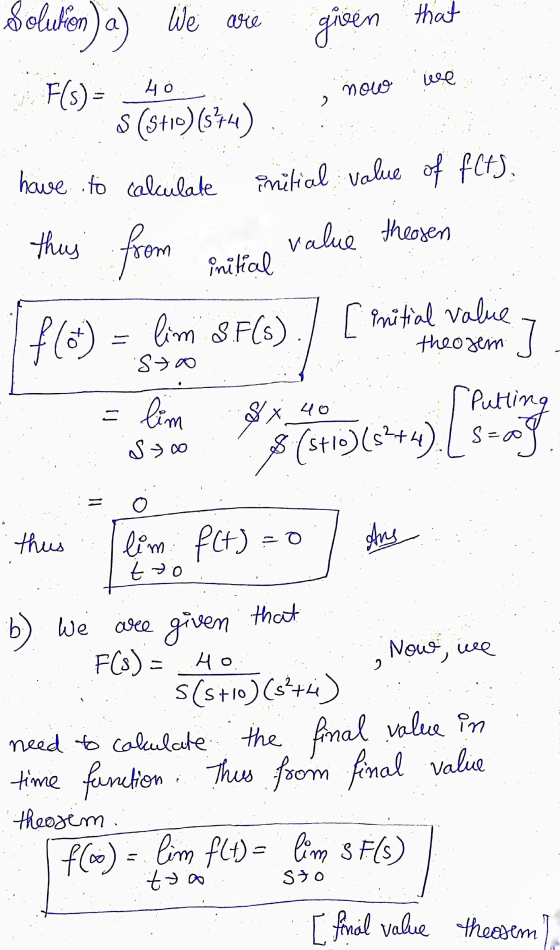
 summary
- thus all the required values were calculated out with correct
explanation of the used formula and explanation was provided.
summary
- thus all the required values were calculated out with correct
explanation of the used formula and explanation was provided.
Add Answer to:
. Problem 3 a) (2 points) What is the initial value of time function f(t) corresponding...
Problem 2 (3 points) Given the unilateral Laplace transform of the impulse response for a causal...
 Problem 2 (3 points) Given the unilateral Laplace transform of the impulse response for a causal system H(s) Determine h(t) the impulse response? Hint synthetic division! (s+10) 40 t-10 Problem 3 a) (2 points) What is the initial value of time function f(t) corresponding to the one sided Laplace Transform F(s) = (i.e. f(t) is causal) s(s+10)(2+4) lim f(t) = 0 40 lim f(t) = 1. t-0 10 x 4 lim f(t) = 0 t-0 lim f(t) cannot be computed...
Signal and Systems Problem 2 (3 points) Given the unilateral Laplace transform of the impulse response...
 Signal and Systems
Problem 2 (3 points) Given the unilateral Laplace transform of the impulse response for a causal system H(s) Determine h(t) the impulse response? Hint synthetic division! (s+10) 40 t-10 Problem 3 a) (2 points) What is the initial value of time function f(t) corresponding to the one sided Laplace Transform F(s) = (i.e. f(t) is causal) s(s+10)(2+4) lim f(t) = 0 40 lim f(t) = 1. t-0 10 x 4 lim f(t) = 0 t-0 lim f(t)...
Signal and Systems
Problem 2 (3 points) Given the unilateral Laplace transform of the impulse response for a causal system H(s) Determine h(t) the impulse response? Hint synthetic division! (s+10) 40 t-10 Problem 3 a) (2 points) What is the initial value of time function f(t) corresponding to the one sided Laplace Transform F(s) = (i.e. f(t) is causal) s(s+10)(2+4) lim f(t) = 0 40 lim f(t) = 1. t-0 10 x 4 lim f(t) = 0 t-0 lim f(t)...
Signal and Systems 8 + If Problem la (10 points) Find the inverse Laplace transform of:...
 Signal and Systems
8 + If Problem la (10 points) Find the inverse Laplace transform of: Fo(s) 12 the ROC is defined as: -12 <Re(s) <0 Identify terms as right sided or left sided. S+12 Re(s) < 0 Re(s) >-12 Х X -12 0 Problem 1b (2 points) Circle one: The function f(t) Is: causal anti-causal not causal Explain why:
Signal and Systems
8 + If Problem la (10 points) Find the inverse Laplace transform of: Fo(s) 12 the ROC is defined as: -12 <Re(s) <0 Identify terms as right sided or left sided. S+12 Re(s) < 0 Re(s) >-12 Х X -12 0 Problem 1b (2 points) Circle one: The function f(t) Is: causal anti-causal not causal Explain why:
8 + If Problem la (10 points) Find the inverse Laplace transform of: Fo(s) 12 the...
 8 + If Problem la (10 points) Find the inverse Laplace transform of: Fo(s) 12 the ROC is defined as: -12 <Re(s) <0 Identify terms as right sided or left sided. S+12 Re(s) < 0 Re(s) >-12 Х X -12 0 Problem 1b (2 points) Circle one: The function f(t) Is: causal anti-causal not causal Explain why:
12 Problem la (10 points) Find the inverse Laplace transform of: Fo(s) the ROC is defined...
 12 Problem la (10 points) Find the inverse Laplace transform of: Fo(s) the ROC is defined as: -12 < Re(s) <0 Identify terms as right sided or left sided. 8 +- If S S+12 Re(s)< 0 Re(s) >-12 X X -12 0 Problem lb (2 points) Circle one: The function f(t) Is: causal anti-causal not causal Explain why: Given the unilateral Laplace transform of the impulse response for a causal system H(S) = Determine h(t) the impulse response? Hint synthetic...
Laplace Transform Problem 3. (15 points) Given f(t) = 4e-2tu(t) + 29u(-t) a) Using the Laplace...
 Laplace Transform
Problem 3. (15 points) Given f(t) = 4e-2tu(t) + 29u(-t) a) Using the Laplace Transform table 9.2 find the bilinear Laplace transform, F($) and sketch the region of convergence (ROC) in the s-plane showing all poles. State the ROC as an inequality. b) Another function is added so that fa(t) = 4e-2tu(t) + 7u(-t) – 10e-10t u(-t). Find the Bilinear Laplace Transform of fa(t) and sketch the region of convergence in s-plane also showing all the poles. State...
Laplace Transform
Problem 3. (15 points) Given f(t) = 4e-2tu(t) + 29u(-t) a) Using the Laplace Transform table 9.2 find the bilinear Laplace transform, F($) and sketch the region of convergence (ROC) in the s-plane showing all poles. State the ROC as an inequality. b) Another function is added so that fa(t) = 4e-2tu(t) + 7u(-t) – 10e-10t u(-t). Find the Bilinear Laplace Transform of fa(t) and sketch the region of convergence in s-plane also showing all the poles. State...
A continuous-time LTI system has unit impulse response h(t). The Laplace transform of h(t), also called...
 A continuous-time LTI system has unit impulse response h(t). The
Laplace transform of h(t), also called the “transfer function” of
the LTI system, is
.
For each of the following cases, determine the region of
convergence (ROC) for H(s) and the corresponding h(t), and
determine whether the Fourier transform of h(t) exists.
(a) The LTI system is causal but not stable.
(b) The LTI system is stable but not causal.
(c) The LTI system is neither stable nor causal
8...
A continuous-time LTI system has unit impulse response h(t). The
Laplace transform of h(t), also called the “transfer function” of
the LTI system, is
.
For each of the following cases, determine the region of
convergence (ROC) for H(s) and the corresponding h(t), and
determine whether the Fourier transform of h(t) exists.
(a) The LTI system is causal but not stable.
(b) The LTI system is stable but not causal.
(c) The LTI system is neither stable nor causal
8...
Given a continuous periodic function f ( t ) with period 3 T, let F (...
 Given a continuous periodic function f ( t ) with period 3 T,
let F ( s ) be the Laplace transform of f ( t ). Identify the
correct expressions for A and B which make the formula for the
Laplace transform of f ( t ) correct:
F ( s ) = ∫ 0 A f ( t ) e − s t d t 1 − e B
Group of answer choices
Given a continuous periodic function...
Given a continuous periodic function f ( t ) with period 3 T,
let F ( s ) be the Laplace transform of f ( t ). Identify the
correct expressions for A and B which make the formula for the
Laplace transform of f ( t ) correct:
F ( s ) = ∫ 0 A f ( t ) e − s t d t 1 − e B
Group of answer choices
Given a continuous periodic function...
0.1.For the following Laplace transform, F(s) a) Determine the steady state solution fs using the Final value theorem. b) Find the corresponding time function f(t) using partial fractions. a Use b...
 0.1.For the following Laplace transform, F(s) a) Determine the steady state solution fs using the Final value theorem. b) Find the corresponding time function f(t) using partial fractions. a Use block diagram reduction to obtain the transfer function YIR of the following feedback system. Fuc R(s) Manifold Air b Ga(a) G1) Pressure Sparks pai FIQUREdle soed cortenal aetem
0.1.For the following Laplace transform, F(s) a) Determine the steady state solution fs using the Final value theorem. b) Find the corresponding...
0.1.For the following Laplace transform, F(s) a) Determine the steady state solution fs using the Final value theorem. b) Find the corresponding time function f(t) using partial fractions. a Use block diagram reduction to obtain the transfer function YIR of the following feedback system. Fuc R(s) Manifold Air b Ga(a) G1) Pressure Sparks pai FIQUREdle soed cortenal aetem
0.1.For the following Laplace transform, F(s) a) Determine the steady state solution fs using the Final value theorem. b) Find the corresponding...
please show steps 4. (25 points) Laplace and LCCDE Systems Consider an LTI system with input-output...
 please show steps
4. (25 points) Laplace and LCCDE Systems Consider an LTI system with input-output relation described by the LCCDE: -2y(t) - y0) + 3x(t) + deco (O) = (a) (5 pts) Find the transfer function H(s) and write it in factored form. (b) (5 pt) Sketch the ROC corresponding to H(s) if it is known the system is causal. Mark the poles and zeros. (c) (5 pts) Sketch the ROC corresponding to H(s) if it is known the...
please show steps
4. (25 points) Laplace and LCCDE Systems Consider an LTI system with input-output relation described by the LCCDE: -2y(t) - y0) + 3x(t) + deco (O) = (a) (5 pts) Find the transfer function H(s) and write it in factored form. (b) (5 pt) Sketch the ROC corresponding to H(s) if it is known the system is causal. Mark the poles and zeros. (c) (5 pts) Sketch the ROC corresponding to H(s) if it is known the...
 Problem 2 (3 points) Given the unilateral Laplace transform of the impulse response for a causal system H(s) Determine h(t) the impulse response? Hint synthetic division! (s+10) 40 t-10 Problem 3 a) (2 points) What is the initial value of time function f(t) corresponding to the one sided Laplace Transform F(s) = (i.e. f(t) is causal) s(s+10)(2+4) lim f(t) = 0 40 lim f(t) = 1. t-0 10 x 4 lim f(t) = 0 t-0 lim f(t) cannot be computed...
 Signal and Systems
Problem 2 (3 points) Given the unilateral Laplace transform of the impulse response for a causal system H(s) Determine h(t) the impulse response? Hint synthetic division! (s+10) 40 t-10 Problem 3 a) (2 points) What is the initial value of time function f(t) corresponding to the one sided Laplace Transform F(s) = (i.e. f(t) is causal) s(s+10)(2+4) lim f(t) = 0 40 lim f(t) = 1. t-0 10 x 4 lim f(t) = 0 t-0 lim f(t)...
Signal and Systems
Problem 2 (3 points) Given the unilateral Laplace transform of the impulse response for a causal system H(s) Determine h(t) the impulse response? Hint synthetic division! (s+10) 40 t-10 Problem 3 a) (2 points) What is the initial value of time function f(t) corresponding to the one sided Laplace Transform F(s) = (i.e. f(t) is causal) s(s+10)(2+4) lim f(t) = 0 40 lim f(t) = 1. t-0 10 x 4 lim f(t) = 0 t-0 lim f(t)...
 Signal and Systems
8 + If Problem la (10 points) Find the inverse Laplace transform of: Fo(s) 12 the ROC is defined as: -12 <Re(s) <0 Identify terms as right sided or left sided. S+12 Re(s) < 0 Re(s) >-12 Х X -12 0 Problem 1b (2 points) Circle one: The function f(t) Is: causal anti-causal not causal Explain why:
Signal and Systems
8 + If Problem la (10 points) Find the inverse Laplace transform of: Fo(s) 12 the ROC is defined as: -12 <Re(s) <0 Identify terms as right sided or left sided. S+12 Re(s) < 0 Re(s) >-12 Х X -12 0 Problem 1b (2 points) Circle one: The function f(t) Is: causal anti-causal not causal Explain why:
 8 + If Problem la (10 points) Find the inverse Laplace transform of: Fo(s) 12 the ROC is defined as: -12 <Re(s) <0 Identify terms as right sided or left sided. S+12 Re(s) < 0 Re(s) >-12 Х X -12 0 Problem 1b (2 points) Circle one: The function f(t) Is: causal anti-causal not causal Explain why:
 12 Problem la (10 points) Find the inverse Laplace transform of: Fo(s) the ROC is defined as: -12 < Re(s) <0 Identify terms as right sided or left sided. 8 +- If S S+12 Re(s)< 0 Re(s) >-12 X X -12 0 Problem lb (2 points) Circle one: The function f(t) Is: causal anti-causal not causal Explain why: Given the unilateral Laplace transform of the impulse response for a causal system H(S) = Determine h(t) the impulse response? Hint synthetic...
 Laplace Transform
Problem 3. (15 points) Given f(t) = 4e-2tu(t) + 29u(-t) a) Using the Laplace Transform table 9.2 find the bilinear Laplace transform, F($) and sketch the region of convergence (ROC) in the s-plane showing all poles. State the ROC as an inequality. b) Another function is added so that fa(t) = 4e-2tu(t) + 7u(-t) – 10e-10t u(-t). Find the Bilinear Laplace Transform of fa(t) and sketch the region of convergence in s-plane also showing all the poles. State...
Laplace Transform
Problem 3. (15 points) Given f(t) = 4e-2tu(t) + 29u(-t) a) Using the Laplace Transform table 9.2 find the bilinear Laplace transform, F($) and sketch the region of convergence (ROC) in the s-plane showing all poles. State the ROC as an inequality. b) Another function is added so that fa(t) = 4e-2tu(t) + 7u(-t) – 10e-10t u(-t). Find the Bilinear Laplace Transform of fa(t) and sketch the region of convergence in s-plane also showing all the poles. State...
 A continuous-time LTI system has unit impulse response h(t). The
Laplace transform of h(t), also called the “transfer function” of
the LTI system, is
.
For each of the following cases, determine the region of
convergence (ROC) for H(s) and the corresponding h(t), and
determine whether the Fourier transform of h(t) exists.
(a) The LTI system is causal but not stable.
(b) The LTI system is stable but not causal.
(c) The LTI system is neither stable nor causal
8...
A continuous-time LTI system has unit impulse response h(t). The
Laplace transform of h(t), also called the “transfer function” of
the LTI system, is
.
For each of the following cases, determine the region of
convergence (ROC) for H(s) and the corresponding h(t), and
determine whether the Fourier transform of h(t) exists.
(a) The LTI system is causal but not stable.
(b) The LTI system is stable but not causal.
(c) The LTI system is neither stable nor causal
8...
 Given a continuous periodic function f ( t ) with period 3 T,
let F ( s ) be the Laplace transform of f ( t ). Identify the
correct expressions for A and B which make the formula for the
Laplace transform of f ( t ) correct:
F ( s ) = ∫ 0 A f ( t ) e − s t d t 1 − e B
Group of answer choices
Given a continuous periodic function...
Given a continuous periodic function f ( t ) with period 3 T,
let F ( s ) be the Laplace transform of f ( t ). Identify the
correct expressions for A and B which make the formula for the
Laplace transform of f ( t ) correct:
F ( s ) = ∫ 0 A f ( t ) e − s t d t 1 − e B
Group of answer choices
Given a continuous periodic function...
 0.1.For the following Laplace transform, F(s) a) Determine the steady state solution fs using the Final value theorem. b) Find the corresponding time function f(t) using partial fractions. a Use block diagram reduction to obtain the transfer function YIR of the following feedback system. Fuc R(s) Manifold Air b Ga(a) G1) Pressure Sparks pai FIQUREdle soed cortenal aetem
0.1.For the following Laplace transform, F(s) a) Determine the steady state solution fs using the Final value theorem. b) Find the corresponding...
0.1.For the following Laplace transform, F(s) a) Determine the steady state solution fs using the Final value theorem. b) Find the corresponding time function f(t) using partial fractions. a Use block diagram reduction to obtain the transfer function YIR of the following feedback system. Fuc R(s) Manifold Air b Ga(a) G1) Pressure Sparks pai FIQUREdle soed cortenal aetem
0.1.For the following Laplace transform, F(s) a) Determine the steady state solution fs using the Final value theorem. b) Find the corresponding...
 please show steps
4. (25 points) Laplace and LCCDE Systems Consider an LTI system with input-output relation described by the LCCDE: -2y(t) - y0) + 3x(t) + deco (O) = (a) (5 pts) Find the transfer function H(s) and write it in factored form. (b) (5 pt) Sketch the ROC corresponding to H(s) if it is known the system is causal. Mark the poles and zeros. (c) (5 pts) Sketch the ROC corresponding to H(s) if it is known the...
please show steps
4. (25 points) Laplace and LCCDE Systems Consider an LTI system with input-output relation described by the LCCDE: -2y(t) - y0) + 3x(t) + deco (O) = (a) (5 pts) Find the transfer function H(s) and write it in factored form. (b) (5 pt) Sketch the ROC corresponding to H(s) if it is known the system is causal. Mark the poles and zeros. (c) (5 pts) Sketch the ROC corresponding to H(s) if it is known the...
Most questions answered within 3 hours.
-
Where is the error in this code sequence?
String s1 = "Hello";
String s2 = "ello";...
asked 11 months ago -
Financial data for Joel de Paris, Inc., for last year
follow:
Joel de Paris, Inc.
Balance...
asked 11 months ago -
Consider this reaction:
Al2(SO4)3 (aq)+ BaCl3
(aq) Al2Cl6 (aq)- +
3BaSO4(s) . What is the...
asked 11 months ago -
Suppose that Savneet is considering increasing her
recent random sample from 20 car rentals to 40...
asked 11 months ago -
Trucks arrive at an unloading terminal at an average rate of 120
per hour.
Trucks arrive...
asked 11 months ago -
Why are methanol and ethanol completely soluble in water while
octanol is not very little soluble....
asked 11 months ago -
A facilities manager at a university reads in a research report
that the mean amount of...
asked 11 months ago -
When the CuSO4 is rehydrated by adding water to the anhydrous
compound, is this an endothermic...
asked 11 months ago -
A ray of sunlight is passing from diamond into crown glass; the
angle of incidence is...
asked 11 months ago -
A block of mass 0.249 kg is placed on top of a light, vertical
spring of...
asked 11 months ago -
how do the kidneys compensate in the presences of acidosis
a) trigger hyperventilate
b) reserve acid...
asked 11 months ago -
Question 501 pts
The rental rate of capital to the firm increases. Which of the
following...
asked 11 months ago