
Homework Answers
Request Answer!
We need at least 10 more requests to produce the answer.
0 / 10 have requested this problem solution
The more requests, the faster the answer.
Add Answer to:
QUESTION 17 In which group does the reactivity decrease as you move down the column? 1A...
c. As you move down a family, the reactivity of nonmetals f. The most reactive nonmetal...
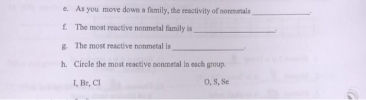 c. As you move down a family, the reactivity of nonmetals f. The most reactive nonmetal family is 8. The most reactive nonmetal is h. Circle the most reactive nonmetal in each group. I, Br, Cl O, S, Se
Symbol Electronegativity Group 1 Period Number Atomic Number Atomic Mass (amu) Atomic Radius (pm) lonization Energy...
 Symbol Electronegativity Group 1 Period Number Atomic Number Atomic Mass (amu) Atomic Radius (pm) lonization Energy (kJ/mol Valence Electrons AW Electronegativity Period 2 Group Number 1 (1A) Symbol Atomic Number Atomic Mass amu Atomic Radius (pm) lonization Energy (kJ/mol) Valence Electrons Be 2 (2A) 13 (3A) 14 (4A) 15 (5A) 16 (6A) 17 (7A) 18 (8A) o Zoo Periodic Table Trends Activity (Protected View) - Word (Unlicensed Product) Review View Help Tell me what you want to do ruses. Unless...
Question 3 2 pts lonization energy as you move down a column (top to bottom) and...
 Question 3 2 pts lonization energy as you move down a column (top to bottom) and move across a period (left to right). _ as you increases; increases decreases; decreases increases; decreases decreases; increases
The ionization energy of Group 2 elements decrease and the radii decrease down the group. Therefore a. The metals a...
 The ionization energy of Group 2 elements decrease and the radii decrease down the group. Therefore a. The metals are less easily oxidized down the group b. The metals are more easily oxidized down the group c. Redox properties do not change systematically down the group Which Group 2 element DOES NOT form ionic hydrides? a. Ca b. Sr e. Be What is the pH of a saturated solution of Ca(OH)? The solubility of Ca(OH) is 2.1x10⁻³M a. 11.02 b....
can someone help me to answer those questions N Ctrl Extension Questions Model 3 - Ionization...
 can someone help me to answer those questions
N Ctrl Extension Questions Model 3 - Ionization Energies 2400 2200 .. 1st lonization Energy (kJ/mol) .. Period 1 .- Period 2 - Period 3 Period 4 - 400 Part 1 Elect 1A 2A 7A 8A 3A4A SA 6A Column of Periodic Table 17. Refer to the graph in Model 3. a. What property of atoms does the graph illustrate? b. There are four lines on the graph. What do the lines...
can someone help me to answer those questions
N Ctrl Extension Questions Model 3 - Ionization Energies 2400 2200 .. 1st lonization Energy (kJ/mol) .. Period 1 .- Period 2 - Period 3 Period 4 - 400 Part 1 Elect 1A 2A 7A 8A 3A4A SA 6A Column of Periodic Table 17. Refer to the graph in Model 3. a. What property of atoms does the graph illustrate? b. There are four lines on the graph. What do the lines...
Question 17 (1 point) Through which of the following processes does an innovation stream move from...
 Question 17 (1 point) Through which of the following processes does an innovation stream move from one technology cycle to another? a) technological substitution b) technological variation O c) technological continuity o d) technological selection Question 18 (1 point) Saved Which of the following countries has the largest foreign direct investment in Canada? a) China Ob) Scotland Oc) Mexico d) United Kingdom
13) Which statement is true about effective nuclear charge? A) effective nuclear charge increases as you...
 13) Which statement is true about effective nuclear charge? A) effective nuclear charge increases as you move to the right across a row in the periodic table and increases as you move down a column. B) effective nuclear charge increases as you move to the right across a row in the periodic table and decreases as you move down a column. c) effective nuclear charge decreases as you move to the right across a row in the periodic table and...
QUESTION 17 The product of the reaction below will have an SCH3 group in which position?...
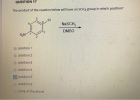 QUESTION 17 The product of the reaction below will have an SCH3 group in which position? NaSCH DMSO ON 1 position 1 position 2 position 3 position 4 position 5 position 6 none of the above
15. How does the price elasticity of demand change as you move down along a straight line demand ...
 15. How does the price elasticity of demand change as you move down along a straight line demand curve? a. it becomes larger in magnitude. b. it becomes smaller in magnitude. c. it doesn't change in magnitude. d. vou can't tell without more information. 16. Quasi-concavity of utility functions insures that with only two goods, these goods must be a. gross substitutes. b. gross complements. c. net substitutes d. net complements. 17. If goods x and y are substitutes, then...
1a. You are driving down the street at a constant speed of 60mph. Draw a graph...
1a. You are driving down the street at a constant speed of 60mph. Draw a graph of distance versus time over the course of 4 hours. b. How would you use the graph to determine the rate (speed in mph) at which the car is traveling (assuming you did not already know the answer)? Hint: What is the slope for the graph in part A? What does the term slope mean? c. Now draw a new graph (still distance vs....
 c. As you move down a family, the reactivity of nonmetals f. The most reactive nonmetal family is 8. The most reactive nonmetal is h. Circle the most reactive nonmetal in each group. I, Br, Cl O, S, Se
 Symbol Electronegativity Group 1 Period Number Atomic Number Atomic Mass (amu) Atomic Radius (pm) lonization Energy (kJ/mol Valence Electrons AW Electronegativity Period 2 Group Number 1 (1A) Symbol Atomic Number Atomic Mass amu Atomic Radius (pm) lonization Energy (kJ/mol) Valence Electrons Be 2 (2A) 13 (3A) 14 (4A) 15 (5A) 16 (6A) 17 (7A) 18 (8A) o Zoo Periodic Table Trends Activity (Protected View) - Word (Unlicensed Product) Review View Help Tell me what you want to do ruses. Unless...
 Question 3 2 pts lonization energy as you move down a column (top to bottom) and move across a period (left to right). _ as you increases; increases decreases; decreases increases; decreases decreases; increases
 The ionization energy of Group 2 elements decrease and the radii decrease down the group. Therefore a. The metals are less easily oxidized down the group b. The metals are more easily oxidized down the group c. Redox properties do not change systematically down the group Which Group 2 element DOES NOT form ionic hydrides? a. Ca b. Sr e. Be What is the pH of a saturated solution of Ca(OH)? The solubility of Ca(OH) is 2.1x10⁻³M a. 11.02 b....
 can someone help me to answer those questions
N Ctrl Extension Questions Model 3 - Ionization Energies 2400 2200 .. 1st lonization Energy (kJ/mol) .. Period 1 .- Period 2 - Period 3 Period 4 - 400 Part 1 Elect 1A 2A 7A 8A 3A4A SA 6A Column of Periodic Table 17. Refer to the graph in Model 3. a. What property of atoms does the graph illustrate? b. There are four lines on the graph. What do the lines...
can someone help me to answer those questions
N Ctrl Extension Questions Model 3 - Ionization Energies 2400 2200 .. 1st lonization Energy (kJ/mol) .. Period 1 .- Period 2 - Period 3 Period 4 - 400 Part 1 Elect 1A 2A 7A 8A 3A4A SA 6A Column of Periodic Table 17. Refer to the graph in Model 3. a. What property of atoms does the graph illustrate? b. There are four lines on the graph. What do the lines...
 Question 17 (1 point) Through which of the following processes does an innovation stream move from one technology cycle to another? a) technological substitution b) technological variation O c) technological continuity o d) technological selection Question 18 (1 point) Saved Which of the following countries has the largest foreign direct investment in Canada? a) China Ob) Scotland Oc) Mexico d) United Kingdom
 13) Which statement is true about effective nuclear charge? A) effective nuclear charge increases as you move to the right across a row in the periodic table and increases as you move down a column. B) effective nuclear charge increases as you move to the right across a row in the periodic table and decreases as you move down a column. c) effective nuclear charge decreases as you move to the right across a row in the periodic table and...
 QUESTION 17 The product of the reaction below will have an SCH3 group in which position? NaSCH DMSO ON 1 position 1 position 2 position 3 position 4 position 5 position 6 none of the above
 15. How does the price elasticity of demand change as you move down along a straight line demand curve? a. it becomes larger in magnitude. b. it becomes smaller in magnitude. c. it doesn't change in magnitude. d. vou can't tell without more information. 16. Quasi-concavity of utility functions insures that with only two goods, these goods must be a. gross substitutes. b. gross complements. c. net substitutes d. net complements. 17. If goods x and y are substitutes, then...
Most questions answered within 3 hours.
-
Where is the error in this code sequence?
String s1 = "Hello";
String s2 = "ello";...
asked 10 months ago -
Financial data for Joel de Paris, Inc., for last year
follow:
Joel de Paris, Inc.
Balance...
asked 10 months ago -
Consider this reaction:
Al2(SO4)3 (aq)+ BaCl3
(aq) Al2Cl6 (aq)- +
3BaSO4(s) . What is the...
asked 10 months ago -
Suppose that Savneet is considering increasing her
recent random sample from 20 car rentals to 40...
asked 10 months ago -
Trucks arrive at an unloading terminal at an average rate of 120
per hour.
Trucks arrive...
asked 10 months ago -
Why are methanol and ethanol completely soluble in water while
octanol is not very little soluble....
asked 10 months ago -
A facilities manager at a university reads in a research report
that the mean amount of...
asked 10 months ago -
When the CuSO4 is rehydrated by adding water to the anhydrous
compound, is this an endothermic...
asked 10 months ago -
A ray of sunlight is passing from diamond into crown glass; the
angle of incidence is...
asked 10 months ago -
A block of mass 0.249 kg is placed on top of a light, vertical
spring of...
asked 10 months ago -
how do the kidneys compensate in the presences of acidosis
a) trigger hyperventilate
b) reserve acid...
asked 10 months ago -
Question 501 pts
The rental rate of capital to the firm increases. Which of the
following...
asked 10 months ago