


Homework Answers
Add Answer to:
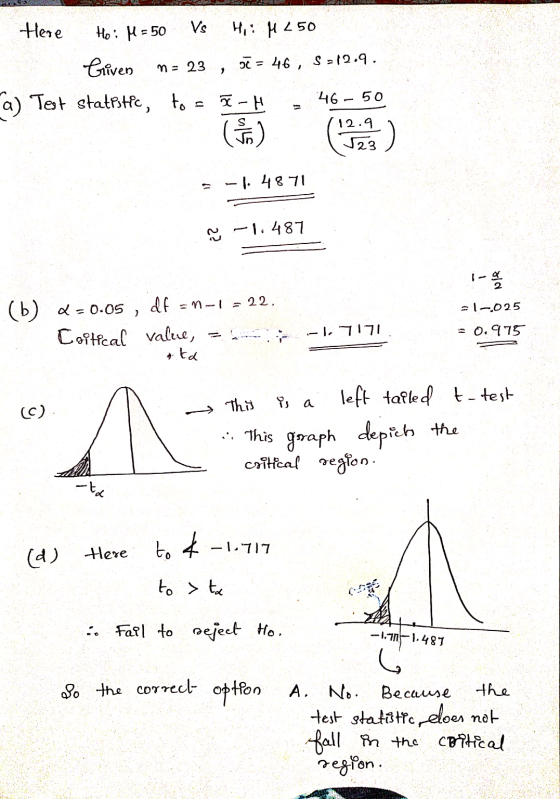
a through d please
To test Ho = 50 versus Hy < 50, a random sample...
Question Help To test Ho: -50 versus H: <50, a random sample of size n=25 is...
 Question Help To test Ho: -50 versus H: <50, a random sample of size n=25 is obtained from a population that is known to be normally distributed. Complete parts (a) through (d) below. Click here to view the t-Distribution Area in Right Tai (a) If x= 46.6 and s-13.8, compute the test statistic. to=(Round to three decimal places as needed.) (b) If the researcher decides to test this hypothesis at the c 0.05 level of significance, determine the critical value(s)....
To test Ho: u 60 versus Hy: H <60, a random sample of size n 24...
 To test Ho: u 60 versus Hy: H <60, a random sample of size n 24 is obtained from a population that is known to be normally distributed. Complete parts (a) through (d) below. 囲Click here to view the t-Distribution Area in Right Tail. (a) If x 56.4 and s 12.4, compute the test statistic h" □ (Round to three decimal places as needed.)
To test Ho : ?= 20 versus H1 : ?< 20, a simple random sample of...
 To test Ho : ?= 20 versus H1 : ?< 20, a simple random sample of size n = 17 is obtained from a population that is known to be normally distributed Answer parts (a)-(d) E Click here to view the t-Distribution Area in Right Tail (a) If x 18.3 and s 3.8, compute the test statistic. t-(Round to two decimal places as needed.)
To test Ho: u= 20 versus Hy: u<20, a simple random sample of size n= 19...
 To test Ho: u= 20 versus Hy: u<20, a simple random sample of size n= 19 is obtained from a population that is known to be normally distributed. Answer parts (a)-(d). Click here to view the t-Distribution Area in Right Tail. (a) If x = 18.1 and s= 3.9, compute the test statistic. (Round to two decimal places as needed.) t = (b) Draw a t-distribution with the area that represents the P-value shaded. Which of the following graphs shows...
To test Ho: p= 100 versus Hy: p + 100, a simple random sample size of...
 To test Ho: p= 100 versus Hy: p + 100, a simple random sample size of n = 19 is obtained from a population that is known to be normally distributed. Answer parts (a)-(d). Click here to view the t-Distribution Area in Right Tail. (a) If x = 105.4 and s = 9.7, compute the test statistic. t= (Round to three decimal places as needed.) (b) If the researcher decides to test this hypothesis at the a= 0.01 level of...
To test Ho: p= 100 versus Hy: p* 100, a simple random sample size of n...
 To test Ho: p= 100 versus Hy: p* 100, a simple random sample size of n = 20 is obtained from a population that is known to be normally distributed. Answer parts (a)-(d). Click here to view the t-Distribution Area in Right Tail. (a) If x = 105.4 and s= 9.1, compute the test statistic. (Round to three decimal places as needed.) ta (b) If the researcher decides to test this hypothesis at the a=0.01 level of significance, determine the...
3. (25 points) To test Ho: σ 0.35 versus H1: σ < 0.35, a random sample...
 3. (25 points) To test Ho: σ 0.35 versus H1: σ < 0.35, a random sample of size n = 41 is obtained from a population that is known to be normally distributed a. If the sample standard deviation is determined to be s 0.23, compute the test statistic. (5 pts) b. If the researcher decides to test this hypothesis at the a 0.01 level of significance , determine the critical value. (5 pts) c. Draw a chi-square distribution and...
To test Ho: u = 20 versus Hy: u<20, a simple random sample of size n= 16 is obtained from a population that is known...
 To test Ho: u = 20 versus Hy: u<20, a simple random sample of size n= 16 is obtained from a population that is known to be normally distributed. Answer parts (a)-(d). Click here to view the t-Distribution Area in Right Tail. (a) If x = 18.1 and s = 4.1, compute the test statistic. t (Round to two decimal places as needed.) (b) Draw a t-distribution with the area that represents the P-value shaded. Which of the following graphs...
To test Ho μ-100 versus H1 : μ#100, a simple random sample size ofna 23 is...
 To test Ho μ-100 versus H1 : μ#100, a simple random sample size ofna 23 is obtained from a population that is known to be normally distributed. Answer parts EB Click here to view the t-Distribution Area in Right Tail. (a) If x 105.4 and s 9.3, compute the test statistic (Round to three decimal places as needed.)
Question To test H:160 versus H, H<60, a random sample of size n=24 is obtained from...
 Question To test H:160 versus H, H<60, a random sample of size n=24 is obtained from a population that is known to be normally distributed. Complete parts (a) through (d) below. Click here to view the t-Distribution Area in Right Tal. (m) 1 x - 57.1 and 12.6, compute the text statistic. 1-Round to three decimal places as needed.) (b) If the researcher decides to test this hypothesis at the a= 0.1 level of significanos, determine the critical value(s). Although...
 Question Help To test Ho: -50 versus H: <50, a random sample of size n=25 is obtained from a population that is known to be normally distributed. Complete parts (a) through (d) below. Click here to view the t-Distribution Area in Right Tai (a) If x= 46.6 and s-13.8, compute the test statistic. to=(Round to three decimal places as needed.) (b) If the researcher decides to test this hypothesis at the c 0.05 level of significance, determine the critical value(s)....
 To test Ho: u 60 versus Hy: H <60, a random sample of size n 24 is obtained from a population that is known to be normally distributed. Complete parts (a) through (d) below. 囲Click here to view the t-Distribution Area in Right Tail. (a) If x 56.4 and s 12.4, compute the test statistic h" □ (Round to three decimal places as needed.)
 To test Ho : ?= 20 versus H1 : ?< 20, a simple random sample of size n = 17 is obtained from a population that is known to be normally distributed Answer parts (a)-(d) E Click here to view the t-Distribution Area in Right Tail (a) If x 18.3 and s 3.8, compute the test statistic. t-(Round to two decimal places as needed.)
 To test Ho: u= 20 versus Hy: u<20, a simple random sample of size n= 19 is obtained from a population that is known to be normally distributed. Answer parts (a)-(d). Click here to view the t-Distribution Area in Right Tail. (a) If x = 18.1 and s= 3.9, compute the test statistic. (Round to two decimal places as needed.) t = (b) Draw a t-distribution with the area that represents the P-value shaded. Which of the following graphs shows...
 To test Ho: p= 100 versus Hy: p + 100, a simple random sample size of n = 19 is obtained from a population that is known to be normally distributed. Answer parts (a)-(d). Click here to view the t-Distribution Area in Right Tail. (a) If x = 105.4 and s = 9.7, compute the test statistic. t= (Round to three decimal places as needed.) (b) If the researcher decides to test this hypothesis at the a= 0.01 level of...
 To test Ho: p= 100 versus Hy: p* 100, a simple random sample size of n = 20 is obtained from a population that is known to be normally distributed. Answer parts (a)-(d). Click here to view the t-Distribution Area in Right Tail. (a) If x = 105.4 and s= 9.1, compute the test statistic. (Round to three decimal places as needed.) ta (b) If the researcher decides to test this hypothesis at the a=0.01 level of significance, determine the...
 3. (25 points) To test Ho: σ 0.35 versus H1: σ < 0.35, a random sample of size n = 41 is obtained from a population that is known to be normally distributed a. If the sample standard deviation is determined to be s 0.23, compute the test statistic. (5 pts) b. If the researcher decides to test this hypothesis at the a 0.01 level of significance , determine the critical value. (5 pts) c. Draw a chi-square distribution and...
 To test Ho: u = 20 versus Hy: u<20, a simple random sample of size n= 16 is obtained from a population that is known to be normally distributed. Answer parts (a)-(d). Click here to view the t-Distribution Area in Right Tail. (a) If x = 18.1 and s = 4.1, compute the test statistic. t (Round to two decimal places as needed.) (b) Draw a t-distribution with the area that represents the P-value shaded. Which of the following graphs...
 To test Ho μ-100 versus H1 : μ#100, a simple random sample size ofna 23 is obtained from a population that is known to be normally distributed. Answer parts EB Click here to view the t-Distribution Area in Right Tail. (a) If x 105.4 and s 9.3, compute the test statistic (Round to three decimal places as needed.)
 Question To test H:160 versus H, H<60, a random sample of size n=24 is obtained from a population that is known to be normally distributed. Complete parts (a) through (d) below. Click here to view the t-Distribution Area in Right Tal. (m) 1 x - 57.1 and 12.6, compute the text statistic. 1-Round to three decimal places as needed.) (b) If the researcher decides to test this hypothesis at the a= 0.1 level of significanos, determine the critical value(s). Although...
Most questions answered within 3 hours.
-
Where is the error in this code sequence?
String s1 = "Hello";
String s2 = "ello";...
asked 10 months ago -
Financial data for Joel de Paris, Inc., for last year
follow:
Joel de Paris, Inc.
Balance...
asked 10 months ago -
Consider this reaction:
Al2(SO4)3 (aq)+ BaCl3
(aq) Al2Cl6 (aq)- +
3BaSO4(s) . What is the...
asked 10 months ago -
Suppose that Savneet is considering increasing her
recent random sample from 20 car rentals to 40...
asked 10 months ago -
Trucks arrive at an unloading terminal at an average rate of 120
per hour.
Trucks arrive...
asked 10 months ago -
Why are methanol and ethanol completely soluble in water while
octanol is not very little soluble....
asked 10 months ago -
A facilities manager at a university reads in a research report
that the mean amount of...
asked 10 months ago -
When the CuSO4 is rehydrated by adding water to the anhydrous
compound, is this an endothermic...
asked 10 months ago -
A ray of sunlight is passing from diamond into crown glass; the
angle of incidence is...
asked 10 months ago -
A block of mass 0.249 kg is placed on top of a light, vertical
spring of...
asked 10 months ago -
how do the kidneys compensate in the presences of acidosis
a) trigger hyperventilate
b) reserve acid...
asked 10 months ago -
Question 501 pts
The rental rate of capital to the firm increases. Which of the
following...
asked 10 months ago