
Homework Answers
a. Probability that he or she drives less than 10000 miles per year or has an accident = Probability that he or she drives less than 10000 miles per year + Probability that he or she has an accident - Probability that he or she drives less than 10000 miles per year and has an accident = 0.20+0.40-0.05=0.55
b. Probability that he or she drives more than 10000 miles per year and has no accident = Probability that he or she has no accident - Probability that he or she drives less than 10000 miles per year and has no accident = 0.60-0.15=0.45
Add Answer to:
if
a driver is selected at random what is the probability that
Insurance. By examining the...
if a driver in this city is selected at random what is the probability that finite...
 if
a driver in this city is selected at random what is the probability
that
finite
Insurance. By examining the past driving records of drivers in a certain city, an insurance company has determined the following (empirical) probabilities: Less than 10,000, M .05 .15 .20 Miles Driven per Year 10,000 - 15,000 inclusive, M2 .10 20 .30 More than 15,000, My 25 .25 .50 Totals .40 .60 1.0 Accident No Accident Totals If a driver in this city is selected...
if
a driver in this city is selected at random what is the probability
that
finite
Insurance. By examining the past driving records of drivers in a certain city, an insurance company has determined the following (empirical) probabilities: Less than 10,000, M .05 .15 .20 Miles Driven per Year 10,000 - 15,000 inclusive, M2 .10 20 .30 More than 15,000, My 25 .25 .50 Totals .40 .60 1.0 Accident No Accident Totals If a driver in this city is selected...
Insurance. By examining the past driving records of drivers in a certain city, an insurance company...
 Insurance. By examining the past driving records of drivers in a certain city, an insurance company has determined the following (empirical) probabilities: Less than 10,000, M .05 .10 .15 Miles Driven per Year 10,000 - 15,000 inclusive, M, .15 .10 25 More than 15,000, м. .30 .30 .60 Accident No Accident Totals Totals .50 .50 1.0 If a driver in this city is selected at random, what is the probability that a. He or she drives less than 10,000 miles...
Insurance. By examining the past driving records of drivers in a certain city, an insurance company...
 Insurance. By examining the past driving records of drivers in a certain city, an insurance company has determined the following (empirical) probabilities: Less than 10,000, M .05 .15 20 Miles Driven per Year 10,000 - 15,000 inclusive, M2 .10 More than 15,000, м. .30 .30 .60 Totals .10 .45 .55 1.0 20 Accident No Accident Totals a driver in this city is selected at random, what is the probability that a. He or she drives less than 10,000 miles per...
15. Insurance. By examining the past driving records of drivers in a certain city, an insurance...
 15. Insurance. By examining the past driving records of drivers in a certain city, an insurance company has determined the following (empirical) probabilities: Miles Driven per Year 10,000- 15,000 10,000, inclusive, 15,000, M2 .15 .25 40 Less than More than Accident No Accident Totals M1 .10 .10 20 M3 .15 .25 40 Totals 40 60 1.0 If a driver in this city is selected at random, what is the probability that a. He or she drives less than 10,000 miles...
By examining the past driving records of drivers in a certain city, an insurance company has...
 By examining the past driving records of drivers in a certain city, an insurance company has determined the (empirical) probabilities in the table to the right. Use the empirical) probabilities to complete parts (A) and (8) below. Totals Miles Driven per Year Less 10,000 - More Than 15,000 Than 10,000, Inclusive, 15,000, M M2 м. 0.10 0.15 0.20 0.10 0.20 0.25 0.20 0.35 0.45 Accident A No Accident A' Totals 0.45 0.55 1.0 (A) Find the probability that a city...
Suppose an automobile insurance company classifies a driver as good, average, or bad. Of all their...
Suppose an automobile insurance company classifies a driver as good, average, or bad. Of all their insured drivers, 3.21% are classified good, 51.40% are average, and the rest are classified as bad. Suppose for the coming year, a good driver has a 6.00% chance of having an accident, and average driver has 18.56% chance of having an accident, and a bad driver has a 38.15% chance. If a driver had an accident in the past year, what is the probability...
Help with probability HW, please! For each of the following situations, calculate the probability of the...
Help with probability HW, please! For each of the following situations, calculate the probability of the specified event using the appropriate approach (relative frequency, classical, subjective). In addition, explain why the approach you used was the best fit for the situation. 1. Sam drives to work during rush hour traffic every day (Monday - Friday). During the past 30 days, Sam has been late for work five times, due to the traffic. What is the probability that Sam was late...
Consider the following events for a driver selected at random from a general population. A = driver is under 25 year...
Consider the following events for a driver selected at random from a general population. A = driver is under 25 years old (1) B = driver has recieved a speeding ticket (2) Translate each of the following phrases into symbols. (a) The probability the driver is under 25 years old and has recieved a speeding ticket. (b) The probability a driver who is under 25 years old has recieved a speeding ticket. (c) The probability a driver who has recieved a speeding...
I need help with this question. lifetime, an average U.S. driver takes 55,000 trips. probability of a fatal aocident over a iletime? (Hint: Assume independence.) (Round your answer to 4 decimal places...
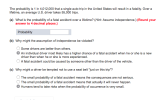 I need help with this question.
lifetime, an average U.S. driver takes 55,000 trips. probability of a fatal aocident over a iletime? (Hint: Assume independence.) (Round your answer to 4 decimal places.) Probability (b) Why might the assumption of independence be violated? Some drivers are better than others. An individual driver most likely has a higher chance of a fatal accident when he or she is a new driver than when he or she is more experienced. A fatal accident...
I need help with this question.
lifetime, an average U.S. driver takes 55,000 trips. probability of a fatal aocident over a iletime? (Hint: Assume independence.) (Round your answer to 4 decimal places.) Probability (b) Why might the assumption of independence be violated? Some drivers are better than others. An individual driver most likely has a higher chance of a fatal accident when he or she is a new driver than when he or she is more experienced. A fatal accident...
An insurance company selected samples of clients under 18 years of age and over 18 and...
 An insurance company selected samples of clients under 18 years of age and over 18 and recorded the number of accidents they had in the previous year. The results are shown below. Under Age of 18 ni = 500 Number of accidents = 180 Over Age of 18 n2 = 600 Number of accidents = 150 We are interested in determining if the accident proportions differ between the two age groups. Refer to Exhibit 11-7. The p-value is a. 0.3...
 if
a driver in this city is selected at random what is the probability
that
finite
Insurance. By examining the past driving records of drivers in a certain city, an insurance company has determined the following (empirical) probabilities: Less than 10,000, M .05 .15 .20 Miles Driven per Year 10,000 - 15,000 inclusive, M2 .10 20 .30 More than 15,000, My 25 .25 .50 Totals .40 .60 1.0 Accident No Accident Totals If a driver in this city is selected...
if
a driver in this city is selected at random what is the probability
that
finite
Insurance. By examining the past driving records of drivers in a certain city, an insurance company has determined the following (empirical) probabilities: Less than 10,000, M .05 .15 .20 Miles Driven per Year 10,000 - 15,000 inclusive, M2 .10 20 .30 More than 15,000, My 25 .25 .50 Totals .40 .60 1.0 Accident No Accident Totals If a driver in this city is selected...
 Insurance. By examining the past driving records of drivers in a certain city, an insurance company has determined the following (empirical) probabilities: Less than 10,000, M .05 .10 .15 Miles Driven per Year 10,000 - 15,000 inclusive, M, .15 .10 25 More than 15,000, м. .30 .30 .60 Accident No Accident Totals Totals .50 .50 1.0 If a driver in this city is selected at random, what is the probability that a. He or she drives less than 10,000 miles...
 Insurance. By examining the past driving records of drivers in a certain city, an insurance company has determined the following (empirical) probabilities: Less than 10,000, M .05 .15 20 Miles Driven per Year 10,000 - 15,000 inclusive, M2 .10 More than 15,000, м. .30 .30 .60 Totals .10 .45 .55 1.0 20 Accident No Accident Totals a driver in this city is selected at random, what is the probability that a. He or she drives less than 10,000 miles per...
 15. Insurance. By examining the past driving records of drivers in a certain city, an insurance company has determined the following (empirical) probabilities: Miles Driven per Year 10,000- 15,000 10,000, inclusive, 15,000, M2 .15 .25 40 Less than More than Accident No Accident Totals M1 .10 .10 20 M3 .15 .25 40 Totals 40 60 1.0 If a driver in this city is selected at random, what is the probability that a. He or she drives less than 10,000 miles...
 By examining the past driving records of drivers in a certain city, an insurance company has determined the (empirical) probabilities in the table to the right. Use the empirical) probabilities to complete parts (A) and (8) below. Totals Miles Driven per Year Less 10,000 - More Than 15,000 Than 10,000, Inclusive, 15,000, M M2 м. 0.10 0.15 0.20 0.10 0.20 0.25 0.20 0.35 0.45 Accident A No Accident A' Totals 0.45 0.55 1.0 (A) Find the probability that a city...
 I need help with this question.
lifetime, an average U.S. driver takes 55,000 trips. probability of a fatal aocident over a iletime? (Hint: Assume independence.) (Round your answer to 4 decimal places.) Probability (b) Why might the assumption of independence be violated? Some drivers are better than others. An individual driver most likely has a higher chance of a fatal accident when he or she is a new driver than when he or she is more experienced. A fatal accident...
I need help with this question.
lifetime, an average U.S. driver takes 55,000 trips. probability of a fatal aocident over a iletime? (Hint: Assume independence.) (Round your answer to 4 decimal places.) Probability (b) Why might the assumption of independence be violated? Some drivers are better than others. An individual driver most likely has a higher chance of a fatal accident when he or she is a new driver than when he or she is more experienced. A fatal accident...
 An insurance company selected samples of clients under 18 years of age and over 18 and recorded the number of accidents they had in the previous year. The results are shown below. Under Age of 18 ni = 500 Number of accidents = 180 Over Age of 18 n2 = 600 Number of accidents = 150 We are interested in determining if the accident proportions differ between the two age groups. Refer to Exhibit 11-7. The p-value is a. 0.3...
Most questions answered within 3 hours.
-
Where is the error in this code sequence?
String s1 = "Hello";
String s2 = "ello";...
asked 10 months ago -
Financial data for Joel de Paris, Inc., for last year
follow:
Joel de Paris, Inc.
Balance...
asked 10 months ago -
Consider this reaction:
Al2(SO4)3 (aq)+ BaCl3
(aq) Al2Cl6 (aq)- +
3BaSO4(s) . What is the...
asked 10 months ago -
Suppose that Savneet is considering increasing her
recent random sample from 20 car rentals to 40...
asked 10 months ago -
Trucks arrive at an unloading terminal at an average rate of 120
per hour.
Trucks arrive...
asked 10 months ago -
Why are methanol and ethanol completely soluble in water while
octanol is not very little soluble....
asked 10 months ago -
A facilities manager at a university reads in a research report
that the mean amount of...
asked 10 months ago -
When the CuSO4 is rehydrated by adding water to the anhydrous
compound, is this an endothermic...
asked 10 months ago -
A ray of sunlight is passing from diamond into crown glass; the
angle of incidence is...
asked 10 months ago -
A block of mass 0.249 kg is placed on top of a light, vertical
spring of...
asked 10 months ago -
how do the kidneys compensate in the presences of acidosis
a) trigger hyperventilate
b) reserve acid...
asked 10 months ago -
Question 501 pts
The rental rate of capital to the firm increases. Which of the
following...
asked 10 months ago