
Homework Answers
// C++ Code:-
#include<bits/stdc++.h>
using namespace std;
void PrintDailySales(double sales[100][10])
{
for(int i=0;i<100;i++)
{
double sum=0.0;
for(int j=0;j<10;j++)
sum+=sales[i][j];
double avg=sum/10.0;
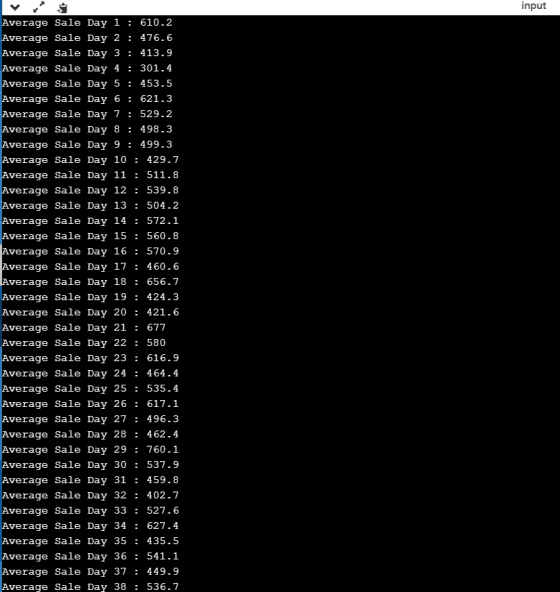
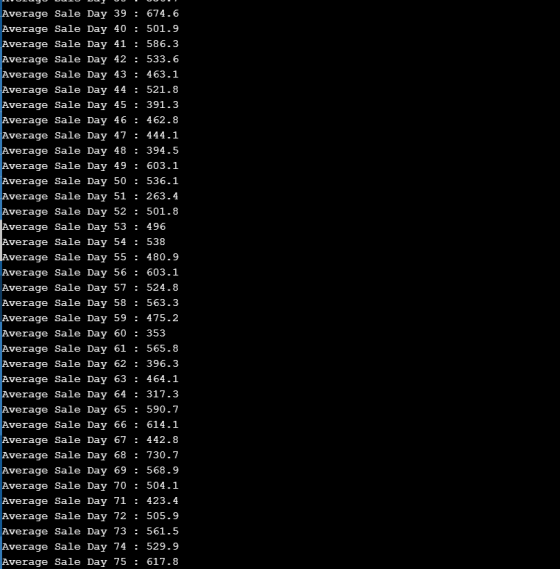
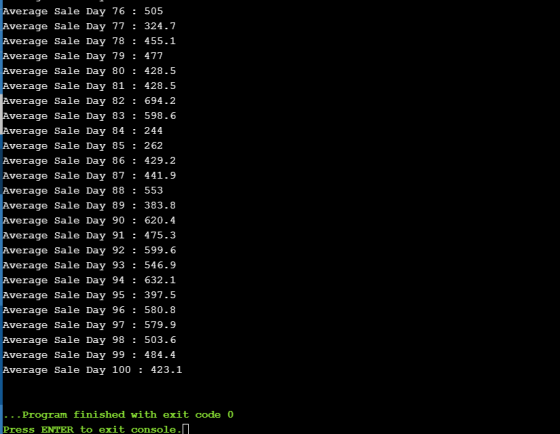
cout<<"Average Sale Day "<<i+1<<" :
"<<avg<<endl;
}
}
int main()
{
// The array represents 10 sales for 100 days.
double sales[100][10];
// Filling the array with random doubles between 6.5 to
1005.5
// you can create the number in any range. I used this for
simplicity.
for(int i=0;i<100;i++)
{
for(int j=0;j<10;j++)
sales[i][j]=rand()%1000+6.5;
}
// Calling function to print the average sale per day.
PrintDailySales(sales);
return 0;
}
![5 6 8 } main.cpp 1 #include<bits/stdc++.h> 2 using namespace std; void PrintDailysales(double sales[100][10]) 4-{ for(int i=0](http://img.homeworklib.com/questions/8eb147d0-e59f-11ea-ba7b-9f5823426635.png?x-oss-process=image/resize,w_560)
Add Answer to:
Code the following in C++ #include <iostream> int main() { the array below represents 10 sales...
Convert the below code into if else selection: #include <iostream> using namespace std; int main() {...
 Convert the below code into if else selection: #include <iostream> using namespace std; int main() { int num; sin. >> num; switch (num) { case 1: cout << "Casel: Value is: << num << endl; break; case 2: break; case 3: cout << "Case3: Value is: " << num << endl; break; default: cout << "Default: Value is: << num << endl; break; } return; }
1. What is wrong with the following C++ program? #include <iostream> int main() { a =...
 1. What is wrong with the following C++ program? #include <iostream> int main() { a = 4; b = 6; cout << a << "+" << b << "=" << a+b; return 0; 2. What is wrong with the following C++ program? What was its intended output? #include <iostream> using namespace std; int main() { cout << "What is larger? e pi or pi e?" << endl; double ans1 = exp(pi); double ans2 = pi exp(1.); cout << "epi is...
Need a FLOW Chart for that code. #include <iostream > using namespace std; int PowerFive(int); //Function...
 Need a FLOW Chart for that code.
#include <iostream > using namespace std; int PowerFive(int); //Function prototype declaration int main() for (int i=-10 ; i(z10; 1++) {//for each # cout<<"("<< ǐ<<") ^5. "<<PowerFive(1)くくendl;// calling the defined Function int PowerFive (int a) //Function definition return a*a*a*a*a;
Need a FLOW Chart for that code.
#include <iostream > using namespace std; int PowerFive(int); //Function prototype declaration int main() for (int i=-10 ; i(z10; 1++) {//for each # cout<<"("<< ǐ<<") ^5. "<<PowerFive(1)くくendl;// calling the defined Function int PowerFive (int a) //Function definition return a*a*a*a*a;
in c++ #include <iostream> using namespace std; int main() int beta[7] = 3, 5); for (int...
 in c++
#include <iostream> using namespace std; int main() int beta[7] = 3, 5); for (int i = 2; i < 7; i++) beta[i] = 3 * i + 2; beta[i - 1] = beta[i - 1] + beta[i]; beta[i - 2) = betali - 2] + beta (i - 1]; for (int i = 0; i < 7; i++) cout << beta[i] << " "; cout << endl; return 0;
in c++
#include <iostream> using namespace std; int main() int beta[7] = 3, 5); for (int i = 2; i < 7; i++) beta[i] = 3 * i + 2; beta[i - 1] = beta[i - 1] + beta[i]; beta[i - 2) = betali - 2] + beta (i - 1]; for (int i = 0; i < 7; i++) cout << beta[i] << " "; cout << endl; return 0;
please help me asap 1 Determine the output for the following code: #include<stdio.h> int main static...
 please help me asap
1 Determine the output for the following code: #include<stdio.h> int main static int num; fornum : ++ num: num++) -- printf("%d". num): if num ==8) break; [10] COI retum 1 b) #include<stdio.h> int main int test: fortest - 0: tests=5: test); printer test: retum
please help me asap
1 Determine the output for the following code: #include<stdio.h> int main static int num; fornum : ++ num: num++) -- printf("%d". num): if num ==8) break; [10] COI retum 1 b) #include<stdio.h> int main int test: fortest - 0: tests=5: test); printer test: retum
What prints here? # include <iostream> using namespace std; int main() -{int a = 7; bool...
 What prints here? # include <iostream> using namespace std; int main() -{int a = 7; bool b = a -2; cout <<" b is" << endl;} b is false Syntax error Wrong type for b. 1s 0 is true is 5 is 1
* The output of the following code is #include <iostream> using namespace std: int prod (int...
 * The output of the following code is #include <iostream> using namespace std: int prod (int x, int y=3){ int d; int a=x*y; return (a); int main ({ cout << prod (7) <<" "<<prod (6, 4); return 0; 21 12 O 49 24 O 21 24 O 21 18
Consider the following C++code snippet and what is the output of this program? # include<iostream> using...
 Consider the following C++code snippet and what is the output of this program? # include<iostream> using namespace std; void arraySome (int[), int, int); int main () const int arraysize = 10; int a[arraysize]-1,2,3,4,5, 6,7,8,9,10 cout << "The values in the array are:" << endl; arraySome (a, 0, arraySize) cout<< endl; system ("pause") return 0; void arraySome (int b[], int current, int size) if (current< size) arraySome (b, current+1, size); cout << b[current] <<""; a) Print the array values b) Double...
1) Fix the Function #include <iostream> void print Num() { std::cout << number; }; int main()...
 1) Fix the Function #include <iostream> void print Num() { std::cout << number; }; int main() { int number = 35; printNum (number); return 0; (Give two ways to fix this code. Indicate which is preferable and why.) #include <iostream> void double Number (int num) {num = num * 2;} int main() { int num = 35; double Number (num); std::cout << num; // Should print 70 return 0; (Changing the return type of doubleNumber is not a valid solution.)
#include "stdio.h" #include <iostream> int main() { unsigned char var1 = 4; unsigned short int var2...
 #include "stdio.h" #include <iostream> int main() { unsigned char var1 = 4; unsigned short int var2 = 255; unsigned short int var3 = 16; unsigned int var4 = 1; asm_ MOV AL, var1; MOV AX, var2; MOV AX, var3; MOV EBX, var4; MOVZX ECX, AX; What is the hexadecimal value of BX?
 Convert the below code into if else selection: #include <iostream> using namespace std; int main() { int num; sin. >> num; switch (num) { case 1: cout << "Casel: Value is: << num << endl; break; case 2: break; case 3: cout << "Case3: Value is: " << num << endl; break; default: cout << "Default: Value is: << num << endl; break; } return; }
 1. What is wrong with the following C++ program? #include <iostream> int main() { a = 4; b = 6; cout << a << "+" << b << "=" << a+b; return 0; 2. What is wrong with the following C++ program? What was its intended output? #include <iostream> using namespace std; int main() { cout << "What is larger? e pi or pi e?" << endl; double ans1 = exp(pi); double ans2 = pi exp(1.); cout << "epi is...
 Need a FLOW Chart for that code.
#include <iostream > using namespace std; int PowerFive(int); //Function prototype declaration int main() for (int i=-10 ; i(z10; 1++) {//for each # cout<<"("<< ǐ<<") ^5. "<<PowerFive(1)くくendl;// calling the defined Function int PowerFive (int a) //Function definition return a*a*a*a*a;
Need a FLOW Chart for that code.
#include <iostream > using namespace std; int PowerFive(int); //Function prototype declaration int main() for (int i=-10 ; i(z10; 1++) {//for each # cout<<"("<< ǐ<<") ^5. "<<PowerFive(1)くくendl;// calling the defined Function int PowerFive (int a) //Function definition return a*a*a*a*a;
 in c++
#include <iostream> using namespace std; int main() int beta[7] = 3, 5); for (int i = 2; i < 7; i++) beta[i] = 3 * i + 2; beta[i - 1] = beta[i - 1] + beta[i]; beta[i - 2) = betali - 2] + beta (i - 1]; for (int i = 0; i < 7; i++) cout << beta[i] << " "; cout << endl; return 0;
in c++
#include <iostream> using namespace std; int main() int beta[7] = 3, 5); for (int i = 2; i < 7; i++) beta[i] = 3 * i + 2; beta[i - 1] = beta[i - 1] + beta[i]; beta[i - 2) = betali - 2] + beta (i - 1]; for (int i = 0; i < 7; i++) cout << beta[i] << " "; cout << endl; return 0;
 please help me asap
1 Determine the output for the following code: #include<stdio.h> int main static int num; fornum : ++ num: num++) -- printf("%d". num): if num ==8) break; [10] COI retum 1 b) #include<stdio.h> int main int test: fortest - 0: tests=5: test); printer test: retum
please help me asap
1 Determine the output for the following code: #include<stdio.h> int main static int num; fornum : ++ num: num++) -- printf("%d". num): if num ==8) break; [10] COI retum 1 b) #include<stdio.h> int main int test: fortest - 0: tests=5: test); printer test: retum
 What prints here? # include <iostream> using namespace std; int main() -{int a = 7; bool b = a -2; cout <<" b is" << endl;} b is false Syntax error Wrong type for b. 1s 0 is true is 5 is 1
 * The output of the following code is #include <iostream> using namespace std: int prod (int x, int y=3){ int d; int a=x*y; return (a); int main ({ cout << prod (7) <<" "<<prod (6, 4); return 0; 21 12 O 49 24 O 21 24 O 21 18
 Consider the following C++code snippet and what is the output of this program? # include<iostream> using namespace std; void arraySome (int[), int, int); int main () const int arraysize = 10; int a[arraysize]-1,2,3,4,5, 6,7,8,9,10 cout << "The values in the array are:" << endl; arraySome (a, 0, arraySize) cout<< endl; system ("pause") return 0; void arraySome (int b[], int current, int size) if (current< size) arraySome (b, current+1, size); cout << b[current] <<""; a) Print the array values b) Double...
 1) Fix the Function #include <iostream> void print Num() { std::cout << number; }; int main() { int number = 35; printNum (number); return 0; (Give two ways to fix this code. Indicate which is preferable and why.) #include <iostream> void double Number (int num) {num = num * 2;} int main() { int num = 35; double Number (num); std::cout << num; // Should print 70 return 0; (Changing the return type of doubleNumber is not a valid solution.)
 #include "stdio.h" #include <iostream> int main() { unsigned char var1 = 4; unsigned short int var2 = 255; unsigned short int var3 = 16; unsigned int var4 = 1; asm_ MOV AL, var1; MOV AX, var2; MOV AX, var3; MOV EBX, var4; MOVZX ECX, AX; What is the hexadecimal value of BX?
Most questions answered within 3 hours.
-
Where is the error in this code sequence?
String s1 = "Hello";
String s2 = "ello";...
asked 10 months ago -
Financial data for Joel de Paris, Inc., for last year
follow:
Joel de Paris, Inc.
Balance...
asked 10 months ago -
Consider this reaction:
Al2(SO4)3 (aq)+ BaCl3
(aq) Al2Cl6 (aq)- +
3BaSO4(s) . What is the...
asked 10 months ago -
Suppose that Savneet is considering increasing her
recent random sample from 20 car rentals to 40...
asked 10 months ago -
Trucks arrive at an unloading terminal at an average rate of 120
per hour.
Trucks arrive...
asked 10 months ago -
Why are methanol and ethanol completely soluble in water while
octanol is not very little soluble....
asked 10 months ago -
A facilities manager at a university reads in a research report
that the mean amount of...
asked 10 months ago -
When the CuSO4 is rehydrated by adding water to the anhydrous
compound, is this an endothermic...
asked 10 months ago -
A ray of sunlight is passing from diamond into crown glass; the
angle of incidence is...
asked 10 months ago -
A block of mass 0.249 kg is placed on top of a light, vertical
spring of...
asked 10 months ago -
how do the kidneys compensate in the presences of acidosis
a) trigger hyperventilate
b) reserve acid...
asked 10 months ago -
Question 501 pts
The rental rate of capital to the firm increases. Which of the
following...
asked 10 months ago