
Homework Answers
Add Answer to:
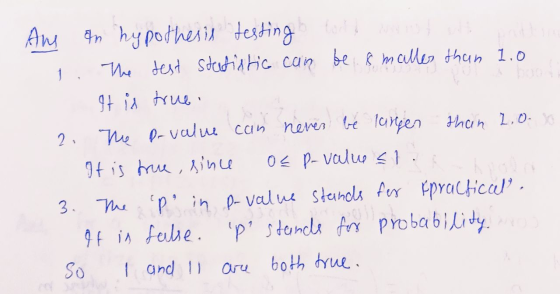
1. In hypothesis testing, which of the following statements is/are true? The test statistic can be...
15) Which of the following statements are true? I. If a population parameter is known, there...
15) Which of the following statements are true? I. If a population parameter is known, there is no reason to run a hypothesis test on that population parameter. II. The P -value can be negative or positive depending upon whether the sample statistic is less than or greater than the claimed value of the population parameter in the null hypothesis. III. The P -value is based on a specific test statistic so it must be chosen before an experiment is...
You conduct a two-sided hypothesis test (a=0.05), and obtain a Z-score equal to -2.3 (N is...
 You conduct a two-sided hypothesis test (a=0.05), and obtain a Z-score equal to -2.3 (N is large) Which of the following statements are ALWAYS true? 1. You reject the null hypothesis Ho II. The resulting p-value is 0.0215 III. You have made a Type I Error. All of the Above I only I and Ill only I and II only Ill only
You conduct a two-sided hypothesis test (a=0.05), and obtain a Z-score equal to -2.3 (N is...
 You conduct a two-sided hypothesis test (a=0.05), and obtain a Z-score equal to -2.3 (N is large) Which of the following statements are ALWAYS true? 1. You reject the null hypothesis Ho II. The resulting p-value is 0.0215 III. You have made a Type I Error. All of the Above I only I and Ill only I and II only Ill only
Which of the following statements are true about the significance level a of a test? 1. It is the probability that we f...
 Which of the following statements are true about the significance level a of a test? 1. It is the probability that we fail to reject Ho when it is false. II. It is the probability that we reject Ho when it is true. III. The probability for us to make a Type Il error is 1 - a. O ll only o Tonly O all are true O II and III O III only
In hypothesis testing, a researcher can never: a. Compute a test statistic before making a decision....
In hypothesis testing, a researcher can never: a. Compute a test statistic before making a decision. b. Make decisions about the null hypothesis. c. Prove that his or her hypothesis is correct. d. Know the likelihood of obtaining a sample mean if the null hypothesis were true.
1. For the standardized test statistic approach to hypothesis testing, calculate the test statistic for testing...
1. For the standardized test statistic approach to hypothesis testing, calculate the test statistic for testing the null hypothesis that the population mean is less than or equal to 9.94, given a sample mean of 15.20, a sample size of 49, and a population standard deviation of 3.25. Round to two decimals. 2. The manager of a paint supply store wants to determine if the mean amount of paint contained in 1- gallon cans purchased from a nationally known manufacturer...
Which of the following statements are true? 1. The estimated method in determining the minimum detectable...
 Which of the following statements are true? 1. The estimated method in determining the minimum detectable concentration assumes the y-intercept for the calibration curve and the average blank signal are both approximately 0. 11. A typical minimum acceptable correlation coefficient range from 0.955 to 0.999. III. The first digit of the absolute uncertainty is the last significant digit in your value. IV. A 500 mL volumetric flask has a higher relative uncertainty than a 100 mL volumetric flask. Ill and...
Question 5 2 pts Which of the following statements is true? (a) we reject a null...
 Question 5 2 pts Which of the following statements is true? (a) we reject a null hypothesis if the p-value of the test is smaller than the level of the significance a. (b) we accept a null hypothesis if the p-value of the test is smaller than the level of the significance a. (c) we reject a null hypothesis if the p-value of the test is larger than the level of the significance a. . (a) . (b) . (c)
1. Which of the following statements are not generally true? a. A type I error is...
1. Which of the following statements are not generally true? a. A type I error is usually more serious than a type II error. b. A type II error is usually more serious than a type I error. c. A test with significance level is one for which the type I error probability is controlled at the specified level. d. When an experiment and a sample size are fixed, then decreasing the size of the rejection region to obtain...
6. Which of the following statements about hypothesis testing are true? • A type I error...
 6. Which of the following statements about hypothesis testing are true? • A type I error occurs if H, is rejected when it is true. • A type II error occurs if He is rejected when it is true. • The power of a test is the probability of failing to reject H, when it is false.
 You conduct a two-sided hypothesis test (a=0.05), and obtain a Z-score equal to -2.3 (N is large) Which of the following statements are ALWAYS true? 1. You reject the null hypothesis Ho II. The resulting p-value is 0.0215 III. You have made a Type I Error. All of the Above I only I and Ill only I and II only Ill only
 You conduct a two-sided hypothesis test (a=0.05), and obtain a Z-score equal to -2.3 (N is large) Which of the following statements are ALWAYS true? 1. You reject the null hypothesis Ho II. The resulting p-value is 0.0215 III. You have made a Type I Error. All of the Above I only I and Ill only I and II only Ill only
 Which of the following statements are true about the significance level a of a test? 1. It is the probability that we fail to reject Ho when it is false. II. It is the probability that we reject Ho when it is true. III. The probability for us to make a Type Il error is 1 - a. O ll only o Tonly O all are true O II and III O III only
 Which of the following statements are true? 1. The estimated method in determining the minimum detectable concentration assumes the y-intercept for the calibration curve and the average blank signal are both approximately 0. 11. A typical minimum acceptable correlation coefficient range from 0.955 to 0.999. III. The first digit of the absolute uncertainty is the last significant digit in your value. IV. A 500 mL volumetric flask has a higher relative uncertainty than a 100 mL volumetric flask. Ill and...
 Question 5 2 pts Which of the following statements is true? (a) we reject a null hypothesis if the p-value of the test is smaller than the level of the significance a. (b) we accept a null hypothesis if the p-value of the test is smaller than the level of the significance a. (c) we reject a null hypothesis if the p-value of the test is larger than the level of the significance a. . (a) . (b) . (c)
 6. Which of the following statements about hypothesis testing are true? • A type I error occurs if H, is rejected when it is true. • A type II error occurs if He is rejected when it is true. • The power of a test is the probability of failing to reject H, when it is false.
Most questions answered within 3 hours.
-
Where is the error in this code sequence?
String s1 = "Hello";
String s2 = "ello";...
asked 10 months ago -
Financial data for Joel de Paris, Inc., for last year
follow:
Joel de Paris, Inc.
Balance...
asked 10 months ago -
Consider this reaction:
Al2(SO4)3 (aq)+ BaCl3
(aq) Al2Cl6 (aq)- +
3BaSO4(s) . What is the...
asked 10 months ago -
Suppose that Savneet is considering increasing her
recent random sample from 20 car rentals to 40...
asked 10 months ago -
Trucks arrive at an unloading terminal at an average rate of 120
per hour.
Trucks arrive...
asked 10 months ago -
Why are methanol and ethanol completely soluble in water while
octanol is not very little soluble....
asked 10 months ago -
A facilities manager at a university reads in a research report
that the mean amount of...
asked 10 months ago -
When the CuSO4 is rehydrated by adding water to the anhydrous
compound, is this an endothermic...
asked 10 months ago -
A ray of sunlight is passing from diamond into crown glass; the
angle of incidence is...
asked 10 months ago -
A block of mass 0.249 kg is placed on top of a light, vertical
spring of...
asked 10 months ago -
how do the kidneys compensate in the presences of acidosis
a) trigger hyperventilate
b) reserve acid...
asked 10 months ago -
Question 501 pts
The rental rate of capital to the firm increases. Which of the
following...
asked 10 months ago